Easter Sunday Massacre, Army’s False Rescue Claims, and a Suspended Lawmaker: Civil Society Breaks Silence on Kaduna’s Descent into Terror


Five worshippers killed. Thirty-eight abducted from two churches. A military rescue claim the families say is a lie. And a lawmaker suspended for daring to speak the truth.

This is Ariko, Kachia Local Government Area, Kaduna State, on Easter Sunday, 2026.

On the morning of 5th April, heavily armed terrorists stormed Ariko Community in Awon Ward, attacking the First ECWA Church and the Catholic Church while congregants gathered for one of the most sacred observances on the Christian calendar. When the violence subsided, five people were dead and thirty-eight others had been dragged away into captivity.

What followed was, to many observers, almost as disturbing as the attack itself.

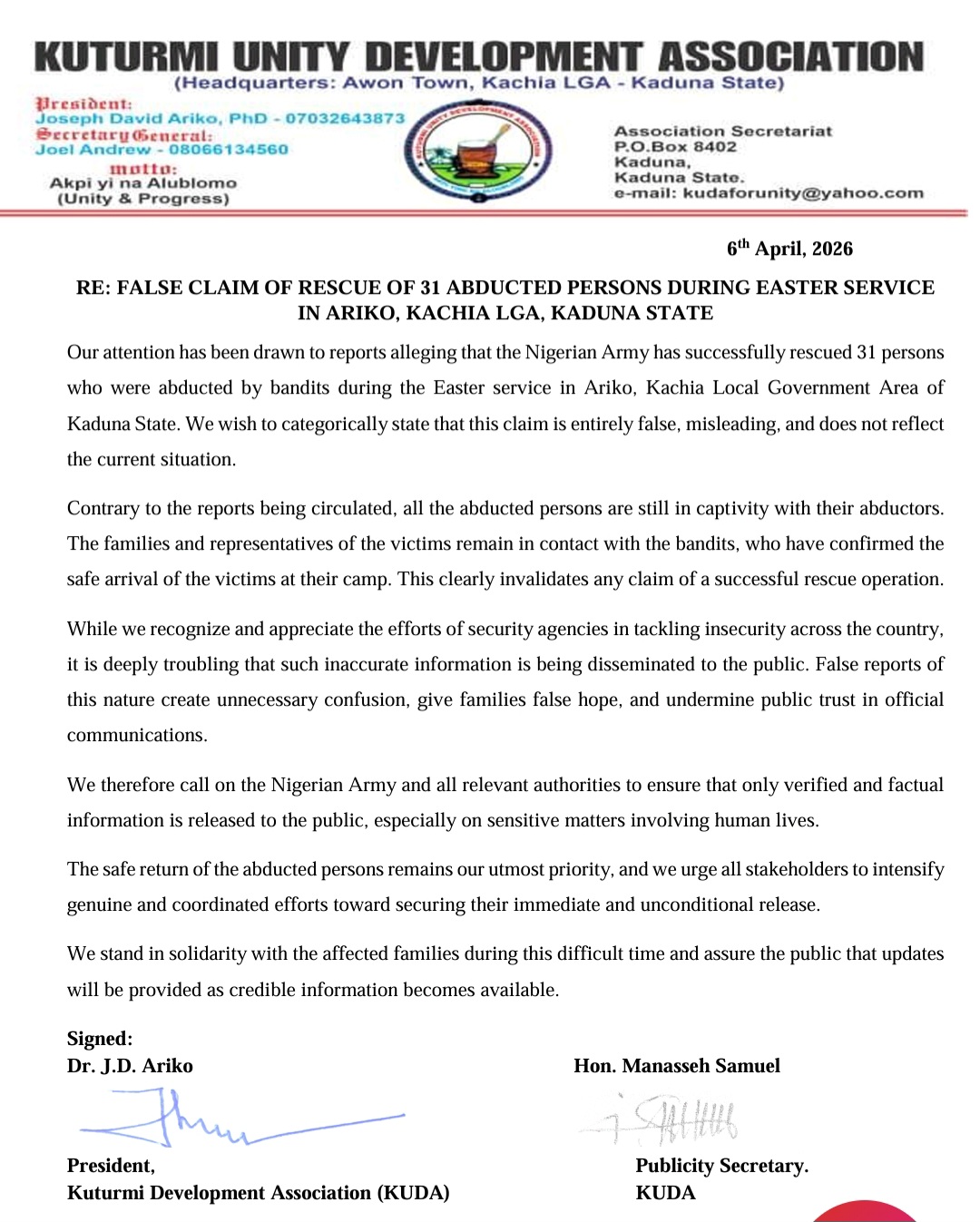
The Nigerian Army issued a widely circulated statement claiming to have rescued 31 of the abducted victims. But the families of those victims say it never happened. As of the time of this publication, all abducted persons remain in the hands of their captors. The Kuturmi Unity Development Association (KUDA), whose president Dr. J.D. Ariko signed a statement on 6th April, said plainly: “Contrary to the reports being circulated, all the abducted persons are still in captivity with their abductors. This clearly invalidates any claim of a successful rescue operation.” KUDA’s Publicity Secretary, Hon. Manasseh Samuel, co-signed the statement.

The families have confirmed they remain in direct contact with the abductors, who have themselves confirmed the victims are in their camps.

In a press statement released on 10th April, the Civil Society for Good Governance and Accountability, a coalition of over thirty human rights and community organisations, described the Army’s statement as propaganda, saying it revealed “unfortunate efforts at deception rather than a plausible effort at the rescue of the abducted.”

But for the civil society coalition, the Army’s false claims are not the whole story. They point to a recognisable pattern. On 18th January 2026, armed bandits abducted 177 worshippers from three churches in Kurmin Wali, Kajuru LGA. The Police and the Kajuru LGA Chairman initially denied the attack entirely. Public outrage eventually forced an acknowledgment. The coalition’s statement is blunt: “The playbook is unchanged: deny, deflect, discredit, then concede only when pressure becomes unbearable.”

The Ariko attack is also not the only active emergency in the region.

On 29th March 2026, Palm Sunday, terrorists killed 13 people in a night raid on Kahir, Aribi Ward, Kagarko LGA, and abducted 28 others. Ransoms of 200 million naira are being demanded. Those 28 remain in captivity. On 31st March, bandits abducted 11 people from Zunturum, also in Kachia LGA, and are demanding 150 million naira and 10 motorcycles for their release. In Maro Kasuwa, Easter Sunday also brought bloodshed: three people were killed and an unconfirmed number abducted.

Kachia LGA Chairman Dr. Manzo Daniel Maigari’s own admission compounds the scale of the crisis. He has acknowledged that 74 communities in Kachia have been deserted due to insecurity, a figure the coalition describes as “a clear indictment of both state and federal governments.”

Yet even as communities are hollowed out by violence, truth-tellers are being punished.

The Honourable Speaker of the Kachia LGA Legislative Council, Hon. Mark Bawa, gave a press interview published in The Punch on 5th April addressing the reality of the Ariko attack. Two days later, the Executive Chairman issued a directive suspending him indefinitely. The suspension letter alleged that the Speaker had “misrepresented the true position on ground” and had failed to attend a meeting with the General Officer Commanding (GOC) of the Army’s 1 Division “to clarify and possibly apologize.” The letter called his conduct “a deliberate attempt to sabotage the efforts of Government.”

The civil society coalition has rejected the suspension in unambiguous terms. “Suspending a lawmaker for speaking about a security incident that affects his own constituents makes him a double victim,” the statement reads. The signatories include legal practitioners, professors, community associations, and advocacy organisations drawn from across southern Kaduna and the Middle Belt.

Their demands are clear: the unconditional reinstatement of Hon. Mark Bawa; the immediate rescue or facilitated release of all abductees across Ariko, Zunturum, Kahir, and Maro Kasuwa; the return of displaced persons from 74 abandoned communities; and full activation of the government’s constitutional obligations under Section 14(2)(b) of the 1999 Constitution.

“These are not numbers,” the statement says. “They are mothers, fathers, children, and grandparents whose safe return must be the single most urgent priority of every security agency in Kaduna State.”

As of press time, not one of the hostages has been returned.
MUSAWAH FOR YOUTH AND DEVELOPMENT INITIATIVE IN RESPONSE TO THE MISGUIDED UTTERANCES OF OMOYELE SOWORE AND ONE ABDUL DAN BATURE ON THE MINISTER OF DEFENCE GEN CHRISTOPHER MUSA


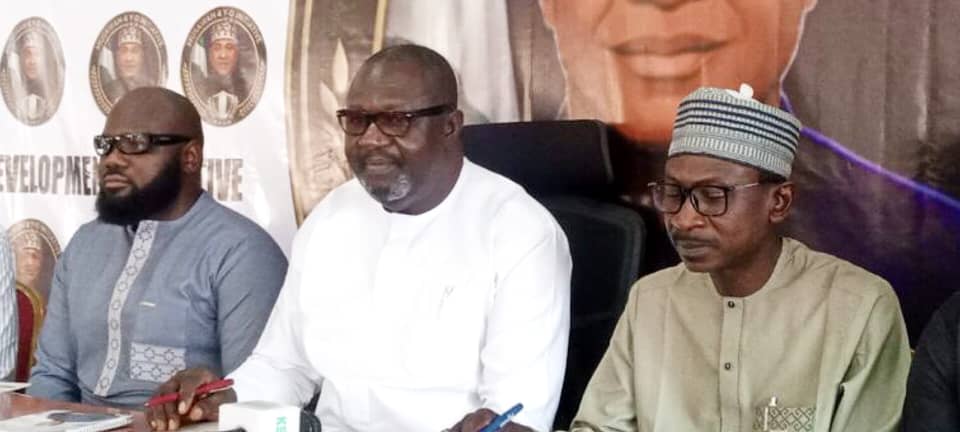
TEXT OF A PRESS CONFERENCE BY THE MUSAWAH FOR YOUTH AND DEVELOPMENT INITIATIVE IN RESPONSE TO THE MISGUIDED UTTERANCES OF OMOYELE SOWORE AND ONE ABDUL DAN BATURE ON THE MINISTER OF DEFENCE GEN CHRISTOPHER MUSA HELD AT THE MUSAWAH HEAD OFFICE, KADUNA ON THURSDAY 12TH MARCH, 2026.

Gentlemen of the Press:

Our attention has been drawn to a recent public statement and social media videos in which Mr. Omoyele Sowore and a so-called group Arewa Youths, led by one Abdul Dan Bature, launched attacks against the Honourable Minister of Defence, General Christopher Musa.

In the circulated remarks, Dan Bature called for the removal of the Honourable Minister from office over rising insecurity while Mr. Sowore publicly mocked the Minister’s proposal to strengthen Nigeria’s border security, ridiculing the suggestion that Nigeria should reinforce its borders to reduce insecurity.

These statements have generated significant online debate. However, they have also contributed to misinformation and unnecessary politicisation of a very serious national issue.

 The Distinguished Service Record of General Christopher Musa

General Christopher Musa is not a social media personality. He is a career military officer who has devoted decades of his life to the Defence of Nigeria.

Throughout his professional career in the Armed Forces, he has served in numerous operational and strategic positions and has played key roles in the fight against insurgency, terrorism, and banditry across different regions of the country.

Like many security leaders around the world, he also communicates publicly to explain national security challenges and reassure citizens. Responsible communication with the public should never be mischaracterised as “content creation.”

Questions That Must Be Asked 

While criticism is part of democracy, Nigerians are also entitled to ask important questions about those who make sweeping attacks against national security leadership.

At a time when Nigerian soldiers are risking their lives daily in the fight against terrorism and banditry, why would public commentators choose to ridicule national security discussions instead of supporting efforts to strengthen them?

It is unfortunate that Sowore has refused to be serious in his life, always behaving like a street charlatan who does not understand governance yet he wants to be president of over 250 million Nigerians. His choice of words against the minister of Defence shows how disrespectful, irresponsible, parochial and rude he can be, little wonder he can’t ever achieve his leadership aim. 

Or is there something Sowore is benefitting when serious national security discussions are reduced to political theatre designed primarily for social media attention?

For Dan Bature, the so-called Arewa Youth leader, we advise that you should join others to support the minister in his quest to restore peace across communities in Nigeria instead of joining forces against him. The north is facing multiple security challenges and the minister is doing his best to stem the tide. He does not need distraction now from road side gossips. For President Bola Tinubu to have appoint Gen. Christopher Musa Minister of Defence after he served as Chief of Defence staff means he trust his capacity and ability to deliver.

A Call for Responsible National Dialogue

Nigeria’s security challenges are too serious to be trivialised through sensational commentary or politically motivated attacks.

Constructive criticism is welcome in a democracy. However, such criticism must be responsible, informed, and directed toward strengthening national institutions rather than undermining public confidence in them.


We therefore call on all public commentators, activists, and political actors to approach discussions on national security with the seriousness and patriotism the subject demands.


Nigeria’s security must remain a shared national responsibility.


Thank you and may God bless the federal republic of Nigeria.


Signed,


Amb. Dr. Polycarp Gankon

National Coordinator

Musawah For Youth & Development Initiative

Kaduna Survivors Unite: Coalition Demands Justice for Victims of El-Rufai Era Abuses

A powerful coalition of survivors, victims’ families, and civil society groups has emerged to demand full accountability for alleged human rights violations during the eight-year governorship of Nasir el-Rufai in Kaduna State, vowing “no more impunity, no more silence.”

The Kaduna Victims’ Coalition, comprising community leaders, traditional rulers, academics, lawyers, journalists, and other professionals, issued a press statement on Monday calling for thorough investigations and prosecutions of alleged crimes committed between 2015 and 2023.

At the heart of their demands are high-profile cases that have come to symbolize what the coalition describes as an era of unchecked impunity. Among them is the October 2018 abduction and brutal murder of HRH Dr. Maiwada Raphael Galadima, the Agwam Adara (paramount ruler of the Adara Chiefdom), who was killed despite a ransom payment. The coalition notes that suspects arrested for his murder have yet to be successfully prosecuted, and their whereabouts remain unknown.

Equally prominent is the case of Abubakar Idris, popularly known as Dadiyata, a lecturer at Federal University Dutsenma and social media commentator who was abducted from his Barnawa residence in Kaduna on August 2, 2019. Nearly seven years later, his whereabouts remain unknown. August 2026 will mark the seventh anniversary of his disappearance, triggering a statutory presumption of death under Nigerian law.

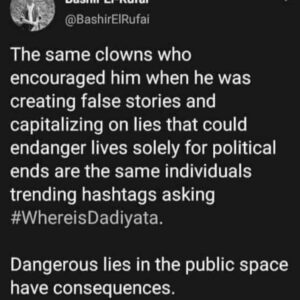
The coalition highlighted a controversial tweet posted by Bashir el-Rufai, son of the then-Governor, on December 23, 2019, shortly after Dadiyata’s abduction, which was “widely perceived as gloating over the incident and dismissing calls for his safe return.”

“We speak today as representatives of countless individuals, families, and communities who endured eight years of profound hardship, terror, fear, and loss,” the coalition stated. “These acts bypassed constitutional safeguards and Nigerian law, turning gubernatorial immunity into unchecked impunity.”

The coalition accused the former governor of presiding over “a pattern of indiscriminate actions: arbitrary abductions, persecution of critics, reprisal violence, unlawful demolitions of homes, mass dismissals of workers without due process, forced sackings by employers of perceived opponents, and the displacement of citizens into exile.”

Expressing concern over recent attempts to “reframe this history, portraying Nasir el-Rufai as a champion of due process and human rights,” the coalition insisted that survivors and families continue to seek truth and justice.

“On behalf of ourselves, and in solemn memory of those killed or disappeared who cannot speak, we have a moral and civic duty to bear witness,” the statement read. “Our sole demand is accountability under the rule of law: thorough, independent investigations; prosecutions where evidence warrants; and closure for traumatized victims and families.”

The coalition pledged full cooperation with law enforcement agencies, judicial bodies, and human rights institutions, offering to provide testimonies, evidence, and material assistance to support inquiries.

The statement was accompanied by hashtags #JusticeToElrufai, #JusticeForKadunaVictims, #WhereIsDadiyata, and #AccountabilityNow.

The statement was signed by the following individuals and organizations on behalf of the coalition:

1. Chidi Anselm Odinkalu
2. Audu Maikori, Esq
3. Gloria Ballason, Esq
4. Steven Kefas
5. Luka Binniyat
6. Midat Joseph
7. Segun Onibiyo
8. House of Justice
9. Community Development & Rights Advocacy Foundation
10. Resilient Aid and Dialogue Initiative
11. Southern Kaduna Indigenous Progressive Forum (SKIPFo)
12. Atrocities Watch Africa (AWA)

The coalition’s emergence represents a significant moment in the quest for accountability in Kaduna State, as victims and their families publicly break their silence on alleged abuses that have long remained unaddressed.

A CALL FOR PROTECTION AND SAFETY OF DISPLACED PERSONS & COMMUNITIES AT THIS CHRISTMAS AND BEYOND.

Since the 2010 Christmas day twin bombing at Ungwan Rukuba and Gada Biyu in Jos, Plateau State and the terror attack at St. Theresa Catholic Church, Madalla, Niger state on 25 December, 2011, there has been a grief- mapped mass displacement of persons and communities due to terror attacks at Christmas in Northern Nigeria and more incessantly, in the Middle Belt region.

On 24 December, 2016, Goska community in Jema’a Local Government, Southern Kaduna, was attacked. About 20 people were killed and hundreds of people in the community had to flee for safety.

In recent times, more specifically, at the 2023 Christmas, over 212 people were killed across communities in Bokkos and Barikin Ladi of Plateau State, causing over 10,000 persons to be displaced.

At the 2024 Christmas celebrations, about 46 worshippers were killed at Anwase, Gboko of Benue State, causing 6,800 persons to join the over 150,000 displaced persons.

In the days leading up to the 2025 Christmas, 20 worshippers have been kidnapped in an ECWA Church in Ayetorokiri, Bunu-Kabba, Kogi state.

This pattern of Christmas season mass atrocities across different parts of the Middle Belt of Nigeria needs to be addressed and prevented to drive a wedge between the intersection of faith-based insecurity and the violence of domestic terrorism across the country.

Consequently, the undersigned call on the Nigerian government to:

1. Put in place security measures to protect communities, churches and worshippers as citizens travel for the Christmas festivities across the country.

2. Urgently prioritize the welfare and protection of displaced Persons (IDPs) and Internally Displaced Communities (IDCs) in the Middle-Belt and across all parts of Nigeria at this Christmas and beyond.

3. Acknowledge the severe and complex challenges displaced persons face including loss of homes and livelihoods; documentation and identity; as well as the indiscriminate consequences of vulnerability to violence.

4. Strive to timely reduce the number of displaced persons and communities in protracted situations through creative and stabilizing economic empowerment solutions.

5. Ensure that the National Emergency Management Authority (NEMA) and State Emergency Management Agencies (SEMA) are immediately mobilized to provide, food, water, shelter and physical security during this season to IDPs & IDCs across the Middle-Belt & other parts of the country.

6. Enable the safe and dignified return and resettlement of displaced persons and communities to their places of habitual residence in assurance of support to be self-reliant.

7. See to the voluntary return, local integration or resettlement of IDPs and IDCs by providing support for reintegration into communities and ensuring their participation in decisions and processes that affect their lives for durable solutions.

8. Ensure that statutory security and law enforcement agencies work in collaboration with locally established security and vigilante groups towards harnessing actionable intelligence and strengthening community policing.

9. Prevent the upsurge of displaced persons and communities by acting on security reports to prevent further attacks.

10. Urge President Bola Ahmed Tinubu to grant assent to the African Union Convention for the Protection and Assistance of Internally Displaced Persons in Africa (Kampala Convention) (Domestication Bill), to ensure a coordinated and harmonized rights-based approach to a national crisis of IDPs & IDCs.

We hope that the government will urgently prioritize action in addressing the protection needs of IDPs & IDCs, prevent further incidents that could increase their numbers and address the displacement problem in an enduring and sustainable manner.


Signed:


House of Justice


Prof. Chidi Anselm Odinkalu


Global Rights


Atrocities Watch Africa


Open Bar Initiative


The Kukah Centre


The Gideon and Funmi Para- Mallam Peace Foundation


Middle Belt Times


Resilient Aid and Dialogue Initiative (RADi)


Community Development and Rights Advocacy Foundation


Christian Women for Excellence and Empowerment in Nigerian Society (CWEENS)


The Benue We Deserve Foundation (BenDeF)


Leadership, Ethics and Accounability Development Foundation

(LEAD Foundation)


Dinidari Foundation


Sesor Empowerment Foundation


Middle Belt Concern


Initiative for Leadership, Environment and Empowerment Advanced (ILEEA)


Gloria Mabeiam Ballason Esq


Rt. Hon. Cephas Dyako


Ier Jonathan Ichaver


Abiodun Baiyewu Esq


Ndi Kato


Steven Kefas


Bulus Y. Atsen, fsi, Esq


Pyemwa Samantha Deshi ,Kinabuti Initiative.


Kaneng Rwang Pam, Kaneng Rwang-Pam Foundation for Education & Migration Awareness (KRP FEMA)

Call to Glory: Middle Belt Forum Kaduna State Chapter Mourns Senator Solomon Ewuga

The Middle Belt Forum (MBF), Kaduna State Chapter, received with deep shock and profound sadness the news of the passing of His Excellency, Senator Solomon Ewuga, former Deputy Governor of Nasarawa State and Chairman, Board of Trustees of the Middle Belt Forum, who departed this life on Tuesday, September 22, 2025, in Abuja.

Senator Ewuga was a statesman of uncommon courage and conviction. He embodied the true spirit of the Middle Belt struggle — a life of sacrifice, service, and unwavering commitment to justice, equity, and national unity. His wisdom, integrity, and vision left an indelible mark not only on the Middle Belt but also on the nation at large.

We in the Kaduna State Chapter deeply mourn his departure. His leadership, guidance, and dedication to the Middle Belt cause will forever remain a source of inspiration. Though he has passed on, his legacy will continue to strengthen our resolve in the pursuit of fairness, justice, and inclusive development.

On behalf of our members, we extend heartfelt condolences to his beloved family, the Eggon Nation, the government and people of Nasarawa State, and indeed the entire Middle Belt and Nigeria. May the Almighty grant his soul eternal rest and give strength to all who mourn this great loss.

Signed:

Air Commodore John Bako Ajeye (Rtd.)

Chairman, Middle Belt Forum, Kaduna State Chapter

A PRESS STATEMENT FROM THE MIDDLE BELT FORUM, KADUNA STATE CHAPTER

The attention of the Middle Belt Forum (MBF), Kaduna State Chapter, has been drawn to the recent incendiary, false, and deliberately misleading comments made by the former Governor of Kaduna State, Mallam Nasir El-Rufai, during his appearance on Channels Television’s “Politics Today” a major part that has to do with Southern Kaduna, which is part of the Middle Belt absorbed into the North West geopolitical zone.
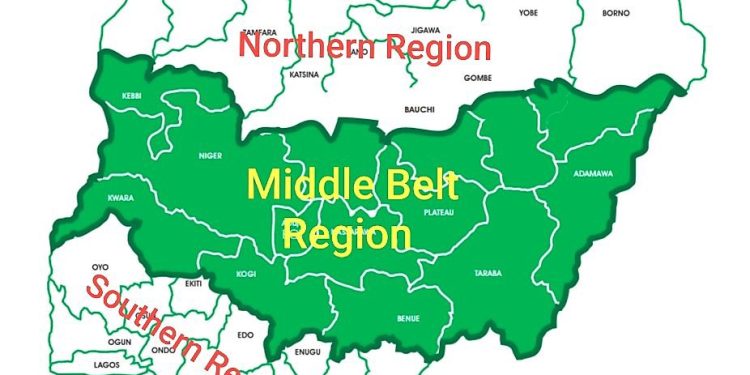
For the avoidance of doubt, the Middle Belt of Nigeria is made up of all the ethnic nationalities of the 19 Northern States plus the Federal Capital Territory (FCT) that are not Hausa, Fulani and Kanuri.

The MBF, Kaduna state Chapter, therefore, considers it a solemn duty to the world and to posterity to set the record straight and counter this orchestrated campaign of shocking falsehood and demographic gaslighting from El-Rufai targeted at the good people of Southern Kaduna and the Middle Belt region at large.

El-Rufai’s interview was a desperate deception; a pathetic attempt to rewrite reality and diminish the undeniable political and demographic facts of Southern Kaduna on the weight and relevance of Christians majority area in the political culture of Kaduna State.
Contrary to El-Rufai’s fictitious claim that Christians constitute “not even 25%” of Kaduna State, verified data from independent and governmental sources presents a starkly different reality.
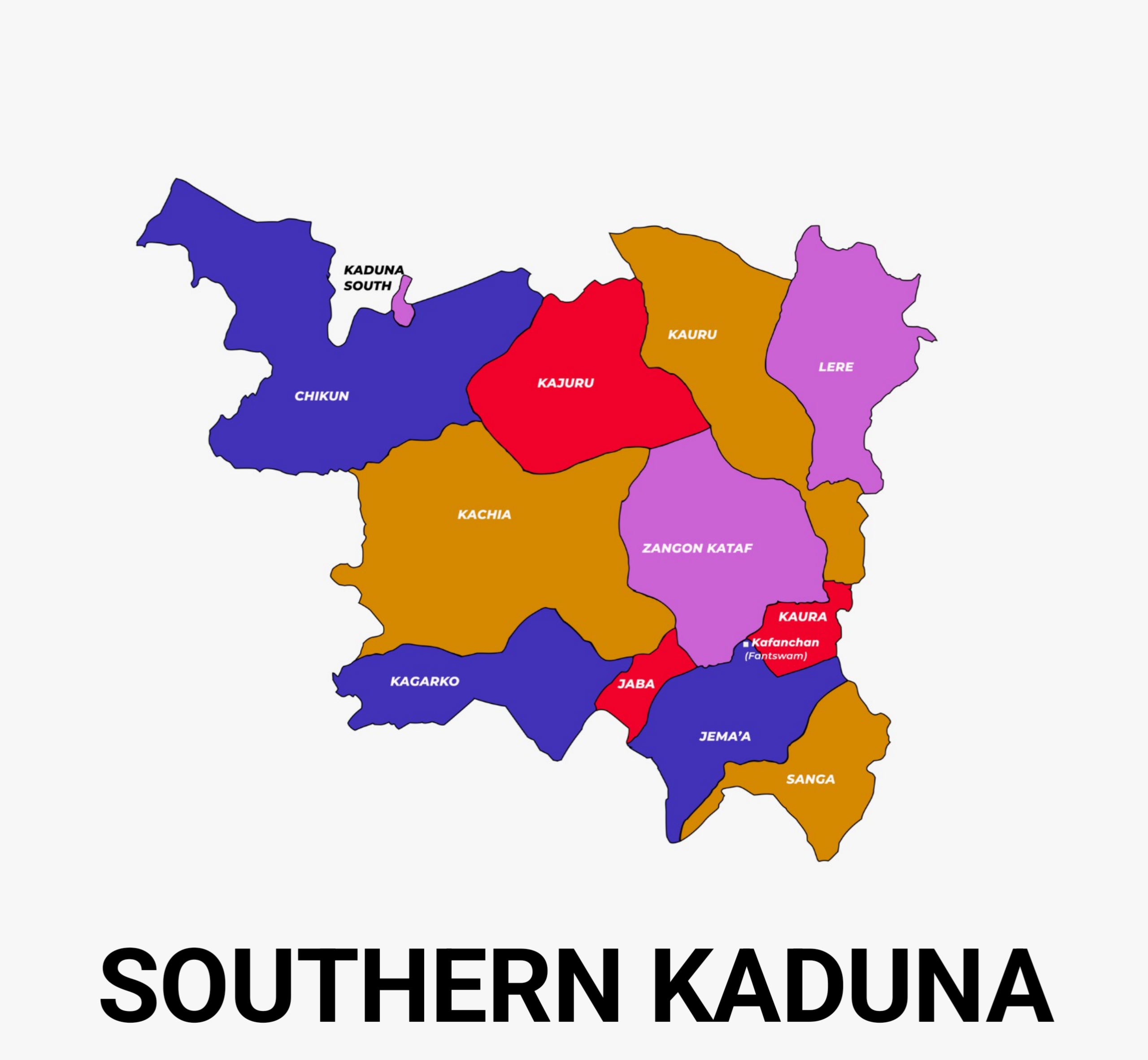
“Southern Kaduna” is a socio-cultural, historical connected ethnic nationalities of Kaduna State that are not Hausa and Fulani and geographically contiguous with Christianity as its dominant religion. Southern Kaduna forms 12 Local Government Areas with the 8 LGAs of ‘zone 3’ or Kaduna South Senatorial Zone forming its core. But Southern Kaduna, based on its definition, includes Chikun, Kajuru, Kaduna South, and Lere. It spans approximately 26,000 sq km and is home to a projected population of 5.1 million people, constituting almost half of the state’s population of today.

Kaduna State is not Christian-minority bloc but also a hub of education, intellectualism, and civil service excellence, producing legendary Nigerian pioneers like Dr. Barau Dikko and Prof. Ishaya Audu who were all Christians.

El-Rufai’s attempt to politically diminish Southern Kaduna is the height of lies. He must be reminded that touching Southern Kaduna is as good as touching the Middle Belt, and no distortion or falsehood can erase this fact.
The 2023 gubernatorial election, which his protégé, Sen Uba Sani of the APC, won by a razor-thin margin of 10,806 votes, was decisively determined by the votes from Southern Kaduna, which boasts 43.7% of the state’s registered voters. It is the height of ingratitude for a man who benefitted from a similar coalition in 2015 to now turn around and label the same people as “insignificant” because they roundly rejected his toxic politics of division.

His comparison of the peaceful, democratic Christian communities of Southern Kaduna to the proscribed Shiite movement is not only reckless but deeply bigoted, designed solely to incite hatred and justify the systemic marginalization and violence these communities have endured under his watch and beyond.

We are not surprised by El-Rufai’s vitriol. It is the bitter cry of a man facing a well-deserved political shame, which is the direct price for the wickedness he meted out on the people of Southern Kaduna. His administration was marked by the deliberate balkanization of our traditional institutions, the unjust redrawing of electoral wards to disenfranchise our people, the abandonment of critical projects, and a shocking disregard for the security of lives and property.

He has forgotten that he was the first governor to admit on national television that he paid bandits. Beyond that, credible reports — including from respected security chiefs — confirmed that his administration directly negotiated and disbursed huge sums running into billions of naira to these criminal elements. In effect, he governed more like a bandits’ patron than a protector of the people. He has forgotten he was caught on video stating that the Muslim-Muslim ticket was deliberately chosen to “enthron Islam.” Now, he contradictorily claims it was merely to win an election. This is the height of dishonesty. He is not the only graduate in Kaduna; we are all educated enough to see through his duplicity.

Today, El-Rufai is an excess baggage to any political platform, a burden to any party that associates with him. His political relevance has expired, and Kaduna State has long moved beyond his toxic brand of politics.

We admonish Mallam Nasir El-Rufai to desist from spreading falsehood and poisoning the well of unity in our dear state. At his age, he should be seeking peace and making amends in preparation to meet his maker, not actively working to plunge future generations into conflict.

Though his days in the political limelight are numbered, he is tragically determined to leave the political space as its most disgraced, humiliated, and unfulfilled figure. We urge well-meaning Nigerians and the media to disregard his malicious fabrications.

The Middle Belt Forum, Kaduna State, remains committed to advocating for equity, transparent governance, and the unity of all peoples of Kaduna State based on truth and justice, not the pathological lies of a failed politician.

Signed:
Air Commodore John Bako Ajeye (Rtd)
Chairman, Middle Belt Forum (MBF) Kaduna State Chapter

Middle Belt Forum Draws Battle Lines Over Sultan’s Proposed Permanent Traditional Leadership Role

(Makurdi), The Middle Belt Forum has thrown down the gauntlet in what promises to be one of the most heated constitutional debates of 2025, declaring unequivocal opposition to a clause in the National Council for Traditional Rulers of Nigeria Bill that would make the Sultan of Sokoto a permanent co-chairman of the proposed national body.

In a strongly-worded statement released Sunday, the forum’s National Spokesman, Luka Binniyat, described the provision as a “grievous insult” to ancient Middle Belt kingdoms and warned of mass boycotts if the legislation passes in its current form.

The controversy centers on the National Council for Traditional Rulers of Nigeria (Establishment) Bill, 2024, sponsored by Senator Simon Bako Lalong of Plateau South. Having sailed through its second reading in March, the bill now sits before the Senate Committee on Establishment and Public Service, where its fate—and potentially the unity of Nigeria’s traditional institution—hangs in the balance.

Ancient Kingdoms Challenge Modern Politics

At the heart of the Middle Belt Forum’s objection lies a compelling historical argument that challenges conventional assumptions about traditional hierarchy in Nigeria. The forum contends that several Middle Belt monarchies predate the Sokoto Caliphate by centuries, making the proposed permanent arrangement historically unjustifiable.

“The Kwararafa Confederacy flourished from the 800s to the 1700s A.D.,” Binniyat noted, pointing to the Aku Uka of Wukari as the spiritual heir to a legacy that existed long before the Sokoto Caliphate’s establishment in 1804. Similarly, the forum highlighted the Attah of Igala, whose kingdom thrived before and after the 14th century, and the Etsu Nupe, representing a 15th-century kingdom that maintained its cultural identity despite later Islamic influence.

Perhaps most significantly, the forum emphasized that the Tiv Nation—one of Nigeria’s largest ethnolinguistic groups—was never conquered by the Sokoto Caliphate. The Tor Tiv, they argue, represents a proud, independent people whose acephalous society thrived without external domination.

Religious Leadership Versus Traditional Authority

The Middle Belt Forum’s opposition extends beyond historical precedence to fundamental questions about the nature of leadership in a pluralistic democracy. They argue that the Sultan’s primary role as the spiritual head of Nigerian Muslims makes his permanent secular leadership problematic in a constitutionally secular state.

“His institutionalized leadership over a national council of traditional rulers would alienate Christians, traditional worshippers, and other faiths,” the statement declared, warning that such an arrangement would “promote religious supremacy under the guise of traditional unity.”

This concern gains additional weight from the forum’s pointed reference to the Sultan’s patronage of the Miyetti Allah Cattle Breeders Association (MACBAN), an organization they link to violent conflicts that have claimed thousands of lives across the Middle Belt. The forum argues that making someone with such associations a permanent leader would be insensitive to victims of these conflicts.

Colonial Legacy and Modern Resistance

The statement reveals deep-seated resentment about colonial-era impositions that artificially elevated certain traditional authorities over others. The forum argues that British indirect rule forcefully placed autonomous Middle Belt communities under Emirate control, creating “an artificial hierarchy that granted undue privilege and influence to Fulani-dominated Emirates.”

“More than six decades after the end of colonial rule, it is unacceptable for any traditional authority to be elevated above others, particularly in a democratic Nigeria that champions equality, justice, and federal character,” Binniyat emphasized.

This historical grievance underscores why the current proposal strikes such a sensitive nerve. For many in the Middle Belt, permanent co-chairmanship arrangements evoke memories of colonial subjugation that independent Nigeria was supposed to remedy.

High-Stakes Threats and Alternative Proposals

The Middle Belt Forum has not limited itself to criticism—it has issued concrete threats that could fragment Nigeria’s traditional institution. Should the bill pass with the contentious clause intact, the forum promises to mobilize all Middle Belt ethnic nationalities to boycott the council entirely.

More dramatically, they threaten to establish an autonomous Council of Middle Belt Traditional Rulers, effectively creating a parallel institution that could undermine the national body’s legitimacy and effectiveness.

However, the forum also offered constructive alternatives, proposing that the chairmanship be rotational across geopolitical zones or ethnic blocs, with tenure-based arrangements ensuring all traditional rulers feel included. They suggest allowing traditional rulers themselves to democratically choose their leadership through transparent, inclusive processes.

National Unity at a Crossroads

As this debate unfolds, it highlights deeper tensions about identity, representation, and historical justice in modern Nigeria. The Middle Belt Forum’s position reflects broader anxieties about religious and ethnic dominance in a diverse nation still grappling with colonial legacies.

Senator Lalong, ironically described by the forum as “a respected son of the Middle Belt,” now finds himself at the center of a controversy that could define his legislative legacy. As the Senate Committee on Establishment and Public Service deliberates, they face a choice between maintaining the bill’s current structure and risking institutional fragmentation, or finding compromise solutions that address historical grievances while preserving national unity.

The stakes could hardly be higher. Traditional rulers have long served as bridges between Nigeria’s diverse communities and the federal government. Any arrangement that alienates significant segments of this institution could have far-reaching consequences for national cohesion.

As one traditional ruler privately noted, “This is not just about who sits where in meetings. It’s about whether Nigeria can create institutions that truly reflect our diversity and shared humanity.”

The coming weeks will reveal whether Nigeria’s lawmakers can navigate these treacherous waters or whether the ancient kingdoms of the Middle Belt will chart their own separate course in the nation’s traditional landscape.

Ethnic Cleansing Crisis Grips Nigeria’s Middle Belt: Coalition Demands Urgent Federal Action

[spacing size=””]A coalition of 22 civil society organizations, under the banner of the Civic Coalition Against Mass Atrocities in the Middle Belt, has issued a scathing press release, sounding the alarm on a spiraling security crisis in Nigeria’s Middle Belt region. The group is urgently calling for federal intervention to halt what they describe as a systematic campaign of ethnic cleansing that threatens not only lives but the very fabric of democracy in the country.

The Middle Belt, encompassing states like Plateau, Benue, Nasarawa, Taraba, Niger, Kogi, Kwara, Southern Kaduna, Borno, Gombe, and Adamawa, has long been a hotspot for violence. However, the coalition’s report paints a grim picture of escalating atrocities: targeted attacks, massacres, and abductions that have claimed countless lives, left survivors traumatized, and displaced entire communities. The perpetrators, according to the coalition, are not only emptying villages but replacing locals with imported settlers, fundamentally altering the region’s demographic and political landscape.

The coalition identifies three key triggers fueling the current wave of violence. First, the upcoming national census, which they allege is being exploited by terrorist groups to seize territory—ensuring that displaced locals are not counted, thus handing control to the occupiers. Second, the 2027 elections, where the violence could disenfranchise Middle Belt voters, reshaping electoral outcomes. Third, the recent establishment of the Livestock Ministry, which some interpret as a green light for pastoralists to take over land, further inflaming tensions. Adding to the fear, new terrorist fronts led by groups like Lakurawa and Mahmuda have emerged in Niger and Kwara states, raising concerns of a broader regional conflict.

The coalition’s analysis reveals a chilling pattern. The affected states are landlocked, lacking direct access to international borders, making escape or external aid difficult. Over 20,000 square kilometers across Benue, Nasarawa, and Plateau States have been forcibly seized, with the displaced replaced by new settlers. This methodical displacement, the coalition argues, is a deliberate attempt to erase indigenous communities and redraw electoral maps—a campaign they label as ethnic cleansing with devastating implications for Nigeria’s food security, as the Middle Belt is a traditional breadbasket for the country.

“This is not just a security crisis; it’s an attack on the future of elective government in Nigeria,” the coalition stated, emphasizing the need for immediate action. They are urging President Bola Ahmed Tinubu to deploy federal resources to address the region-wide violence, which no single state can tackle alone. Their 12-point action plan calls for coordinated strategies, including a regional security framework led by Middle Belt governors, consultation with border state leaders, and the return of displaced communities to their lands with full executive backing.

The coalition also proposes modern solutions, such as integrating geospatial technology and drones to enhance security operations, alongside an intelligence framework that leverages local knowledge to prevent attacks. They advocate for inter-community security cooperation to bridge ethnic and religious divides and reforms to the Fire Arms Act of 2004, allowing threatened communities to legally defend themselves under supervision—a response to the overwhelming firepower of attackers.

Beyond security, the coalition addresses cultural and political injustices. They demand the restoration of illegally deposed chiefs and scrapped chiefdoms, particularly in Kaduna, where the previous administration under Governor Nasir El-Rufai allegedly dismantled traditional structures like the Adara chiefdom. Citing Article 8(2) of the Rome Statute, they classify the destruction of cultural heritage as a war crime, calling for its reversal.

Judicial accountability is another priority, with the coalition urging swift trials for perpetrators to deter further violence. They also propose a Special Crisis Accountability Bureau (SCAB) to ensure justice, involving top security officials under the Chief of Defence Staff and National Security Adviser. Additionally, they stress the need to protect food security and guarantee voting rights for displaced communities, pressing the Independent National Electoral Commission (INEC) to ensure no one is disenfranchised.

The press release, signed by organizations like the House of Justice, Christian Solidarity Worldwide, The Para-Mallan Peace Foundation, the Southern Kaduna Resilience Fund, to mention but a few underscores their readiness to collaborate with authorities. They aim to provide evidence and support sustainable solutions to what they describe as a political crisis with profound humanitarian consequences.

As Nigeria grapples with this escalating crisis, the coalition’s plea is clear: President Tinubu must act decisively to secure the Middle Belt, protect its people, and preserve the nation’s democratic integrity. The stakes, they warn, could not be higher.

PRESS STATEMENT FROM THE MIDDLE BELT FORUM (MBF) ON THE PASSAGE OF CHIEF EDWIN CLARK

(February 18, 2025)

The Middle Belt Forum (MBF) Tuesday issued a statement saying it is deeply devastated by the passing of Chief Edwin Kiagbodo Clark, a revered nationalist, elder statesman, and leader of the Southern and Middle Belt Leaders Forum (SMBLF). The Statement added that the demise of Chief Clark marks the end of an era for Nigeria’s struggle for equity, justice, and true federalism.

According to a Statement, the President of MBF, Dr. Bitrus Pogu, expressed profound sorrow, emphasizing Chief Clark’s unwavering commitment to the progress and well-being of the Middle Belt.

“Chief Edwin Clark was deeply invested in the welfare of the Middle Belt region. He stood by us in our most challenging times and made several interventions to champion our cause,” Dr. Pogu stated.

“He dedicated his entire life to serving Nigeria, advocating tirelessly for justice, peace, and the protection of marginalized ethnic groups that have historically faced domination and suppression within the Nigerian state. His commitment to fairness and national unity was unparalleled,” he added.

Pogu went on to say that the Middle Belt mourns the loss of an irreplaceable leader, who served as a pivotal rallying point for those advocating for an inclusive Nigeria.

“His voice resonated beyond the South-South region, as he fought alongside other regional leaders to uphold the rights of all Nigerians, particularly those in the Middle Belt and Southern regions,” Pogu went on.

Dr. Pogu noted that Chief Clark’s passing is even more heartbreaking as it comes less than a week after the demise of Afenifere leader, Chief Ayo Adebanjo, who served as Deputy Leader of the SMBLF.

“Their near-simultaneous departures leave a great void in the collective struggle for justice and equity in Nigeria.

“The passing of these two distinguished nonagenarians is not only a profound loss to their respective regions but also to the Middle Belt and to the entire nation. Their leadership, wisdom, and relentless pursuit of fairness will be sorely missed,” Pogu said.

“As we mourn this monumental loss, we pray that the Almighty Creator welcomes Pa Edwin Clark with open arms and grants him eternal rest after a lifetime of selfless service to humanity.

“May his legacy continue to inspire the fight for a just and equitable Nigeria,” the statement reads in conclusion.

Signed:
Luka Binniyat
National Spokesman, Middle Belt Forum (MBF)

THE MIDDLE BELT FORUM (MBF), KADUNA STATE CHAPTER. Press Statement For Immediate Release (9th January, 2025)

Punch Newspaper is one of the top most national dailies which has created enormous integrity for itself over the decades. It has attained this rare fit through its courageous, uncompromising and very professional reportage for which the Middle Belt and especially Southern Kaduna (SK) have greatly benefited from over the years.

The Middle Belt Forum, Kaduna State Branch, is therefore taken aback by Punch’s rather acerbic criticism of news of the approval of the establishment of a Federal University of Applied Sciences in Kachia, Kachia LGA, in Southern Kaduna, which falls under the Middle Belt.

In its Editorial of 7th January, 2025, the Editorial Board of Punch threw a heavy punch at the Government of President Bola Ahmed Tinubu for assenting to create the first university ever in Southern Kaduna, dismissing it as “political” and a “greek gift.”

https://punchng.com/new-federal-varsity-a-misnomer

Well we have no issues whatsoever with the observations and facts churned out by the Editorial Board of Punch regarding the

poor fundings Federal Universities and other associated matters raised in the Editorial, we feel that had the Editors of Punch been armed with the shocking marginalization that SK has suffered in allocation of federal institutions in Kaduna state, they would.have written its Editorial from a rather sympathetic perspective. They would not have set out in that Editorial to discourage the Federal Government from concluding a development that has stirred so much joy and emotions among the people of SK and indeed all residents members of the Middle Belt in Kaduna State.

We say this for the following reasons:

A Reps Speaker, Hon Tajudeen Abbas, who represents Zaria Federal Constituency of Kaduna state, secured the approval and funds for the establishment and immediate construction of FOUR! (4) new tertiary institutions in Zaria town, including a UNIVERSITY!

B . At the flag off of the construction of one of the schools in Zaria, on the 15th December, 2024, Abbas announced to the media that the sum of N80 billion had been approved for the construction of the schools.

The brand new Federal tertiary institutions for Zaria town alone are

a. Federal College of Nursing and Midwifery

b. Federal College of Education

c. Federal Open University

d. Federal College of Legal Studies.

C) The Editors of the Punch ought to be aware that Zaria town is unarguably the only town in the entire Nigeria that has the highest numbers of federal institutions as listed below:

1) Ahmadu Bello University (ABU)
2) Federal College of Education (FCoE)

3) Nigerian Institute of Transport Technology

4) Nigerian Leather Research Institute
5) Nigeria College of Aviation Technology
6) Division of Agricultural Colleges (DAC)

7)Institute of Agricultural Research (IAR).

8) National Research Institute for Chemical Technology

9)National Animal Production Research Institute

10) National Agricultural Extension and Research Liaison Services.

11) Nigerian Army School of Military Police

12) Nigeria Army School of Legal Services, Basawa Zaria.

That invariably means that there are now 16 Federal tertiary schools in just one town – Zaria which straddles two LGAs North of Kaduna state.

D) For the information of the Editorial Board of Punch, the term “Southern Kaduna (SK)” is a Geo-socio/cultural zone made up of no less than 60 ethnic nationalities. It is not a Geo-political zone like “Kaduna South Senatorial Zone” that is subsumed under SK.

SK is made up of 12 LGAs out of the 23 LGAs of Kaduna state. Kaduna South Senatorial Zone is made up of 8 LGAs.

E ) Kaduna state has an approximate land mass of 46,000 sq.km. Out of this, Southern Kaduna has an estimated 26,000 sq.km. In fact, SK is bigger than Kano State (20,000 sq.km) which has 44 LGAs. Yet SK has no single University.

F ) Going by the National Population Commission (NPC) 2006 Census figures, Kaduna state had a population of 6,113,503 of which 51.2% came from the 12 LGAs of Southern Kaduna. Today, SK is estimated to have a population of about 5.2 million people of the 10.2 million population of Kaduna state in 2024.

G ) It may also interest Punch to note that most of the indigenous skilled and educated workforce of Kaduna state comes from SK.

H ) Will it then not be shocking to the Editors of the Punch that the only Federal Institution of Higher Learning in Southern Kaduna is a decrepit Federal School of Statistics, Manchok, Kaura LGA in Southern Kaduna. The highest certificate issued there is a Higher National Diploma (HND).

Our Query to the Punch Editorial

1) Why didn’t the Editors of Punch write its Editorial condemning the creation of new Federal universities when Zaria town, which is already saturated with 11 Federal Tertiary Schools, got additional Four new ones at a go?

2) As aptly pointed out by the Editors of Punch: “During his tenure (2010-2015), Jonathan established 12 universities. His successor (Buhari) established about 10 tertiary schools. Each arm of the military and the police now have a university.”

Shouldn’t it have bothered the Editors of the Punch that Southern Kaduna, with its landmass and population didn’t get any of these universities at that time? Should we not therefore be happy with President Ahmed Bola Tinubu over this gesture?

3) Again, unlike Speaker Abbas who has secured N80 billion funding for Zaria’s new schools, the Federal University of Applied Sciences, Kachia already has a well-developed physical structure. It was a privately built institution called Nok University, complete faculties, departments, Admin blocks and every basic needed infrastructure in a university. It had in place a school administration and a Board.

Nok University, owned a son of the Middle Belt, was on the verge of taking off after admitting its first batch of students in 2022, when the EFCC closed it down. The EFCC later declared its forfeiture to the Federal Government, claiming it was built from proceeds of corruption. Whatever the reason, we are grateful that there was a structure on ground.

Therefore, the only University in Southern Kaduna, unlike the other new ones, is not costing the Federal Government any much to build. Why then should the Editorial Board of the Punch pick on it?

Our Fears

We are at pains to say that we suspect that the motive behind the Punch Editorial is to discourage the Federal Government from seeing the takeoff of the Federal University of Applied Sciences, Kachia.

The Middle Belt and indeed, SK has powerful foes that can go to any extent to ensure that we that we are tied to one place.

If not so, is the Editorial Board of the Punch not aware that a university is not merely a place of learning? That a university is an economy and a development hub of its own with accompanied value chains that could dramatically spark unprecedented prosperity to its area of location and environs?

This suspicion can only be lifted by another Editorial given the hindsight that we have provided. And if that is done, we shall be very appreciative.

Signed: Luka Binniyat

(Chairman, Middle Belt Forum, Kaduna State Chapter) 9th December, 2025.