Blood on the Hills: Thirty Silenced at Naridon While Nigeria’s Army Watched From Three Kilometres Away


By Steven Kefas

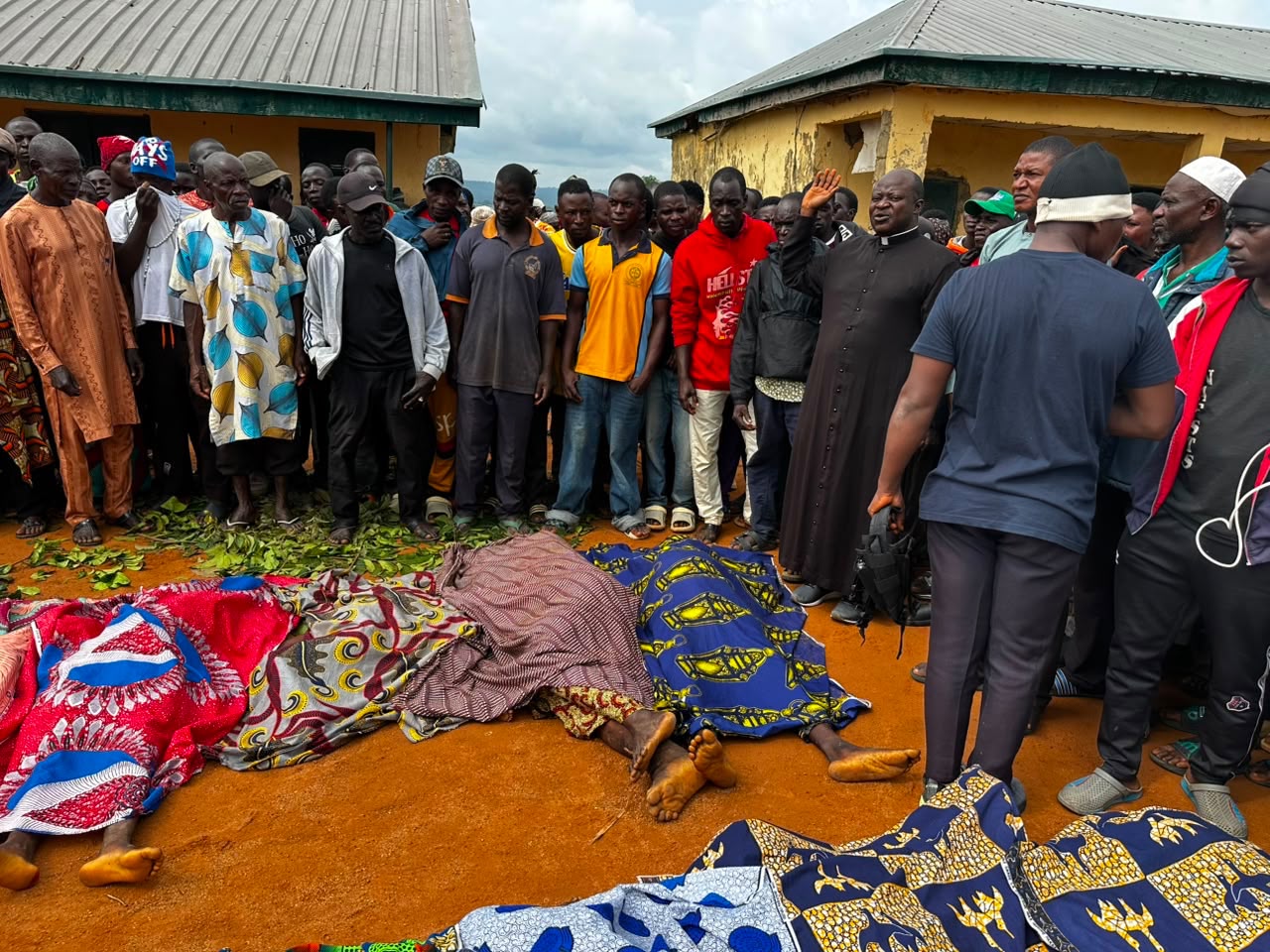
(Kaduna), Terrorists killed thirty people, eleven of them children, during a three-hour rampage in Naridon, Kaduna State, on Monday morning, just kilometers from an army base that never responded.

A Village Wakes to Gunfire

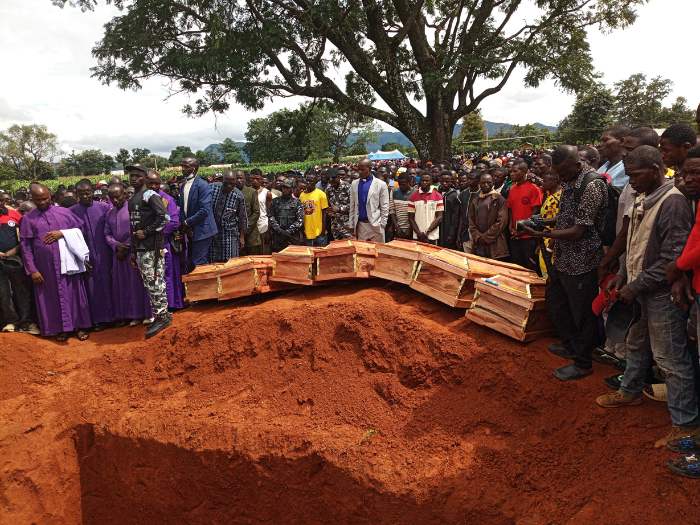
Naridon, a Christian farming settlement tucked into the hills of Kamaru Ward in Kaduna State’s Kauru Local Government Area, had gone to sleep like any other Sunday night. By the time dawn broke on Monday, 27 July 2026, thirty of its people lay dead. Eleven were children. The youngest, Geoffrey Monday, was three years old. The oldest, Kaka Umaru, had lived eighty-seven years before gunmen cut his life short in the compound where he had likely been born.

For close to three hours, armed men locals described as Fulani militants moved through Naridon unchallenged, according to Rev Fr Mark Bissan, the Catholic priest of Kamaru Chawai who compiled the parish’s account of the dead, injured and destroyed. They shot residents in their homes and in the open, torched shops and houses, and desecrated musical instruments inside the community church. Seven more people were wounded, among them a five-year-old girl and a seven-year-old boy. Whole family lines were nearly wiped out in a single night: the Emmanuel household alone lost five children, from five-year-old Irimiya to thirteen-year-old Deborah.

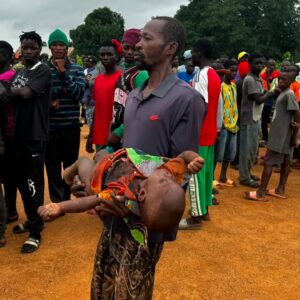
A young child killed during the attack. Credit: Fr Bissan

A Response That Never Came

What makes Naridon’s grief sharper is geography. A Nigerian Army forward operating base sits barely three kilometres from the village, close enough that soldiers there could plausibly have heard the gunfire. No help arrived while the attack was underway, and none had arrived when Middle Belt Times visited the community on Wednesday, forty-eight hours after the killing began. There was not a single security operative on the ground, even as residents relayed threats from the attackers themselves that they intended to return and, in their words, to finish what they started. Neighbouring communities say they have received similar warnings.

Thirty bodies were taken to an embalming facility in Zangon Kataf, where grieving relatives now wait to bury their dead. The Kaduna State government has yet to deliver relief materials to a community that has lost its breadwinners, its children and its sense of safety in one night. This is despite the state government mandating the state emergency management agency to deliver relief 72 hours ago.

President Bola Tinubu has, as he has done after previous massacres, ordered that those responsible be identified and prosecuted. Survivors of Naridon have reason to doubt that order will be carried out. This is not the first attack their area has suffered, and it will not be remembered as an isolated tragedy. On 16 June 2026, nine people were killed in nearby Ungwan Magaji by attackers survivors identified as Fulani ethnic militia. Less than a year earlier, on 25 August 2025, eight people were killed in Ungwan Rimi, in the same local government area, reportedly by the same attackers. Disturbingly, some of those arrested in connection with the 2025 attack were reportedly released without ever facing prosecution, and survivors of the June 2026 killing say they recognised those same men among their attackers. Naridon is now the deadliest single attack recorded in Kaduna state since the current federal and state administrations took office on 29 May 2023.

A Pattern the World Keeps Missing

Naridon did not happen in a vacuum, and neither did the silence around it. A six-year study released on 30 June 2026 by the Observatory for Religious Freedom in Africa (ORFA), titled Four Times Boko Haram? How the World Misreads Nigeria’s Violence, documented 79,323 people killed across the country between 2020 and 2025, more than 42,000 of them civilians. The study found that Boko Haram and the Islamic State West Africa Province, the two groups most associated with Nigerian terrorism in Western reporting, together accounted for just twelve percent of civilian deaths. Armed groups the report classifies as Fulani Terror Groups were responsible for forty-four percent, roughly four times the combined toll of Boko Haram and ISWAP.

That imbalance has not been matched by attention from Washington. American policy and media coverage of Nigeria’s violence has overwhelmingly tracked the North-East insurgency, the theatre where Boko Haram and ISWAP operate, while the killing fields of Kaduna, Plateau, Taraba, Niger, Kwara and Benue states draw comparatively little notice. When American forces did act, striking suspected terrorist positions in Sokoto’s Bauni Forest on Christmas Day, the operation targeted the North-West’s militant enclaves rather than the networks terrorising Middle Belt farming communities. The strikes have had no discernible effect on the violence closer to Naridon. If anything, attacks on Christian farming communities in Kaduna, Benue, Taraba and Plateau intensified in the months that followed.

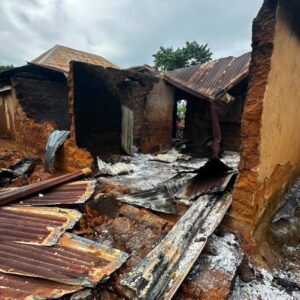
A destroyed building in Naridon. Credit: Fr Bissan

Plateau and Benue Bleed in Parallel

Naridon’s grief is being lived out simultaneously elsewhere in the Middle Belt. In Benue State’s Otukpo Local Government Area, gunmen have carried out a string of attacks through July, culminating in a raid on Efeyi-Ugboju community that has left at least fourteen people dead this week alone, part of a wave of Otukpo violence that has killed dozens of farmers and villagers since early July. In Plateau State, the killing has followed a near-identical script: armed Fulani militia have shot Christian vigilantes standing unarmed watch in Barkin Ladi, wiped out a family of nine in Kum village, and killed community leaders who had publicly appealed for peace. Survivors and rights monitors describe the same features again and again, attacks late at night, army positions nearby that do not respond in time, and communities left to bury their own dead without government support.

A Government More Focused on Washington Than on Kauru

While villages like Naridon wait for security and relief, Nigeria’s federal government has directed considerable resources toward its image in the United States. Abuja signed a six-month, nine-million-dollar contract with the Washington lobbying firm DCI Group, brokered through Kaduna-based Aster Legal on behalf of the National Security Adviser, to persuade American policymakers that Nigeria is not turning a blind eye to the killing of Christians and to preserve Washington’s redesignation of Nigeria as a security partner rather than a Country of Particular Concern. Critics in the US Congress have called the spending a culture of denial, more concerned with managing perception abroad than protecting the villages where the killing is actually happening.

For the people of Naridon, none of that diplomacy has translated into a soldier at their gate. Thirty coffins are being prepared in Kafanchan. Children who survived the attack are sleeping without their siblings. And a community that buried its dead from June 2026, and August 2025 before that, is now bracing for a third round, because the men who threatened to come back have given no one reason to believe they were bluffing.


…Steven Kefas is a conflict reporter with over a decade experience covering the crisis in the Middle Belt

“The Blanket at the Door”: Inside Southern Kaduna Villages Where Bandits Have Become the Government


By Steven Kefas for Middle Belt Times


Editor’s Note: This report contains descriptions of violence and sexual abuse that some readers may find distressing.

In a remote community in Kajuru Local Government Area of Kaduna State, a blanket left at the entrance of a house is not a harmless mistake. It is a terrifying message.

It means an armed terrorist has chosen that home for the night. The husband must sleep outside. The wife or sometimes a daughter will be sexually assaulted inside the house. The children are often forced to witness the ordeal in silence.

For one father of five, this has become the unbearable reality of life under the rule of heavily armed terrorists many believed to be of Fulani origin.

His identity and the name of his community are being withheld for security reasons.

The man recently escaped the community after spending an entire week secretly making his way out. What he recounted paints a chilling picture of villages where the Nigerian state has effectively disappeared and criminal gangs now determine every aspect of daily life.

Veteran journalist Reuben Buhari, who first documented the survivor’s account on his Facebook page, wrote:

“This is the back of someone who lives in a community that has entered into an agreement with Fulani kidnappers following repeated attacks. The community is now in its third year living alongside bandits.”

To protect the survivor, Bihari deliberately photographed only his back.

According to the survivor’s testimony, the so-called “agreement” was not voluntary. It was born out of repeated attacks and the absence of effective protection, leaving villagers with what they believed was a choice between death and submission.

But the price of survival has been devastating.

As Buhari reported:

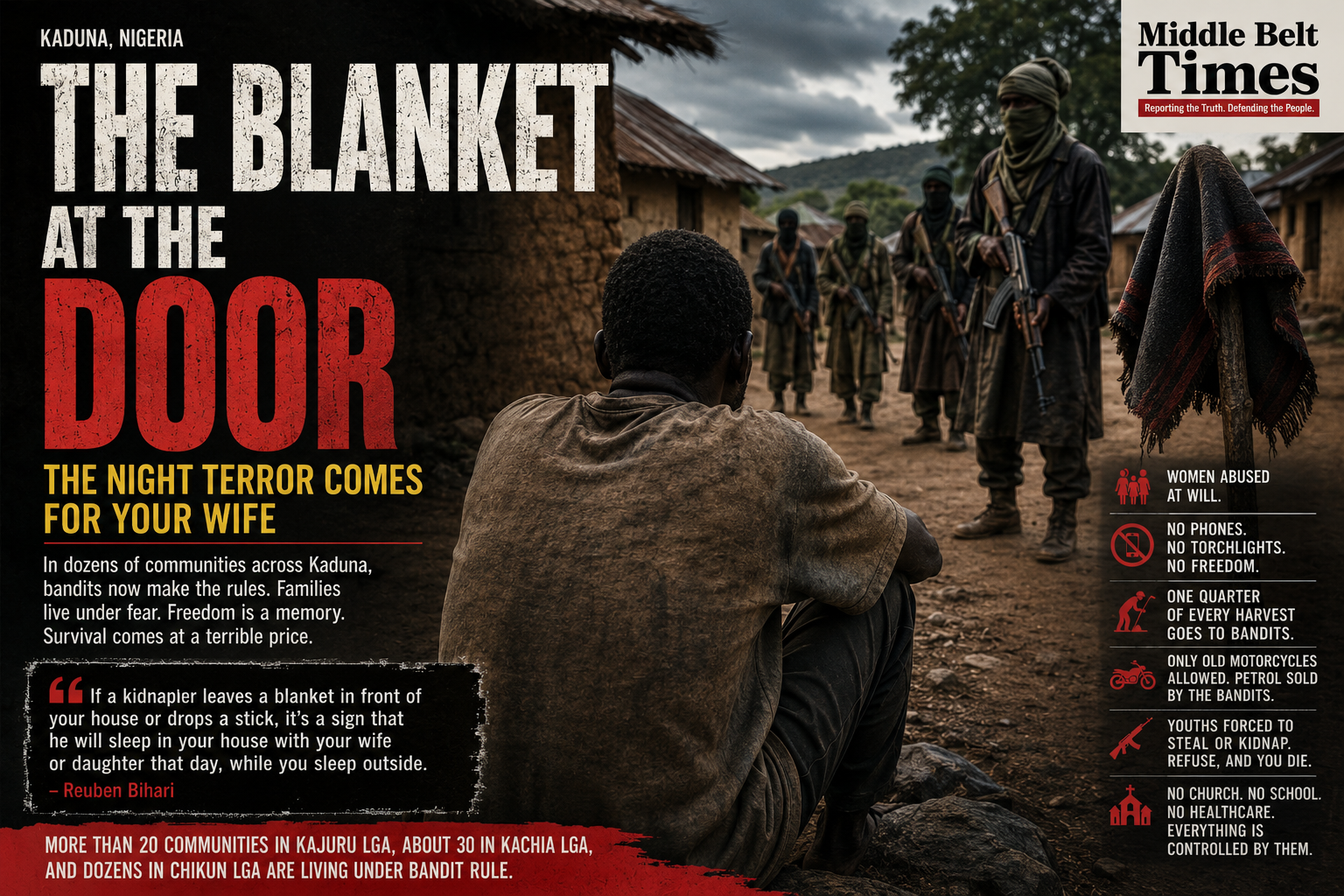
“The man you see is married with 5 children, but his wife doesn’t belong to him since the agreement was entered into. The kidnappers sleep with her whenever they feel the urge, sometimes while the children watch. If he protests, he will be shot. The same thing happened to all the women in the village. If a kidnapper leaves a blanket in front of your house or drops a stick, it’s a sign that he will sleep in your house with your wife or daughter that day, while you sleep outside.”

The alleged abuses extend far beyond sexual violence.

According to the account, villagers live under a rigid system of rules imposed by the armed groups. They cannot leave without permission. Anyone caught attempting to flee risks execution. Carrying a travelling bag invites suspicion and searches.

Farmers are permitted to cultivate their land, but a quarter of every harvest reportedly belongs to the terrorists.

Ownership of everyday items is also tightly controlled.

“They aren’t allowed to own a phone,” Buhari wrote. “If you are caught, you will be shot.”

The same restrictions reportedly apply to torchlights, new motorcycles and even new clothes. Any valuable possession can simply be taken by the armed men.

“They aren’t allowed to own a machete; only hoes and diggers are permitted for farming,” Buhari added.

The restrictions also isolate the communities from the outside world.

According to the survivor, men are generally forbidden from visiting neighbouring communities that have not entered into similar arrangements with the terrorists. When goods must be purchased from outside, women are sent instead. If they fail to return, the consequences are fatal for those left behind.

“If the wives don’t return, the husbands and children will be shot,” Buhari quoted the survivor as saying.

Young men face another grim reality.

Rather than merely living under occupation, they are allegedly forced to participate in criminal operations.

“Youths in the community are forced to accompany the bandits to steal or kidnap,” Buhari wrote. “They are forced to ride the motorcycle while the bandits sit behind with guns. If you refuse to go, you are shot.”

The effect, according to the testimony, is that entire communities have become captives, unable to resist, unable to flee, and increasingly trapped within a system of coercion.

Religious life has also been severely disrupted.

“They can’t hold any church service on Sunday unless the bandits are not around,” Buhari reported.

Essential public services have likewise collapsed.

Schools no longer function because teachers have fled. Primary Healthcare Centres have reportedly been abandoned, leaving residents without access to education or basic medical care.

Fear itself has become a weapon.

According to the survivor, the armed groups occasionally execute members of the community simply to reinforce obedience and demonstrate the consequences of resistance.

Reflecting on the testimony, Buhari concluded:

“Everything is controlled by the kidnappers. Sometimes they pick people from the community and shoot them to show what will happen to anyone who disobeys them.”

The veteran journalist stressed that what he published represented only a fraction of the survivor’s account.

“This is just a summary of the chilling things this man said,” he wrote.

Perhaps most alarming is his claim that the problem extends far beyond a single village.

“There are more than 20 communities in Kajuru LGA, about 30 in Kachia LGA, and dozens in Chikun LGA that have entered into such agreements with these kidnappers and are living under harsh conditions. Though the conditions vary, but most have no freedom at all.”

Middle Belt Times has in recent time  independently verified similar allegations as the ones contained in the survivor’s testimony. It is also worthy of note that repeated attacks, kidnappings and mass displacement have been documented across parts of Kajuru, Kachia and Chikun Local Government Areas over several years by Nigerian authorities, civil society organisations and media reports. The January 18, 2026 abduction of 177 worshippers from three Churches during Sunday service in Kurmin Wali village in Kajuru local government area is one of such attacks.

This survivor’s account reflects conditions in some of these communities. It also raises urgent questions about the humanitarian situation facing thousands of rural residents who may be living under the effective control of armed criminal groups.

Behind every statistic is a family like his, a father forced to surrender his dignity to stay alive, a mother robbed of her bodily autonomy, children growing up surrounded by violence, and communities cut off from the protection and freedoms guaranteed under the Nigerian Constitution.

For this unnamed father, escape was possible only after days of careful planning.

Many others, according to his testimony, remain behind, waiting for the next blanket to appear at their door.


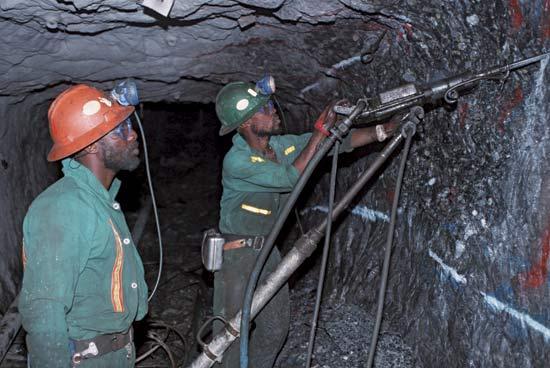
Fees Before Mines: How Nigeria’s Mining Ministry Became Its Own Worst Enemy


The Ministry of Solid Minerals Development is celebrating record revenue but the available data suggests the money is coming predominantly from licence fees rather than from mines. The pattern, if confirmed by full-year data, would reveal a regulatory regime that may be pricing out legitimate investors, driving production underground, and suppressing the royalties Nigeria desperately needs. Granular verification is hampered by the absence of comprehensive public data — a transparency failure that is itself part of the problem.

Special Report  |  Nigeria Mining Monitor

Nigeria’s solid minerals sector generated N68 billion in revenue in 2025, a figure that Minister Dele Alake’s team has trumpeted as proof of a transformed industry. The headline may be accurate but the story behind it is not the one being told.

A reading of the government’s own data, cross-referenced with international trade records and fee schedules from Australia and Canada, raises serious questions about whether this sector’s revenue growth is built on administrative charges rather than productive mining. Royalties — the income stream that actually reflects minerals being mined, processed, and sold appear to remain a structurally suppressed component of total collections. Meanwhile, the Ministry’s fee policies appear to have created conditions that systematically favour illegal operators over legitimate ones, shrunk the pool of formal licence holders, and allowed substantial volumes of minerals and metals to leave the country without confirmed royalty payments. Due to limitations in the granularity and timeliness of data published by the Mining Cadastre Office (MCO) and the Ministry, full verification of the scale of these problems is not currently possible. This opacity is itself a governance concern.

Taxing the paperwork, not the production

In a well-functioning mining jurisdiction, royalties dominate revenue. They are, by definition, the state’s share of its natural wealth — calculated as a percentage of the value of minerals actually extracted and sold. Licence fees are secondary: legitimate cost-recovery for administrative services. Nigeria’s available data suggests this logic has been inverted — though the absence of a consistent, publicly published annual breakdown of fees versus royalties prevents a definitive structural conclusion.

In December 2025, the Ministry’s own FAAC submission recorded fees of N2.59 billion against royalties of just N1.58 billion — meaning fees accounted for approximately 62% of that month’s solid minerals revenue. This is the most recent month for which disaggregated data is publicly available. The Ministry does not consistently publish monthly or annual revenue breakdowns distinguishing fees from royalties across the full year, making it impossible to confirm with certainty whether December’s ratio is representative or exceptional. The available partial-year data suggests the pattern is broadly consistent across 2025, but the MCO’s data collection practices do not permit the kind of longitudinal verification that would put this beyond reasonable dispute. For a country sitting atop gold, lithium, tin, and dozens of other commercially significant minerals, even a single-month ratio of this kind is a governance alarm bell.

The royalty problem is compounded by how royalties are calculated. Nigeria’s official “approved market value” for each mineral, the base on which the royalty percentage is applied appears not to be updated to reflect actual market prices. Based on analysis published in November 2025 by Regan van Rooy, a specialist in Nigerian mining royalty valuations, the approved value for gold is approximately USD 750 per ounce. If this USD 750/oz benchmark remains operative, or anything close to it, the gap with market rates is extraordinary: the London spot price in late 2025 was approximately USD 4,138 per ounce. Even if every gold miner in Nigeria declared every gram honestly, royalties would be collected on less than one-fifth of the mineral’s actual worth. Whether this results from deliberate policy, administrative inertia, or a failure to update administrative instruments in line with market movements, the practical outcome is the same: the royalty base is structurally disconnected from real values.

Related Fact: 62 % is the Proportion of December 2025 solid minerals revenue derived from administrative fees, not production royalties, based on FAAC submission data. In a well-governed sector, this ratio should be significantly reversed. Full-year disaggregated data is not publicly available to confirm whether this month is representative of the annual pattern.

The July 2024 fee shock: a revenue surge with a hidden ceiling

On 4 July 2024, Minister Alake announced sweeping new rates across 268 items in the mining sector. The Mining Lease annual service fee jumped to N1,250,000. A new Mining Lease application was pegged at N3,000,000. Exploration licence fees rose sharply. And a punitive late-renewal penalty structure was introduced: N1.5 million for an exploration licence renewal paid late, and N3,000,000 equal to the original application fee for a late Mining Lease renewal.

The revenue effect was immediate and substantial. Collections rose from N6 billion in 2023 to N38 billion in 2024 and reached N68 billion in 2025. The Ministry hailed this as transformative. But context matters. The 2025 budget target set for the Ministry was N36.88 billion, a figure so conservative it was exceeded by April. The Ministry’s own officials had publicly projected over N70 billion for the year; the actual result of N68.1 billion fell short of even that revised target. More importantly, the surge appears to have been driven primarily by fee collection, not by a measurable expansion in mining output.

That dial has a ceiling. Fee schedules cannot be increased indefinitely. When charges reach the point at which formal operation becomes economically irrational compared with informal activity, operators make a rational choice: they go underground. The Ministry has not published exit surveys, licence surrender analyses, or operator feedback data that would allow a precise determination of whether this tipping point has been reached. The circumstantial evidence — rising revocations, documented illegal operations, and the divergence between royalty collections and export volumes is consistent with the hypothesis that the tipping point has been reached. But in the absence of behavioural data, this remains a well-grounded inference rather than a demonstrated fact.

The lithium gap: Nigeria’s missing billions

No single data series raises more serious governance questions than the contrast between Nigeria’s royalty collections and Chinese customs records.

According to the General Administration of Customs of the People’s Republic of China (GACC), as reported by Shanghai Metals Market and Mysteel, Nigeria has become one of the world’s major suppliers of spodumene — the primary ore from which lithium is refined for use in electric vehicle batteries. In July 2025, Chinese customs recorded 217,000 tonnes of spodumene imported from Nigeria in a single month. Over the January–September 2025 period, arrivals from Nigeria appear to have exceeded 800,000 tonnes.

This “Mirror Data” of Chinese customs country-of-origin data should be treated as indicative rather than definitive proof of royalty liability. It does not account for possible re-exports, stockpiled material assembled from multiple sources, timing lags between shipment and royalty assessment, or informal cross-border aggregation. What it does establish is a very large physical volume of spodumene identified by Chinese importers as originating in Nigeria — a volume that warrants a credible, transparent reconciliation against Nigeria’s own royalty collection records. No such reconciliation has been published.

At Nigeria’s official royalty rate of N9,500 per tonne for spodumene, the July shipments alone would imply a royalty exposure of approximately N2.06 billion, more than Nigeria’s total royalty collection across all minerals in December 2025. The implied royalty exposure on nine months of spodumene exports would approach N7.6 billion. Whether these amounts were collected, deferred, or lost is unknown because the Ministry does not publish operator-level or mineral-level royalty data in the detail that would enable verification.

Is the lack of data from Nigeria’s Ministry of Mines intentional so as to thwart verification or is it simply very poor management?

The explanation for any gap is not complicated. A 2024 Associated Press investigation documented Chinese-funded operations employing artisanal miners including children as young as six at illegal sites across Nasarawa and other lithium-rich northern states. Dozens of arrests of illegal operators, including Chinese nationals convicted in Ilorin in April 2024, confirm that the activity is widespread and systematic. SBM Intelligence, a Lagos-based research firm, has documented links between illegal mining revenues and insecurity in affected regions; their reporting suggests a connection to the financing of armed actors, though the specific financial mechanisms and quantified flows have not been independently verified and this claim should be read accordingly. The minerals are leaving Nigeria. Whether, and to what extent, the royalties are being collected remains unanswerable given current data availability.

Related Fact: N7.6bn+ is the Estimated royalty exposure on Nigerian spodumene recorded arriving in China (Jan–Sep 2025), based on GACC data and Nigeria’s official royalty rate of N9,500/tonne. Whether these amounts were assessed and collected cannot be confirmed from publicly available data. Total royalties collected from ALL minerals in the same period appear to be a small fraction of this figure.

Paying more, getting less: the international comparison

A comparison with Western Australia and the Canadian provinces of Ontario and British Columbia, three of the world’s most active and investor-friendly mining jurisdictions, is instructive, though it requires contextual qualification. Nigeria’s fee structure looks not merely expensive but economically incoherent when set against these benchmarks, even accounting for differences in development stage and institutional capacity.

A Nigerian Mining Lease application costs approximately USD 1,875 at current exchange rates. The equivalent application fee in Western Australia is AUD 669 (approximately USD 426), that is less than a quarter of Nigeria’s charge. In Ontario, the equivalent is CAD 90 (approximately USD 65). In exchange for these modest fees, investors in WA and Canada receive: free, comprehensive digital geological databases covering decades of exploration data; publicly searchable, real-time tenement registers; 21-year Mining Lease terms renewable as of right; and regulatory frameworks where non-payment results in forfeiture, not criminal referral to an anti-corruption agency.

Nigeria offers comparatively little in return for fees. Its geological map costs N300,000. Its tenure register, the eMC+ system, has limited public accessibility and long periods offline. Geological survey data — the single most important input to any investment decision in mining  is thin relative to the country’s endowment. It is fair to note that Western Australia’s and Canada’s geological databases reflect decades of public investment that Nigeria did not make in the same period. The gap in data quality is partly a legacy issue, not purely a matter of current policy choice. That contextual point does not, however, explain why Nigeria’s current fees significantly exceed those jurisdictions’ charges while delivering demonstrably fewer services with attendant far greater risks.

Perhaps most structurally damaging is what Nigeria’s fees do not require: actual exploration work. In WA, Ontario, and BC, a licence is maintained by demonstrated expenditure on geological work, drilling, sampling, geophysics — that adds to the nation’s knowledge. Dormant licences lapse naturally. In Nigeria, licences are maintained by cash payment alone, with no requirement that any work occur. The Ministry has not published data on what proportion of licence holders have conducted exploration expenditure in any given year, which makes it impossible to quantify directly how widespread dormant licence-holding is. The absence of such a requirement, however, is structural and visible in the regulatory framework itself.

Related Fact: Nigeria’s fees are 29x Cananda’s. Nigeria’s Mining Lease application fee (USD 1,875) relative to Ontario’s equivalent (CAD 90 / USD 65). Nigerian operators receive no comparable geological database, limited tenure security, and face criminal referral for late payment. WA and Canadian fees reflect different development contexts, but the gap in cost-to-service ratio remains material.

3,794 revocations: an industry under pressure

Since President Tinubu’s administration took office in May 2023, the Ministry has revoked 3,794 mining licences. The waves came in three tranches: 1,633 in November 2023, 924 in May 2024, and 1,263 in September 2025. The primary trigger in every case was failure to pay annual service fees.

To understand the administrative scale of this, consider that the Mining Cadastre Office issued approximately 2,249 mineral titles in the entire year of 2023. Revocations since May 2023 therefore substantially exceed a full year’s worth of new grants. The Ministry may argue that many revoked licences were dormant, speculative, or non-compliant, legacy titles that added little productive value to the sector and whose removal represents regulatory hygiene rather than suppression however without production, employment, or investment data disaggregated by licence holder, it is not possible to determine definitively what proportion of revoked titles were genuinely active. The MCO does not publish this breakdown. What can be said is that more revocations are occurring than new licences are being issued, and that the compounding effect of punitive late-payment penalties makes recovery of title economically prohibitive for many operators who might otherwise have continued.

In Western Australia or Ontario, fee structures are calibrated to be sustainable for operating companies. Tenements are forfeited, not revoked with EFCC referral threats when operators cannot continue. Individual cases go through formal adjudication. The process is designed to preserve productive tenure in active hands, not to punish operators for cash flow difficulties. Nigeria’s approach creates the opposite incentive structure, regardless of intent.

For any international investor conducting due diligence, the combination of high fees, punitive late-payment penalties, and a track record of mass revocations represents a material risk factor. No investor surveys or documented deal withdrawals are cited here that data has not been published by the Ministry or by any independent body but the structural risk profile described is consistent with what deters capital in comparable emerging-market jurisdictions.

The transparency problem no one wants to name

Underlying all of the above is a failure of transparency that makes every other problem harder to solve. The IMF, the Extractive Industries Transparency Initiative, and every major mining jurisdiction treat granular revenue disclosure as a baseline governance requirement. Published production volumes by mineral and by operator, royalty declarations verifiable against independent trade data, licence registers open to public scrutiny — these are not luxuries. They are the tools that deter underreporting, build investor confidence, and allow policymakers to detect when a system is broken.

Nigeria’s Ministry does not consistently publish royalty data broken down by mineral type or by operator. The royalty base values which determine how much is owed per tonne are set administratively at prices that appear significantly disconnected from market rates, with no published methodology for how or when they are updated. It is acknowledged that some data is available through EITI submissions and FAAC reporting, and that these represent genuine improvements over earlier periods. The problem is not total absence of data, but insufficient granularity, consistency, and timeliness to allow external verification of whether royalties are being correctly assessed and collected. The MCO’s data collection practices do not currently support the kind of mineral-level, operator-level reconciliation that would make the sector’s royalty performance auditable.

A structural change is underway. As of January 2026, royalty collection has transitioned from the Ministry to the Federal Inland Revenue Service, now operating as the Nigeria Revenue Service under new tax laws. Both institutions have pledged collaboration and transparency. The intent is encouraging, and the separation of revenue collection from the regulating Ministry is consistent with international best practice. However, institutional reorganisation without data transparency is a rearrangement, not a reform. The transfer of collection responsibility to the Treasury does not, by itself, address the fundamental problem: Nigeria cannot yet reliably determine how much mineral is being extracted, by whom, and whether correct royalties are being paid. That will require investment in the information infrastructure, production monitoring, operator reporting obligations, and independent verification that neither institution has yet committed to provide, aside from the failed eMC+ system with its limited public accessibility and ongoing “upgrade” costs.

The verdict

Nigeria’s Ministry of Solid Minerals Development set out to transform a neglected sector. It has instead constructed a regulatory regime that charges heavily to hold ground, punishes those who struggle to pay, offers little in return in terms of data or security, and leaves the front door open for operators who have no intention of paying anything at all.

The result is visible in the data that is available: fees apparently outpacing royalties in the months for which disaggregated figures have been published; substantial volumes of lithium leaving the country with royalty collections that appear to fall far short of the implied liability; nearly 4,000 licences revoked in two years; and a sector whose headline revenue growth is almost entirely a product of administrative price increases rather than expanding output. The absence of more comprehensive public data, annual fee-versus-royalty breakdowns, operator-level royalty declarations, production volumes by mineral, means that the full extent of these problems cannot be established with precision. That absence is not a reason to dismiss the evidence that does exist; it is a governance failure in its own right.

Nigeria has extraordinary mineral endowments. It will not unlock their value by pricing legitimate operators into illegality. The path to a productive, revenue-generating mining sector runs through stable tenure, market-linked royalties, transparent data, and a fee structure that rewards development rather than punishing it. The January 2026 transfer of royalty collection to the Treasury is a step in the right direction. It will only matter if it is accompanied by the information systems and disclosure standards that make royalty compliance auditable and royalty performance visible.

Until the Ministry and the Nigeria Revenue Service together build that infrastructure and publish the results, the minerals will keep leaving the country and the royalties will remain, as they are today, largely unaccounted for.

The Ministry’s responsibility to develop Nigeria’s mining potential and transform Nigeria’s oil and gas economy into a clean energy and mining economy will remain just that — an unrealised potential.

Steven Kefas is a Nigerian journalist, activist, and mining enthusiast with nearly a decade of experience following Nigeria’s mining sector.


Sources and methodology

This analysis draws on MSMD monthly FAAC submissions (January–December 2025); the Nigeria Mining Cadastre Office 2023 Annual Report; GACC spodumene import data as reported by Shanghai Metals Market and Mysteel (January–September 2025); the MSMD July 2024 rate schedule (268-item fee revision); DEMIRS Western Australia Fees and Charges 2024–25 (effective 1 July 2024); Ontario O. Reg. 65/18 and O. Reg. 113/91; BC Mineral Tenure Act Regulation; Regan van Rooy analysis of Nigerian royalty valuations (November 2025); and reporting from THISDAY, Premium Times, AllAfrica, PBS NewsHour, Associated Press, SBM Intelligence, and Business & Human Rights Resource Centre. Exchange rates: USD 1 = N1,600; AUD 1 ≈ USD 0.637; CAD 1 ≈ USD 0.725. The approved gold royalty value of approximately USD 750/oz is drawn from the Regan van Rooy analysis; the Ministry has not published a current royalty valuation schedule and has not confirmed or denied this figure in response to requests for information. Full-year disaggregated fee-versus-royalty data for 2024–2025 has not been published by the Ministry or MCO; the December 2025 FAAC figure is the most recent month for which this breakdown is available.

Who Is Behind the Violence in Northern Nigeria?


By Steven Kefas

Nigeria is often portrayed in international headlines as simply “unstable,” a sweeping, unhelpful label that conceals a far more complex and geographically specific crisis. For those seeking to understand the country’s security situation, the details matter enormously. Over the past ten years, I have conducted extensive field research across Nigeria with a particular focus on the north, carrying out on-the-ground interviews with victim communities, local leaders, survivors, and witnesses. What I found challenges vague narratives and points to identifiable actors perpetrating the majority of violence in two critical regions: the Northwest and the North Central.

Systematic data gathered by the Observatory for Religious Freedom in Africa (ORFA) consistently records a significant proportion of Christian victims even in predominantly Muslim northwestern states, evidence that the violence carries a dimension that purely ethnic or economic explanations cannot fully account for. This piece argues that the crisis is best understood as ethno-religious in character: rooted in ethnic identity, but inflected with religious targeting that demands honest acknowledgment.

The Northwest: Bandits, or Something More?

In Nigeria’s Northwest comprising states such as Zamfara, Katsina, Sokoto, Kebbi, and Kaduna, the dominant perpetrators of mass violence are armed groups widely referred to as “bandits.” This label, while useful as shorthand, does not fully capture the sophistication, the ethnic profile, or the religious dimensions of these actors.

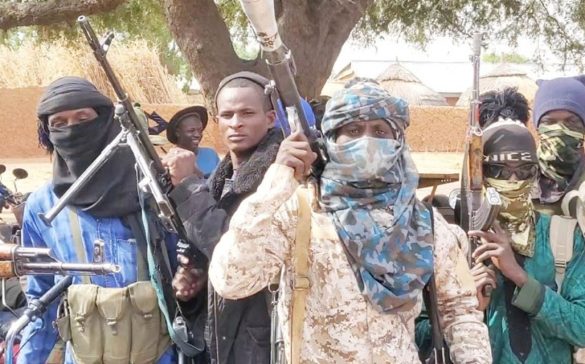
After conducting field interviews across victim communities in this zone over ten years, my research found that at least 95% of the perpetrators are of Fulani origin. This finding is broadly consistent with what credible international and Nigerian bodies have documented. Approximately 30,000 Fulani bandits operate in several groups in northwest Nigeria, with individual groups consisting of anywhere from 10 to 1,000 members. These are not loosely organized mobs. They are structured armed networks that have carved out territories, imposed illegal taxation on farming communities, and responded to resistance with lethal force.

This ethnic and religious identification of the bandits was confirmed publicly by one of Nigeria’s most senior political figures. In September 2021, then-Katsina State Governor Aminu Bello Masari, himself a Fulani man made an extraordinary admission on Channels Television’s “Politics Today” programme, stating that the bandits were “the same people like me, who speak the same language like me, who profess the same religious beliefs like me.” He added that “majority of those involved in this banditry are Fulanis, whether it is palatable or not, but that is the truth,” and noted that some fighters had infiltrated from West and North African countries, all of Fulani extraction. His candid acknowledgment effectively confirmed from within Nigeria’s political establishment what field researchers and affected communities had long documented.

What makes these groups particularly alarming is the level of weaponry in their possession. Bandit gangs notably downed a Nigerian Air Force Alpha Jet on 18 July 2021, a stunning demonstration of anti-aircraft capabilities. This is not the profile of ordinary criminals; it is the profile of an insurgent-level armed group[i].

The Religious Dimension in the Northwest

Framing the northwest violence purely as criminality or ethnic predation risks missing an important layer. ORFA data document a disproportionately high number of Christians among the dead in northwestern states, including Kaduna, Katsina, Sokoto, Zamfara, Katsina, and Kebbi states where Christians are a demographic minority. The targeting pattern is not random. Churches have been burned, Christian farming communities repeatedly selected for raids, and witnesses across multiple communities have reported attackers chanting Allahu Akbar during assaults. This does not make every attack a formally declared religious war, but it does mean that religion functions as a marker of who is targeted and who is spared in many attacks in the region.

The historical memory of the Usman Dan Fodio jihad of the early nineteenth century, which transformed the religious and political landscape of what is now northern Nigeria remains a live current in the identity of sections of the Fulani community. This does not reduce every Fulani herder to a jihadist. But it means the violence should be understood as ethno-religious in character: ethnicity and religion are intertwined as both motivation and method. The term “ethno-religious warfare” captures this more accurately than either “religious warfare” (as practised by Boko Haram and ISWAP) or plain criminality. Minority Christian communities in the Muslim northwest have come under attacks in a manner that suggests they are being targeted. For example, in Faskari LGA of Katsina state, the ORF four-year report shows a significant number of Christians killed. Considering the small population of Christians in the LGA, there is no better explanation to the number killed than being targeted.

Furthermore, the convergence between bandit groups and declared jihadist networks adds an additional dimension to an already dangerous situation. ISWAP and Boko Haram factions  including Ansaru, Mahmuda, and Lakurawa  have claimed attacks in northwest Nigeria, and some bandit groups have reportedly forged alliances with these jihadist organisations.

The economic impact has been devastating regardless of motive. Armed Fulani militant networks have inflicted catastrophic damage on Nigeria’s economy and governance, with deliberate destruction of farms and grain stores triggering soaring food prices and nationwide food insecurity, and millions displaced since the crisis began.


The Middle Belt: Armed Herdsmen and Ethno-Religious Targeting

In Nigeria’s Middle Belt, covering states such as Plateau, Benue, Nasarawa, Taraba, Niger, and Kwara, the picture is similar in terms of perpetrator identity but different in framing. Here, the media refers to armed actors as “Armed Herdsmen” rather than bandits. My field research, spanning ten years of interviews in the Middle Belt, led me to the same conclusion as in the Northwest: over 95% of the perpetrators are of Fulani descent.

Attacks on 23 to 24 December 2023 in Plateau State left at least 200 people dead and more than 500 injured across no fewer than 20 rural communities in Bokkos and Barkin Ladi Local Government Areas, were attributed to Fulani militants. Less than two years later, on 14 June 2025, at least 258 Christians were brutally murdered in Yelwata, Benue State, in an attack attributed to armed Fulani militia fighters.

These are not isolated incidents. They form part of a sustained and escalating pattern of violence against settled farming communities, communities that are overwhelmingly Christian, carried out with apparent impunity and, in documented accounts, accompanied by religious invocations.

The Nasarawa Connection

Field research and security reporting have established that some of the most lethal Fulani militant groups operating across the Middle Belt do not simply emerge from within the states they attack. Several armed groups have maintained known encampments in Nasarawa State, using these as staging posts for coordinated raids into Plateau, Benue, Taraba, and other Middle Belt states. This cross-state operational pattern, attackers arriving, killing, and retreating to camps across state line has frustrated local security responses and allowed militant networks to strike with impunity while remaining outside the effective jurisdiction of any single state authority. This is not a local herder dispute; it is a coordinated militant operation with identifiable logistics, known geography, and a command structure that must be addressed at both federal and state levels.

Religious Markers in Middle Belt Attacks

The ethno-religious character of the Middle Belt attacks is well-documented, and the evidence is substantial. Across multiple states and many years of field interviews, survivors and witnesses have consistently reported the following:

Burning of churches. The deliberate targeting and destruction of Christian places of worship has been documented in attacks across Plateau, Benue, Taraba, and Southern Kaduna. In numerous incidents, church buildings are primary targets, not incidental casualties of fighting.

Chants of Allahu Akbar. Multiple survivor testimonies, corroborated by field researchers and documented record attackers chanting “God is Greatest” in Arabic during raids on Christian communities. This is not consistent with violence that has no religious dimension.

Targeting of pastors and their families. Church leaders have been disproportionately killed or abducted in attacks across the Middle Belt. The deliberate elimination of religious leaders signals an intent that goes beyond land and grazing disputes.

These patterns do not mean that every armed Fulani herder is motivated primarily by religion, or that ecological pressures are irrelevant. But when attackers burn churches, announce their actions in religious terms, and single out pastors for killing, the violence has crossed into ethno-religious territory that demands a different analytical and policy response.

Governor Elrufai’s Admission

The identity of the perpetrators responsible for killings in Southern Kaduna was confirmed by the state’s own governor. In December 2016, then-Kaduna State Governor Nasir Elrufai made a public admission that he had identified the killers as Fulani, including foreign Fulani fighters from Cameroon, Niger Republic, Chad, Mali, and Senegal. Rather than pursuing legal accountability, Elrufai disclosed that his government sent emissaries across borders to appeal to these individuals to stop the killings, because he, as governor, was Fulani like them. He stated plainly that he sent people to tell them “there is a new governor who is Fulani like them and has no problem paying compensations for lives lost and he is begging them to stop killing.”

What the World Needs to Understand

The violence in northern Nigeria is not random or faceless. Field research consistently points to identifiable armed groups, predominantly of Fulani origin, operating with sophisticated weapons, organised command structures, cross-state logistics, and ethno-religious motivations that make the label “farmer-herder conflict” dangerously inadequate.

Framing this crisis as mere “ethnic conflict” or “farmer-herder clashes” serves several false purposes: it implies mutual fault between two equal parties, it erases the religious dimension of targeting, and it obscures the organised, predatory, and often one-sided nature of attacks on civilian communities. ORFA data demonstrate clearly that Christians bear a disproportionate share of the killing, not only in the Middle Belt, where this might seem demographically predictable, but in northwestern states where Christians are a distinct minority. That pattern is not an accident of geography; it is evidence of targeting.

For policymakers, aid organisations, and international observers, understanding who the perpetrators are and what drives them is not an exercise in blame. It is a prerequisite for crafting responses that can actually protect lives. The communities I interviewed are not statistics. They are people who have survived raids, buried their dead, seen their churches burned, and are still waiting for meaningful intervention.

This crisis demands a response commensurate with its actual character: ethno-religious violence, prosecuted by organised armed groups, with identifiable actors, documented methods, and a regional geography that crosses state and national borders.


Steven Kefas has conducted field research across northern Nigeria for over ten years. Data referenced from ORFA (Observatory for Religious Freedom in Africa) is available at www.orfa.africa . For previous reporting on these communities, see the author’s coverage in www.middlebelttimes.com 


Australian Mining Executive Referred to Australian Federal Police as Kaduna Communities Allege Bribery and Corruption


By Biliyaminu Suraj

Fresh allegations of coercion, political interference and foreign bribery have emerged around one of Nigeria’s most promising lithium deposits, after community leaders in Kaduna State referred an Australian mining executive to the Australian Federal Police  for investigation.

The case centres on Colin Ikin, an Australian national linked to a cluster of companies — Atlantic Mining Techniques, Mystic Mining and Kings Mines — that have been attempting to secure community consent to operate on tenements discovered and developed by UK-registered Jupiter Lithium Ltd in the Kaninkon Chiefdom of Jema’a Local Government Area.

Community leaders say Mr Ikin and his associates sought to pressure them into granting access to the mine-ready project, despite Jupiter Lithium’s long-standing presence and development work in the area.

Community alleges high-level assurances

According to letters sent to Nigerian and Australian authorities and reviewed by this newspaper, representatives of the so-called “Atlantic group” met the Paramount Ruler in December 2025. The delegation, introduced through a village chief, allegedly told the ruler that they had the backing of  high level Nigerian government officials that Jupiter’s titles would be revoked or “cut into pieces” to allow new entrants – an assertion that, if verified, would raise serious concerns about political interference in the allocation of mining rights in a sector the government has repeatedly described as central to Nigeria’s economic future.

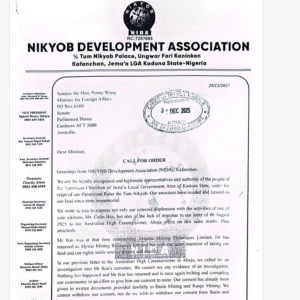
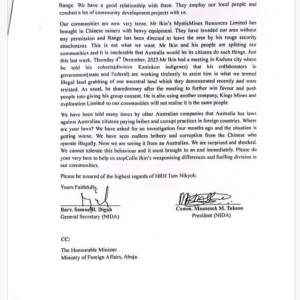
Community leaders say they rejected the overtures, citing Jupiter Lithium’s seven-year record of community development, local employment and a formal Community Development Agreement (CDA). “We refused to give consent to any of Mr Ikin’s companies,” the community wrote in one of several letters to the minister and the DG-NMCO.

A controversial figure resurfaces in Nigeria

Mr Ikin is a familiar figure in Australian mining circles. As head of the former ASX-listed Preston Resources, he presided over the Bulong laterite nickel project near Kalgoorlie — one of Western Australia’s most notorious mining failures. The project collapsed with estimated debts of about A$600 million and accumulated losses of roughly A$750 million.

Nigerian media have previously reported concerns about his activities in other African countries. Individuals familiar with the matter say Mr Ikin is employed by businessman Gilbert Chagoury, and that the companies involved in the Kaduna push are administered by associates linked to the Chagoury network.

Escalation to the Australian government

After receiving no response to multiple letters sent to Nigeria’s Minister of Solid Minerals and the DG-NMCO, the Kaninkon community escalated the matter to the Australian High Commission in Abuja, alleging that Mr Ikin’s conduct amounted to foreign bribery and corruption under Australian law.

When their first two letters went unanswered, the community wrote directly to Australia’s Minister for Foreign Affairs. In January 2026, the Australian High Commissioner advised that allegations involving an Australian citizen should be referred to the Australian Federal Police, which has jurisdiction to investigate foreign bribery and grand corruption offences involving Australian nationals. The community subsequently submitted a formal referral to the AFP’s Taskforce Solaris in Canberra.

The AFP does not comment on ongoing assessments, but any inquiry would likely examine the alleged political assurances Mr Ikin is said to have cited, as well as the corporate structures behind Atlantic Mining Techniques and related entities.

A test for Nigeria’s mining reforms

The dispute comes at a sensitive moment for Nigeria’s mining sector, which the Tinubu administration has positioned as a cornerstone of its economic diversification agenda. Investors say the allegations highlight persistent weaknesses in licensing transparency, political interference and institutional oversight.

Jupiter Lithium Ltd, which has had several of its mining lease titles revoked, has been unable to commence mining on its remaining tenements despite completing exploration and development work. The company said the credibility of Nigeria’s mining reforms depends on adherence to due process. “Transparency and the rule of law must prevail,” a representative said.

For the Kaninkon community, the stakes are immediate. “We have worked with Jupiter for seven years,” a community leader said. “We cannot allow people to come with political backing to take what is ours.”

Whether the Australian Federal Police opens a full investigation may determine how far the allegations reverberate — in Abuja, in Canberra, and across a global critical minerals market increasingly shaped by governance risks.


General Musa’s Rising Charisma: A Strategic Asset for President Tinubu and a Political Advantage the APC Cannot Ignore

In every political era, certain personalities rise above the noise not because they shout the loudest, not because they seek attention, but because their character, competence, and calm presence resonate with the public in ways the political class often fails to anticipate.

In Nigeria today, that figure is General Christopher Gwabin Musa (Rtd.), the Minister of Defence and one of the most unexpectedly influential personalities in the Tinubu administration.

His influence is not formal.
It is not partisan.
It is not manufactured.

It is rooted in earned trust built over decades of military service and now crystallizing into a quiet yet powerful political force.

This article examines the extraordinary rise of Musa’s charisma, its implications for the Tinubu administration, and why the APC may be sitting on one of its most significant political advantages heading into the coming years.

A Reputation Built on Service, Not Politics

Unlike many public figures whose reputations are shaped in the arena of political bargaining, alliances, and media engineering, General Musa’s national appeal is a by-product of his professional journey.

From his days at the forefront of counter-insurgency operations to his tenure as Chief of Defence Staff, Musa became synonymous with discipline, integrity, humility, operational excellence, and national service above personal ambition.

These qualities have followed him into the Federal Executive Council.

In a period when Nigeria continues to grapple with insurgency, banditry, regional tensions, and organized criminal networks, Musa’s appointment was a deliberate signal by President Tinubu to anchor national defence in competence rather than politics.

That decision is now yielding political dividends.

Why Musa’s Charisma Is Different

In Nigeria, political charisma is often loud, theatrical, combative, and attention-seeking. Musa’s charisma is the opposite. It is quiet, steady, and deeply persuasive.

It is the charisma of competence, not performance.

His public appeal rests on four pillars:

1. Calm Demeanor
At a time when public communication is often emotionally charged, Musa speaks with measured precision. He avoids sensationalism and speaks to citizens with respect. His clarity inspires confidence.

2. Authentic Humility
He does not project himself as a politician hungry for relevance. He carries himself as a custodian of responsibility. This humility makes him relatable and trustworthy.

3. Record-Backed Authority
Musa does not need political propaganda to legitimize his views. Nigerians remember his frontline contributions from overseeing the mass surrender of insurgents to stabilizing military operations in difficult theatres.

4. A Non-Partisan Reputation
Though a key figure in the Tinubu administration, Musa is viewed as above partisan politics. He is seen as a national asset, not a party operative. This gives him credibility across political divides.

This combination of attributes is incredibly rare and politically invaluable.

A Strategic Win for the Tinubu Administration

President Bola Ahmed Tinubu has long demonstrated an ability to recognize and elevate credible technocrats whose work bolsters the image of his government. Musa’s appointment fits this strategic pattern perfectly.

Through Musa, the administration has achieved the following:

1. Restored Public Confidence in Defence Leadership
After years of skepticism toward Nigeria’s security system, Musa’s reputation reassures citizens that competent hands are steering the sector.

2. Strengthened Internal Stability
His leadership provides stability and continuity within the military hierarchy, reducing internal friction and strengthening operational cohesion.

3. Projected Professionalism Over Politics
Musa symbolizes the administration’s preference for expertise over political interference a key narrative as Tinubu implements complex reforms.

4. Enhanced the APC’s National Appeal
A credible, widely respected figure in a politically tense environment helps soften public criticism toward the government.

These advantages are not symbolic they are strategic.

A Political Advantage the APC Cannot Ignore

The APC currently faces a difficult communication environment due to economic reforms, subsidy removal impacts, and rising living costs. In moments like this, political parties need figures who inspire trust.

General Musa fits that profile.

He is a:

credible spokesperson
national unifier
trusted public face
competent operator
reassuring communicator

He reduces political hostility without engaging in politics.

This is political capital rare, powerful, and often decisive.

A Bridge Across Nigeria’s Divides

One of Musa’s most remarkable strengths is that he appeals to voters across ethnic, religious, and regional lines.

Across the North, he is respected for professionalism and results.

Across the South, he is admired for his articulate communication and unassuming leadership style.

Among Christian communities, his presence in a high-security office is seen as reassuring and inclusive.

Among Muslim communities, his military reputation commands respect.

Among the youth, he represents discipline, intelligence, calm, and a non-corrupt public image.

This broad appeal is politically significant. Very few figures in Nigeria today can draw admiration across such diverse constituencies without controversy. Musa is one of them.

Media Visibility and Rising Public Trust

In recent months, Musa’s visibility has increased not because he is seeking attention, but because:

he is central to resolving critical national issues
he communicates effectively
media platforms find him credible
citizens trust him instinctively

His statements often go viral because Nigerians yearn for leadership that sounds both competent and sincere.

Public discourse on national security, governance, and leadership quality increasingly references him as a stabilizing figure.

This organic rise is the clearest proof that his political value is expanding naturally.

A Nightmare for the Opposition’s Strategy

Opposition parties typically rely on portraying government officials as incompetent or corrupt. But attacking Musa is politically risky because:

he has no corruption scandals
no record of ethnic or religious bias
no political baggage
no history of public misconduct
no reputation for disrespect or arrogance

He is difficult to discredit.

Any attempt to malign him risks alienating neutral Nigerians who view him as one of the few credible figures in government.

This gives the APC a protective shield and forces the opposition to rethink its messaging strategy.

Could Musa Become a National Political Force?

Not necessarily in the electoral sense though in politics, anything is possible but in terms of influence, Musa is already becoming a defining figure.

He strengthens:

public trust
institutional legitimacy
inter-agency cooperation
national confidence in security leadership
APC’s perception across key demographics

In previous administrations, figures like Dora Akunyili, Lamido Sanusi, and Attahiru Jega became national stabilizers. Musa fits into this lineage.

His influence, if strategically harnessed, could reshape the APC’s national image ahead of the next election cycle.

Conclusion: The Era of The Musa Effect

General Christopher Musa may not be a traditional politician, but he represents the kind of leadership Nigerians crave competent, calm, sincere, and unifying.

He strengthens the Tinubu administration.
He boosts the APC’s credibility.
He reassures investors, communities, and citizens.
He elevates the public perception of Nigeria’s security leadership.
He bridges divides in a polarized nation.

In an era where political noise often disguises a lack of substance, Musa’s quiet strength is refreshing. Nigeria is noticing. The political establishment is noticing. And the ruling party, if strategic, will recognize that it has in Musa one of its most valuable assets.

The Musa Effect has begun.
Its implications will be felt for years to come.

By Samuel Ateh Stephen
Digital Strategist & Public Affairs Commentator
Focused on National Development
19/01/2025

Breaking Down the CPC Designation: How Government Appeasement of Terrorists Led to International Sanction

By Steven Kefas

Yesterday, the United States designated Nigeria as a Country of Particular Concern (CPC) for severe violations of religious freedom, a long-overdue recognition of the systematic persecution of Christians and other vulnerable communities that has claimed tens of thousands of lives over the past two decades. This designation didn’t emerge from vacuum; it reflects years of documented evidence, mounting international pressure, and most critically, the lack of political will by successive Nigerian governments to confront the Fulani jihadist insurgency decimating indigenous communities across the Middle Belt and beyond.

Understanding the CPC Designation

A Country of Particular Concern designation under the International Religious Freedom Act represents one of the most serious diplomatic rebukes the United States can issue. It signals that a government has either engaged in or tolerated systematic, ongoing, and egregious violations of religious freedom. For Nigeria, this designation specifically addresses the government’s failure to prevent, investigate, or prosecute mass atrocities against Christian communities, particularly those carried out by armed Fulani militia groups operating with apparent impunity across multiple states.

The designation comes with potential consequences including sanctions, travel restrictions on government officials, and limitations on security assistance. More significantly, it places Nigeria alongside countries like China, Russia, Iran, and North Korea on a list of the world’s worst violators of religious freedom, a devastating blow to Nigeria’s international reputation and a clear message that the world is no longer willing to ignore the bloodshed.

The Fulani Jihadist Insurgency: An Unacknowledged Genocide

For over two decades, armed Fulani militia groups have waged a systematic campaign of violence against predominantly Christian farming communities across Nigeria’s Middle Belt states including Plateau, Niger, Kwara, Kogi, Benue, Taraba, Adamawa, and Southern Kaduna. These attacks follow predictable patterns: midnight raids on sleeping villages, mass shootings, burning of homes and churches, destruction of farmland, kidnapping for ransom, and forced displacement of entire communities from their ancestral lands.

The Nigerian government and many media outlets have persistently characterized this violence as “farmer-herder clashes” driven by competition over land and water resources, a narrative that deliberately obscures the religious and ethnic dimensions of these attacks. This framing ignores overwhelming evidence that these are coordinated military-style operations targeting Christian communities specifically, not spontaneous conflicts between economic groups. Survivors consistently report attackers shouting “Allahu Akbar” during raids, specifically targetingChristian farming communities.

International organizations including Genocide Watch, the United States Commission on International Religious Freedom (USCIRF), and Open Doors have repeatedly warned that the violence against Christians in Nigeria’s Middle Belt exhibits markers of genocide according to the UN Convention on Genocide. Yet the Nigerian government continues to downplay the religious dimensions, refuses to designate perpetrating groups as terrorists, and has failed to arrest or prosecute those responsible for these atrocities despite thousands of documented attacks.

The Paradox of Invisible Terrorists

During my own incarceration in Kaduna Custodial Center (prison), in the very heart of the region most affected by Fulani terrorist violence, I made a disturbing observation: despite thousands of documented attacks, mass killings, and the displacement of millions, I never encountered a single Fulani terrorist among the prison population. The prisons were filled with common criminals, political detainees, and individuals accused of various offenses, but conspicuously absent were members of the armed groups terrorizing communities just kilometers away from the prison walls.

This glaring absence raises fundamental questions about the Nigerian government’s commitment to justice and accountability. If Fulani militias are genuinely criminal groups operating outside state control, why aren’t security forces arresting them? If they’re terrorists threatening national security, why aren’t they being prosecuted? The most troubling explanation is that these groups operate with official protection or at minimum, deliberate tolerance from elements within Nigeria’s security architecture.

Multiple credible reports document security forces arriving hours after attacks despite communities alerting authorities during ongoing raids, refusing to pursue fleeing attackers, and in some cases, actively preventing communities from defending themselves. Some survivors report security personnel withdrawing from areas just before attacks occur, suggesting foreknowledge if not coordination. This pattern of complicity extends to the judicial system, where rare arrests of suspected Fulani militants typically result in quiet releases without prosecution.

The Nuhu Ribadu Problem: Peace Deals That Embolden Terrorists

At the center of Nigeria’s failed counterterrorism strategy sits National Security Adviser, Mallam Nuhu Ribadu, whose approach to the Fulani jihadist insurgency has been characterized by appeasement rather than confrontation. Ribadu has allegedly championed “peace deals” with armed Fulani groups in the North West that require no genuine disarmament, demand no accountability for past atrocities, and impose no meaningful conditions on participants.

Most disturbingly, these peace meetings have become theatrical displays where armed terrorists attend openly carrying weapons, not as surrendered arms but as symbols of their continued power. Rather than being disarmed and arrested, these individuals are feted, given platforms to air grievances, and often provided government resources ostensibly for “rehabilitation” that never materializes into genuine transformation. The message sent is clear: terrorism pays, and the Nigerian state will negotiate with you while you remain armed and dangerous.

This approach represents a fundamental misunderstanding of counterinsurgency principles. Genuine peace processes require that armed groups demonstrate commitment to peace through verifiable disarmament, cessation of violence, and accountability for past crimes. Ribadu’s peace deals offer none of these, instead legitimizing terrorist groups as stakeholders in governance while their victims remain displaced, traumatized, and vulnerable to renewed attacks.

For communities that have lost thousands of family members, seen their villages burned repeatedly, and remain displaced years after initial attacks, these peace deals represent a betrayal. They watch their attackers attend government-sponsored meetings with full military regalia while they languish in IDP camps with no justice, no compensation, and no protection against future violence. This is not peace; it is surrender disguised as reconciliation.

The Controversial Defense Appointment: Signaling Priorities

The Tinubu administration’s appointment of former Zamfara State Governor Bello Matawalle Minister of State for Defence sends a chilling message about the government’s priorities regarding the Fulani jihadist insurgency. Matawalle’s tenure as Zamfara governor was marked by controversial policies toward armed bandits and terrorists operating in the state, including peace deals that critics argue emboldened rather than deterred violence.

Under Matawalle’s governorship, Zamfara became infamous for its approach of negotiating with terrorists while often taking harsh measures against communities advocating for self-defense. His administration faced accusations of sympathizing with armed groups while failing to protect vulnerable populations. Now elevated to a key defense position at the federal level, Matawalle’s appointment suggests either profound tone-deafness about the optics of placing a terrorist sympathizer in charge of national defense, or a deliberate signal that the government’s appeasement approach will continue.

This appointment is particularly offensive to Christian communities in the Middle Belt who have borne the brunt of Fulani terrorist violence. It communicates that their concerns about religious persecution are not taken seriously, that their calls for justice fall on deaf ears, and that those who accommodate terrorists are rewarded with higher office while their victims remain forgotten.

The Broader Context: Why Accountability Matters

The lack of accountability for religious persecution in Nigeria extends beyond the Fulani insurgency, though that remains the deadliest manifestation. It includes the Boko Haram and ISWAP insurgencies in the Northeast that have killed tens of thousands and displaced millions, primarily targeting Christians and moderate Muslims. It encompasses discriminatory Sharia law implementation in Northern states that criminalizes Christian evangelism while permitting Islamic proselytization. It involves systematic discrimination in government appointments, educational opportunities, and economic development that favors Muslims over Christians in Northern states.

This pattern of impunity has convinced perpetrators that targeting Christians carries no consequences. When terrorist commanders remain free after documented massacres, when government officials who facilitate violence face no sanctions, when security forces who fail to protect vulnerable communities receive no discipline, the message is clear: Christian lives don’t matter in Nigeria’s calculus of power.

The CPC designation represents the international community finally saying: we see what you’re doing, we will no longer accept your excuses, and there will be consequences for continued inaction. This is not interference in Nigeria’s internal affairs; it is a response to a government’s failure to protect its own citizens and uphold its obligations under international human rights law.

What Must Change: A Roadmap for Action

For Nigeria to address the concerns underlying the CPC designation and genuinely protect religious freedom, several immediate actions are necessary:

First, National Security Adviser Nuhu Ribadu must be removed and replaced with a competent, no-nonsense security official committed to crushing jihadist insurgencies rather than accommodating them.

The current appeasement approach has demonstrably failed, emboldening terrorists while failing to provide security for vulnerable communities. Nigeria needs security leadership that understands counterterrorism, respects human rights, and prioritizes protection of all citizens regardless of religious identity.

Second, armed Fulani militia groups must be officially designated as terrorist organizations and prosecuted accordingly.

The fiction that these are mere “herders” involved in resource conflicts must end. These are organized armed groups conducting systematic attacks on civilian populations with religious and ethnic motivations. They must be treated as the terrorists they are, with full application of Nigeria’s terrorism laws including arrests, prosecutions, and asset freezures.

Third, a comprehensive program of arrests and prosecutions of terrorist commanders must be implemented immediately.

Years of documented attacks have produced extensive evidence aboutsponsors, operational patterns, and specific perpetrators. This evidence must be acted upon with coordinated operations to arrest sponsors, dismantle networks, and bring perpetrators before courts. This requires political will from the highest levels of government to overcome resistance from those who benefit from the status quo.

Fourth, the appointment of controversial figures like Bello Matawalle to key security positions must be reversed.

These appointments signal that the government is not serious about confronting religious persecution. Replacing such officials with individuals who have demonstrated commitment to protecting all Nigerians regardless of religious identity is essential for restoring confidence in government intentions.

Fifth, a comprehensive program of justice and reparations for victims must be established.

Millions of displaced persons need pathways to return home safely, rebuild destroyed communities, and receive compensation for losses. Survivors of attacks need access to trauma counseling and medical care. Communities need assurance that their security will be prioritized and that future attacks will be prevented.

The Trump Factor: Why This Time Is Different

While I sympathize with President Tinubu’s administration, which inherited these problems when taking office just two years ago, the reality is that the lack of political will to confront Fulani jihadists predates his presidency and continues under his watch. Previous U.S. administrations issued strongly worded statements about religious persecution in Nigeria but took limited concrete action. The Trump administration has demonstrated willingness to move beyond rhetoric to consequences, as evidenced by the CPC designation.

This represents a potential turning point. Under President Trump’s leadership, the United States has signaled that the days of endless massacre of Christians without accountability are over. The CPC designation is likely just the beginning, with targeted sanctions, visa restrictions, and other measures potentially forthcoming if Nigeria fails to demonstrate genuine progress on protecting religious freedom.

For Nigerian officials who have operated with impunity while facilitating or tolerating religious persecution, this should serve as a wake-up call. The world is watching, documentation is being compiled, and accountability mechanisms are being activated. The comfortable assumption that international outrage will never translate into consequences is no longer valid.

A Message to the Nigerian Government

You have lied to the world about the nature of violence against Christians in Nigeria, characterizing genocide as “farmer-herder clashes” and systematic religious persecution as resource competition. You have protected perpetrators while abandoning victims. You have appointed terrorist sympathizers to defense positions while imprisoning those who dare to defend themselves. You have negotiated with armed terrorists while refusing justice to their victims.

The world is watching, and your lies are no longer accepted. The CPC designation is deserved, and more actions will follow if you continue on this path. It is time to act and act very fast. Crush the jihadists, protect the lives of Christians and other vulnerable communities, demonstrate through concrete actions rather than empty rhetoric that you are committed to religious freedom, and the USA will undesignate Nigeria with immediate alacrity.

The choice is yours: continue the current path of appeasement and complicity and face increasing international isolation and consequences, or demonstrate genuine political will to confront religious persecution and restore Nigeria’s standing in the community of nations that respect human rights.

Conclusion: Hope Amidst Darkness

Despite the grim realities documented above, there is reason for cautious hope. The CPC designation represents international recognition that has eluded victims of religious persecution in Nigeria for decades. It validates their suffering, acknowledges their testimonies, and signals that they have not been forgotten by the wider world.

For those of us who have documented these atrocities, advocated for victims, and refused to accept official narratives that obscure the truth, this designation represents vindication. Our work has not been in vain. The evidence we have compiled, the testimonies we have preserved, and the advocacy we have undertaken has finally broken through the wall of denial and reached decision-makers willing to act.

The question now is whether the Nigerian government will respond with genuine reform or with defiance and denial. The path forward is clear: accountability, justice, protection, and genuine commitment to religious freedom for all Nigerians. Whether Nigeria’s leadership has the wisdom and courage to take this path remains to be seen, but one thing is certain—the world is watching, and the days of impunity are numbered.

Steven Kefas is an investigative journalist, Senior Research Analyst at the Observatory for Religious Freedom in Africa, and Publisher of Middle Belt Times. He has documented religious persecution and forced displacement in Nigeria’s Middle Belt for over a decade

How Fulani Militias Became Nigeria’s Deadliest Group While Escaping Global Notice

By Steven Kefas

In 2015, when the Global Terrorism Index (GTI) ranked Armed Fulani militants as the fourth deadliest terror group in the world, Nigeria was already grappling with the brutal reality of multiple security threats. Yet nearly a decade later, as these same militants have grown exponentially more lethal, they have mysteriously vanished from international terrorism rankings —despite becoming what many security experts now consider Nigeria’s most deadly non-state armed group.

This paradox raises troubling questions about how the global community measures and responds to terrorism, particularly when it involves complex ethnoreligious conflicts in Africa. While international attention remains focused on jihadist groups like Boko Haram and the Islamic State West Africa Province (ISWAP), a more devastating threat has been systematically erasing entire communities across Nigeria’s Middle Belt.

The Numbers Tell a Devastating Story

Recent data from the Observatory for Religious Freedom in Africa (ORFA) paints a picture of unprecedented violence that dwarfs the carnage attributed to Nigeria’s better-known terrorist organizations. Note: The following data represents preliminary research findings that have not yet been published on ORFA’s website but are based on their ongoing documentation efforts. Between October 2019 and September 2024, ORFA documented 66,656 deaths across Nigeria, of these, 36,056 were civilians. The Fulani Ethnic Militia (FEM) were responsible for a staggering 47% of all civilian killings —more than five times the combined death toll of Boko Haram and ISWAP, which together accounted for just 11% of civilian deaths.

These figures represent more than statistical abstractions; they reflect a systematic campaign of violence that has fundamentally altered the demographic landscape of Nigeria’s Middle Belt. The data reveals that 2.4 Christians were killed for every Muslim during this period, with proportional losses to Christian communities reaching exceptional levels. In states where attacks occur, Christians were murdered at a rate 5.2 times higher than Muslims relative to their population size.

The scope of violence extends far beyond killings. ORFA documented 13,437 incidents of extreme violence during the five-year study period, including 29,180 civilians abducted. The trajectory of kidnappings alone illustrates the escalating nature of the crisis: from 1,665 civilians abducted in 2020 to 7,705 in 2022, before declining slightly to 6,255 in 2023, then rising again to 7,648 in 2024. By the end of 2024, the International Displacement Monitoring Centre reported that 3.4 million Nigerians had been forcibly displaced from their homes by conflict and violence.

A Pattern of Systematic Violence

Unlike the headline-grabbing attacks of jihadist groups such as Boko Haram and ISWAP, Muslim Fulani militants violence follows a different but equally devastating pattern. ORFA’s research indicates that 79% of civilian killings are land-based community attacks, where armed groups “invade mostly small Christian farming settlements to kill, rape, abduct, and burn homes.” This methodology, while less spectacular than suicide bombings or mass hostage situations, has proven far more effective at achieving long-term territorial control and demographic change.

The geographic concentration of these attacks is particularly telling. The North Central Zone and Kaduna state have borne the brunt of FEM violence. ORFA documented 3,776 incidents with civilian killings and 1,990 incidents with civilian abductions. Most of them by FEM. This concentrated campaign has effectively depopulated entire communities while military resources remain focused on the North-East and North-West regions where Boko Haram/ISWAP and Fulani bandits operate.

Recent mass casualty events underscore the escalating brutality of these attacks. The Yelwata massacre of June 13-14, 2025, stands as one of the most horrific examples, where FEM militants killed over 150 people—mostly women and children—in the farming community of Yelwata in Guma Local Government Area of Benue State. This attack followed a familiar pattern of targeting vulnerable agricultural communities during periods when people are fast asleep.

The violence is not new, but its intensity has dramatically increased. The Agatu Massacre of February-March 2016 saw between 300 and 500 people killed by FEM in Agatu Local Government Area of Benue State, marking one of the earliest large-scale coordinated attacks that would become the group’s signature methodology. More recently, the Christmas Eve massacre in Bokkos Local Government Area of Plateau State claimed over 200 lives, demonstrating how FEM deliberately targets Christian communities during religious celebrations to maximize psychological impact.

The Global Terrorism Index Conundrum

The disappearance of Fulani militants from GTI rankings despite their escalating lethality raises fundamental questions about how international terrorism monitoring systems categorize and prioritize threats. The GTI, published annually by the Institute for Economics and Peace, uses specific criteria to define terrorist incidents, requiring acts to be intentional, involve violence or threat of violence, and have sociopolitical objectives.

However, the framing of Fulani militia violence as “farmer-herder conflicts” or “ethnic clashes” rather than terrorism may have contributed to their exclusion from global terror rankings. This categorization problem has real-world consequences, affecting international aid allocation, security cooperation, and diplomatic pressure. When violence is labeled as communal conflict rather than terrorism, it receives less international attention and fewer resources for intervention.

The methodological approach of global terrorism databases may also inadvertently favor tracking spectacular attacks by designated terrorist organizations over systematic violence by ethnoreligious militias. While Boko Haram’s suicide bombings and mass kidnappings generated international headlines and clear database entries, the daily reality of village raids, targeted killings, and forced displacement may be underreported or miscategorized.

The Cost of Invisibility

The absence of Fulani militias from international terrorism rankings has had profound implications for Nigeria’s security response and international support. While billions of dollars in international aid and military assistance have flowed toward countering Boko Haram and ISWAP, the regions most affected by Fulani militia violence have received comparatively little attention or resources.

This mismatch between threat levels and resource allocation has allowed the crisis to metastasize. ORFA’s data shows that what security experts describe as “twin” Islamist threats—Boko Haram/ISWAP in the northeast and Fulani militias in the Middle Belt—have created a pincer effect that is reshaping Nigeria’s religious and ethnic geography.

The human cost extends beyond immediate casualties to include the systematic destruction of agricultural communities that form the backbone of Nigeria’s food security. As Christian farming communities are displaced or destroyed, the country faces not only a humanitarian crisis but also long-term food production challenges that could affect regional stability.

Questions Demanding Answers

The case of Nigeria’s invisible terror crisis demands serious examination of how the international community monitors and responds to political violence. If the deadliest group responsible for civilian casualties can operate below the radar of global terrorism indices, what other threats are being overlooked? How can monitoring systems be reformed to capture the full spectrum of political violence, regardless of whether perpetrators fit traditional terrorist profiles?

The ORFA data suggests that Nigeria is experiencing what amounts to a slow-motion genocide in its Middle Belt, with one ethnic militia group systematically targeting civilian populations based on religion and ethnicity. The pattern evident from Agatu in 2016 to Yelwata in 2025 shows a consistent strategy of mass killing designed to achieve territorial control and demographic change. Yet this crisis receives a fraction of the international attention devoted to other jihadist groups operating in Nigeria with lower casualty rates.

As Nigeria heads into an uncertain future, the international community must grapple with uncomfortable questions about selective attention to terrorism and the consequences of allowing certain forms of mass violence to remain invisible. The 36,056 civilian deaths documented by ORFA represent more than statistics—they are fathers, mothers, children, and community leaders whose lives were cut short while the world looked elsewhere.

The time has come to acknowledge that terrorism takes many forms, and the deadliest threats are not always the ones that make international headlines. Until global monitoring systems adapt to capture the full spectrum of political violence, groups like the Fulani militias will continue to operate in the shadows, leaving devastation in their wake while escaping the accountability that comes with international recognition and response.


Celebrating a Global Icon: Bishop Matthew Hassan Kukah at 72

Middle Belt Times Special Feature

Today, we at the Middle Belt Times join the chorus of voices from around the globe to celebrate the remarkable life and legacy of Bishop Matthew Hassan Kukah, a man whose influence knows no bounds. As he turns 72, we reflect on the profound impact he has had on our nation, our continent, and the world at large.

Bishop Kukah is not just a spiritual leader; he is a beacon of hope, a champion of justice, and a bridge-builder in a world often divided by conflict and mistrust. His tireless efforts in promoting peace, interfaith dialogue, and inclusive governance have earned him a place among the most respected leaders of our time.

Through The Kukah Centre, Bishop Kukah has created a legacy that will outlive his years. This platform stands as a testament to his vision of a united, compassionate, and inclusive society. It is a space where the ideals of leadership and service are nurtured, inspiring countless individuals to strive for the common good.

His voice, both gentle and powerful, has been a guiding light in the darkest of times. Bishop Kukah’s commitment to speaking truth to power has challenged us all to reflect on the values that define our humanity. His influence extends beyond the walls of the church, resonating in global arenas where his wisdom and vision are sought after by leaders and communities alike.

As a nation, we are proud of Bishop Kukah’s contributions to Nigeria and Africa. His leadership has strengthened faith across the continent, bringing people together in pursuit of peace and understanding. His work is a testament to the power of dedication and service, reminding us that true leadership is about humility, sacrifice, and an unwavering commitment to making the world a better place.

In these challenging times, Bishop Kukah remains a light of hope. His legacy is one of resilience, progress, and an unyielding belief in the potential for positive change. As we celebrate his 72nd birthday, we are honored to walk alongside him on this journey toward a more just and peaceful world.

Happy Birthday, Bishop Kukah. Your life and work inspire us all.

Samuel Ateh Stephen
Chief Technology Officer, Middle Belt Times

National Peace Committee Presents 2023 General Election Report at Abuja Event

Abuja, Nigeria – The National Peace Committee, under the leadership of His Excellency, General Abdulsalami A. Abubakar, GCFR, has officially presented its report on the 2023 general elections, titled Nigeria’s Pursuit of Electoral Compliance: National Peace Committee 2023 General Election Report. The report was unveiled to the public on Friday, 16th February 2024, at the Kukah Centre, the Secretariat of the Committee in Abuja.

Prior to the public presentation, the Committee held a closed-door session to deliberate on the current socio-economic and political climate in Nigeria. During the session, the Chairman of the Independent National Electoral Commission (INEC), Professor Mahmood Yakubu, briefed the Committee on INEC’s preparations for the upcoming off-cycle elections in Edo and Ondo states. The Committee, led by General Abdulsalami, expressed its deep concerns regarding these elections, acknowledging the growing mistrust among Nigerians towards the electoral system. Discussions centered on strategies to rebuild this trust and ensure credible elections.

The report itself highlights critical observations from the 2023 general elections and provides strategic recommendations aimed at deepening Nigeria’s democratic culture.

Key Observations from the 2023 General Elections:

Significant lack of compliance with electoral legal frameworks, guidelines, and policies.
A widespread trust deficit in government agencies and institutions responsible for managing elections.
Limited political awareness among citizens regarding electoral laws, processes, policies, and guidelines.
Challenges associated with the technology adopted to enhance transparency and integrity in the electoral process.
The impact of poverty and dispossession on credible elections.

Strategic Recommendations for Deepening the Culture of Democracy:

Adopting a whole-of-society approach to managing elections in Nigeria.
Ensuring that the government in power complies with and implements the social contracts it has signed with Nigerians.
Improving the Election Management Body by implementing the recommendations of the Justice Uwais Electoral Reform Committee.
Rejuvenating the political party management system to be participatory, inclusive, transparent, and value-driven.
Continuing the Peace Committee’s role in providing moral interventions where trust deficits are rampant and judicial structures have failed.

The Committee acknowledged the steadfast support of the European Union, particularly through its European Union Support to Democratic Governance in Nigeria (EU-SDGN) initiative, which played a pivotal role in the success of this endeavor.

The National Peace Committee’s report serves as a crucial document aimed at strengthening Nigeria’s democratic institutions and processes, as the country moves forward in its pursuit of electoral integrity and compliance.