

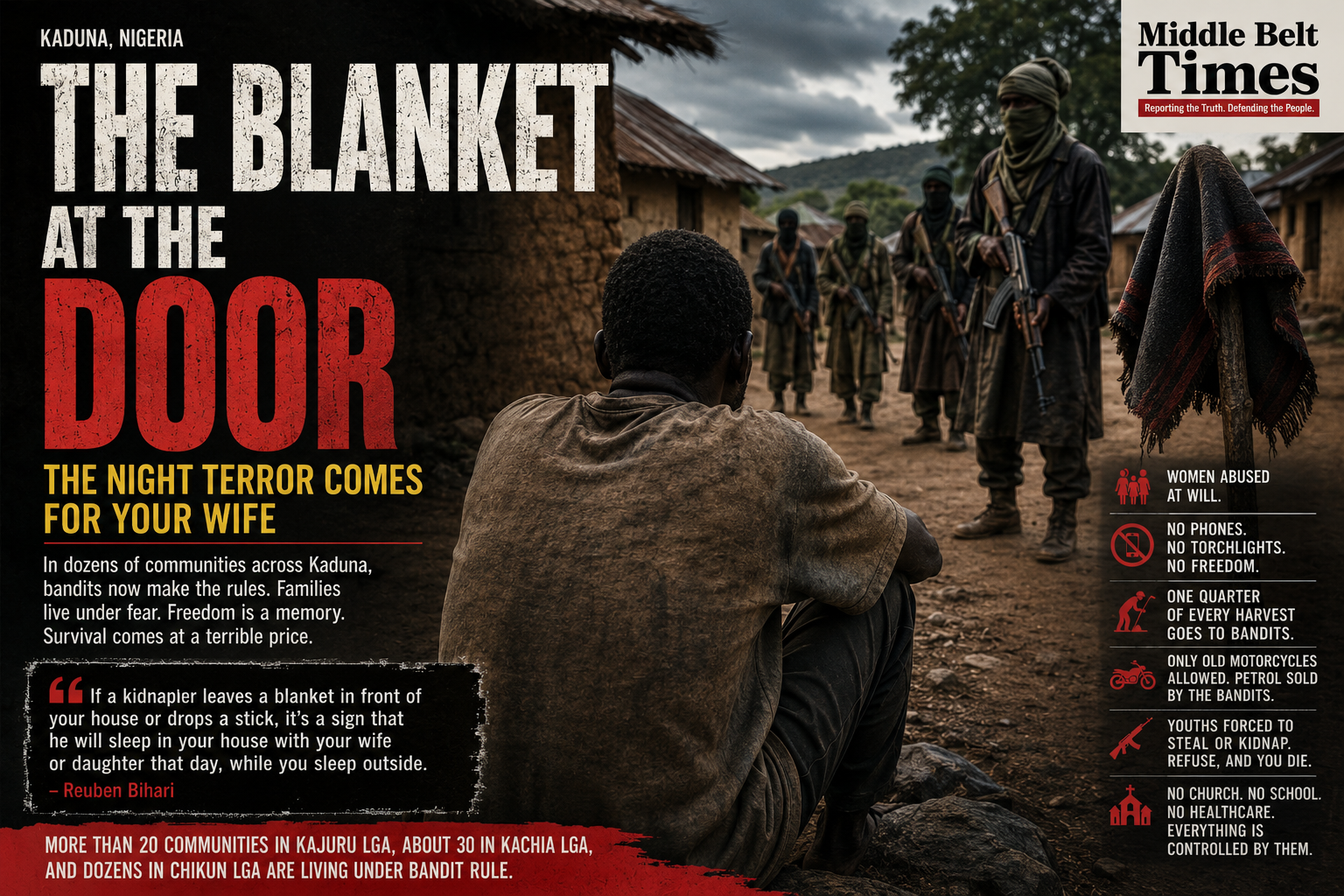

“The Blanket at the Door”: Inside Southern Kaduna Villages Where Bandits Have Become the Government
By Steven Kefas for Middle Belt Times
Editor’s Note: This report contains descriptions of violence and sexual abuse that some readers may find distressing.
In a remote community in Kajuru Local Government Area of Kaduna State, a blanket left at the entrance of a house is not a harmless mistake. It is a terrifying message.
It means an armed terrorist has chosen that home for the night. The husband must sleep outside. The wife or sometimes a daughter will be sexually assaulted inside the house. The children are often forced to witness the ordeal in silence.
For one father of five, this has become the unbearable reality of life under the rule of heavily armed terrorists many believed to be of Fulani origin.
His identity and the name of his community are being withheld for security reasons.
The man recently escaped the community after spending an entire week secretly making his way out. What he recounted paints a chilling picture of villages where the Nigerian state has effectively disappeared and criminal gangs now determine every aspect of daily life.
Veteran journalist Reuben Buhari, who first documented the survivor’s account on his Facebook page, wrote:
“This is the back of someone who lives in a community that has entered into an agreement with Fulani kidnappers following repeated attacks. The community is now in its third year living alongside bandits.”
To protect the survivor, Bihari deliberately photographed only his back.
According to the survivor’s testimony, the so-called “agreement” was not voluntary. It was born out of repeated attacks and the absence of effective protection, leaving villagers with what they believed was a choice between death and submission.
But the price of survival has been devastating.
As Buhari reported:
“The man you see is married with 5 children, but his wife doesn’t belong to him since the agreement was entered into. The kidnappers sleep with her whenever they feel the urge, sometimes while the children watch. If he protests, he will be shot. The same thing happened to all the women in the village. If a kidnapper leaves a blanket in front of your house or drops a stick, it’s a sign that he will sleep in your house with your wife or daughter that day, while you sleep outside.”
The alleged abuses extend far beyond sexual violence.
According to the account, villagers live under a rigid system of rules imposed by the armed groups. They cannot leave without permission. Anyone caught attempting to flee risks execution. Carrying a travelling bag invites suspicion and searches.
Farmers are permitted to cultivate their land, but a quarter of every harvest reportedly belongs to the terrorists.
Ownership of everyday items is also tightly controlled.
“They aren’t allowed to own a phone,” Buhari wrote. “If you are caught, you will be shot.”
The same restrictions reportedly apply to torchlights, new motorcycles and even new clothes. Any valuable possession can simply be taken by the armed men.
“They aren’t allowed to own a machete; only hoes and diggers are permitted for farming,” Buhari added.
The restrictions also isolate the communities from the outside world.
According to the survivor, men are generally forbidden from visiting neighbouring communities that have not entered into similar arrangements with the terrorists. When goods must be purchased from outside, women are sent instead. If they fail to return, the consequences are fatal for those left behind.
“If the wives don’t return, the husbands and children will be shot,” Buhari quoted the survivor as saying.
Young men face another grim reality.
Rather than merely living under occupation, they are allegedly forced to participate in criminal operations.
“Youths in the community are forced to accompany the bandits to steal or kidnap,” Buhari wrote. “They are forced to ride the motorcycle while the bandits sit behind with guns. If you refuse to go, you are shot.”
The effect, according to the testimony, is that entire communities have become captives, unable to resist, unable to flee, and increasingly trapped within a system of coercion.
Religious life has also been severely disrupted.
“They can’t hold any church service on Sunday unless the bandits are not around,” Buhari reported.
Essential public services have likewise collapsed.
Schools no longer function because teachers have fled. Primary Healthcare Centres have reportedly been abandoned, leaving residents without access to education or basic medical care.
Fear itself has become a weapon.
According to the survivor, the armed groups occasionally execute members of the community simply to reinforce obedience and demonstrate the consequences of resistance.
Reflecting on the testimony, Buhari concluded:
“Everything is controlled by the kidnappers. Sometimes they pick people from the community and shoot them to show what will happen to anyone who disobeys them.”
The veteran journalist stressed that what he published represented only a fraction of the survivor’s account.
“This is just a summary of the chilling things this man said,” he wrote.
Perhaps most alarming is his claim that the problem extends far beyond a single village.
“There are more than 20 communities in Kajuru LGA, about 30 in Kachia LGA, and dozens in Chikun LGA that have entered into such agreements with these kidnappers and are living under harsh conditions. Though the conditions vary, but most have no freedom at all.”
Middle Belt Times has in recent time independently verified similar allegations as the ones contained in the survivor’s testimony. It is also worthy of note that repeated attacks, kidnappings and mass displacement have been documented across parts of Kajuru, Kachia and Chikun Local Government Areas over several years by Nigerian authorities, civil society organisations and media reports. The January 18, 2026 abduction of 177 worshippers from three Churches during Sunday service in Kurmin Wali village in Kajuru local government area is one of such attacks.
This survivor’s account reflects conditions in some of these communities. It also raises urgent questions about the humanitarian situation facing thousands of rural residents who may be living under the effective control of armed criminal groups.
Behind every statistic is a family like his, a father forced to surrender his dignity to stay alive, a mother robbed of her bodily autonomy, children growing up surrounded by violence, and communities cut off from the protection and freedoms guaranteed under the Nigerian Constitution.
For this unnamed father, escape was possible only after days of careful planning.
Many others, according to his testimony, remain behind, waiting for the next blanket to appear at their door.