WIKIPEDIA: JUKUN WAPAN LANGUAGE TO GET ITS OWN EDITION 

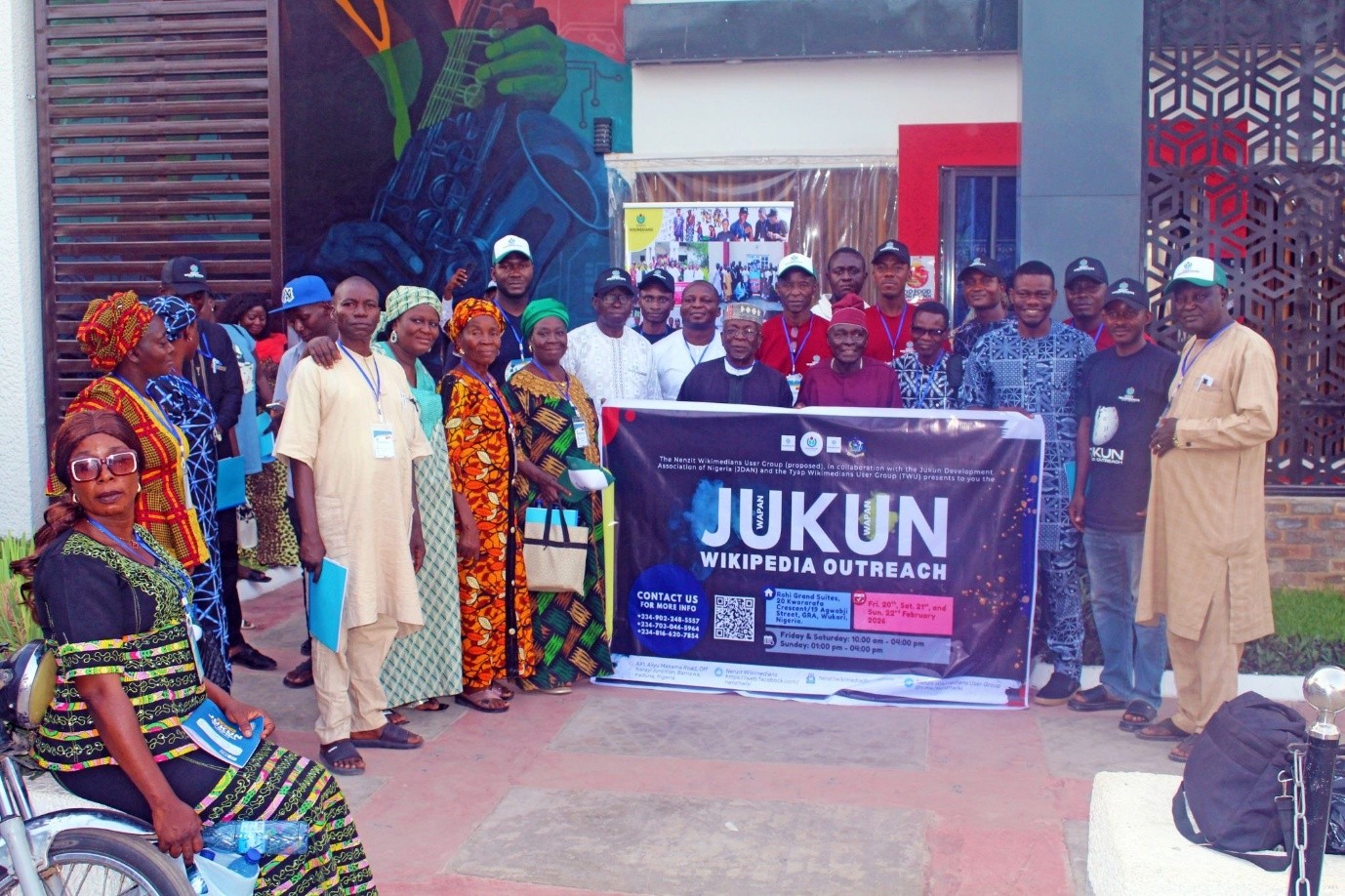
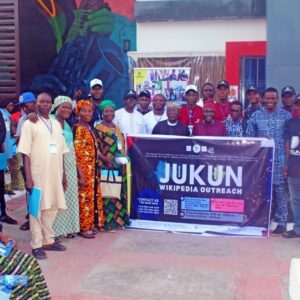
Not less than 50 Jukun Wapan speakers gathered on Friday, 20th February 2026, as the news of the Nenzit Wikimedians team coming to help start the Jukun Wapan Wikipedia was heard, to participate in the Jukun Wikipedia Outreach. The Wikimedia team, consisting of members of the Tyap Wikimedians User Group from Tyap-speaking background (Kambai Akau and Kuyet Friday Musa) and Jju-speaking background (Joshua Jacob Nzamah and Abukam Peter Adamu) on arrival, headed to see the Aku Uka of Wukari in his palace, to brief him of the reason for their visitation. The Aku Uka was very delighted and gave the team his blessings. The Wikimedia team was accompanied to the Aku Uka’s palace by members of the Jukun Wapan bible translation team, led by the coordinator, a retired clergyman and village head of Byepyi, Atando James Kinda Agbu, and another member of the team, Amos Jonathan Ajotsatutu, who made sure that the Wikimedia team was well taken care of. After the visit to the Aku Uka, the team headed back to meet the venue at Rohi Grand Suites, 20 Kwararafa Crescent/19 Agwabji Street, GRA, Wukari, where they began the first of the three-day session with the aspiring editors.

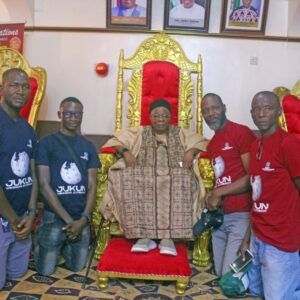
Image: L-R: Friday Kuyet Musa, Kambai Akau, Aku Uka of Wukari (Dr. Ishaku Adda Ali, Matakitswen I), Joshua Jacob Nzamah, and Abukam Peter Adamu. (File:Nenzit Wikimedians and the Aku Uka, Matakhitswen 02.jpg. (2026, March 17). Wikimedia Commons.

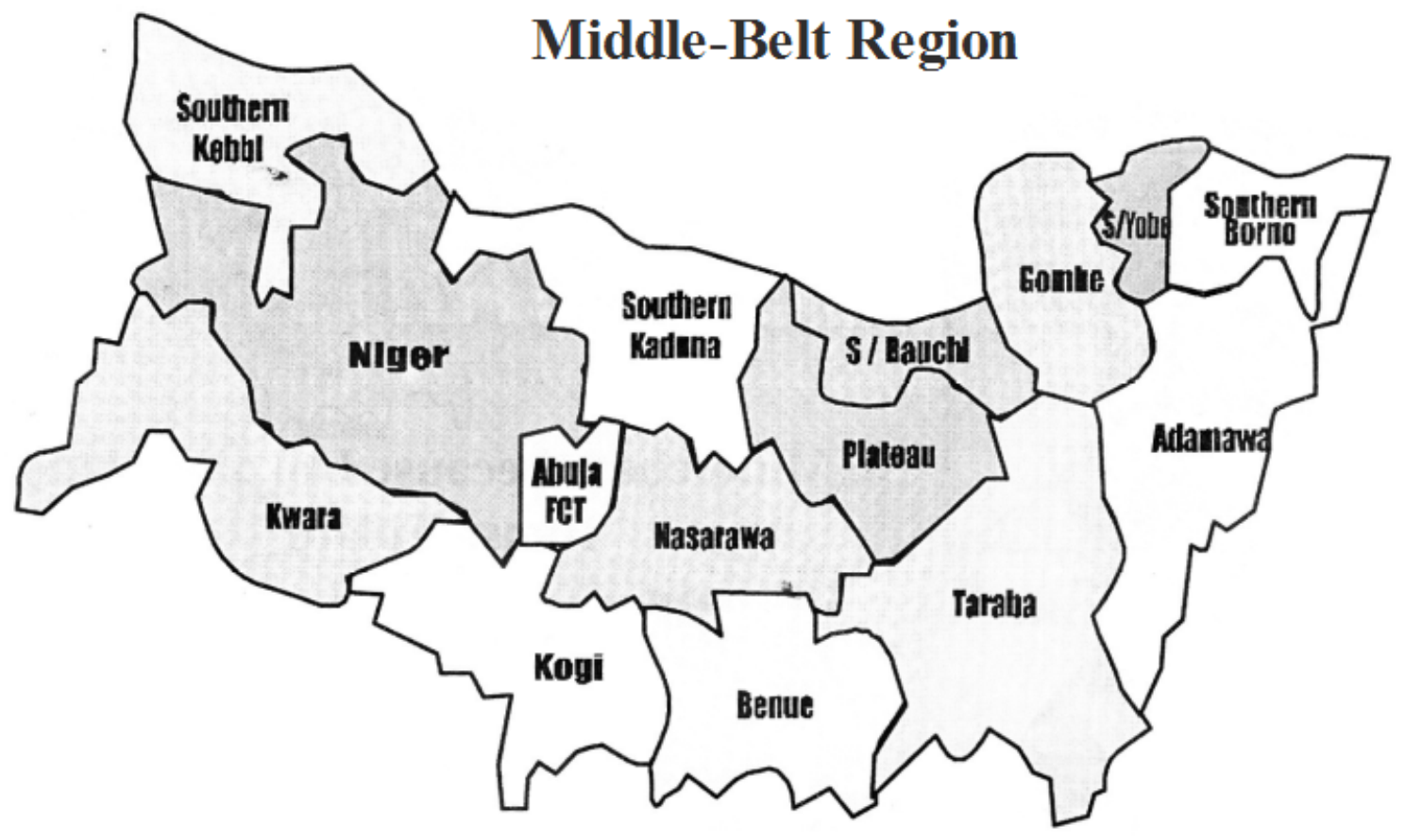
The Jukun Wapan language, one of the about 17 Jukunoid languages in existence today, will be the first of them to have a Wikipedia edition in Taraba State, and maybe one of the few languages in the Middle Belt after the Tyap, Igala, Nupe, Jju, and Karekare Wikipedia editions. There are currently language editions like Bole, Berom, and Hyam Wikipedia editions being developed in the Wikimedia Incubator, and Jukun Wapan just got added to the list.

In 2022, the Tyap language, spoken in Southern Kaduna and Plateau States became the very first language in the Middle Belt to get its own Wikipedia. The Tyap Wikimedians User Group became an approved affiliate of Wikimedia Foundation Inc. (WMF), later in the same year, and the Tyap Wikimedians Organisation registered with the CAC in January 2023. Kambai Akau (Levi Kambai Timothy) leads the activities of the group and is supported by Kuyet Friday Musa and other community volunteer staff. Nenzit Wikimedians is a tag for all editors of Central Nigerian (Nenzit or Platoid) languages, consisting of the likes of Tyap, Jju, Berom, Hyam, Jukun, Tarok, Tsuvadi, and many more belonging to the Plateau, Kainji, and Jukunoid subbranches.

The Nigerian Middle Belt boasts of over 200 languages, but most of them are underdeveloped and endangered. The bigger languages spoken in Nigeria, namely: Hausa, Igbo, and Yoruba, including English and Nigerian Pidgin languages, are dominant. These languages tend to have more attention from the Nigerian government at the expense of the minoritized languages. Through the support from the WMF, the Nenzit Wikimedians hope to change that narrative, and document, preserve, and promote the wealth of the cultures of the Middle Belt for posterity’s sake and to instill the needed confidence for the natives of these languages to continue speaking their languages and developing their identity, especially the youths.

Image: Participants on the second day of events (File:Attendees during the Jukun Wikipedia Outreach 02.jpg. (2026, March 17). Wikimedia Commons. 

The Jukun Wikipedia Outreach was a success. It lasted from Friday, 20th to Sunday, 22nd February, 2026, with Kambai taking most of the workshop sessions, supported by Kuyet and Joshua. Prior to the program’s kick-off, many participants followed the guidelines on the Event:Jukun Wikipedia Outreach page on Meta-Wiki to create their user accounts. In the program, they learned about the Wikimedia sister projects and were shown how to navigate and create their first articles and edit them in the Wikimedia Incubator, where new Wikimedia language editions are developed before being launched publicly. At the end of the event, not less than 140 articles were created by the participants, among which was one of the sons of Dr. Shekarau Angyu Masa-Ibi (Kuvyon II), the previous Aku Uka of Wukari, Prince Ajifada Shekarau, who was an event co-organizer alongside Amos Jonathan Ajotsatutu, Peter Agan, and Sike-Uwbu Daude Gbana. Many writers and scholars of Jukun Wapan extraction were present, and books written in Jukun Wapan were donated to the Nenzit Wikimedians, and others were purchased. The Nenzit Wikimedians were fed with huge wraps of pounded and fish from the Benue River, experiencing the Jukun hospitality at its utmost!

Day 3’s group picture (File:A group photograph on the Day 3 of the Jukun Wikipedia Outreach 2026.jpg. (2026, March 17). Wikimedia Commons.

The top editors in the outreach program were gifted with souvenirs on the last day of the event, with Joseph Atebo N. Afyenakun, Yavini Ladi, and Jibo Paul Aten-wunu topping the first three highest editor ranks. Others were also encouraged to keep editing even after the event, to enable the project to move out of the Wikimedia Incubator within the next couple of months.

The Nenzit Wikimedia team travelled all the way from Kaduna and Zonkwa to attend the program in Wukari, and had to cross the Benue River at Ibi, where the a bridge is yet to be constructed, for the sake of bringing more underrepresented languages in the Middle Belt into lamplight because they take it s a responsibility which they owe the next generations unborn, for the preservation of the identity of the peoples of the region through online open source documentation on Wikimedia sister projects like Wikipedia, Wikidata, and Wikimedia Commons.

The group seeks the partnership of non-governmental organizations working along the same terrain to boost synergy and increase the momentum needed to preserve and enhance the linguistic identity of the underrepresented in the Middle Belt.


WHY ARE THEY SO SCARED AT THE MENTION OF MIDDLE BELT?


By Col Gora Albehu Dauda Rtd
13 December 2025


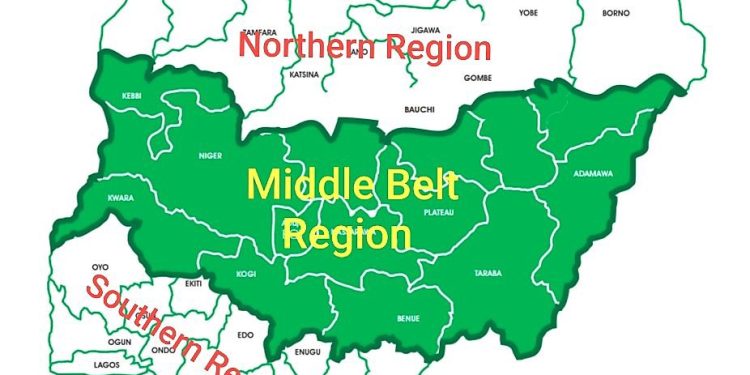
They are feigning ignorance about the Middle Belt geographical space of Nigeria. Of course they know the Middle Belt, their pretences not withstanding. If they do not know where the Middle Belt is, then why are they always in a state of palpable fear at the very mention of the Middle Belt. One thing is very clear, the Middle Belt of Nigeria has existed in time and space and they know this to be true. The pretences aside, and their contrived blindness aside, WE shall help them register the Middle Belt of Nigeria in their brains.

The Social media space in the North of Nigeria has had to accommodate huge volume in of traffic on the subject matter of the Middle Belt. What is responsible for this state of affairs? The reason(s) cannot be too far fetched as it has to do with the potential unraveling of the old North into its component parts that were compelled into an unequal union by the Fulani settlers who the British colonialists helped to take over many of our lands. How can they now say they do not know where the Middle Belt is? Do they not understand that what was then called the Northern Region was more than 60 percent of Middle Belt territory?

How could they have forgotten so soon in the day about a Tiv man and one of the fighters for Nigeria’s independence Joseph S Tarka and whose main preocupation was to secure the independence of the geographical Middle Belt on the platform of the United Middle Belt Congress? Have they also forgotten that the Fulani settler political party NPC fought with all its might and strengthened by British colonial interest made sure that the agitation by JS Tarka for the creation politically of a Middle Belt was defeated?

They may have forgotten that there is a subject called History. We remind them that History lives. Surely they will remember the Tiv riots or have they forgotten that too? If they remember, they will do well to also remember the reasons and or background to the riots. If they are able to recall the History very well, then they cannot but remember that the Middle Belt which they are now conveniently denying is alive and well. Ordinarily, responding to their denial would not have been necessary but because the records have to be updated and preserved, it became imperative to tell them to their faces that the Middle Belt is here to stay.

Through time, it was convenient for them to harvest our numbers as Middle Belters during all of the many fraudulent head counts of the past to find the strength they needed but only to disregard the very fact that the Middle Belt was deserving of the goodies and wealth the Northern Region of that time produced. They promoted their faith whilst also preventing the spread of other faiths, particularly the Christian faith. They have deployed all the means at their disposal to not only undermine or hinder the spread of Christian values, they have sought to acknowledge that there are Christian in the behemoth North.

Not surprising at all, because they have conveniently forgotten that it was largely Middle Belters who answered Gen Gowon’s wartime call “To keep Nigeria One is a Task that Must be Done” of the Nigeria Civil War years. Sadly after the victory, elements from the feudal regime pulled the carpets from under the feet of those who won the victory and now, they cannot tell on the map of Nigetia where the Middle Belt is located. They can continue living in denial for all we care but the reality of the Middle Belt will come upon them much like a thief in the dead of night.

The truth remains that their elite know for a fact the place as well as relevance of the Middle Belt in the Nigerian equation and by extension that of Nigeria as a country . Those ranting the denial of the Middle Belt are inconsequential and blind as bats but the scales will soon be falling from their unclean eyes. Because of the dictum that “Impossible is Nothing”, I thought that they should have been redying themselves for the reality that will in due time dawn on them. Some of the reasons they are so scared of what is to come to pass shortly includes the loss of votes, lands, cheap revenues they have been enjoying to sponsor terrorists, bandits as well as jihadists. Put in another way, they will no longer have others doing their dirty jobs. They are better adviced to face up to the imminent changes on the way. To God Be The Glory

The Cost of Silence: How Apathy Deepens the Middle Belt Crisis

By Ankeli Daniel

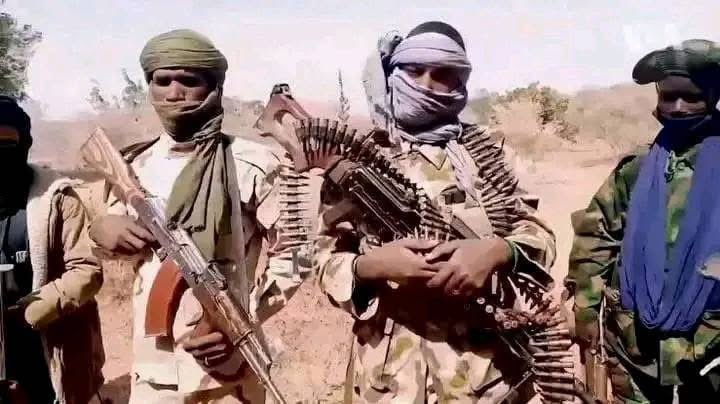
For years, the Middle Belt has been crying out for help, sometimes in quiet pleas, sometimes in desperate screams. Whole communities have been destroyed by waves of terror and displacement, yet the silence that follows often feels even heavier than the violence itself.
This silence from citizens, leaders, and the global community is not an absence of sound. It is a decision, and that decision carries consequences.

The Sound of Neglect

In a country that never stops moving, tragedies easily fade into background noise. One day it is villages burned in Benue, the next it is kidnappings in Kogi or fresh attacks in Southern Kaduna. The headlines shift quickly, but the survivors do not get to move on.

Behind every “breaking news” alert are people who may never return home, families trapped in makeshift camps, and children who learn the meaning of loss long before they learn the meaning of hope.

The scale of this crisis is undeniable. According to Amnesty International, over 10,217 people were killed in armed attacks across several Nigerian states in just two years, with Benue State alone accounting for 6,896 deaths. UNHCR estimates that Nigeria now has roughly 3.5 million displaced or stateless people, about 600,000 of them from Middle Belt communities.

Still, the silence continues in offices, churches, and conversations. We scroll past these tragedies, waiting for someone else to care first. But silence always takes a side. It stands with power, not the powerless, with comfort
instead of conscience.

When Silence Becomes Complicity

When we stop asking where security funds disappear to, when we look past displaced families struggling to live with dignity, and when we downplay acts of terror by calling them “skirmishes”, we are not just ignoring the problem, we are helping it grow.

Injustice doesn’t survive because evil is powerful; it survives because good people stay quiet.

The Internal Displacement Monitoring Centre reported 291,000 new conflict-related displacements in 2023, pushing Nigeria’s total to 3.4 million internally displaced people. Each displacement left unresolved, each attack left unpunished, becomes soil for impunity to grow. The suffering of the Middle Belt is not inevitable. It is the result of what we have tolerated for decades.

Apathy in High Places

It is not only ordinary citizens who stay silent. Many in positions of power, with the means to make real change, have chosen indifference over action.

Governments at both the federal and state levels often respond with words of sympathy but show little accountability. Security funds disappear without explanation, while communities remain unprotected. Relief materials arrive too late or not at all.

Every broken promise leaves another scar, and every ignored report erases another piece of truth.
Yet, the apathy of those in power is fueled by the apathy of the people. When we stop demanding better, they stop delivering.

Breaking the Silence

There is strength in our collective voice. Each time people speak out, ask the hard questions, or tell the story of someone who has survived, the walls of silence begin to break.

This, is why Middle Belt Concern (MBC) exists; to amplify those voices, to remind Nigeria and the world that silence has a cost too heavy to bear.

We stand for a region that refuses to be forgotten, for survivors who deserve justice, and for accountability that rebuilds trust in those who lead.

Speaking up means choosing courage instead of comfort, truth instead of silence, and life instead of loss.

What We Can Do

Breaking the silence is more than just speaking; it’s about taking action.
Share verified stories from the Middle Belt, because every repost helps fight misinformation.
Ask your leaders the hard questions. Demand transparency about how security funds are used.

Support local efforts that provide relief, education, and advocacy for displaced families and communities.
Organize or join dialogues and discussions that keep these conversations alive.
Every voice raised brings us closer to justice, and every action taken helps a survivor take one step closer to healing.

Hope in the Noise

Silence may have allowed this crisis to grow, but purposeful, persistent, and united voices can help bring it to an end.
The story of the Middle Belt is not one of defeat, but of strength and defiance. Its people have endured unimaginable pain and are still standing. What they need now are allies who will speak when it is easier to stay quiet.
In the end, history does not honor those who chose comfort; it remembers those who chose courage.
So, speak up.
Share the truth.
Stand with the Middle Belt until silence is no longer an option.

Daniel Ankeli is a photographer, media professional, and human rights advocate who documents insecurity, displacement, and community resilience across the Middle Belt. He is a member of Middle Belt Concern and writes from Jos, Plateau State.