Kaduna Survivors Unite: Coalition Demands Justice for Victims of El-Rufai Era Abuses

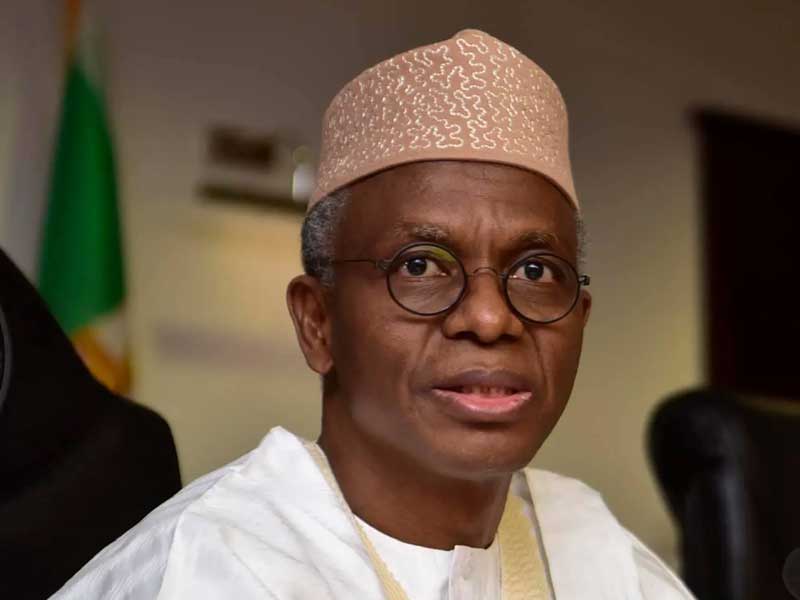
A powerful coalition of survivors, victims’ families, and civil society groups has emerged to demand full accountability for alleged human rights violations during the eight-year governorship of Nasir el-Rufai in Kaduna State, vowing “no more impunity, no more silence.”

The Kaduna Victims’ Coalition, comprising community leaders, traditional rulers, academics, lawyers, journalists, and other professionals, issued a press statement on Monday calling for thorough investigations and prosecutions of alleged crimes committed between 2015 and 2023.

At the heart of their demands are high-profile cases that have come to symbolize what the coalition describes as an era of unchecked impunity. Among them is the October 2018 abduction and brutal murder of HRH Dr. Maiwada Raphael Galadima, the Agwam Adara (paramount ruler of the Adara Chiefdom), who was killed despite a ransom payment. The coalition notes that suspects arrested for his murder have yet to be successfully prosecuted, and their whereabouts remain unknown.

Equally prominent is the case of Abubakar Idris, popularly known as Dadiyata, a lecturer at Federal University Dutsenma and social media commentator who was abducted from his Barnawa residence in Kaduna on August 2, 2019. Nearly seven years later, his whereabouts remain unknown. August 2026 will mark the seventh anniversary of his disappearance, triggering a statutory presumption of death under Nigerian law.

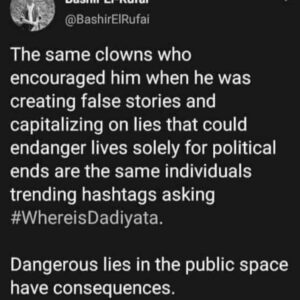
The coalition highlighted a controversial tweet posted by Bashir el-Rufai, son of the then-Governor, on December 23, 2019, shortly after Dadiyata’s abduction, which was “widely perceived as gloating over the incident and dismissing calls for his safe return.”

“We speak today as representatives of countless individuals, families, and communities who endured eight years of profound hardship, terror, fear, and loss,” the coalition stated. “These acts bypassed constitutional safeguards and Nigerian law, turning gubernatorial immunity into unchecked impunity.”

The coalition accused the former governor of presiding over “a pattern of indiscriminate actions: arbitrary abductions, persecution of critics, reprisal violence, unlawful demolitions of homes, mass dismissals of workers without due process, forced sackings by employers of perceived opponents, and the displacement of citizens into exile.”

Expressing concern over recent attempts to “reframe this history, portraying Nasir el-Rufai as a champion of due process and human rights,” the coalition insisted that survivors and families continue to seek truth and justice.

“On behalf of ourselves, and in solemn memory of those killed or disappeared who cannot speak, we have a moral and civic duty to bear witness,” the statement read. “Our sole demand is accountability under the rule of law: thorough, independent investigations; prosecutions where evidence warrants; and closure for traumatized victims and families.”

The coalition pledged full cooperation with law enforcement agencies, judicial bodies, and human rights institutions, offering to provide testimonies, evidence, and material assistance to support inquiries.

The statement was accompanied by hashtags #JusticeToElrufai, #JusticeForKadunaVictims, #WhereIsDadiyata, and #AccountabilityNow.

The statement was signed by the following individuals and organizations on behalf of the coalition:

1. Chidi Anselm Odinkalu
2. Audu Maikori, Esq
3. Gloria Ballason, Esq
4. Steven Kefas
5. Luka Binniyat
6. Midat Joseph
7. Segun Onibiyo
8. House of Justice
9. Community Development & Rights Advocacy Foundation
10. Resilient Aid and Dialogue Initiative
11. Southern Kaduna Indigenous Progressive Forum (SKIPFo)
12. Atrocities Watch Africa (AWA)

The coalition’s emergence represents a significant moment in the quest for accountability in Kaduna State, as victims and their families publicly break their silence on alleged abuses that have long remained unaddressed.

ONLY THE FULANI JIHADIST–IMPERIAL AGENDA FEARS A UNITED MIDDLE BELT


Barr. John Apollos Maton
9th February 2026


A REBUTTAL TO A SAD JOKE MASQUERADING AS POLITICAL ANALYSIS

I don’t know who the recent Fulani stooge Cham Faliya Sharon is, but his/her writeup “IS THE CONFUSION OF THE MIDDLE BELT COMING FULL CIRCLE TO BITE THE MIDDLE BELT” is such a ridiculous piece I was ashamed for the writer when it opened with a quote from Thomas Paine. I mean, it takes a special pompous type of clown to not only go through writing this but even have it reshared on public platforms by the Fulani Immigrants Nigeria should be sending packing.

The joke of an article under review is not analysis but performance—an exercise in ideological ventriloquism by a writer who mistakes obedience for insight. It reads like a brief written to order, not a position arrived at through honest inquiry. Like Judas Iscariot, the author appears to have concluded that selling one’s intellectual integrity for proximity to power is a rational transaction. History, however, records such bargains not as cleverness but as cowardice.

We are told, with great theatrical confidence, that the Middle Belt is a confusion: a geographical impossibility, a political contradiction, a manufactured identity sustained by ignorance and manipulation. Yet what is truly confused is an argument that elevates imposed constitutions to divine scripture while dismissing lived history as irrelevant; that treats maps as sacred while treating people as disposable; and that assumes identity must first be approved by dominant blocs before it can exist. This is not reason—it is authoritarian logic wrapped in the language of common sense.

Let us nonetheless grant the author every imaginable concession. Let us ignore, for the moment, the extensive scholarly work of Dr. Bitrus Pogo and numerous historians, sociologists, and political scientists who have rigorously documented the Middle Belt as a historical and political reality. Let us assume—without conceding—that they are wrong. Let us even accept the childish claim that because the phrase “Middle Belt” does not appear verbatim in the 1999 Constitution, the identity itself must therefore be fraudulent. Even under these generous assumptions, the argument collapses completely.

For even if the Middle Belt were nothing more than a political consciousness emerging from shared experiences of marginalization, violence, and exclusion, that alone would make it real. Peoples are not born fully mapped and notarized; they are forged through history, memory, and struggle. And it is precisely this process—now ripening into collective clarity—that terrifies the imperial imagination animating the essay.


FREEDOM OF ASSOCIATION AND SELF-DETERMINATION ARE NOT GIFTS FROM ANY HEGEMON

At the most elementary level, the argument fails because it assumes identity is something granted rather than asserted. Under Nigeria’s own Constitution, this assumption is indefensible. Section 40 of the 1999 Constitution explicitly guarantees every citizen the right to assemble freely and associate with others for the protection of their interests. Section 39 guarantees freedom of expression, including the right to receive and impart ideas. These provisions are not decorative—they are foundational.

Beyond domestic law, Nigeria is a signatory to binding international instruments that go even further. Article 20 of the African Charter on Human and Peoples’ Rights affirms the unequivocal right of all peoples to self-determination and to freely pursue their political, economic, and social development. Article 22 reinforces this by recognizing the collective right to development. These are not abstract ideals; they are enforceable norms incorporated into Nigerian law by domestication of the Charter.

At the global level, the principle is even clearer. Common Article 1 of both the International Covenant on Civil and Political Rights (ICCPR) and the International Covenant on Economic, Social and Cultural Rights (ICESCR) states plainly that all peoples have the right to self-determination and to freely determine their political status. Nowhere in international law is there a requirement that a people must first satisfy the cartographic preferences of their detractors before asserting this right.

The demand that the Middle Belt must “draw a perfect map” before it may exist is therefore not legal reasoning; it is imperial obstruction. Colonial borders across Africa were drawn arbitrarily, yet no one questions their legitimacy on the grounds of incoherence. To suddenly demand mathematical neatness only when marginalized peoples organize themselves is not intellectual rigor—it is selective skepticism deployed as a weapon.


THE MIDDLE BELT POSSESSES ANCESTRAL LAND, HISTORY, AND MEMORY—IT IS NOT A FICTION

While totally excusing the Fulani Immigrants who have made the lives of true natives and real Indigenes of Nigeria a living hell, one of the most dishonest maneuvers in the essay is its deliberate avoidance of ancestry. We are invited to obsess over lines on a map while ignoring the more uncomfortable question of who has lived where, for how long, and under what conditions. The communities commonly described as Middle Belt peoples are not recent arrivals, nor are they abstract categories invented in conference halls. They are indigenous populations rooted in specific territories long before colonial intrusion.

Unlike the Fulani Immigrants who don’t belong in Nigeria, these communities possess traceable genealogies, distinct languages, religious traditions, and systems of governance that predate both British colonial rule and the later Nigerian state. Historical records—from colonial archives to oral histories—document repeated episodes of subjugation, forced incorporation, and indirect rule imposed upon them. To pretend that these histories dissolve simply because a constitution failed to name them explicitly is not ignorance; it is historical vandalism.

International law has long rejected the notion that identity disappears because it is inconvenient to power. The United Nations’ recognition of indigenous peoples worldwide—culminating in the UN Declaration on the Rights of Indigenous Peoples in 2007—affirmed that historical continuity with pre-colonial societies is a valid basis for collective rights, regardless of later political rearrangements. Identity survives conquest; memory survives subjugation.

What unsettles the Fulani and their stooge — the essay’s author is that this memory is now politically articulate. The Middle Belt is not asking to be invented; it is insisting on being recognized on its own terms, not as an appendix to someone else’s empire. And once ancestry and land are acknowledged, violence can no longer be dismissed as “misunderstanding,” nor dispossession reframed as inevitability.


POLITICAL DIVERSITY DOES NOT NEGATE COLLECTIVE EXISTENCE

Perhaps the most intellectually hollow claim advanced is that internal political diversity invalidates Middle Belt identity. By this logic, Nigeria itself—fractured by ethnic, religious, and ideological divisions—should not exist. The argument collapses the moment it is applied consistently.

Political disagreement is not evidence of non-existence; it is evidence of political life. Only caricatures are uniform. Real peoples debate leadership, disagree on strategy, and pursue competing interests while still recognizing shared historical experiences and structural threats. To demand absolute unanimity as the price of recognition is to demand silence, not coherence.
International practice confirms this reality. From Catalonia to Kurdistan, from Quebec to Scotland, political plurality has never been treated as proof that a people does not exist. On the contrary, it is often cited as evidence of democratic maturity. The insistence that the Middle Belt must be perfectly homogeneous before it can claim identity is therefore not a standard—it is a pretext.

What truly disturbs the essay’s author is not contradiction but consolidation. As long as Middle Belt communities were forced to negotiate individually, they could be managed and ignored. A shared political vocabulary changes that balance. Patterns can be named, responsibilities assigned, and demands articulated collectively. That shift, not geography, is the real provocation.


IDENTITY ERASURE AS A CLASSIC IMPERIAL STRATEGY

The structure of the essay follows a script as old as the attempted Immigrant Fulani empire in Nigeria itself. First, deny that the people exist. Next, ridicule their attempts at self-definition. Then, frame their resistance as manipulation by outsiders. Finally, present continued domination as common sense and stability. This pattern has been documented across colonial history, from the Americas to Africa to Asia.

International law evolved precisely to dismantle this logic. The post-World War II order—reflected in the UN Charter’s emphasis on self-determination—was a direct response to the catastrophic consequences of identity denial and imperial domination. The decolonization movements of the twentieth century did not succeed because empires suddenly became benevolent; they succeeded because peoples insisted on naming themselves.

By portraying Middle Belt consciousness as a southern plot or a geographical error, the essay avoids confronting the structural realities of exclusion and violence. Identity erasure here is not accidental; it is instrumental. If a people do not exist, then nothing done to them can be legally or morally framed as injustice.
What the Fulani and author fears, ultimately, is accountability. A people who know who they are can trace how they arrived at their present condition. They can distinguish accident from policy, conflict from campaign. Once that distinction is made, the old excuses collapse, and the Immigrants who have long overstayed their welcome will be evicted.


CONCLUSION: MIDDLE BELT UNITY IS THE THREAT TO FULANI IMPERIALISM, NOT CONFUSION

Strip away the sarcasm, selective geography, and performative concern, and one truth remains unmistakable: a united Middle Belt disrupts long-standing arrangements of Fulani immigrant domination. It replaces silence with memory and fragmentation with demand for what we as a native people are due. It transforms suffering and genocide under the Fulani Islamic Terrorist Jihadists agenda into political clarity, self determination and intolerance for foreign terrorist influence.

The Middle Belt does not require validation from those Fulani invested in its marginalization and destruction. It does not need permission to associate, to name itself, or to pursue its collective interests. Even the fake Nigerian constitutional law made to further Fulani agenda in Nigeria protects this right. African human-rights law affirms it. International law enshrines it.

The joke of an article I was sent and repeatedly asked to consider is therefore not a warning to the Middle Belt but a confession from Fulani and their stooges. It reveals anxiety, not authority—fear, not confidence.

Like with the Fualni’s who through the Genocide of Christians and Indigenes of Nigeria hope to continue the Fodio Caliphate agenda, empires are never threatened by confusion. They are threatened by clarity.

And clarity is precisely what is emerging.

THE MIDDLE BELT QUESTION: HISTORY, POWER, AND THE CURRENT REALITY


By: Dr. Pogu Bitrus


It has become imperative to respond decisively to a mischievous and intellectually dishonest article circulating under the headline “The Manufactured Middle Belt: The Untold History, Foreign Backing and the Agenda to Fracture Northern Nigeria,” authored under the pseudonym Safyan Umar Yahaya. Far from being a work of history and of social concern, the piece is an alarmist pamphlet—animated by fear and bigotry not facts, all aimed at delegitimizing the rising social and political

consciousness of the Middle Belt.


The anxiety beneath the essay is unmistakable. For over a century, certain ruling blocs have exploited the Middle Belt economically, subordinated it politically, and tried to diminish it culturally. Today, as the people of the region reclaims its history, pride and asserts its unity, anger and blackmail is the response of the losers.


The central claim—that the Middle Belt is a recent political fabrication without historical roots—is not merely false; it is a deliberate distortion built on colonial convenience and selective amnesia.


WHAT THE MIDDLE BELT ACTUALLY IS


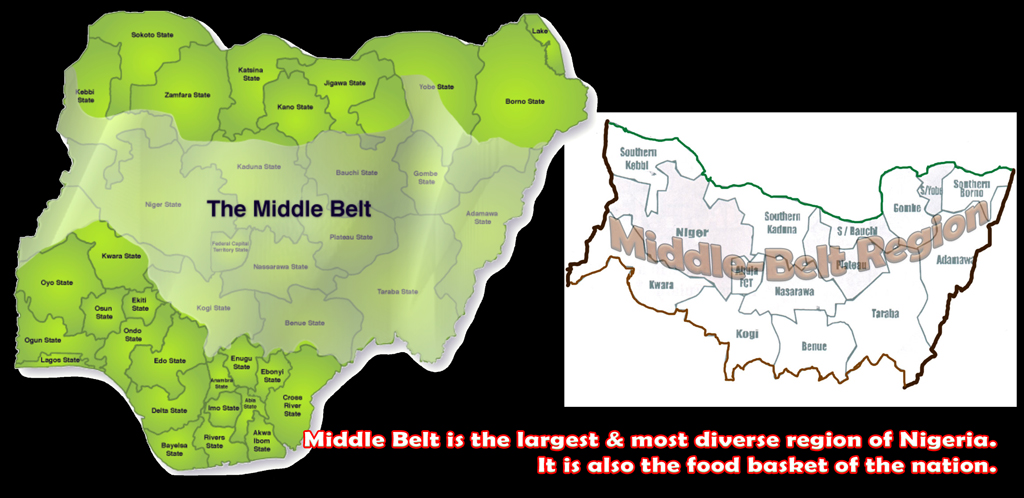
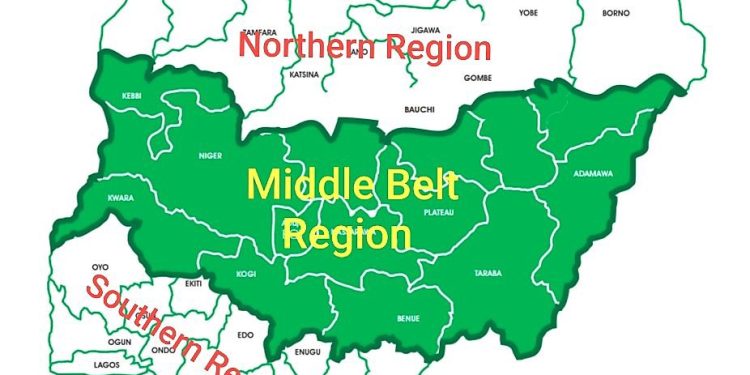
The Middle Belt refers to the vast geographical and cultural zone inhabited by indigenous ethnic nationalities of the former Northern Region—now spanning 19 Northern states and the Federal Capital Territory—who were never conquered or where never largely ruled by the Sokoto Caliphate or the Kanem-Borno Empire prior to British colonisation.

Put plainly: the Middle Belt consists of the autochthonous peoples of Northern Nigeria who are neither Hausa, Fulani, nor Kanuri, and who historically existed outside the authority of Islamic caliphates, notwithstanding some pockets of Emirate enclaves among it. This is not opinion; it is an established historical fact.


Long before colonial rule, the Middle Belt was home to sovereign empires, kingdoms, chiefdoms, and complex stateless societies whose political systems predated the 19th-century jihads by centuries. Among the most prominent was the Kwararafa Confederacy, centred in the Gongola – Benue Valley. Between the 18th and 19th centuries, Kwararafa repeatedly defeated and humiliated Hausa city-states such as Kano and Zaria and even challenged Kanem-Borno—long before Usman dan Fodio’s jihad of 1804.


Other well-documented polities include the Igala Kingdom, Jukun states, Nupe Kingdom, and countless Tiv, Idoma, Gbagyi, Birom, Angas, Lelna, Bwatye, Eggon, and Goemai societies among hundreds of others — each with distinct political traditions, land tenure systems, and military histories. They had a common solidarity hinged on wading off Islamisation and genocidal slave raids.


COLONIAL CONQUEST AND FORCED SUBORDINATION


The author inadvertently exposes his argument’s weakness when he ignores a crucial colonial reality: the British conquered the Muslim emirates with relative ease, largely by co-opting existing centralized hierarchies. In contrast, Middle Belt societies resisted British conquest fiercely.


British colonial records—by administrators such as Frederick Lugard and C.L. Temple—document prolonged military campaigns, punitive expeditions, and scorched-earth tactics used against Middle Belt communities from the early 1900s to the 1920s. This resistance is precisely why the British imposed Indirect Rule by force, subordinating Middle Belt peoples to Fulani and Kanuri emirs they had never known, accepted, or recognized.

That imposition,nnot foreign conspiracy, is the historical root of Middle Belt political consciousness.


THE COLONIAL FALLACY OF “NON-EXISTENCE”


The article’s reliance on colonial maps and constitutions to argue that the Middle Belt did not exist before the 1940s is intellectually indefensible. Colonial documents recognized what served imperial administration, not indigenous reality. By that logic, countless African nations and identities would vanish simply because Europeans failed—or refused—to acknowledge them.

Even then, the claim is factually weak. The term “Middle Belt” appears descriptively in colonial correspondence as early as the first decade of the 20th century, used by administrators and missionaries to describe the non-emirate central zone of Northern Nigeria. The British deliberately refused to create a Middle Belt Region, not because it lacked coherence, but because doing so would weaken the numerical and political dominance of the Hausa-Fulani-Kanuri oligarchy that sustained Indirect Rule.

The agitation for recognition therefore predates independence; it merely became organized in the 1950s.


THE UMBC AND THE MYTH OF FOREIGN MANIPULATION


The United Middle Belt Congress (UMBC) under Joseph Sarwuan Tarka did not invent the Middle Belt identity. It articulated long-standing grievances: land dispossession, political exclusion, cultural suppression, force labour, and religious discrimination.

To dismiss the UMBC as a tool of missionaries or foreign interests is not only false but insulting. Middle Belt people and leaders were among the most educated and politically sophisticated Nigerians of their generation, many trained in Britain and elite Nigerian institutions well before independence. They required no NGO or missionary to understand injustice they lived daily.


The historical record—petitions against Native Authority abuses, resistance to emirate taxation, land struggles, and demands for self-rule—is open to anyone willing to read honestly.


THE CONTEMPORARY MOMENT


Today’s Middle Belt movement is neither separatist nor violent. It is a demand for recognition, equity, and freedom from an imposed Arewa identity that neither reflects its history nor aligns with its values. The Middle Belt does not deny the existence of Northern Nigeria; it rejects the falsehood that Northern Nigeria is synonymous with the Middle Belt.

What has long been marketed as “Northern unity” has, in truth, been a forced political marriage, sustained by coercion rather than consent.

Increasingly, the Middle Belt is stating what history has always known: this union was never voluntary!

If language must be blunt, then so be it—this relationship has often resembled political rape, and the survivors have finally found their voice.


2027 AND THE PANIC OF DECLINING HEGEMONY


The fear driving this revisionist essay is understandable. The once-boasted “monolithic Northern voting bloc” is fracturing. Demographics, political awareness, and historical truth are converging.

For the first time, Nigeria’s political establishment is confronting an uncomfortable reality: the Middle Belt is the decisive factor in national politics.


THE MIDDLE BELT, RELIGION, AND THE COLLAPSE OF OLD MYTHS


A recurring propaganda tactic is to label the Middle Belt a “Bible Belt,” as though its political awakening is a sectarian religious project. This claim is demonstrably false. The Middle Belt has always been religiously plural, home to Christians, Muslims, and adherents of African traditional religions for centuries. Even institutionally, the Middle Belt Forum (MBF) disproves this caricature: its Board of Trustees and National Working Committee include Muslims, reflecting the region’s inclusive ethos. While it is true that the Middle Belt today is predominantly Christian—largely due to historical resistance to jihadist conquest and the voluntary embrace of Christianity—majority faith does not translate into religious extremism. The Middle Belt struggle is not about imposing religion; it is about ending political subjugation, cultural erasure, and systemic inequality. Reducing this legitimate quest to sectarianism is not analysis but propaganda.


Demise of the Hausa/Fulani Amalgam.


Equally misleading is the continued use of the term “Hausa-Fulani” as though it remains a coherent political or cultural bloc. Increasingly, Hausa intellectuals and opinion leaders reject this forced amalgam, insisting that there is Hausa land and there is the Middle Belt, but no natural or “Arewa” identity. The very terms “Northern Nigeria” and “Arewa” now irritate many enlightened Hausa voices who recognize them as tools historically used to sustain Fulani political dominance and economic exploitation. Recent events have further exposed this fracture: widespread violence by Fulani bandits against Hausa rural communities has shattered the illusion of a shared destiny. For decades, the Hausa masses were mobilized as demographic instruments against Middle Belt minorities; today, they are confronting the reality that they too have borne the costs of an unjust hierarchy. What is unfolding is not a Middle Belt conspiracy, but the collapse of an artificial political fiction. History, not agitation, has caught up with it.


Dr: Pogu Bitrus is the President of the Middle Belt Forum (MBF) and hails from Chibok, Southern Borno.

EVALUATING THE HOUSE OF JUSTICE IMPACT AT IBA 


The Aircraft glided its descent into Toronto Pearson International Airport at 20:02hrs – twelve minutes behind the estimated arrival time. The temperature outside was 9°C , the sun had set. Gloria Mabeiam Ballason Esq, Founder and Chief Executive Officer of the House of Justice set foot on the Great White North for the 2025 International Bar Association Conference which held at the Metro Toronto Convention Centre.

For the House of Justice, the purpose was beyond attending a conference to keep up with global legal trends or networking; it was for a mission much nobler: consolidating the public’s access to justice and finding effective methods of accountability against mass atrocities. The starting point for the intervention is Nigeria, her home country where political operations frequently affect terror crimes victims’ access to justice.

Building it Better Through Magnitsky Proceedings.

For a society that continues to evolve, it is imperative that accountability measures keep pace – and what better way than to explore the Magnitsky procedure.

After the death of Sergei Magnitsky, Sir Bill Browder, KCMG, curated the Global Magnitsky Justice Campaign.

Browder’s lawyer, Sergei Magnitsky, had uncovered a massive tax fraud of $230million by the Russian government. The innovative legal procedure which is named in honour of Browder’s lawyer, Sergei Magnitsky, enables accountability measures like asset freezes, disruption of access to western financial systems, restrictions on travel, banking, or ability to conduct businesses globally. The procedure creates significant personal and financial consequences and deterrence for sanctioned individuals.

The Global Magnitsky Act (2016) expanded its reach to target abusers worldwide with similar laws enacted by the EU, UK, Canada, and Australia. Time for the House of Justice to pitch in: ‘What is the legal framework and success rate of the Magnitsky procedure?’

Browder in reply said the Global Magnitsky Act had since sanctioned individuals from various countries including former Gambian president, Yahya Jammeh who was convicted for corruption and human rights abuses, Dan Gertler, an Israeli businessman, for corrupt mining deals in the Democratic Republic of the Congo, Abdulaziz al-Hasawi who was implicated in the 2018 assassination of journalist Jamal Khashoggi,

Chen Quanguo and other Chinese officials sanctioned in 2020 for human rights abuses against Uyghurs in Xinjiang, China and

Filipos Woldeyohannes, the Eritrean military leader, sanctioned in 2021 for war crimes in Tigray.

If Eritrea’s Filipos Woldeyohannes could be sanctioned under the Global Magnitsky Human Rights Accountability Act for leading an entity accused of “despicable acts” then surely, there could be individual accountability for terrorism and Mass Atrocities in the Sahelian states.

Ballason raised the stakes higher: In a private conversation with Sir Browder, she proposed an extension of Magnitsky accountability alongside International Criminal Law justice to terrorism and Mass Atrocities in Africa’s Sahelian countries. ‘Oh, brilliant! pleased to work on that; Browder replied, handing his contact card to Ballason for the continuation of engagement to actualize the idea.

In the course of the conference, the War Crimes Committee of the International Bar Association also explored the question of accountability.

Terrorism and war crimes continue in the 21st century despite a plethora of alternatives for war prevention and war crimes accountability. Ballason, whose life story is shaped by religious crisis that marred her childhood and terrorist attacks that have shaped much of her work as advocate, consultant and regional justice and peace worker, was fully engaged in the brainstorming:

‘The ultimate goal is to ensure war and terrorism do not take root as accountability cannot match the irreparable damage on humanity or resources; ‘ said Ballason. In the session which had in attendance Nigeria’s Dr. Babatunde Ajibade, SAN, Chair of the International Bar Association’s Section on Public and Professional Interest,

Ballason explained that the House of Justice position requires that governments unable to prevent war or terrorism have a duty to frame conflicts and crises for what they are: ‘ Call it ‘terrorism’ not ‘Farmer-Herder, Religious or Communal clashes’ if there is unlawful use of violence or threats that create widespread fear and intimidates government or civilian populations for the achievement of political, religious, or ideological goals; and by all means, call it ‘Genocide’ when there are killings and serious harm that inflict life conditions, prevents births, destroys in whole or in part, a national, ethnical, racial, or religious group. No government should sugar coat it. If it smells, feels, tastes, looks or is perceived as it, then it is it;’ Ballason said, her voice searing the room.

House of Justice: Rejecting Justice Rollback on Terrorism.

Why is House of Justice moving for justice for victims of Terrorism and Mass Atrocities?

Nigeria and the Sahelian countries fit Maximilien de Robespierre, the French revolutionary leader and political philosopher’s, description when he said: ‘when a person is killed, it is termed murder; when tens are killed, the killers are seen as lunatics and when thousands are killed, the killers are invited to the negotiation table.’

The psychic numbing illustrates how state accountability does not scale proportionally instead it often decreases with the scale of atrocities floating over politically transcendent or conventional laws.

The House of Justice galvanises the public to elevate their anger at injustice beyond their fears, to be uncomfortable with despots and to hold to criminal sanctions officials who through commission or negligence, are responsible for mass casualties.

The Only Way is Justice.

Since 2014, The House of Justice has continued to work on accountability measures against terrorism and Mass Atrocities through litigation, stripping corrupt leaders off public engagement and submitting petitions to ensure enablers and sponsors of terrorism are not appointed to political offices. One of such high ranking officials is Mallam Nasir Ahmad El-Rufai whose tenure as Governor of Kaduna state, Nigeria’s third largest state, was characterized by numerous murders, enforced disappearances, wilful destruction of cultural heritages, brutal persecution of critics and journalists and mass illegal destruction of houses and means of livelihood. President Muhammadu Buhari who led Nigeria, Africa’s largest country between 2015-2023 was egregiously negligent as Nigeriacontinued to feature in the rating of the top most terrorized countries in the world accounting for two top terrorist groups: Boko Haram and Herdsmen Terrorists – two groups the President was reluctant to declare as terrorists until the global community affirmed them as such.

The House of Justice continues to call for global collaboration in addressing root causes, provision of alternative narratives, terror and war financing disruption, actionable intelligence and multi-sector collaboration in preventing terror and where there are war and terror victims, that victims’ justice and resettlement should be prioritized by the state while those in the ecosystem of wars such as financiers, instigators, collaborators or executors of terrorism are held to account.

For the House of Justice, the mission is more than Law and Justice. The end point is the supremacy of the Rule of Law so there can be just societies and a safe world.

The Bombs That Had to Fall: America’s Christmas Day Strike on Jihadist Camps in Sokoto, Seat of the Caliphate


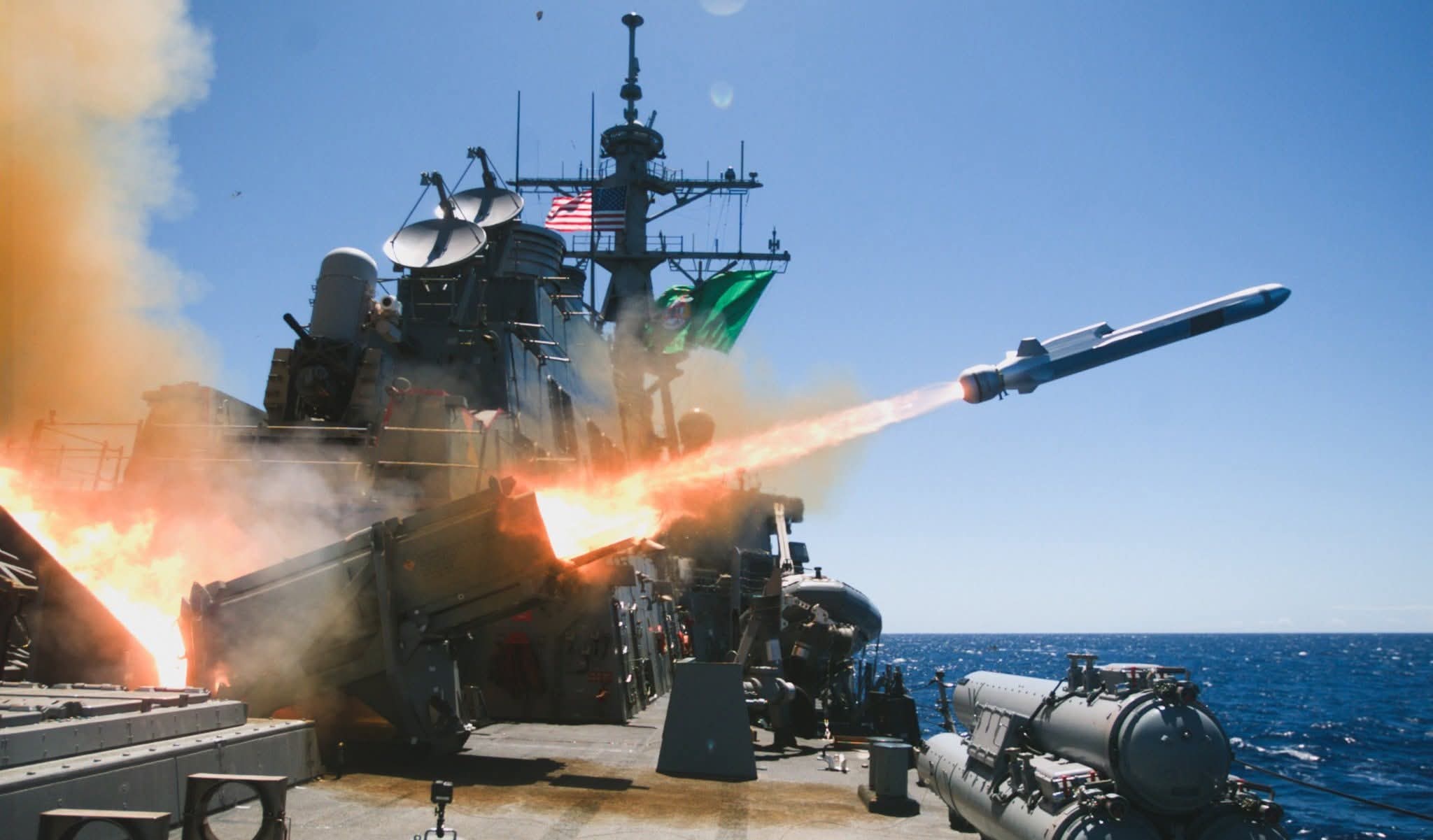
In the early hours of December 26, 2024, as most Nigerians slept off Christmas festivities, the skies over Tangaza Local Government Area in Sokoto State erupted with the thunderous roar of precision airstrikes. For 45 minutes, from 11:45 PM on December 25 to 12:30 AM, United States military aircraft unleashed what President Donald Trump described as “a powerful and deadly strike against ISIS Terrorist Scum in Northwest Nigeria.”

The operation, estimated by experts to have cost between $1 million and $3 million, marked a significant escalation in international counterterrorism efforts within Nigeria’s borders. Both the U.S. Department of War and Nigeria’s Foreign Minister confirmed that the strikes were a coordinated operation between the two nations, targeting a terrorist base hosting key jihadist affiliates in the Bouni axis of Tangaza.

Yet, predictably, the strikes have sparked intense debate across Nigeria. Skeptics have questioned everything from the existence of ISIS in Sokoto to the legitimacy of American military intervention on Nigerian soil. Kaduna-based Islamic cleric Sheikh Ahmed Gumi went as far as calling the operation symbolic of a “neo-Crusade war against Islam,” urging Nigeria to halt all military cooperation with the United States and seek assistance from China, Turkey, or Pakistan instead.

But as someone who has reported extensively from Tangaza and witnessed firsthand the creeping menace of transnational jihadism in Nigeria’s Northwest, I can say with confidence: these airstrikes were not only necessary, they were overdue.

The Lakurawa Threat: A Clear and Present Danger

In November 2024, my colleague Segun Onibiyo and I published an exclusive investigation into Tangaza and the alarming influx of foreign Islamist terrorists from the Sahel region into Nigeria through its porous northwestern borders. What we found was chilling: the Lakurawa terrorist group, a coalition of jihadists with ambitions to establish Islamic caliphates stretching from the Sahel down to the coast of Ghana, had been actively recruiting local fighters, including Fulani militias, across Sokoto and Kebbi states.

Tangaza, situated along Nigeria’s border with Niger Republic, has become a critical transit and operational hub for these jihadists. The porosity of this border facilitates the seamless movement of fighters, weapons, and ideology between the Sahel’s conflict zones and Nigeria’s increasingly vulnerable Northwest. This isn’t speculation, it’s documented reality.

The Lakurawa aren’t merely bandits or cattle rustlers. They represent a sophisticated, ideologically driven terror network affiliated with Jama’at Nusrat al-Islam wal-Muslimin (JNIM), an Al-Qaeda affiliate operating across the Sahel. Their objectives are clear: destabilize governments, impose harsh interpretations of Sharia law, and expand their territorial control. Their methods are equally clear: targeted assassinations, mass kidnappings, extortion, and brutal attacks on anyone who resists their authority, including Muslims.

Why Sokoto? Understanding the Strategic Significance

Critics have questioned why Sokoto, the historic seat of Nigeria’s caliphate and a region perceived as peaceful, would be targeted. This question betrays a dangerous ignorance of contemporary jihadist strategy.

Sokoto’s symbolic importance cannot be overstated. For groups like Lakurawa and their Sahel-based allies, controlling or influencing territories with deep Islamic heritage lends them religious legitimacy. Tangaza’s strategic location along smuggling routes and its proximity to ungoverned spaces in Niger Republic make it an ideal staging ground for operations deeper into Nigeria.

Furthermore, the U.S. military doesn’t invest millions of dollars in precision airstrikes based on hunches. In recent weeks, American forces have conducted intensive Intelligence, Surveillance, and Reconnaissance (ISR) operations across the Sahel region of Nigeria. These missions undoubtedly revealed credible intelligence about the presence of high-value terrorist targets in Tangaza, likely including senior commanders planning coordinated attacks across multiple Nigerian states.

The Sokoto State Government has confirmed that terrorist locations were indeed bombed. Reports from Niger indicate that Nigerien soldiers observed fleeing Lakurawa fighters escaping Tangaza after the strikes. The operation targeted a terrorist base where top jihadist commanders were reportedly meeting to strategize large-scale attacks. No civilian casualties were recorded, a testament to the precision and coordination involved.

Trump’s “ISIS” Rhetoric: Politics Meets Reality

President Trump’s characterization of the targets as “ISIS Terrorist Scum” warrants clarification. While Lakurawa is primarily affiliated with JNIM and Al-Qaeda rather than ISIS, the distinction may be more relevant to terrorism analysts than to practical counterterrorism operations. Both organizations share overlapping ideologies, tactics, and objectives. Both seek to establish Islamic caliphates through violence and terror. Both recruit from the same radicalized populations and exploit the same governance vacuums.

Trump’s reference to ISIS likely serves a dual purpose: it resonates with American audiences familiar with ISIS’s atrocities, and it simplifies a complex security landscape into terms that justify decisive action. For Nigerians living under the threat of these groups, whether the terrorists pledge allegiance to ISIS, Al-Qaeda, or JNIM matters far less than whether they’re being effectively neutralized.

The Broader War: Why This Strike Matters

This operation represents more than just a tactical victory, it signals a renewed international commitment to confronting transnational terrorism in West Africa. For too long, Nigeria has faced these threats with insufficient resources, inadequate intelligence capabilities, and an overstretched military. The involvement of U.S. military assets, with their advanced surveillance technology, precision strike capabilities, and real-time intelligence, provides a force multiplier that Nigeria desperately needs.

The Lakurawa threat extends beyond Sokoto and Kebbi. Their influence has been felt in Zamfara, and increasingly in parts of Niger and Kwara States. They operate with impunity in areas where state presence is minimal or non-existent. They impose taxes on communities, recruit disaffected youth, and coordinate with local bandits to create a complex web of criminality and ideological extremism.

Sheikh Gumi’s concerns about sovereignty and the symbolism of American intervention are not without merit in principle. No nation should casually cede control of military operations within its borders. However, his suggestion that “terrorists don’t fight terrorists” ignores the fundamental difference between legitimate counterterrorism operations conducted with host-nation consent and the indiscriminate violence perpetrated by jihadist groups.

His recommendation that Nigeria seek assistance from China, Turkey, or Pakistan instead raises its own questions. Are these nations better positioned to provide the sophisticated ISR capabilities, precision strike assets, and actionable intelligence that this operation demonstrated? The evidence suggests otherwise.

Looking Forward: Recommendations for Sustained Action

While the Tangaza strikes represent a significant achievement, they cannot be a one-off event. Nigeria’s counterterrorism strategy must evolve to address the full spectrum of jihadist threats across the country.

The next priority should be the systematic dismantling of known terror cells in the Middle Belt, particularly in Nasarawa, Plateau, Benue, and Taraba states. These cells serve as planning and staging grounds for attacks on farming communities that have displaced thousands and devastated agricultural production. Precision airstrikes targeting these locations, combined with ground operations to clear and hold territory, would significantly degrade their operational capacity.

Nigeria must also invest in border security infrastructure along its northern frontiers. Technology, surveillance drones, biometric checkpoints, rapid response units, must replace the current patchwork of undermanned outposts. Regional cooperation with Niger, Chad, and Cameroon needs strengthening to create a coordinated response to groups that exploit national boundaries.

Finally, Nigeria must address the governance vacuums that make communities vulnerable to jihadist recruitment. Where the state is absent, in providing security, justice, education, and economic opportunity, extremist groups fill the void. Long-term victory against terrorism requires not just military action but the restoration of effective governance.

Conclusion: A Necessary Strike in a Long War

The Christmas Day airstrikes in Tangaza were not an American crusade against Islam, as some have claimed. They were a necessary surgical intervention against a metastasizing terrorist threat that endangers Muslims and Christians alike. The Lakurawa and their affiliates have killed indiscriminately, enslaved communities, and sought to drag Nigeria into the chaos consuming the Sahel.

Those who doubt the necessity or success of these strikes should ask themselves: Would they prefer that the terrorists meeting in that Tangaza forest had been left to execute whatever atrocities they were planning? Would they prefer that Nigeria face these transnational threats entirely alone, without the intelligence and capabilities that international partnerships provide?

The war against terrorism in Nigeria is far from over. But on December 25, 2025, in the skies over Sokoto, a significant battle was won. Now comes the harder work: sustaining the pressure, expanding operations to other terrorist strongholds, and building the state capacity necessary to ensure that when terrorists are eliminated, they cannot simply be replaced.

The strike in Tangaza matters because it demonstrates that Nigeria is not alone in this fight, and that those who wage jihad against innocent Nigerians, regardless of their religious affiliation or international backing, will face consequences.

The question now is whether Nigeria has the political will to build on this success or whether the Tangaza strikes will remain an isolated event in an otherwise reactive and inadequate counterterrorism strategy.

For the sake of every Nigerian farmer, trader, student, and family living under the shadow of these groups, we must choose the former.


…Steven Kefas is an investigative journalist, Senior Research Analyst at the Observatory for Religious Freedom in Africa, and Publisher of Middle Belt Times. He has documented religious persecution, terrorism and forced displacement in Nigeria’s Middle Belt for over a decade.

WHO IS THE GENOCIDE CULPRIT IN NIGERIA?


A Critical Examination of the Claim That “Muslims Are Also Killed” as a Response to the Genocide of Christians and Indigenes/Natives of Nigeria

by

Barr. John Apollos Maton

20th December 2025

INTRODUCTION: THE DANGEROUS SIMPLICITY OF FALSE BALANCE

In every conflict marked by sustained violence against a particular group, there emerges a predictable rhetorical maneuver: false equivalence. When the subject of mass killings of Christians is raised, especially in locations plagued by sectarian violence, a familiar refrain is deployed; “Muslims are also killed.” This statement is often presented not as a call for universal justice, but as a rhetorical shield meant to dilute, deflect or delegitimize the claims of targeted persecution. The purpose is not to mourn all victims or empathise with survivors, but to suspend moral urgency, silence advocacy and neutralize accountability.

The unanswered questions by the protagonists of “Muslims are also killed” despite repeatedly asking is a simple but uncomfortable one: Who is the culprit of the gangster killing spree in Nigeria?

When Christians are being killed systematically, and the response is that ‘Muslims are also killed’, then logic demands further inquiry; Who is killing whom? Under what circumstances? With what intent? And in whose name? These are not questions of sentiment but of truth, evidence and responsibility. To refuse to ask these questions is not neutrality, it is complicity in obscuring reality.

DEFINING GENOCIDE AND TARGETED VIOLENCE

Genocide is not defined merely by the existence of death inflicted by gangster and selective violence; it is defined by domestic cum international law based on observed pattern, intent and identity. The killing of members of a group because they belong to that group constitutes a crime of a fundamentally different moral and legal category than killings resulting from crime, collateral conflict or intra-group violence (eg. arising from boundary disputes).

When Christian communities are attacked and killed in their bedrooms while asleep, in their villages, churches, farmlands and market places, often without reprisal aggression, the issue is not about quantum numbers alone. It is targeting. It is the selection of victims based on ethnoreligious identity. It is the destruction of lives, livelihoods, properties, sacred spaces and communal continuity. To respond to such evidence with the vague assertion that “others are also killed” is to evade the definition of genocide entirely.

No serious moral framework allows the suffering of one group to be dismissed simply because suffering exists elsewhere.

THE “MUSLIMS ARE ALSO KILLED” ARGUMENT: A LOGICAL AUTOPSY

At first glance, the claim that “Muslims are also killed” appears humane. Who would deny that all lives matter? Yet when examined closely, the argument collapses under its own contradictions.

If Muslims are also killed, then by who and why? Are they killed by Christians acting collectively? Are Christian militias invading Muslim villages? Are churches mobilizing armed groups to attack mosques? What is the evidence, public declarations or ideological manifestos supporting such claims?

The answer, based on available historical records including data, is unequivocal: No. Christians, as a collective religious group, have not organized, celebrated, or justified mass attacks on Muslims in the territorial locations under discussion. There are no evidential records and data of Christian mobs chanting religious slogans while burning Muslims or their settlements, worship places, livelihoods and markets. Nor are there such records and data of sermons by Christian clerics calling for the extermination of Muslims. No coordinated religious campaigns encouraging violence or crime. This absence of evidence is not accidental. It reflects a fundamental asymmetry that the claims in “both sides” narrative refuses to confront.

THE QUESTION OF EVIDENCE: RECORDINGS, ADMISSIONS, AND PATTERNS

One of the most damning aspects of modern conflicts is that they are often documented by the perpetrators themselves. Videos, photographs, statements and social media posts have become tools of intimidation and ideological signaling.

In the cases under discussion on genocides against Christians, there exist repeated instances where attackers openly identify themselves, invoke religious language, and frame their violence as justified or divinely sanctioned. These are not anonymous accidents. They are ideological acts. When individuals proudly record and disseminate evidence of their crimes, they remove ambiguity about intent.

By contrast, there is no comparable archive of Christians collectively boasting about religiously motivated mass violence. This is not a claim of moral perfection, but of empirical reality. Individual crimes exist everywhere. Organized religious extermination by Christians in these contexts does not exist. Thus, when Muslims are killed, the crucial question remains unanswered by deflection: who killed them, and why?

COLLATERAL DEATH VERSUS TARGETED EXTERMINATION

Another deliberate confusion lies in the failure to distinguish between collateral deaths and targeted killing for extermination. In territorial locations affected by insurgency, banditry, and terrorism, civilians of all identities may tragically die. But not all deaths are equal in meaning.

When a Christian farmer is killed because his farmland is trespassed and crops ravaged, his homestead is seized, his church burned, and his village erased, the motive is clear. When worshippers are massacred during religious services, the symbolism is undeniable. When survivors are told to convert, flee, or die, the intent is explicit.

If Muslims are killed in clashes between armed groups, criminal networks, or internal disputes, those deaths are tragic and demand justice, but they do not negate evidence of a parallel, targeted campaign against Christians. Conflating the two is not analysis; it is obfuscation. Yet, the question remains; who killed the Muslims and why?

WHY THE FALSE BALANCE IS POLITICALLY USEFUL

The insistence on “both sides suffer” serves powerful political interests. It allows governments to avoid naming perpetrators. It enables international actors to maintain diplomatic comfort. It shields extremist ideologies from scrutiny by dissolving them into generalized chaos.

Most dangerously, it gaslights victims including survivors. It tells survivors that their suffering is exaggerated, their fear misplaced, and the death of their kinsfolk is a mere statistic in a symmetrical tragedy. This rhetorical strategy does not promote peace—it perpetuates silence. History shows that genocide is rarely denied outright in its early stages by the perpetrators and supporters of the evil. Instead, it is minimized, relativized, pacified and buried under calls for patience and restraint, so the voices of the victims are lost and the true agenda hidden. In Plateau State and many parts of Nigeria, the strategy denying cries against this Genocide is to have even the government misnormered it as being “Insecurity” or the infamous “Farmer-Herder Clash”.

THE MORAL FAILURE OF SILENCE AND DEFLECTION

There is a profound ethical failure in responding to cries of persecution with deflection. Moral seriousness requires specificity. Justice requires naming crimes accurately. Peace requires confronting uncomfortable truths. To acknowledge that Christians are targeted does not require hatred of Muslims. To demand accountability does not require collective blame. But to refuse acknowledgment because it disrupts a preferred narrative is to abandon both truth and humanity. The question is not whether Muslims are also killed. The question is whether Christian deaths are being used as a bargaining chip in a moral shell game designed to avoid responsibility.

WHY CONDEMN THE AID COMING FOR CHRISTIANS?

1. The Moral Contradiction at the Heart of the Objection

The first question that must be confronted honestly is this: why would any morally serious person oppose humanitarian aid to civilians facing mass violence, regardless of their faith? Aid is not a theological endorsement; it is a response to human suffering. Condemning assistance to Christian communities under attack does not reduce violence, save Muslim lives, or advance justice—it merely withholds relief from victims. When opposition to aid becomes louder than condemnation of the killings themselves, priorities are exposed. Humanitarian intervention should never be framed as a zero-sum competition between communities, especially in a context where civilians of multiple faiths are being brutalized by armed groups.

2. The Missed Opportunity for Collective Advocacy

Nigeria’s insecurity has attracted rare international attention, and this moment could have been used constructively to amplify all civilian suffering. Instead of rejecting the framing of Christian victimhood outright, critics could acknowledge it while simultaneously presenting evidence of Muslim civilian casualties and calling for inclusive protection. International actors are capable of responding to multiple crises at once. Denial does not broaden concern; it narrows it. By rejecting the language of “Christian genocide” rather than supplementing it with documented accounts of Muslim suffering, critics inadvertently weaken the overall case for international engagement against terrorism.

3. Denial as a Strategy—and Its Consequences

There is a profound difference between contextualizing violence and denying it. When denial becomes the dominant response, it signals that controlling the narrative matters more than protecting lives. If Christians are being targeted in identifiable patterns—through church attacks, village raids, forced displacement, or selective killings—then disputing terminology should never take precedence over stopping the violence. The insistence on denial, especially when paired with hostility toward aid, creates the impression that reputational defense of a group or ideology has eclipsed compassion for victims. This perception, whether intended or not, damages trust and deepens communal suspicion.

4. If the Culprit Is the Same, Why Resist Intervention?

If both Christians and Muslims are suffering at the hands of the same armed actors—terrorist groups, criminal militias, or transnational extremists—then logic demands a united civilian front. Aid, investigations, and security interventions aimed at dismantling those networks should be welcomed, not resisted. Shielding perpetrators indirectly—by downplaying their impact on one community—undermines the safety of all communities. Terrorist violence does not respect religious boundaries; it exploits them. Any response that fragments civilian solidarity only strengthens the attackers.

5. The Responsibility of Muslims in Indigenous Communities

Muslims who are of the Indigenous tribes of Nigeria, like indigenous Christians, have deep historical, cultural, and communal ties to their regions. Their interests are aligned with peace, stability, and the protection of ancestral lands—not with violent actors who destabilize societies and invite external chaos. Standing against terrorism does not mean standing against Islam; it means standing for life, dignity, and coexistence. When indigenous Muslim voices openly support interventions that protect all civilians, they reclaim moral leadership and make it harder for extremists to masquerade as defenders of faith.

6. Aid Is Not the Enemy—Violence Is

Ultimately, the question is not whose suffering counts more, but whether suffering is allowed to continue unchecked. Humanitarian aid for Christians under attack does not negate Muslim suffering; it establishes a precedent that civilian lives matter. The appropriate response to selective attention is not obstruction, but expansion—demanding broader protection, deeper investigations, and comprehensive aid for all affected communities. Condemning aid aimed at one group risks normalizing cruelty. Supporting aid, while insisting on inclusivity, affirms a shared commitment to justice and human life above sectarian rivalry.

WHO, THEN, IS THE CULPRIT?

If Christians are not attacking Muslims as a religious collective, yet Muslims are also among those killed, then the perpetrators must be clearly and explicitly identified: armed extremist groups, criminal militias, terrorist organizations, or ideological movements that exploit religion for power and violence. Historical and contemporary data suggests the Islamist Fulani jihadists as the only group that fits this narrative; immigrants whose pristine motive from their first incursion to some territories that are constituent parts of what comprise present-day Nigeria was an Islamic jihad aimed at conquest and displacement of native people and institutions.

The refusal to distinguish between Islam as a faith and the Fulani violent actors who profess Islam harms everyone. It allows the Fulani settler immigrants and extremists to hide behind populations of indigenous ethnic groups and critics to be accused of bigotry for asking legitimate questions. Precision is not prejudice; it is the foundation of justice.

CONCLUSION: TRUTH IS NOT HATRED

Asking “Who is the culprit?” is not an act of hostility. It is an act of moral responsibility.

The lives of Christians lost to targeted violence cannot be erased by the rhetorical symmetry of the culprits. Nor can justice be achieved by pretending that all deaths arise from the same causes or carry the same intent.

If Muslims are killed, they deserve justice. If Christians are targeted for extermination, they also deserve justice, recognition and protection. These truths are not mutually exclusive. What is unacceptable is the weaponization of one tragedy to silence another. Truth demands clarity. Justice demands courage.

And, history will judge not only those who killed, but those who refused to ask who did it, and those who keep pretending not to know it’s the continuation of the genocidal campaign of the immigrant Islamist Fulani jihadists against the Native Indigenous Ethnic People and Christians of Nigeria.

Sheikh Gumi, Usman Yusuf, and the Dangerous Politics of Sympathizing With Terror in Nigeria

By Nasiru I. M. Jagaba

21 December 2025

jagabanasiru@gmail.com

For over a decade, Nigeria has endured an unrelenting wave of terrorism and large-scale banditry that has claimed tens of thousands of lives, displaced millions, and devastated entire regions. From the abduction of schoolgirls in Chibok to mass killings in the Middle Belt and the bombing of the

Abuja-Kaduna passenger train, the victims have overwhelmingly been ordinary, unarmed citizens.

Nigeria’s tragedy is not rooted in a lack of military capability. The country possesses trained forces, intelligence assets, and international partnerships. What has consistently failed is political resolve, compounded by the role of influential voices who have normalized, justified, or indirectly shielded terrorists under the language of dialogue, ethnicity, or religious fraternity.

At the heart of this troubling pattern are Sheikh Ahmad Gumi and Professor Usman Yusuf, two public figures whose words, actions, and associations demand scrutiny rather than reverence.

Documented Presence With Terrorists in Their Havens

Before any discussion of motives or rhetoric, one foundational fact must be stated plainly: Sheikh Ahmad Gumi and Professor Usman Yusuf have, on multiple occasions, been seen in photographs and video footage holding court with armed terrorists inside their forest havens across several Nigerian states. These were not accidental encounters or second-hand claims; they were direct, documented meetings conducted deep within territories controlled by bandit and terrorist groups.

Such repeated access establishes an unavoidable reality: anyone who can consistently meet terrorists in their strongholds knows who they are, where they are located, and how to reach them. In a country where security agencies often cite intelligence gaps as a constraint, this level of familiarity raises grave questions. If these individuals possess such access and knowledge, Nigerians are entitled to ask why this proximity has not translated into the exposure, disruption, or dismantling of terror networks, but instead has coincided with public advocacy that appears to soften, excuse, or rationalize their violence.

From Mediation to Legitimization: The Gumi Question

Beginning around 2020, Sheikh Ahmad Gumi publicly ventured into bandit-controlled forests across Zamfara and neighboring states, presenting himself as a mediator. These visits were not clandestine; they were widely broadcast and documented by BBC Hausa (June 2021), Channels Television (July 2021), and Daily Trust (2021).

Crucially, these encounters produced photographs and video footage showing Gumi sitting openly with armed bandit leaders in their forest enclaves. These images carry unavoidable implications: anyone who repeatedly meets terrorists in their strongholds knows who they are, where they operate, and how to reach them.

Yet rather than use this access to expose terror networks, Gumi consistently positioned himself as their public interpreter, often describing them in collective, possessive language such as “our boys” or “our warriors” (mayakanmu) in televised interviews.

In any counter-terrorism doctrine, such language blurs the line between mediation and moral endorsement. It raises a fundamental question Nigerians deserve answered:

If these men know the terrorists so well, why has the nation never been told, clearly and unequivocally, why these groups attack villages, massacre civilians, and wage war on the Nigerian state?

Negotiating for Killers, Silence for Victims

Despite repeated “peace engagements,” violence did not decline; it escalated. Kidnappings expanded from remote villages to highways, schools, and rail infrastructure, culminating in the Abuja–Kaduna train attack of 28 March 2022.

Instead of disarmament, terrorists gained:

Public visibility

A sympathetic national voice

Political and ideological cover

If negotiations are conducted with murderers, a basic moral question arises: Who accounts for the blood already spilled?

When Sheikh Gumi and his allies speak of bandits using inclusive Hausa pronouns, “we” and “us”, they unintentionally frame mass atrocities as collective grievances rather than criminal acts.

Such framing risks converting terror into an ethnic or communal cause, rather than what it is: organized violent crime and war against civilians.

Associations That Deepen Concern

Public concern intensified with the arrest of Tukur Mamu, a close associate of Gumi and a self-described negotiator. On 7 September 2022, Mamu was arrested in Cairo, deported to Nigeria, and detained by security agencies. Authorities stated he was found with items allegedly linked to terrorist logistics (Premium Times, September 2022; Channels TV, September 2022).

Mamu had repeatedly appeared beside Gumi during “peace meetings” with bandits. Yet kidnappings continued unabated throughout this period. This inevitably raises a disturbing question:

Were these engagements aimed at ending terrorism, or managing it?

Earlier, Sheikh Gumi himself had drawn international attention. In 2010, Saudi authorities detained him following intelligence concerns linked to Umar Farouk Abdulmutallab, the Nigerian involved in the failed Christmas Day airline bombing (The New York Times, January 2010). More recently, in May 2025, Saudi Arabia reportedly denied him entry for Hajj.

Such actions by foreign governments may be disputed, but taken together they form a pattern that merits investigation, not dismissal.

Usman Yusuf and the Ethnicization of Terror

Professor Usman Yusuf, former Executive Secretary of the National Health Insurance Scheme (NHIS), has emerged as a vocal critic of military operations against armed terrorist groups.

In opposing decisive action, Yusuf has framed counter-terror efforts as an attack on “Fulani people.” This argument is not merely flawed; it is dangerous.

Northern traditional rulers, security briefings, and multiple media investigations have repeatedly acknowledged that a significant proportion of bandit groups identify as Fulani, without suggesting that Fulani identity itself is criminal.

Terrorism is not an ethnicity; it is a crime.

By Yusuf’s logic, opposing military action against armed militias because of their ethnic identity implies that such groups possess an implicit right to raid villages, displace other ethnic communities, and commit mass killings without resistance. This is a moral and legal absurdity.

Selective Compassion, Selective Justice

Professor Yusuf’s public record also invites scrutiny. During his tenure at NHIS, he faced allegations of financial mismanagement reported by Premium Times (October 2018) and The Punch (December 2018). While he denies wrongdoing and no final conviction has been recorded, these unresolved issues remain part of the public record.

It is therefore legitimate to ask: Why does a former public official, facing unresolved accountability questions, now position himself as a defender of armed groups, while civilians continue to die?

When Terror Becomes a Political Asset

Media investigations by Daily Trust (June 2020) and Premium Times (February 2021) documented state-level arrangements where bandit leaders were paid or settled in exchange for temporary ceasefires. Security analysts cited by The Guardian (August 2021) and the International Crisis Group (2020–2023) warned that such deals often preserved terror networks as political leverage, especially during election cycles. If armed groups are maintained as bargaining tools, terrorism ceases to be merely a security failure and becomes a political strategy, a profound betrayal of the Nigerian people.

Tinubu’s Moment of Truth

President Bola Ahmed Tinubu faces a defining test. Ending insecurity requires placing national survival above political calculations, resisting elite pressure from those threatened by peace, and supporting professional military leadership without equivocation.

The Defence leadership under General Christopher Musa emphasizes coordination, discipline, and results. Such efforts cannot succeed while influential voices undermine operations through ethnic or religious narratives.

A Call for Investigation and Accountability

Criticism alone is no longer sufficient. Investigation is imperative.

Nigeria’s security and justice institutions must examine:

Public advocacy that appears to normalize or defend armed groups

Financial and logistical networks sustaining terrorism

The role of intermediaries who claim peace while violence persists.

International partners should also review credible evidence under frameworks such as the Global Magnitsky Act and Leahy Laws, where terror facilitation is established.

Holy robes must not become shields for unholy alliances.

Conclusion:

Stop Bargaining With Violence

The victims of Nigeria’s terror war, schoolchildren, farmers, commuters, worshippers, were not combatants. They were citizens. This war will not be won by ethnicizing crime, romanticizing killers, or negotiating from moral weakness. It will be won by truth, accountability, and political courage.

Nigeria must stop bargaining with terror, and start defeating it.

A CALL FOR PROTECTION AND SAFETY OF DISPLACED PERSONS & COMMUNITIES AT THIS CHRISTMAS AND BEYOND.

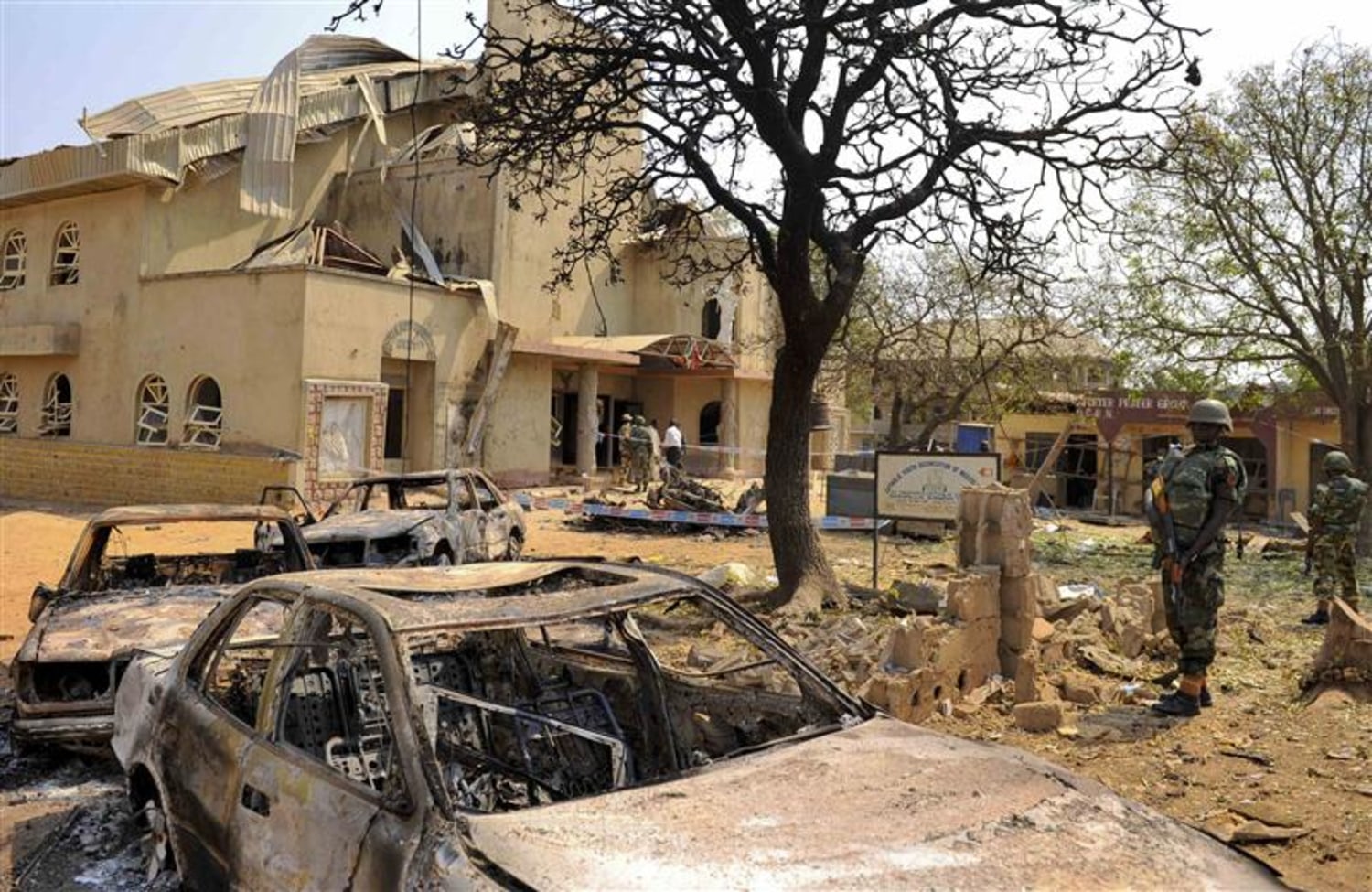
Since the 2010 Christmas day twin bombing at Ungwan Rukuba and Gada Biyu in Jos, Plateau State and the terror attack at St. Theresa Catholic Church, Madalla, Niger state on 25 December, 2011, there has been a grief- mapped mass displacement of persons and communities due to terror attacks at Christmas in Northern Nigeria and more incessantly, in the Middle Belt region.

On 24 December, 2016, Goska community in Jema’a Local Government, Southern Kaduna, was attacked. About 20 people were killed and hundreds of people in the community had to flee for safety.

In recent times, more specifically, at the 2023 Christmas, over 212 people were killed across communities in Bokkos and Barikin Ladi of Plateau State, causing over 10,000 persons to be displaced.

At the 2024 Christmas celebrations, about 46 worshippers were killed at Anwase, Gboko of Benue State, causing 6,800 persons to join the over 150,000 displaced persons.

In the days leading up to the 2025 Christmas, 20 worshippers have been kidnapped in an ECWA Church in Ayetorokiri, Bunu-Kabba, Kogi state.

This pattern of Christmas season mass atrocities across different parts of the Middle Belt of Nigeria needs to be addressed and prevented to drive a wedge between the intersection of faith-based insecurity and the violence of domestic terrorism across the country.

Consequently, the undersigned call on the Nigerian government to:

1. Put in place security measures to protect communities, churches and worshippers as citizens travel for the Christmas festivities across the country.

2. Urgently prioritize the welfare and protection of displaced Persons (IDPs) and Internally Displaced Communities (IDCs) in the Middle-Belt and across all parts of Nigeria at this Christmas and beyond.

3. Acknowledge the severe and complex challenges displaced persons face including loss of homes and livelihoods; documentation and identity; as well as the indiscriminate consequences of vulnerability to violence.

4. Strive to timely reduce the number of displaced persons and communities in protracted situations through creative and stabilizing economic empowerment solutions.

5. Ensure that the National Emergency Management Authority (NEMA) and State Emergency Management Agencies (SEMA) are immediately mobilized to provide, food, water, shelter and physical security during this season to IDPs & IDCs across the Middle-Belt & other parts of the country.

6. Enable the safe and dignified return and resettlement of displaced persons and communities to their places of habitual residence in assurance of support to be self-reliant.

7. See to the voluntary return, local integration or resettlement of IDPs and IDCs by providing support for reintegration into communities and ensuring their participation in decisions and processes that affect their lives for durable solutions.

8. Ensure that statutory security and law enforcement agencies work in collaboration with locally established security and vigilante groups towards harnessing actionable intelligence and strengthening community policing.

9. Prevent the upsurge of displaced persons and communities by acting on security reports to prevent further attacks.

10. Urge President Bola Ahmed Tinubu to grant assent to the African Union Convention for the Protection and Assistance of Internally Displaced Persons in Africa (Kampala Convention) (Domestication Bill), to ensure a coordinated and harmonized rights-based approach to a national crisis of IDPs & IDCs.

We hope that the government will urgently prioritize action in addressing the protection needs of IDPs & IDCs, prevent further incidents that could increase their numbers and address the displacement problem in an enduring and sustainable manner.


Signed:


House of Justice


Prof. Chidi Anselm Odinkalu


Global Rights


Atrocities Watch Africa


Open Bar Initiative


The Kukah Centre


The Gideon and Funmi Para- Mallam Peace Foundation


Middle Belt Times


Resilient Aid and Dialogue Initiative (RADi)


Community Development and Rights Advocacy Foundation


Christian Women for Excellence and Empowerment in Nigerian Society (CWEENS)


The Benue We Deserve Foundation (BenDeF)


Leadership, Ethics and Accounability Development Foundation

(LEAD Foundation)


Dinidari Foundation


Sesor Empowerment Foundation


Middle Belt Concern


Initiative for Leadership, Environment and Empowerment Advanced (ILEEA)


Gloria Mabeiam Ballason Esq


Rt. Hon. Cephas Dyako


Ier Jonathan Ichaver


Abiodun Baiyewu Esq


Ndi Kato


Steven Kefas


Bulus Y. Atsen, fsi, Esq


Pyemwa Samantha Deshi ,Kinabuti Initiative.


Kaneng Rwang Pam, Kaneng Rwang-Pam Foundation for Education & Migration Awareness (KRP FEMA)

When the State Arms the Terrorist: How Nigeria’s Security Architecture Is Collapsing from the Inside

By Steven Kefas

On December 12, 2025, Nigerian security operatives arrested a group of armed Fulani militants in Ifelodun Local Government Area of Kwara State. What followed should have triggered an immediate national security emergency.

In a video recorded during interrogation, one of the suspects calmly explained that the AK-47 rifles and patrol vehicle in their possession were supplied by officials of the Kwara State Government. According to him, they had been operating in the area “for a while” under the guise of patrol duties. “Ilorin government na him give us this motor and the weapons,” he said. “They were the ones that gave us the rifles.”

This was not the rambling of a cornered criminal improvising a story. Days later, the Kwara State Government itself issued a clarification confirming that the arrested armed men were members of Miyetti Allah, the Fulani socio-cultural organization, and that they were participating in a federal security operation coordinated through the Office of the National Security Adviser (ONSA).

In one stroke, Nigeria crossed a line that should alarm every serious observer of national security, human rights, and national stability: armed ethnic militia members linked to a group repeatedly accused of terrorism were officially embedded into state-backed “security operations.”

This is no longer about incompetence. It is about institutional collapse.

Vigilantes or Proxies?

Kwara State is not Fulani territory. It is a predominant Yoruba state, notwithstanding the historical emirate structure imposed during the 19th-century jihad of Usman dan Fodio. Over the past six months, Yoruba farming communities in Kwara have increasingly come under attack by Fulani terrorists.

Against this backdrop, a fundamental question arises: why are Fulani “vigilantes” deployed in Yorubaland to provide security for Yoruba communities while those same Fulani militias are widely implicated in the violence those communities are fleeing?

Where are the Yoruba vigilantes? Why are local populations excluded from securing their own communities, while an armed ethnic group with an established record of violent expansionism is empowered, armed, and legitimized by the state?

This is not community policing. It is demographic and security engineering.

A Pattern, Not an Incident

What happened in Kwara is not an isolated scandal. It fits a disturbing and well-documented pattern.

In January 2024, Miyetti Allah leader Bello Bodejo announced the formation of an armed Fulani militia of 1,144 fighters, euphemistically labeled a “vigilante group.” The launch ceremony took place in Lafia the Nasarawa State capital had among its invited guests the Governor of Nasarawa, Abdullahi Sule as special guest.

Nasarawa State has long been accused by survivors, journalists, and international monitors and even neighbouring state officials of hosting Fulani terrorist camps from which attacks against Plateau, Benue, Taraba Southern Kaduna, and other Middle Belt communities are launched.

When Bodejo was eventually arrested and charged with terrorism, his confessional statement reported by Punch newspaper in April 2024 contained an explosive allegation: he claimed that Governor Sule pressured him to form the militia group known as Kungiya Zaman Lafiya.

Bodejo was later released without trial.

The alleged architect of his release? Nigeria’s National Security Adviser, Mallam Nuhu Ribadu.

The 1,144 armed “vigilantes” subsequently disappeared into thin air. No disarmament. No accountability. No explanation.

From Appeasement to Empowerment

The Kwara arrests now place the Office of the National Security Adviser squarely at the center of another scandal involving armed Fulani operatives embedded in state-sanctioned security frameworks.

If confirmed, this represents a catastrophic breach of counterterrorism doctrine. No serious state fighting terrorism arms ethnic militias tied to insurgent violence. No professional security architecture outsources public safety to groups accused of mass atrocities. And no responsible National Security Adviser permits such an arrangement.

Yet this is precisely what Nigeria appears to be doing, repeatedly.

This pattern lends overwhelming credence to growing national and international calls for Nuhu Ribadu’s immediate removal as National Security Adviser. National security cannot be entrusted to an individual who repeatedly champions peace deals, protection, or legitimacy for armed groups responsible for spreading terror among citizens.

The Matawalle Question

The crisis deepens further with renewed allegations surrounding Bello Matawalle, Nigeria’s Minister of State for Defence.

In recent weeks, Matawalle has been implicated by his former aide in allegations of sponsoring key bandit leaders in Zamfara State. These claims resurrect older, widely circulated videos in which notorious bandit leader Bello Turji openly stated that Matawalle, then governor of Zamfara paid some bandits with public funds in the name of “peace.”

Turji is not a misunderstood local actor. He is a terror commander linked to the killing of hundreds, possibly thousands, of farmers across the North-West.

Matawalle denies wrongdoing, arguing that payments and negotiations were part of a peace strategy. But peace bought with impunity, cash, and legitimacy for terrorists is not peace, it is state-funded terror management.

When combined with the Kwara revelations, the allegations against Matawalle reinforce a chilling conclusion: Nigeria’s defence and security leadership is populated by individuals whose policies consistently reward, empower, and normalize terrorism.

This alone justifies Matawalle’s removal.

“Bombs Cannot Penetrate Forests”

Perhaps nothing illustrates the depth of rot more than the parting statement of Nigeria’s immediate past Defence Minister, Abubakar Badaru, who reportedly remarked during the week of his resignation that “bandits live in forests where bombs cannot penetrate.”

This is not merely false, it is professionally disqualifying.

Modern militaries conduct forest warfare across the globe. Nigeria’s armed forces have done so successfully outside Nigeria. The claim that bombs “cannot penetrate forests” is not a tactical assessment; it is an excuse, one that exposes a leadership class more interested in rationalizing failure than confronting terror.

Why the World Is Responding

In recent days, the United States announced visa restrictions affecting Nigerians. Predictably, outrage followed. Many Nigerians consider the decision unfair or excessive.

They are wrong.

The United States, like any rational state, has a duty to protect itself from countries where terrorism is being mainstreamed into governance structures. When armed ethnic militias tied to terror networks are armed by the state, embedded into official security operations, shielded from prosecution, and rewarded with political appointments, terrorism is no longer an aberration, it is policy-adjacent.

Visa restrictions are not punishment. They are self-defense.

Recommendations: What Must Be Done Immediately

If Nigeria wishes to arrest its rapid descent into international isolation and internal collapse, urgent action is required:

Nuhu Ribadu must resign or be removed as National Security Adviser. His continued tenure undermines confidence in Nigeria’s counterterrorism commitment and poses a grave risk to national cohesion.

Bello Matawalle must be relieved of his defence portfolio pending an independent investigation into allegations of terrorist sponsorship and appeasement.

Miyetti Allah-linked armed formations must be formally investigated for terrorism-related activities and barred from any security role.

Security appointments must prioritize professional competence over ethnic, religious or political proximity. National security is too serious to be managed through sentiment.

International partners must escalate targeted sanctions and visa restrictions against officials credibly linked to terror appeasement.

Conclusion: A State at a Crossroad

The arrest of armed Miyetti Allah operatives in Kwara State is not merely another scandal. It is a warning flare.

Nigeria now stands at a crossroad: continue mainstreaming terrorism through appeasement and ethnic favoritism, or reclaim the basic function of the state, protecting citizens without fear or favor.

The world is watching. And increasingly, it is acting.

Whether Nigeria chooses reform or further collapse will determine not just its security future, but its standing among nations that still believe terrorism must be confronted, not accommodated.


…Steven Kefas is an investigative journalist, Senior Research Analyst at the Observatory for Religious Freedom in Africa, and Publisher of Middle Belt Times. He has documented religious persecution, terrorism and forced displacement in Nigeria’s Middle Belt for over a decade.


WHY ARE THEY SO SCARED AT THE MENTION OF MIDDLE BELT?


By Col Gora Albehu Dauda Rtd
13 December 2025


They are feigning ignorance about the Middle Belt geographical space of Nigeria. Of course they know the Middle Belt, their pretences not withstanding. If they do not know where the Middle Belt is, then why are they always in a state of palpable fear at the very mention of the Middle Belt. One thing is very clear, the Middle Belt of Nigeria has existed in time and space and they know this to be true. The pretences aside, and their contrived blindness aside, WE shall help them register the Middle Belt of Nigeria in their brains.

The Social media space in the North of Nigeria has had to accommodate huge volume in of traffic on the subject matter of the Middle Belt. What is responsible for this state of affairs? The reason(s) cannot be too far fetched as it has to do with the potential unraveling of the old North into its component parts that were compelled into an unequal union by the Fulani settlers who the British colonialists helped to take over many of our lands. How can they now say they do not know where the Middle Belt is? Do they not understand that what was then called the Northern Region was more than 60 percent of Middle Belt territory?

How could they have forgotten so soon in the day about a Tiv man and one of the fighters for Nigeria’s independence Joseph S Tarka and whose main preocupation was to secure the independence of the geographical Middle Belt on the platform of the United Middle Belt Congress? Have they also forgotten that the Fulani settler political party NPC fought with all its might and strengthened by British colonial interest made sure that the agitation by JS Tarka for the creation politically of a Middle Belt was defeated?

They may have forgotten that there is a subject called History. We remind them that History lives. Surely they will remember the Tiv riots or have they forgotten that too? If they remember, they will do well to also remember the reasons and or background to the riots. If they are able to recall the History very well, then they cannot but remember that the Middle Belt which they are now conveniently denying is alive and well. Ordinarily, responding to their denial would not have been necessary but because the records have to be updated and preserved, it became imperative to tell them to their faces that the Middle Belt is here to stay.

Through time, it was convenient for them to harvest our numbers as Middle Belters during all of the many fraudulent head counts of the past to find the strength they needed but only to disregard the very fact that the Middle Belt was deserving of the goodies and wealth the Northern Region of that time produced. They promoted their faith whilst also preventing the spread of other faiths, particularly the Christian faith. They have deployed all the means at their disposal to not only undermine or hinder the spread of Christian values, they have sought to acknowledge that there are Christian in the behemoth North.

Not surprising at all, because they have conveniently forgotten that it was largely Middle Belters who answered Gen Gowon’s wartime call “To keep Nigeria One is a Task that Must be Done” of the Nigeria Civil War years. Sadly after the victory, elements from the feudal regime pulled the carpets from under the feet of those who won the victory and now, they cannot tell on the map of Nigetia where the Middle Belt is located. They can continue living in denial for all we care but the reality of the Middle Belt will come upon them much like a thief in the dead of night.

The truth remains that their elite know for a fact the place as well as relevance of the Middle Belt in the Nigerian equation and by extension that of Nigeria as a country . Those ranting the denial of the Middle Belt are inconsequential and blind as bats but the scales will soon be falling from their unclean eyes. Because of the dictum that “Impossible is Nothing”, I thought that they should have been redying themselves for the reality that will in due time dawn on them. Some of the reasons they are so scared of what is to come to pass shortly includes the loss of votes, lands, cheap revenues they have been enjoying to sponsor terrorists, bandits as well as jihadists. Put in another way, they will no longer have others doing their dirty jobs. They are better adviced to face up to the imminent changes on the way. To God Be The Glory