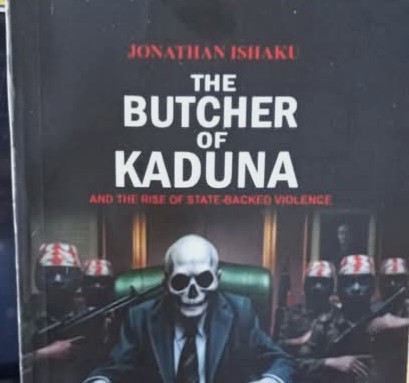
“The Butcher of Kaduna and the Rise of State-Backed Violence”

By Today’s Challenge Magazine

When Silence Becomes Complicity, Truth Must Roar.

In a nation reeling from fear, bloodshed, and betrayal, where headlines echo daily horrors-kidnappings, killings, and communities erased overnight—one voice refuses to look away.

Jonathan Ishaku, acclaimed essayist and one of Nigeria’s most courageous truth-tellers, returns with his most incendiary and urgent book yet:

The Butcher of Kaduna and the Rise of State-Backed Violence.

This isn’t just a book. It’s a reckoning.

From the ashes of once-thriving villages to the halls of power where silence enables slaughter, Ishaku pulls back the curtain on the chilling realities behind Nigeria’s descent into chaos. With unmatched clarity and moral force, he lays bare how political actors, under the cover of state legitimacy, have turned violence into governance—with Kaduna State as ground zero.

In a time when fear silences many, Ishaku names names.

He exposes the politicization of security under Buhari, the rise of emboldened ethnic militias like Miyetti Allah, and the transformation of the North West into a graveyard of governance.

He documents the deadly impunity of Governor Nasir El-Rufai’s regime and dissects the cynical calculus that turns sectarian hatred into policy.

This book honours the fallen, amplifies the silenced, and summons the living to a higher cause: resistance, reform, and truth.

Why Now?

Because Nigeria is at a breaking point. Because too many have died in the shadows. Because state-backed violence is no longer a rumour—it is reality. Because El-Rufai’s Kaduna isn’t an anomaly, it is a warning.

For every Nigerian seeking to understand the roots of our collective trauma—this is your map.

For every patriot tired of lies dressed as leadership—this is your mirror. For every voice yearning for justice—this is your call to arms.

“The Butcher of Kaduna” is more than an exposé. It is a bold, necessary intervention in Nigeria’s fight for its soul.

Pre-order now. Speak up. Stand firm. The time for silence is over.

Every Nigerian Should Learn Self-Defense, Says Defense Chief – A Lesson from Sunday Jackson’s Tragic Case

By Steven Kefas

The Nigerian Chief of Defence Staff, General Christopher Musa, has urged all Nigerians to acquire basic combat skills for self-protection in dangerous situations. Speaking on Channels Television’s Politics Today on Thursday, August 21, 2025 monitored by MBT, General Musa likened learning self-defense to essential life skills such as driving or swimming. “It’s a survival instinct,” he explained. “Whether there’s war or not, knowing how to defend yourself is crucial. In places like Europe, swimming is mandatory, and security training should be treated similarly.”

General Musa proposed that the National Youth Service Corps (NYSC) should incorporate unarmed combat training into its curriculum to equip young Nigerians with skills to protect themselves from violent attacks. He emphasized that the world is becoming increasingly dangerous, with individuals who perpetrate violence without provocation. “Security is everyone’s responsibility,” he stated, encouraging Nigerians to remain vigilant and report suspicious activities within their communities.

The defense chief also highlighted operational challenges facing the military, including poor road infrastructure and inadequate communication networks, which hamper rapid response to attacks by bandits and terrorists. These criminals often execute swift strikes and vanish within minutes, leaving security forces struggling to mount effective pursuit operations.

This call for self-defense resonates deeply with the tragic case of Sunday Jackson, a Middle Belt farmer from Adamawa who was sentenced to death for defending himself against a Fulani herder who invaded his farm with cattle a decade ago. Sunday’s ordeal serves as a stark reminder of why self-defense capabilities are essential. When the herder attacked him on his farmland, Sunday fought back to protect his livelihood, the header died from injuries sustained. However, the justice system failed him, instead of recognizing him as a victim defending his property, he was convicted and now faces execution.

General Musa’s advocacy underscores a harsh reality: many Nigerians, particularly in the Middle Belt, confront threats from terrorist herders, bandits and other criminals with minimal immediate support from security forces. Sunday Jackson’s case illustrates the devastating consequences when citizens are compelled to defend themselves without fair legal protection.

Another example of the failure of the Nigerian judiciary to protect rights to self-defence is the case of Israel Bawa aka Zidane, an indigene of Adara who has been in prison since 2019 over self-defence related issue. Zidane is said to be a fearless young man who alongside others put up strong resistance against Fulani Ethnic Militias attacking their communities. He was arrested by the Nigerian army in 2019, tortured for several months before being transferred to the police, was charged to court and was remanded in prison custody. Zidane left behind a wife and two children who are currently at the mercy of good Samaritans.

The defense chief’s message is unambiguous: Nigerians must prepare to defend themselves in an unpredictable security environment. He also advocated for stronger legislation and expedited justice to prevent criminals from escaping accountability while law-abiding citizens like Sunday Jackson face persecution. As the Middle Belt continues grappling with security challenges, General Musa’s words serve as both a wake-up call for individual preparedness and an indictment of systemic failures that leave citizens vulnerable.

Steven Kefas is a veteran conflict reporter with over 10 years experience.