

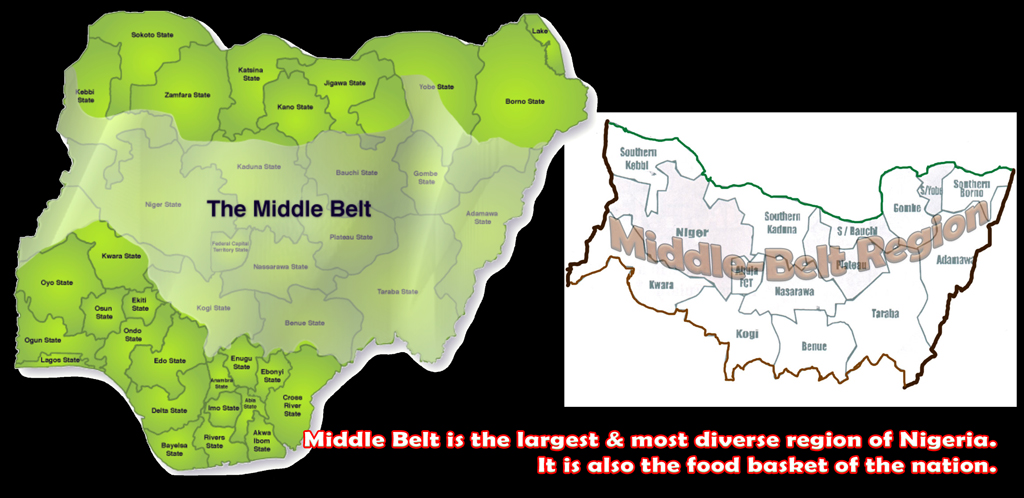

ONLY THE FULANI JIHADIST–IMPERIAL AGENDA FEARS A UNITED MIDDLE BELT
Barr. John Apollos Maton
9th February 2026
A REBUTTAL TO A SAD JOKE MASQUERADING AS POLITICAL ANALYSIS
I don’t know who the recent Fulani stooge Cham Faliya Sharon is, but his/her writeup “IS THE CONFUSION OF THE MIDDLE BELT COMING FULL CIRCLE TO BITE THE MIDDLE BELT” is such a ridiculous piece I was ashamed for the writer when it opened with a quote from Thomas Paine. I mean, it takes a special pompous type of clown to not only go through writing this but even have it reshared on public platforms by the Fulani Immigrants Nigeria should be sending packing.
The joke of an article under review is not analysis but performance—an exercise in ideological ventriloquism by a writer who mistakes obedience for insight. It reads like a brief written to order, not a position arrived at through honest inquiry. Like Judas Iscariot, the author appears to have concluded that selling one’s intellectual integrity for proximity to power is a rational transaction. History, however, records such bargains not as cleverness but as cowardice.
We are told, with great theatrical confidence, that the Middle Belt is a confusion: a geographical impossibility, a political contradiction, a manufactured identity sustained by ignorance and manipulation. Yet what is truly confused is an argument that elevates imposed constitutions to divine scripture while dismissing lived history as irrelevant; that treats maps as sacred while treating people as disposable; and that assumes identity must first be approved by dominant blocs before it can exist. This is not reason—it is authoritarian logic wrapped in the language of common sense.
Let us nonetheless grant the author every imaginable concession. Let us ignore, for the moment, the extensive scholarly work of Dr. Bitrus Pogo and numerous historians, sociologists, and political scientists who have rigorously documented the Middle Belt as a historical and political reality. Let us assume—without conceding—that they are wrong. Let us even accept the childish claim that because the phrase “Middle Belt” does not appear verbatim in the 1999 Constitution, the identity itself must therefore be fraudulent. Even under these generous assumptions, the argument collapses completely.
For even if the Middle Belt were nothing more than a political consciousness emerging from shared experiences of marginalization, violence, and exclusion, that alone would make it real. Peoples are not born fully mapped and notarized; they are forged through history, memory, and struggle. And it is precisely this process—now ripening into collective clarity—that terrifies the imperial imagination animating the essay.
FREEDOM OF ASSOCIATION AND SELF-DETERMINATION ARE NOT GIFTS FROM ANY HEGEMON
At the most elementary level, the argument fails because it assumes identity is something granted rather than asserted. Under Nigeria’s own Constitution, this assumption is indefensible. Section 40 of the 1999 Constitution explicitly guarantees every citizen the right to assemble freely and associate with others for the protection of their interests. Section 39 guarantees freedom of expression, including the right to receive and impart ideas. These provisions are not decorative—they are foundational.
Beyond domestic law, Nigeria is a signatory to binding international instruments that go even further. Article 20 of the African Charter on Human and Peoples’ Rights affirms the unequivocal right of all peoples to self-determination and to freely pursue their political, economic, and social development. Article 22 reinforces this by recognizing the collective right to development. These are not abstract ideals; they are enforceable norms incorporated into Nigerian law by domestication of the Charter.
At the global level, the principle is even clearer. Common Article 1 of both the International Covenant on Civil and Political Rights (ICCPR) and the International Covenant on Economic, Social and Cultural Rights (ICESCR) states plainly that all peoples have the right to self-determination and to freely determine their political status. Nowhere in international law is there a requirement that a people must first satisfy the cartographic preferences of their detractors before asserting this right.
The demand that the Middle Belt must “draw a perfect map” before it may exist is therefore not legal reasoning; it is imperial obstruction. Colonial borders across Africa were drawn arbitrarily, yet no one questions their legitimacy on the grounds of incoherence. To suddenly demand mathematical neatness only when marginalized peoples organize themselves is not intellectual rigor—it is selective skepticism deployed as a weapon.
THE MIDDLE BELT POSSESSES ANCESTRAL LAND, HISTORY, AND MEMORY—IT IS NOT A FICTION
While totally excusing the Fulani Immigrants who have made the lives of true natives and real Indigenes of Nigeria a living hell, one of the most dishonest maneuvers in the essay is its deliberate avoidance of ancestry. We are invited to obsess over lines on a map while ignoring the more uncomfortable question of who has lived where, for how long, and under what conditions. The communities commonly described as Middle Belt peoples are not recent arrivals, nor are they abstract categories invented in conference halls. They are indigenous populations rooted in specific territories long before colonial intrusion.
Unlike the Fulani Immigrants who don’t belong in Nigeria, these communities possess traceable genealogies, distinct languages, religious traditions, and systems of governance that predate both British colonial rule and the later Nigerian state. Historical records—from colonial archives to oral histories—document repeated episodes of subjugation, forced incorporation, and indirect rule imposed upon them. To pretend that these histories dissolve simply because a constitution failed to name them explicitly is not ignorance; it is historical vandalism.
International law has long rejected the notion that identity disappears because it is inconvenient to power. The United Nations’ recognition of indigenous peoples worldwide—culminating in the UN Declaration on the Rights of Indigenous Peoples in 2007—affirmed that historical continuity with pre-colonial societies is a valid basis for collective rights, regardless of later political rearrangements. Identity survives conquest; memory survives subjugation.
What unsettles the Fulani and their stooge — the essay’s author is that this memory is now politically articulate. The Middle Belt is not asking to be invented; it is insisting on being recognized on its own terms, not as an appendix to someone else’s empire. And once ancestry and land are acknowledged, violence can no longer be dismissed as “misunderstanding,” nor dispossession reframed as inevitability.
POLITICAL DIVERSITY DOES NOT NEGATE COLLECTIVE EXISTENCE
Perhaps the most intellectually hollow claim advanced is that internal political diversity invalidates Middle Belt identity. By this logic, Nigeria itself—fractured by ethnic, religious, and ideological divisions—should not exist. The argument collapses the moment it is applied consistently.
Political disagreement is not evidence of non-existence; it is evidence of political life. Only caricatures are uniform. Real peoples debate leadership, disagree on strategy, and pursue competing interests while still recognizing shared historical experiences and structural threats. To demand absolute unanimity as the price of recognition is to demand silence, not coherence.
International practice confirms this reality. From Catalonia to Kurdistan, from Quebec to Scotland, political plurality has never been treated as proof that a people does not exist. On the contrary, it is often cited as evidence of democratic maturity. The insistence that the Middle Belt must be perfectly homogeneous before it can claim identity is therefore not a standard—it is a pretext.
What truly disturbs the essay’s author is not contradiction but consolidation. As long as Middle Belt communities were forced to negotiate individually, they could be managed and ignored. A shared political vocabulary changes that balance. Patterns can be named, responsibilities assigned, and demands articulated collectively. That shift, not geography, is the real provocation.
IDENTITY ERASURE AS A CLASSIC IMPERIAL STRATEGY
The structure of the essay follows a script as old as the attempted Immigrant Fulani empire in Nigeria itself. First, deny that the people exist. Next, ridicule their attempts at self-definition. Then, frame their resistance as manipulation by outsiders. Finally, present continued domination as common sense and stability. This pattern has been documented across colonial history, from the Americas to Africa to Asia.
International law evolved precisely to dismantle this logic. The post-World War II order—reflected in the UN Charter’s emphasis on self-determination—was a direct response to the catastrophic consequences of identity denial and imperial domination. The decolonization movements of the twentieth century did not succeed because empires suddenly became benevolent; they succeeded because peoples insisted on naming themselves.
By portraying Middle Belt consciousness as a southern plot or a geographical error, the essay avoids confronting the structural realities of exclusion and violence. Identity erasure here is not accidental; it is instrumental. If a people do not exist, then nothing done to them can be legally or morally framed as injustice.
What the Fulani and author fears, ultimately, is accountability. A people who know who they are can trace how they arrived at their present condition. They can distinguish accident from policy, conflict from campaign. Once that distinction is made, the old excuses collapse, and the Immigrants who have long overstayed their welcome will be evicted.
CONCLUSION: MIDDLE BELT UNITY IS THE THREAT TO FULANI IMPERIALISM, NOT CONFUSION
Strip away the sarcasm, selective geography, and performative concern, and one truth remains unmistakable: a united Middle Belt disrupts long-standing arrangements of Fulani immigrant domination. It replaces silence with memory and fragmentation with demand for what we as a native people are due. It transforms suffering and genocide under the Fulani Islamic Terrorist Jihadists agenda into political clarity, self determination and intolerance for foreign terrorist influence.
The Middle Belt does not require validation from those Fulani invested in its marginalization and destruction. It does not need permission to associate, to name itself, or to pursue its collective interests. Even the fake Nigerian constitutional law made to further Fulani agenda in Nigeria protects this right. African human-rights law affirms it. International law enshrines it.
The joke of an article I was sent and repeatedly asked to consider is therefore not a warning to the Middle Belt but a confession from Fulani and their stooges. It reveals anxiety, not authority—fear, not confidence.
Like with the Fualni’s who through the Genocide of Christians and Indigenes of Nigeria hope to continue the Fodio Caliphate agenda, empires are never threatened by confusion. They are threatened by clarity.
And clarity is precisely what is emerging.