Minister Alake’s Fantasy Economics: How Unrealistic Targets Are Destroying Nigeria’s Mining Sector

By Billiyamniu Suraj

Biliyasuraj247@yahoo.com

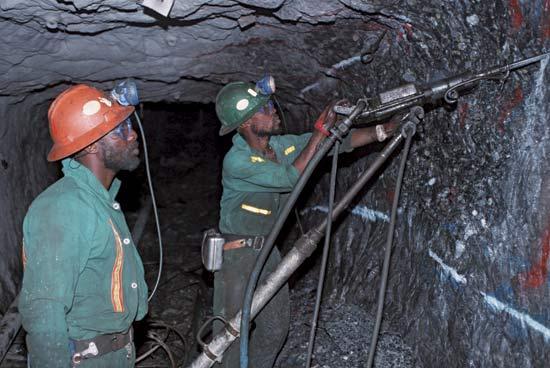
Nigeria’s Minister of Solid Minerals Development, Dr. Dele Alake, has made bold promises about transforming the country’s mining sector. His stated aspiration for mining to contribute “around 50 percent of GDP” has captured headlines and generated excitement about Nigeria’s mineral potential. However, this target reveals not ambition but a fundamental disconnect from the realities of international mining economics , a disconnect that is actively harming the sector it purports to develop.

To understand how divorced from reality this target is, consider the world’s premier mining nations. Australia, with over a century of mining development, world-class geological data, transparent regulation, sophisticated capital markets, and billions in ready investment capital, sees its mining sector contribute approximately 12-14% to GDP. Canada’s mining sector, similarly mature and well-developed, contributed about 4-6% to national GDP in recent years.

Yet Nigeria, where the mining sector currently contributes less than one percent to GDP and actually declined by 21% in 2024 compared to 2023, is supposedly targeting 50%. This is not merely optimistic, it suggests either a catastrophic misunderstanding of the mining industry or a cynical manipulation of public expectations to justify policies that serve other agendas.

The Seven-Point Agenda: Reforms That Ignore Root Causes

Minister Alake has unveiled a seven-point agenda to reposition the sector: establishing the Nigeria Solid Minerals Company, creating Mines Marshalls to combat illegal mining, acquiring comprehensive geological data, formalizing artisanal and small-scale mining, promoting value addition and local processing, attracting large-scale investment, and strengthening stakeholder engagement.

On paper, these initiatives sound reasonable. In practice, they fail to address or even acknowledge the fundamental problems destroying Nigeria’s mining sector: systematic corruption at the Mining Cadastre Office (MCO), lack of security of title, a punishing fee structure that bankrupts local miners, and the systematic sabotage of a $60 million World Bank-funded cadastre system specifically designed to prevent these failures.

The Ministry’s stated reasons for lack of investment, “insufficient geological data, weak infrastructure, informal operations, illegal mining, and a significant financing gap”, conveniently omit the elephant in the room: institutional corruption and regulatory dysfunction that makes Nigeria’s mining sector toxic to legitimate international investors. This selective diagnosis suggests the Ministry either does not understand how the global mining sector works or is deliberately obscuring the real obstacles to development.

When “Reforms” Become Instruments of Corruption

Perhaps most troubling is evidence that even newly created reform initiatives are being corrupted from inception. The Mines Marshalls, established ostensibly to combat illegal mining, have reportedly been deployed as private security for parties in the Minister’s favor. Rather than enforcing the law impartially, this taxpayer-funded force allegedly serves to protect connected operators while harassing legitimate miners who lack political patronage.

If accurate, this transforms a law enforcement initiative into an instrument of favoritism and intimidation, further entrenching the very corruption it was supposedly created to combat. When even new institutions are corrupted before they can function properly, it reveals the depth of the systemic rot and raises serious questions about whether reform is possible under current leadership.

The Revenue Paradox: Punishing Miners to Generate Numbers

In the first quarter of 2025 alone, the MCO and Mines Inspectorate recorded N6.9 billion and N7 billion in revenue respectively, figures the Minister and MCO Director-General hailed as an “outstanding success.” However, this purported success masks a devastating reality for Nigerian miners and exposes the Ministry’s fundamental misunderstanding of how mining investment works.

The dramatic fee increases that generated these revenue figures have created an unprecedented crisis for local mining operators. The national president of the Miners Association of Nigeria (MAN) highlighted that access to finance remains “the number one challenge facing artisanal and small-scale miners,” describing mining as “a capital-intensive and high-risk sector” where “without targeted funding, our local operators cannot survive, let alone thrive.”

Local miners have made clear that after paying the inflated MCO fees, they lack sufficient capital to actually conduct mining operations, forcing them to seek external financing for what should be operational capital. This is particularly devastating in Nigeria’s context, where the mining sector has not yet developed the mature capital markets seen in countries like Canada and Australia, where exploration is financed through regulated stock exchange listings that distribute risk among investors.

In mature mining economies, companies raise capital through public markets, allowing investors to bear exploration risk in exchange for potential returns. Nigeria’s mining sector has not reached this stage of development. Individual miners must find private capital to explore, make discoveries, and prove such discoveries are the basis for commercial mining operations. The exorbitant fees introduced by the Ministry make this already difficult task nearly impossible.

The Mass Revocation Crisis: Creating Illegality by Design

The result has been an unprecedented wave of title revocations as miners default on inflated fees they simply cannot afford. This mass revocation is not merely an administrative matter, it is forcing Nigerian miners to operate illegally, creating the very conditions for insecurity that the government claims to want to prevent.

When legitimate operators are pushed into illegality by impossible regulatory demands, they join the shadow economy alongside criminal networks. The distinction between forced illegality and criminal enterprise becomes blurred, creating lawless zones where neither regulatory authority nor community accountability operates. The natural resources that belong to all Nigerians are thus exploited and sold by illegal operators who pay no royalties to the federal government, enter into no community development agreements, and provide no fair compensation to landowners.

The Ministry has promoted a “use it or lose it” policy regarding mining titles, presenting it as a reform that will open opportunities for new operators. However, this ignores fundamental mining economics. In mature mining economies like Canada and Australia, the average period from discovery to mine development is eighteen years. This timeline reflects the realities of exploration, feasibility studies, environmental assessments, permitting, financing arrangements, and infrastructure development.

An environment where revocation has become routine due to unpayable fees is not an incentive for development, it is a powerful deterrent to international mining investment. Legitimate mining companies operate on decade-long timelines with hundreds of millions of dollars at stake. They cannot invest such capital in jurisdictions where titles can be arbitrarily revoked or where regulatory demands are economically impossible to meet.

The Stark Reality: A Sector in Decline, Not Growth

The statistics tell a story that contradicts the Ministry’s triumphalist rhetoric. According to the National Bureau of Statistics, Nigeria’s solid minerals, mining, and quarrying sector’s contribution to GDP declined by 21 percent in 2024 compared to 2023, this despite “various reforms and policy changes aimed at revitalising the sector under the current administration.”

In 2021, the mining industry contributed a mere 0.33% of Nigeria’s GDP. The sector generated N193.59 billion in revenue that year, representing less than 1% of national GDP, only 2.62% of total revenue, and a negligible 0.24% of total exports. Over fifteen years, the sector has generated only N814.6 billion in revenue total, indicating it is far from being a major revenue earner.

These figures expose the hollowness of the Ministry’s claims of success. When your sector is shrinking rather than growing, when your contribution to GDP is declining rather than increasing, and when international investors are fleeing rather than arriving, declaring high fee collection as an “outstanding success” reveals either profound delusion or deliberate deception.

International Investor Confidence: From Bad to Worse

International investor confidence in Nigeria’s mining sector is at an all-time low, despite ministerial rhetoric to the contrary. Minister Alake has claimed that UK, US, Saudi Arabia, and UAE officials have expressed interest in Nigeria’s lithium and other critical minerals. However, industry insiders describe this as an “improbable interpretation of the real situation.”

The reality is starkly different: the US, Canada, and Australia, all major international mining economies with mature industries, have effectively put investment in Nigeria’s mining sector on hold. The UK, France, and Germany, which require stable long-term supplies of critical minerals for their green energy transitions, are engaged only in tentative discussions with no concrete progress to date.

Nigeria’s absence from the 2025 Africa Down Under conference in Australia is particularly telling. The conference serves as a major platform for African mining investment promotion and would typically feature significant Nigerian participation given the country’s mineral wealth and need for foreign investment. Speculation has linked this absence to concerns about international arbitration proceedings, including those involving Jupiter Critical Minerals Project over a billion-dollar lithium project.

The lack of security of title, the fundamental requirement for mining investment, undermines any possibility of attracting investment from major international mining companies. When legitimate investors face license cancellations, overlapping claims, or other bureaucratic obstacles, they may seek recourse through international arbitration. Nigeria could face multiple such cases, potentially costing the nation far more than any revenue generated by inflated fees.

The Environmental and Social Costs

Beyond financial dysfunction, the Ministry’s policies have enabled environmental destruction on a massive scale. Chinese mining companies operating in Nigeria have been accused of deploying outdated and environmentally destructive technologies that would be banned in their home country. The absence of rigorous environmental oversight has resulted in ecosystem damage, soil degradation, and health problems for communities near mining operations.

Local residents in mining-affected areas report contaminated water sources, destroyed agricultural lands, and respiratory illnesses linked to mining dust and chemical runoff. The failure to enforce environmental standards or revoke licenses from violating operators suggests either incompetence or deliberate complicity in the destruction.

This environmental crisis is compounded by the illegal mining operations that flourish as legitimate miners are forced underground by impossible fee structures. These illegal operators have even less incentive to follow environmental protocols. The irony is stark: while the Ministry claims to be formalizing artisanal and small-scale mining as part of its seven-point agenda, its policies are actually driving miners underground, creating more environmental damage and less regulatory oversight than before.

Meanwhile, foreign companies with ready access to capital and connections operate with impunity, extracting Nigeria’s resources while leaving behind environmental devastation and providing minimal benefit to local communities who bear the costs of contaminated ecosystems. The growing investment by Chinese players in downstream minerals processing, rather than in exploration and development of new mines, creates ready markets for illegally extracted minerals, establishing a parallel economy that benefits foreign processors while Nigerian communities and the national treasury receive nothing.

The Question of Competence vs. Intent

The pattern of policy failures raises a fundamental question: Is the Ministry incompetent or corrupt? Does it genuinely not understand how international mining investment works, or does it deliberately implement policies that serve interests other than national development?

The 50% GDP target suggests profound ignorance of mining economics. The fee structure that bankrupts local miners while generating impressive revenue numbers suggests a focus on short-term financial extraction rather than long-term sector development. The failure to acknowledge or address institutional corruption at the MCO suggests either wilful blindness or complicity. The corruption of new initiatives like the Mines Marshalls suggests that reform is impossible under current leadership because even new institutions are captured before they can function.

Whether through incompetence or intent, the result is the same: a mining sector in accelerating decline, local miners driven into bankruptcy or illegality, international investors fleeing, environmental destruction proceeding unchecked, and billions in potential revenue lost to corruption and dysfunction.

The Cost Question: At What Price “Transformation”?

Minister Alake is determined to transform the sector, but at what cost? At what cost to local miners forced into bankruptcy or illegality? At what cost to communities suffering environmental destruction? At what cost to national security when regulatory failure breeds insecurity and empowers criminal networks? At what cost to Nigeria’s international reputation when legitimate investors flee and arbitration cases loom?

The question “at what cost?” reverberates through every aspect of the current situation. The Minister’s determination has produced impressive revenue numbers but a sector in decline. It has produced bold targets but collapsing investor confidence. It has produced new institutions that are corrupted before they function and new policies that punish compliance while rewarding corruption.

Conclusion: When Ambition Becomes Delusion

Nigeria possesses significant mineral wealth that could drive economic development, create jobs, and reduce dependence on oil revenues. Realizing this potential requires realistic targets grounded in international mining economics, policies that enable rather than punish local investment, genuine security of title, environmental enforcement, and above all, addressing the institutional corruption that makes Nigeria’s mining sector toxic to legitimate investors.

Minister Alake’s 50% GDP target is not ambitious, it is delusional. His seven-point agenda does not address root causes. His revenue numbers mask the destruction of local mining operations. His reforms are corrupted before implementation. His rhetoric about international interest contradicts the reality of fleeing investors.

The Minister’s stated priorities reveal a profound disconnect from reality. Insufficient geological data, weak infrastructure, and informal operations are genuine challenges, but they pale in comparison to the fundamental problem the Ministry refuses to name: institutional corruption so deep and systematic that it has made Nigeria’s mining sector a cautionary tale rather than an investment destination.

Without a fundamental shift in approach, including realistic targets, affordable fee structures, genuine security of title, environmental enforcement, and above all, confronting rather than obscuring institutional corruption, the mining sector will continue its decline. The 21% drop in GDP contribution in 2024 is not an anomaly; it is the predictable result of policies disconnected from economic reality and a leadership either unable or unwilling to address the fundamental obstacles to sector development.

The minerals will remain in the ground long after current officials have departed. The question is whether Nigeria will have developed the institutional capacity, regulatory credibility, and economic understanding necessary to extract them responsibly and profitably, or whether fantasy economics and corrupted reforms will continue to ensure that Nigeria’s mineral wealth benefits everyone except Nigerians.


This article is based on multiple investigative reports, stakeholder accounts, public documents, and industry data detailing policy failures in Nigeria’s Ministry of Solid Minerals Development. The issues documented represent patterns identified by journalists, industry participants, and civil society observers concerned about governance in Nigeria’s mining sector.


Cash, Lies and Lithium: Inside Colin Ikin’s Alleged Exploitation of Nigeria’s Mining Communities

By MB Times Admin

An investigation into Colin Ikin’s operations in Southern Kaduna reveals a troubling pattern of alleged bribery, forged documents, and community manipulation that mirrors his catastrophic corporate history in Australia—raising urgent questions about Nigeria’s mining oversight.


(Kaduna), In the mineral-rich hills of Southern Kaduna, Northwest Nigeria where lithium and nickel deposits lie beneath Kaninkon land, a familiar story of grand promises and questionable tactics is unfolding. At its center stands Colin Ikin, the Australian mining executive whose corporate failures cost investors nearly $750 million in his homeland, and now, allegedly using cash payments and false governmental connections particularly at the presidential level, to gain control over Nigeria’s valuable mining concessions.


Recent investigations in Jama’a Local Government Area of Kaduna state, where Ikin’s Atlantic Mining Techniques Limited has been attempting to operate, reveals a pattern of activities that community leaders describe as manipulative and potentially fraudulent—allegations that gain credibility when viewed against Ikin’s documented history of corporate catastrophe in Australia.


The Southern Kaduna Operations
Community leaders in Bakin Kogi, Dangoma and surrounding areas paint a troubling picture of Ikin’s methods. According to sources who spoke on condition of anonymity due to fear of intimidation, the Australian executive has been using cash payments to secure local support while making claims about high-level government connections.


“In December last year, he gave out millions of Naira to buy loyalties from people who were willing to sell,” revealed a community leader from Bakin Kogi.

“Some group of elders, a few of them were given 10 million naira in December 2024 by Colin Ikin. That is strange to me because Australians are known to be well-behaved people in business. I have worked with them when I was much younger and I can tell you that they hardly do bribes.”


The source’s concerns extend beyond the alleged payments to Ikin’s intimidation tactics and grandiose claims. “Colin Ikin boasts so much of having connections to the presidency, and with that claim, he is bullying our people into accepting his own terms and surrendering our lands to his company, Atlantic Mining Techniques, for peanuts. Unfortunately, some of our elders, like I said earlier, have fallen for his tricks.”


What particularly alarms community leaders is the absence of standard mining industry practices. “What baffles me most is that Colin isn’t talking about anything like a Community Development Agreement; no clear blueprints for our communities, unlike what we have seen other mining companies do in recent years,” the source explained.


Another community leader from Godogodo expressed deep concern about the state government’s apparent endorsement of Ikin’s operations: “The ongoing romance between the Kaduna state government and Colin Ikin will only lead to chaos in the communities as we do not trust the Australian. His methods are not what we have seen from other mining companies operating in our area.”


Federal Ministry Denies Ikin’s Claims

Despite his alleged boasts about presidential connections and his meetings with state governments, independent investigations reveal that Ikin lacks proper authorization from federal authorities. Kayode Ogunbunmi, a media consultant purportedly linked with the Nigerian Mining Office in Abuja, categorically denied any record of Ikin’s applications in a response to an earlier article accusing the mining office of inadequate oversights.


“The glib reference of Kefas to a Mr Colin Ikin allegedly ‘wanted’ in Zimbabwe and being embraced here is nothing short of a stupor induced hallucination. Truth is, there’s no record of any such Mr Colin’s application or titles in the Federal Ministry of Solid Minerals till date!” Ogunbunmi had stated.


This revelation raises serious questions about how Ikin has been operating in multiple Nigerian states—including documented meetings with officials in Kaduna and Nasarawa—without proper federal licensing. It also raises questions about Ikin’s support network in Nigeria that allows him to perpetuate fraudulent claims. Who are his backers? Who owns Atlantic Mining Techniques Ltd?


The Zimbabwe Connection

Nigeria’s failure to conduct proper due diligence on foreign mining operators becomes more concerning when viewed against experiences elsewhere in Africa. Zimbabwe’s former Chairman of Mines and Energy, Temba Mliswa, has documented similar patterns of exploitation by questionable foreign operators.


“A peculiar case of Colin Ikin, a dodgy mining mogul, has raised my interest. Why does the government seem hell-bent on protecting rogue white business people in this country?” Mliswa questioned, highlighting regulatory capture that has become endemic across African mining sectors.


According to Mliswa’s documentation, Ikin faces serious allegations in Zimbabwe, including criminal activity reported to police, forgery of bank documents, and illegal withdrawal of funds. “This time around, he is alleged to have forged bank documents and went ahead to illegally withdraw US$10,000 from an Afrocash Micro NMB account,” Mliswa noted, describing police cases for fraud and forgery of company documents.


Mliswa’s broader observation resonates with Nigeria’s current situation: “It seems we are intent on becoming a safe haven for foreign criminals, while our own people are constantly faced with the rough edges of the law to the point of being second-class citizens.”


Community Resistance and Formal Complaints

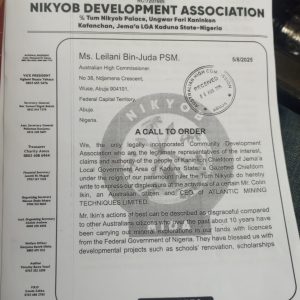
The Nikyob Development Association (NIDA), representing the mining communities in Kaninkon land, has taken formal action against Ikin’s activities. In August 2025, NIDA wrote to the Australian High Commissioner in Abuja, Ms. Leilani Bin-Juda, requesting intervention.


The letter, obtained through this investigation, details a pattern of alleged misconduct: “Mr. Colin Ikin and his company have been involved in forgery, bribery and intimidation of locals who do not support their ‘land grabbing’ scheme. The situation is tense, to say the least.”
NIDA’s complaint highlights the contrast between Ikin’s methods and those of legitimate mining operators: “Other Australian citizens who over the past 10 years, have been carrying out mineral explorations in our lands with licences from the Federal Government of Nigeria… have blessed us with developmental projects such as schools’ renovation, scholarship assistance for students, agricultural support, electrification, water boreholes and other interventions as provided for in our Community Development Agreements.”

A copy of the letter obtained by MBT

The association accused Ikin of attempting to “grab our lands… from the rightful owners and from other licence holders including Basin Mining and Range Mining with the Jupiter Lithium project,” using forged consent documents after the traditional council withdrew its original approval which was obtained with misleading information.


The community leadership has recently written to the Minister and the DG-MCO declaring the community will not give consent to any new company the Ministry or MCO sends to the community seeking for consent. The community wants continuity and consistency in the development of the mineral assets on their traditional land.


“Whatever consent Mr. Ikin has or is parading is a forged document,” NIDA stated, adding that “Atlantic Mining Techniques limited and Colin Ikin are the ones sponsoring” court cases against existing licensed operators.


The Australian Track Record

Ikin’s Nigerian operations become particularly concerning when viewed against his documented corporate history in Australia. As Executive Chairman of Preston Resources, Ikin presided over one of the worst corporate disasters in modern Australian mining history—a spectacular collapse that wiped out nearly $750 million in investor funds.


The Preston Resources saga began when the company, under Ikin’s leadership, acquired the Bulong nickel project for $319 million—money the company didn’t have. Shareholders were effectively held hostage by a $10 million break fee commitment when Preston only had $2 million in the bank.


Despite Ikin’s promotional materials describing Bulong as “an outstanding opportunity” that would make Preston “a significant international nickel producer,” the reality proved catastrophic. The Bulong plant never met production forecasts, cash flow projections failed to materialize, and by 2000, Preston had accumulated losses of $497 million with liabilities exceeding assets by $430 million.


Financial columnist Trevor Sykes, an award-winning journalist with 61 years of experience, documented how investors who had paid $1.50 per share to support the Bulong purchase were “financially disemboweled.” The aftermath saw Preston’s board, including Ikin, proposing to hand over 95% of Bulong to note holders, leaving shareholders with assets worth just $787,000 against liabilities of $5 million.


Regulatory Failures and Systemic Vulnerabilities

The Ikin case exposes critical weaknesses in Nigeria’s mining sector governance. Despite the federal government’s push to diversify from oil revenues and develop the solid minerals sector, the country appears to lack robust systems for vetting foreign operators with questionable backgrounds.


State governments, eager for investment and job creation, appear to be making commitments to operators without proper federal coordination or due diligence. The disconnect between Ikin’s state-level meetings—documented in Kaduna and Nasarawa—and the federal ministry’s denial of any licensing applications reveals dangerous coordination gaps.


This regulatory vacuum creates opportunities for operators like Ikin to exploit Nigeria’s mining potential while potentially exposing communities and investors to the same risks that devastated Preston Resources shareholders in Australia.


A Continental Pattern of Exploitation

Nigeria’s experience with questionable foreign mining operators reflects broader continental challenges. From the Democratic Republic of Congo to Tanzania, African nations have struggled with operators who make grand promises but lack the financial backing or technical competence to deliver sustainable mining operations.


The difference between legitimate operators and questionable ones often becomes apparent in community engagement. Legitimate mining companies typically invest heavily in community development agreements, environmental impact assessments, and stakeholder consultation before beginning operations. They also secure proper licenses and maintain transparent financial backing.


By contrast, operators following the pattern allegedly exhibited by Ikin—cash payments to local leaders, claims about political connections, operations without proper federal licensing, and absence of community development frameworks—represent exactly the kind of extraction-focused approach that leaves host communities worse off than before mining began.


Conclusion: Protecting Nigeria’s Mining Future

As Nigeria seeks to diversify its economy beyond oil dependency, the solid minerals sector offers genuine opportunities for sustainable development. However, realizing this potential requires partnerships with operators who bring not just promises but proven competence, financial backing, and commitment to responsible mining practices.


The Colin Ikin case serves as a powerful reminder that not all foreign investment is beneficial investment. Operators with histories of corporate failure and alleged misconduct in other jurisdictions pose risks not just to investors but to the communities whose lives and lands become entangled with their operations.
Nigerian authorities at federal and state levels must recognize that protecting the country’s mineral wealth requires saying no to questionable operators, regardless of their perceived promotional skills or their claimed political connections. The stakes are too high—and Nigeria’s mining potential too valuable—to risk on operators whose track records suggest they are more likely to leave behind devastation than development.


The communities of Southern Kaduna, like investors who lost fortunes in Preston Resources, deserve better. Nigeria’s mining revolution should create lasting prosperity, not expensive disappointments orchestrated by operators whose previous ventures collapsed in spectacular failure. Learning from other countries’ mistakes isn’t just good governance—it’s essential towards ensuring that Nigeria’s mineral wealth truly serves its people’s interests.

INVESTIGATION: How Federal Government’s Abandonment of Strategic Manchok-Vom Road Strangles Economic Lifeline and Fuels Insecurity

By Steven Kefas

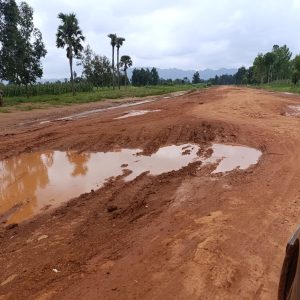
The sun beats down mercilessly on dozens of stranded vehicles along what should be one of Nigeria’s most vital economic arteries. For hours, commercial drivers, traders, and farmers have been trapped in a quagmire of mud, broken asphalt, and bureaucratic neglect that defines the current state of the Manchok-Ganawuri-Vom federal road.

This 52-kilometre stretch, designated as a federal highway, serves as a critical economic lifeline connecting Plateau State with Kaduna and numerous neighboring states across Nigeria’s Middle Belt region. Yet today, it stands as a monument to governmental abandonment and institutional failure.

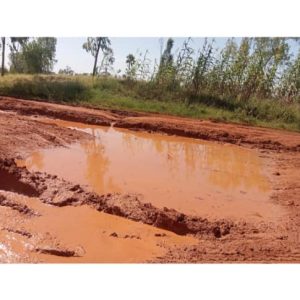
A portion of Ganawuri axis of the Manchok-Vom road. Credit: MBT

The communities dotting this strategic corridor are among Nigeria’s most productive agricultural zones. Farmers here cultivate vast quantities of yam, maize, rice, potatoes, and ginger – crops that feed millions across the country. However, the deplorable condition of their primary route to market has transformed what should be prosperity into a daily nightmare of economic losses and human suffering.

“We produce enough food to feed millions of Nigeria, but we cannot get our harvest to the people who need it,” laments Musa Ibrahim, a farmer from Ganawuri whose truck loaded with yams overturned last month, destroying produce worth over 3 million naira.

The economic implications extend far beyond individual losses. Trucks carrying goods such as bottled drinks, water etc worth millions of naira regularly topple over on the treacherous terrain, their cargo spilling into roadside ditches where it rots under the elements. The ripple effects reach urban markets in Jos, Kaduna, and Abuja, where food prices continue to soar partly due to transportation challenges from these productive farming communities.

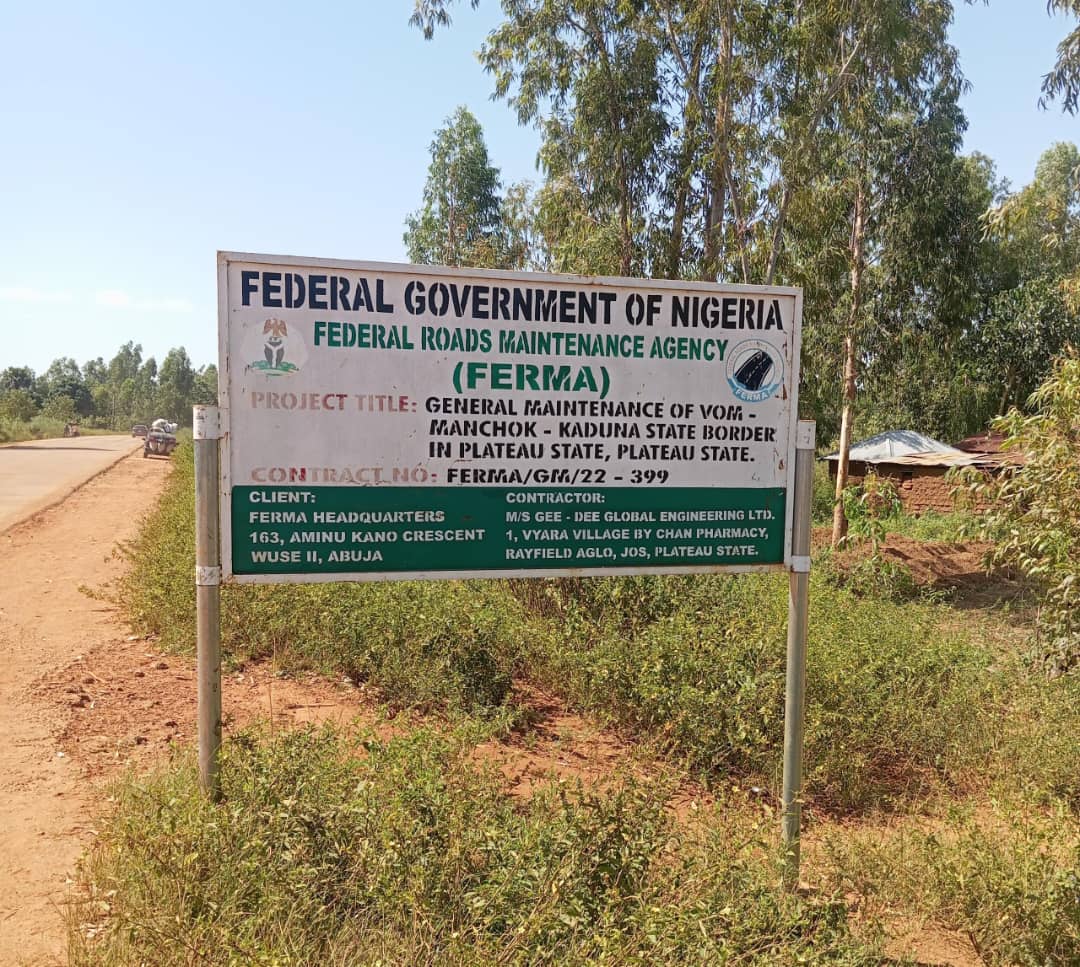
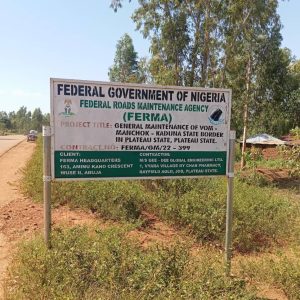
Perhaps the most insulting aspect of this crisis is the massive signpost erected by the Federal Road Maintenance Agency (FERMA) boldly declaring that the Manchok to Vom Junction stretch has been “rehabilitated.” This gigantic billboard stands as a cruel joke to daily road users who navigate crater-sized potholes and impassable mud pools.

FERMA’s gigantic signpost. Credit: MBT

All efforts to reach FERMA for comments on the road’s condition and their maintenance claims proved unsuccessful. Multiple phone calls to the two contact numbers listed on the agency’s official website went unanswered, while a text message sent seeking their response was never replied to.

A closer examination reveals the truth behind FERMA’s claims. While minor patch work was indeed carried out on sections with small potholes, the Ganawuri portion – the most critical and severely damaged section – remains completely untouched. It is a classic case of cosmetic intervention designed more for political optics than genuine infrastructure development.

The agency’s selective rehabilitation approach has created an even more dangerous situation. Drivers, encouraged by the initial smooth patches, accelerate into what becomes a vehicular trap at Ganawuri, where the road deteriorates so dramatically that vehicles frequently get stuck for entire days.

The federal government’s neglect has created an unprecedented situation where local youths have essentially privatized a federal highway. Young men from Ganawuri now control access to the most treacherous sections, strategically placing rocks across deep craters and charging motorists 500 naira for the privilege of attempting passage.

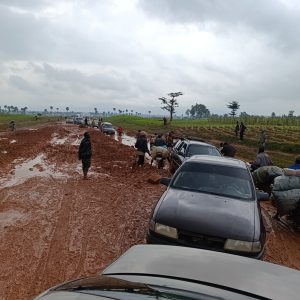
During this reporter’s investigation on Wednesday, August 27, the situation had reached absurd proportions. After paying 1,000 naira through mobile transfer for road access, this correspondent joined dozens of other vehicles in a hours-long traffic standstill that stretched for about 1 kilometre.

Another portion of the road. Credit: MBT

The scene resembled a refugee camp more than a major highway. Frustrated passengers had disembarked, seeking shade that did not exist on the road. Hawkers moved through the stationary traffic selling water, sugarcane, and snacks to stranded travelers. Mothers with crying babies pleaded with drivers to somehow find alternative routes that simply do not exist.

The agricultural community has been forced to adapt in ways that highlight the severity of the situation. Farmers who once loaded their produce onto trucks for efficient transport to distant markets now depend entirely on motorcycles for their logistics chain.

Stranded road users on the bad portion of the road. Credit: MBT

“I used to send bags of potatoes to Kaduna and Abuja markets in one trip,” explains Rebecca Dung, a potato farmer in the area. “Now I can only send two bags at a time on a motorcycle, and the transport cost has tripled. Many of us are considering abandoning farming altogether because we cannot transport our potatoes to the market and they go bad after a few days”

This shift from truck-based to motorcycle-based transportation has reduced agricultural efficiency by approximately 80 percent while increasing costs exponentially. The knock-on effects include reduced agricultural investment, lower crop cultivation, and ultimately, decreased food security for the broader region.

Commercial drivers operating along this route have become unwilling martyrs to federal government negligence. Michael Adamu, who has been plying this route for over a decade, provides a heartbreaking testimony of occupational hazard that no professional should endure.

“Any time I manage to pass this road with passengers during the rainy season like this, I have to go straight to the mechanic workshop,” Adamu reveals, his voice heavy with frustration. “We are suffering here as you can see, we have been here for several hours and don’t know when we will move. The government must do something about this road.”

His experience is not unique. Conversations with multiple commercial drivers reveal a pattern of vehicle damage, increased maintenance costs, and lost income that threatens their livelihoods. Some road users have developed back and joint problems from navigating the rough terrain, while others have abandoned the route entirely, reducing transportation options for rural communities.

The road’s deplorable condition has created a security vacuum that armed militants and criminals exploit with devastating consequences. Habu Lucky, a local vigilante member in Ganawuri, articulates a reality that government security strategists seem to have ignored completely.

“As you can see, the condition of this road also makes it difficult for security response. Even if there is a security challenge, how do you think security personnel can access the communities? Tell me,” he challenges, gesturing toward the impassable terrain.

His concerns proved tragically prophetic on December 22, 2024, when armed Fulani militants attacked Gidan Ado community in Ganawuri chiefdom, Riyom Local Government Area. Fourteen people, including a pregnant woman, were killed in an attack that security forces struggled to respond to effectively due to the impassable road conditions.

The incident illustrates how infrastructure neglect becomes a national security threat. When government forces cannot reach crisis zones quickly, local communities become sitting targets for criminal elements who understand the terrain’s strategic advantages.

The Manchok-Ganawuri-Vom road crisis demands immediate federal intervention that goes beyond the superficial patch work that has characterized previous efforts. What is required is comprehensive reconstruction that acknowledges this route’s strategic importance to Nigeria’s food security and regional economic integration.

The federal government must treat this highway with the urgency it deserves – as a critical piece of national infrastructure whose failure threatens the economic survival of entire communities and the food security of millions of Nigerians.

Until then, farmers will continue watching their harvests rot, drivers will keep visiting mechanics after every journey, and communities will remain vulnerable to security threats that thrive in the shadow of governmental neglect.

The question remains: How long will the federal government allow one of Nigeria’s most productive regions to remain economically strangulated by a road that should be connecting communities, not isolating them?

This investigation was conducted over multiple visits to the Manchok-Ganawuri-Vom corridor, with extensive interviews of affected stakeholders including farmers, commercial drivers, local leaders, and security personnel.

Allegations Of Unpaid Contracts, Corruption Surface Against Formal Act Legacy Limited, CEO Dr. Bashir Ibrahim Bello

A troubling report has emerged alleging unpaid contracts and possible corruption involving Formal Act Legacy Limited, a company known for its community-based interventions in education, health, and water security.

The company, founded in 2011, collaborates with international organizations, local government agencies, and traditional leaders to promote sustainable development, focusing on Sustainable Development Goals 3, 4, and 6.

The allegations centered on claims that Formal Act Legacy Limited and its CEO, Dr. Bashir Ibrahim Bello, awarded contracts that were later sold to subcontractors who reportedly borrowed money to execute the projects. These subcontractors alleged they have not been paid for their work, with the debts stretching over three years.

Furthermore, there are accusations that influential figures, including some government officials and security service chiefs, may be complicit in the alleged misconduct.

The alleged non-payment of contractors has reportedly caused severe financial hardship for those affected, with some unable to provide basic needs for their families.

Accounts from affected subcontractors include distressing reports of poverty, families struggling with education and sustenance, and even deaths resulting from the associated economic strain.

The situation has sparked public outcry, with demands for an immediate and transparent investigation into the company’s activities.

Stakeholders are urging relevant authorities to examine the allegations and hold those responsible accountable.

Advocates stressed the importance of justice and prompt compensation for the subcontractors who have suffered.

The subcontractors, in their pursuit of justice, have already contacted EAGLE BRAIN, a noted social justice advocacy organization, seeking intervention and support in addressing their grievances.

May the Ministry of Steel Development not live by its Homophone —say Amen 

By Shalom Kasim

In the wake of recent scandals involving the Ministries of Humanitarian Affairs and Interior, a looming potential risk emerges with the Ministry of Steel Development. While there’s no current evidence of malfeasance within the steel sector, the prospect of this key ministry collaborating with counterparts under investigation raises significant concerns about the integrity of the government’s economic agenda.

President Tinubu’s vision for a revitalized steel development industry as a catalyst for economic growth (as earlier announced by his singing bird) is commendable. However, the timing of the Ministry of Steel Development’s involvement, amidst ongoing scandals, demands a closer examination of the potential risks that could unfold.

As the government pursues partnerships with foreign companies, such as the Chinese Luan Steel Holding Group and the Indian Jindal Steel Group, the influx of billions of dollars into Nigeria’s steel sector presents both opportunities and dangers. The lack of transparency and accountability in the Ministries of Humanitarian Affairs and ‘ Interior serves as a warning that we should not act deaf to, emphasizing the urgent need for robust oversight mechanisms in the steel industry.

The collaboration between these ministries, tainted by allegations of financial impropriety, poses a threat to the very economic growth the government aims to achieve. The potential for corruption, embezzlement, and mismanagement of funds in the steel sector could jeopardize not only foreign investments but also the livelihoods of thousands of Nigerians who stand to benefit from job opportunities in this critical industry.

Nigerians must remain vigilant and demand proactive measures to safeguard the Ministry of Steel Development from succumbing to the pitfalls witnessed in other government departments. President Tinubu’s commitment to transparency and accountability should extend to the steel sector, ensuring that every dollar invested contributes to the nation’s economic growth rather than lining the pockets of a select few.

While the Ministry of Steel Development may currently be free from scandal, the risks lie in its collaboration with tainted counterparts. As citizens, we cannot afford to turn a blind eye to the potential dangers that may lurk beneath the surface. Let this serve as a warning, urging the government to implement stringent measures to protect the nation’s economic interests and restore public confidence in the face of ongoing challenges.

We are not pessimists. We are just Nigerians who knows their country.

Kasim is a public affairs commentator, a poet and a journalist. He writes from Wukari, Taraba state, Middle Belt Nigeria.

They paid for it; give them their certificates!

By Shalom Kasim

I am deeply concerned about the recent decision to suspend the evaluation and accreditation of degree certificates from Benin Republic and Togo. While the government’s response is rooted in addressing certificate racketeering, we must consider the human angle of this situation.

The investigative report sheds light on a complex issue, revealing the existence of a certificate racketeering syndicate. However, the decision to suspend accreditation without a thorough examination of the circumstances surrounding each certificate undermines the educational pursuits of countless genuine students who earned their degrees legitimately.

It is crucial to acknowledge that not all degrees from these countries are tainted by fraudulent activities. Suspending the evaluation of all certificates casts a shadow of doubt on the entire academic community of Benin Republic and Togo, impacting innocent graduates who have worked diligently to obtain their qualifications.

Furthermore, the collateral damage extends to Nigerians who pursued education in these countries in good faith. Many students choose international institutions for various reasons, seeking diverse educational experiences and opportunities. The blanket suspension risks penalizing these students unfairly.

Instead of a sweeping suspension, a more targeted and nuanced approach should be adopted. Investigative efforts should focus on identifying and penalizing those responsible for the racketeering, rather than punishing an entire academic system. Collaborative efforts between the involved countries, educational institutions, and regulatory bodies can ensure a fair and just resolution.

The decision to involve multiple ministries, security agencies, and internal administrative processes may prolong the resolution, causing unnecessary delays for genuine graduates awaiting accreditation for employment or further studies.

In addressing the issue of degree mills, it is essential to differentiate between reputable institutions and those engaging in fraudulent activities. The global problem of diploma mills requires a coordinated effort, but caution must be exercised to protect the interests of legitimate students and educational institutions.

While the government’s intention to curb certificate racketeering is commendable, the suspension of degree accreditation should be approached with a balanced and targeted strategy. Failing to do so risks harming the futures of countless deserving individuals who pursued their education in good faith.

Someone reminded me the Minister of Education is a professor. I said, “yes, yes.”.

Kasim is public affairs commentator, a poet and a journalist. He writes from Wukari, Taraba State, Middle Belt Nigeria

Female Students’ Unending Battle With Randy Lecturers

Female Students’ Unending Battle With Randy Lecturers

It was in 2018 that Adaora (surname withheld) was admitted to study English and Literary Studies at the Akwa Ibom State University, Ikot Akpandem, Akwa Ibom State. She had earlier sat the United Tertiary Matriculation Examinations three times to study at the University of Uyo, Uyo, without success, before she decided to go to AKSU.

Just three months after school resumption, a part-time lecturer started harassing her.

The first day he saw her, she said he spanked her buttocks, as she walked passed him in a busy hallway. He apologised, saying it was a mistake.

Again in class, she said he came close and sat on the same desk with her while lecturing, giving her seductive gestures.

“He was not a small boy. This man should be in his 50s. He made life a living hell for me at AKSU,” she added.

According to Adaora, when he eventually made his first attempt to speak to her, he asked to see her in his office.

Although it was a shared office, she noted that the other lecturer was out on a Sabbatical leave at another university.

“Immediately I walked in, he stood up, locked the door, and began to push his body against mine. I was scared. I was around 20 years old then. I was confused. I saw this man as a father.

“I ran towards the door to open it because the key was still at the lock but he laughed and told me to come back. He said he was only playing with me. That was the beginning of my problems,” she added.

She said she spoke to a senior colleague, who told her the man was fond of doing such to ladies, warning her to beware.

When the first semester results were released that year, she failed his course.

She was sure she wrote something convincing that would earn her a pass grade, so she wrote to the school’s exams board for a re-mark. She even claimed to have paid some money to another lecturer to ‘facilitate’ it.

But, an approval came in the second week of the second semester. Her scripts were re-marked and she was awarded a ‘D’ grade. Still not convinced, she said she spoke to a female lecturer who told her to get evidence if she wanted to make a complaint.

Her time eventually came in Year Three, when the man, now a full-time lecturer with the department, took another course and made her a group leader in one of the assignment groups.

She claimed he sent her erotic messages, threatening that she would not graduate if she did not ‘surrender’.

Adaora said she went back to the female lecturer, who told her there was still nothing she could do despite showing all the messages.

She also got information about two other ladies, one of whom was already married with two kids, whom the man allegedly harassed the previous year and they filed a petition to the school.

“Till today, that petition did not see the light of the day. I wrote about four other follow-ups. The other ladies even petitioned the gender unit of the university, but nothing was done.

“I am married now with a daughter, and I am even scared to let my daughter stay alone with a neighbour because I don’t know what these men are capable of. If a man that old can look at a 20-year-old virgin girl then and say he wanted to have me, I wonder who is safe from their fangs,” she said.

When our correspondent called the number said to be attached to the Directorate of Information, Public Relations and Protocol of AKSU, the line rang out. Text messages sent to the phone line were also not responded to as of press time.

Endangered

With each passing day, female students are becoming more endangered in institutions of higher learning.

On Wednesday, The PUNCH reported how a female undergraduate student (name withheld) accused a lecturer at the University of Lagos, Akoka, simply identified as Dr Kadiri, of rape.

The student said the incident occurred when she visited the lecturer in the office to sort out issues about her results.

A non-governmental organisation, Inclusive Social Welfare and Empowerment Foundation, where the victim reported the case, said rather than the lecturer attending to the undergraduate’s result issues, he allegedly raped her on August 16, 2023.

Our correspondent gathered that InclusiveSWEF reported the case to the Gender Unit of the state police command and through the OC Gender, the state CP, Idowu Owohunwa, issued a warrant of arrest for the lecturer through the High Court and involved the Vice Chancellor of the university.

The state Police Public Relations Officer, Benjamin Hundeyin, confirmed the incident, saying, “He is to appear in court in the coming days.”

Reacting, the spokesperson for UNILAG, Adejoke Alaga-Ibraheem, told PUNCH Metro that the university was aware of an investigation involving an employee of the university.

She said, “The UNILAG management, on August 28, received a letter from the Nigeria Police Force, inviting an employee of the university for questioning. The employee was immediately informed of the development and advised to comply.

“On August 29, the employee complied. While we are not yet privy to the full details of the incident that led to the arrest of the employee; we are fully aware that the investigation is ongoing and we are cooperating with security agencies to ensure that the matter is resolved in the interest of justice.”

Weeks before this, students of the University of Calabar, Cross Rivers State, lamented how a professor and former dean of the Faculty of Law allegedly sexually harassed them.

Protesting the harassment, the students demonstrated with placards and urged the university’s management to intervene.

The dean has been suspended by the varsity’s Vice-Chancellor, Prof. Florence Obi, and replaced with a female lecturer.

All principal officers of the faculty, who were men before, were replaced with females.

The authorities at the Nnamdi Azikiwe University, Awka, also officially removed lecturers indicted of sexual harassment from their various official positions at the institution.

This was disclosed in a press statement issued by Dr Emmanuel Ojukwu, the Special Adviser on Public Relations and Special Duties to the Vice Chancellor of the institution, Prof. Charles Esimone.

Although in the statement, Ojukwu did not mention the names of the indicted officials, he said there was an ongoing investigation concerning alleged sexual harassment by some lecturers, while insisting that there was no protest at the institution.

“Unfortunately, the students who alleged sexual harassment were not forthcoming to testify before the investigation panel.

“However, the vice chancellor additionally summoned the affected departments to a meeting where he expressed the university’s displeasure and warned lecturers and staff to desist from all actions that would bring the name of the university to disrepute.

“He warned that the university management would severely punish erring staff, especially those who are molesting or sexually harassing our students,” part of the statement read.

In 2018, the Obafemi Awolowo University, Ile-Ife, was said to have dismissed a professor, Richard Akindele, for alleged sexual offenses.

His former student, Monica (surname withheld), accused him of demanding five sex sessions to pass her.

She recorded their conversations, the audio of which shocked the nation. An Osogbo High Court later sentenced Akindele to a two-year jail term.

In 2018, an Associate Professor of Economics at the Lagos State University, Ojo, was entrapped with the help of an NGO, after he allegedly demanded sexual favours from a female student.

Fellow students also caught an accounting lecturer at the Ekiti State University, Ado Ekiti, literally pants down as he attempted to harass a female student.

Studies conducted under the auspices of the United Nations Education Scientific and Cultural Organisation revealed in a 2019 report that sexual harassment of female students results in outcomes ranging from shame, loss of self-esteem, unwanted pregnancies, poor academic performance and, in some extreme cases, suicide.

The report said sexual harassment experienced at university could lead to psychological, emotional and physical harm, as well as negatively impacting victims’ studies.

“In one study, of those students who had experienced sexual violence, 27 per cent contemplated suicide or self-harm, 15 per cent developed an eating disorder and 15 per cent abused alcohol or drugs. Fifty per cent experienced a negative impact on their academic performance and 11 per cent indicated that the progress of their studies was delayed,” the report noted.

Dons, CSO proffer solutions

A professor of law and former Dean, Faculty of Law, University of Nigeria, Nsukka, Enugu State, Prof. Joy Ezeilo (SAN), said all tertiary institutions must have a sexual abuse and harassment policy that handles sexual harassment and proffers sanctions within the university setting.

She also noted that there must not be any sexual relationship between lecturers and students.

“If there are any relationships, there must be a policy of full disclosure. Once there is a full disclosure, that lecturer would have nothing to do with the grading or marking of the scripts of the student in question.

“But because of the kind of fiduciary relationship and the position a lecturer assumes, which is often that which is high and of trust, that position can easily be used to hamper the vulnerability of students. So, the problem is the lack of appropriate sanctions.

“There must be a policy with legal backing treating sexual harassment in schools. Assault is prohibited under the criminal law, but society must have a zero-tolerance policy towards sexual harassment,” she said.

Sighting what happened with the Spanish football coach, Jorge Vilda, who was sacked by the Royal Spanish Football Federation, Ezeilo, who was a United Nations Special Rapporteur on Trafficking in Persons in Africa and former Commissioner for Gender and Social Development, Enugu State, said, “The Western system did not need the footballer in question to petition. All she said was that the kiss was not consensual and everyone saw that kissing her on the lips, even though in the mood of celebration, was inappropriate.

“She said she felt vulnerable and everybody rallied around her. FIFA did not need to sanction the chairman of the Spanish Football Association no matter how powerful the position is in the scheme of things.

“But if that same situation had happened in Nigeria, many people would say it was just an ‘ordinary’ kiss.”

According to her, society has reinforced impunity and stereotypes that women are sex objects or bonanza for people who come into contact with them, especially within the academic institution.

Also, a Professor of English and Vice-Chancellor, Ahman Pategi University, Patigi, Kwara State, Mahfouz Adedimeji, said sexual harassment in varsities had become a big social issue in Nigeria.

In an interview with Saturday PUNCH on Thursday, he said, “It is not only in universities. We find it (sexual harrasment) even in secondary schools, religious places, and social media.

“It is a reflection of what the society has become. Society is so filled with sexually provocative messages. I believe that the social media and the entertainment industry are contributing to it. Nothing is seen as successful today until the female body is objectified.

“We have realised that people appear to be under a lot of social pressure. We are not ready for that conversation. Even when universities take the steps to give a dress code, we are still going to find some people say that their rights are being infringed upon.

“That is why I said the issue of sexual violence in Nigeria has reached an alarming stage, and until everyone in Nigeria considers it a social problem that we all have to sit down to address, we are going to be waiting to witness another calamity.

“It was Calabar, Cross River some time ago. It is Lagos today. It may be another university tomorrow. We do not regulate what goes out in terms of music, videos, skits, and the like. However, this does not justify the recurrence of the issue.

“I would suggest that the family, which is the smallest unit of society, train girls who would be modest and decent in their outlook on life. Also, girls must not be timid to speak up in cases of sexual harassment.”

He noted that the laws had to be stiffer for perpetrators of sexual crimes, as, according to him, most of them feel they could go scot-free after committing the crimes.

Also commenting, a professor of Sociology at the University of Port Harcourt, Rivers State, Ifeanacho Ikechukwu, said handling sexual harassment was an intricate issue.

He said, “One cannot objectively discuss the matter without looking at both sides of the argument. We know that what we now see as modernisation has turned into something else.

“It is unfortunate that some of these cases of harassment are found among lecturers who are professors and highly-placed academics who should know better. By the time one makes a calculation, as a reasonable person, factoring in the shame accusations of sexual harassment bring to one’s family, society, university and career, one would decide to stay off and far away from sexual abuse.

“Sexual harassment negates humanness. It is blackmail. It shows that the perpetrators lack something as a person. It may be that these lecturers in question are suffering from some kind of personality disorder or inferiority complex. As a professor or doctor, one should begin to look back and advise younger colleagues on how to steer clear of sexual harassment.

“There are a lot of health implications that may come out of these sexual abuse cases. How can a lecturer who has put in close to 27 years in the service of a university and has risen to the rank of a professor lose themselves because of sex?

“In cases when these things happen, I am sure the accused would begin to regret.”

He added that lecturers were like parents to their students, noting that they should serve as role models and not predators.

Also commenting, the Chief Executive Officer, Bible Society of Nigeria, Pastor Samuel Sanusi, noted that any society that neglects God and morality would always have issues like sexual harassment.

“The fact that someone is a lecturer does not automatically make that person God-fearing or moral. Anyone who does not fear God can do anything. The only solution to any challenge is doing the will of God.

“God abhors sexual harassment. It should not be found in schools. Some of these lecturers engaged in these acts claim to believe in God but they do not act like they know God at all.

“God urges us to love our neigbours as ourselves. These lecturers would not want their daughters to be molested by their teachers. Why do it to other people’s children?

“These lecturers would need a total surrendering to God and seek spiritual counsel,” he said.

An Islamic scholar, Adulhakeem Alaran, said the Holy Quran frowns at all forms of sexual harassment.

“When I hear cases of lecturers, especially of Muslim faith, harassing their students, it breaks my heart because it shows that they were yet to understand the teaching of Prophet Muhammad (PBUH).

“The laws punishing sexual offenders must be stiffer and victims must not be shamed,” he added.

SOURCE: Punch

Nigeria witnessed worst phase of corruption under Buhari – Kukah

The Bishop of the Catholic Diocese of Sokoto, Matthew Kukah, has said that Nigeria witnessed the worst phase of corruption during the last administration led by President Muhammadu Buhari.

Kukah stated this while delivering a keynote speech at the 60th call to bar anniversary celebration of legal icon, Aare Afe Babalola, in Ado Ekiti on Monday.

The cleric noted that corruption did not start under Buhari, but that his administration amplified it morally and financially.

He said, “We have seen the worst phase of corruption in Nigeria. Femi Falana, my friend here, will speak about that because he has published a series of articles talking about what happened under the Buhari administration.

“They were not the ones who caused corruption but I think in the last administration, we saw the ugliest phase of corruption whether in moral terms, financial terms and other terms,” he said.

Kukah lamented that Nigeria is sharing its sovereignty which is guaranteed in the constitution with bandits and other terrorists.

The clergyman expressed worry that Nigerian is literally being held hostage by people who threaten the very existence of our democracy and country.

According to him, a lot of Nigerians have lost faith in the judiciary.

He described the judiciary as a victim the same way every other institution in Nigeria is suffering a crisis.

According to him, Nigeria should not yet assume that it is a democracy but instead assume that it is matching towards democracy, which means rebuilding Nigeria “after the kind of mess the last administration has left the country.”

The Bishop, however, said it is time to rebuild the country, adding that Nigerians have put the “ugly past” behind them, following the outcome of the 2023 general elections.

Source: Vanguard

Nasarawa Election: INEC Disobeys Court Order, Threatens to Destroy Evidence

Following an order of the court mandating the Independent National Electoral Commission, INEC to allow the Peoples Democratic Party PDP access to inspect election materials used in the just concluded gubernatorial election in Nasarawa state, the PDP has raised concerns over what it described as threat of the Nasarawa state INEC office to destroy election materials used in the election.

The PDP raised the concerns in a statement signed by its Nasarawa state Secretary, Alhaji Adamu Bako Ninga and made available to Middle Belt Times in Lafia on Tuesday. The party said the state INEC office has denied her access to inspect the election materials as ordered by the court.

Recall that the PDP in the state had earlier rejected the declaration of Governor AA Sule as the winner of the Saturday 18th March governorship election. The declaration made by Professor Ishaya Tanko of the University of Jos has received wide condemnations leading to mass protests in the state.

The statement reads in full;

INEC Nasarawa State Office yesterday refused to obey the court order directing them to allow the legal team of the PDP to inspect the documents/reports of the 18 March 2023 governorship election in the state.
Even more disturbing is the alleged threat by the administrative secretary of INEC In the state Alh Musa Usman Wase to destroy the documents/reports in order to hide the evidence of the massive rigging that took place at Gayam and Chiroma wards in Lafia and in Tunga in Awe LGAs.
The Admin Secretary Alh Musa Usman Wase reportedly directed that no document on the election should be released to our lawyers despite the the court order and our official request for the documents.
Besides, there are strong rumors of threat by the Admin Secretary to tamper with the documents because of the obvious discrepancies between the iRev results and the figures announced by the INEC returning officer declaring Abdullahi Sule as winner.
The PDP wishes to alert the public that Usman Wase is working to frustrate the PDP Legal team and to tamper with election documents to hide the rigging that took place in Lafia and Awe LGAs.
PDP calls on the INEC National Chairman to direct the Lafia office to respect the Order of the courts and to immediately release the certified true copies and allow our legal team inspect the election materials.
We condemn the blatant partisanship of Usman Wase and the Director of Operations and the alleged threat to tamper with records of the Governorship election in Nasarawa state.

Uni Jos VC, Tanko, Other Profs Listed Among 2023 Election Riggers by Intersociety

..FUTO VC, Prof Oti, few others exempted

Onitsha, Eastern Nigeria, Sunday 26th March 2023.

Professor Ishaya Tanko, the Vice Chancellor of the prestigious University of Jos was over the weekend listed in an inglorious list of intellectuals who helped mastermind electoral frauds in different parts of the country during the just concluded 2023 general elections. The list compiled by The International Society for Civil Liberties and Rule of Law (Intersociety) described the acts of the intellectuals as shameful while commending few intellectuals who distinguished themselves despite so much pressure during the elections.

Recall that Professor Tanko, a professor of computer science was the state returning officer for the Nasarawa state gubernatorial election. The election has been widely condemned for its lack of credibility with mass protests rocking the mineral rich state since the declaration of Governor AA Sule as winner.

The report reads in full;

The International Society for Civil Liberties and Rule of Law (Intersociety) has investigated and found that 50 top Nigerian university professors played various conspiratorial or vicarious roles in the brutal poll rigging and voter suppression in the 25th Feb Presidential/National Assembly and the 18th March 2023 Governorship/State Assembly Polls. Among the 50 university professors conspiratorially or vicariously involved are 34 Vice Chancellors and a Deputy Vice Chancellor drawn from Federal, State and Private Universities across the country. Apart from the 50 culpably or conspiratorially involved Nigerian University Professors, there are also 34 others involved; including ten Doctorate Degree holders and other former top military, police and spy police officers and former ministers and Government Commissioners including Engineer Olufemi Odunbiyi, former Commissioner for Science and Technology in Lagos State and APC chieftain who was recently placed in charge of INEC ICT as Director. There are also 17 university professors among the 37 INEC’s Resident Electoral Commissioners and 12 National Commissioners widely or publicly accused of coordinating the 2023 armada of electoral fraud. Generally speaking, a total of 88 university professors and other experts are found to be conspiratorially or vicariously involved out of the number, only four are exempted and worthy to be celebrated as heroes of Democracy in Nigeria or any part thereof.

UNIZIK, FUTO, Umudike Agric VCs And Abia REC Exempted

Exempted from the culpability list are Vice-Chancellors of the Nnamdi Azikiwe University, Awka, Anambra State, Prof Charles Esimone, Federal University of Technology, Owerri, Imo State, Prof Nnenna Otti, Michael Okpara Federal University of Agriculture, Umudike, Abia State, Prof Maduebibisi Ofo Iwe and Resident Electoral Commissioner for Abia State, Prof Ike Uzochukwu. VC Esimone of UNIZIK was exempted on account of his doggedness and refusal to compromise the results of the Presidential Poll in Imo State where he served as the ‘State Collation Officer’. His refusal to compromise also pitched him against the State Government and Commissioner of Police. VC Nnenna Otti of FUTO, Owerri was outstanding in her handling of the Abia State Governorship Election of 18th March 2023 where she served as ‘Collation Officer’. Even at the risk of her life and liberty, she remained adamant for truth and in the end, her resilience and resistance triumphed. VC Maduebibisi Iwe of Umudike Agric University was exempted for being resolute and refusing to compromise the Nkanu East doctored results in the Enugu State Governorship of 18th March 2023 where he served as “Collation Officer”. Intersociety also gathered that the erudite and courageous VC held his ground at INEC Headquarters during the “review” and back in Enugu; he still held his ground until the results were corruptly announced against his will. REC Prof Ike Uzochukwu as Abia REC is singled out for exemption on account of his courage and refusal to compromise the results of the State’s Senatorial and House of Reps poll leading to ‘his executive captivity’ until after the announcement of the results at gunpoint using an INEC Admin official. Abia REC’s ‘executive abduction’ was blamed on the on the Abia State Police Command and the State DSS Directorate. On regaining his liberty, Abia REC Prof Uzochukwu addressed the media and disclosed that “some candidates announced as winners were not the real winners of the poll”.

A Society Where University VCs/Professors Have Become Election Riggers Is Irreparably Doomed

By direct perpetrators, they are unlawful conducts direct perpetrators that order, supervise and execute the unlawful acts such as coordination of election rigging or voter suppression and facilitation or supervision of the destruction of evidence-to cover up the unlawful acts. By vicarious liability or responsibility, it is the inescapable responsibility of the superiors for the acts of their subordinates or, the responsibility of any third party that had the “right, ability or duty to control the activities of a violator or a perptaror, but failed or declined to do same.” It is also a liability assigned to an employer or other principal for his agent’s or employee’s acts performed in the course of employment or other duty. The two definitions above aptly capture the involvement in the referenced armada of electoral fraud, of Chairman of INEC, Prof Mahmood Yakubu, the Commission’s National Commissioner for Voter Education, Festus Okoye Esquire and its serving 12 National Commissioners and 37 State Resident Commissioners and Director of ICT as well as the Commission’s hired 37 ad hoc States and FCT Collation Officers. Intersiociety is deeply worried that Nigeria has become a country where university vice-chancellors and professors engage in brazen election rigging and widspread suppression of voters. The damage done on Nigerian universities and their students as well as the country’s corporate image is also gravely irraparable. The rigger-professors and experts involved deserve nothing less than international visa bans and international movement and exchange programs’ restrictions in Europe, North and South America and democratic South-East Asian countries.

We Saw It Coming When APC Apologists And Integrity Challenged Others Became RECs In 2022

The road to the current messy situation at INEC became well noticed following the flooding of the INEC’s list of Electoral Commissioners (14 new RECs and 5 reappointed others) with APC apologists and integrity challenged others. The Buhari/Osinbajo Presidency had on 26th July 2022 forwarded the list to the Senate for confirmation. Critics and activists raised serious concerns over the inclusion of such integrity challenged persons as RECs in brazen violation of paragraph 14 (2a) of the Third Schedule to Nigeria’s 1999 Constitution and Section 2 (3) of the INEC Establishment Act of 2004. According to the Constitutional Paragraph 14 (2a): “a Resident Electoral Commissioner shall be non-partisan and a person of unquestionable integrity” and by Section 2 (3) of the INEC Establishment Act, 2004: “the Chairman and members of the Commission (INEC) shall be non partisan and persons of unquestionable character”. According to informed critics, among the card-carrying APC members and apologists nominated as Resident Electoral Commissioners are: Muhammad Lawal Bashir, a 2015 APC governorship aspirant in Sokoto State; Pauline Onyeka Ugochi, a former head of INEC’s ICT in Imo State publicly accused of corruption and conniving with politicians in undermining elections; Elizabeth Queen Agwu, a former Accountant General of Ebonyi State reportedly suspended in 2016 for corruption and incompetence; and Prof Uchenna Sylvia Agu, a Enugu State APC nominee and younger sister of the current APC National Deputy Chairman for South-East Region. Criticism against them and others was part of the findings by some Civil Society Organizations ‘working for the promotion of Democracy in Nigeria’ as contained in their recent press conference addressed by the Director of Int’l Press Centre, Mr. Lanre Arogundade. The CSOs critic include: Yiaga Africa, the Kukah Centre, Int’l Press Center, Centre for Media and Society, the Albino Foundation, Elect Her, Nigerian Women Trust Fund, Partners for Electoral Reforms and Inclusive Friends Association.

Names Of 34 Conspiratorially Culpable University VCs /Professors As “State/FCT Collation Officers”

Abia: Professor Abel Ezeoha Deputy Vice-chancellor Alex Ekwueme University Abakaliki, Adamawa: Professor Muhammad Laminu Mele, Akwa Ibom: Professor Emmanuel Adigio Vice-chancellor Nigeria Maritime University, Bauchi: Professor Abdulkarim Mohammed Vice-chancellor Federal University, Dutse, Jigawa State, Bayelsa: Professor Lilian Salami Vice-chancellor University of Benin, Benue: Professor Faruk Adamu Kuta Vice-chancellor Federal University of Technology Minna, Niger State, Borno: Professor Jude Rabo Vice-chancellor Federal University Wukari, Cross River: Professor Akpofure Rim-Rukeh Vice-chancellor Federal University of Petroleum Resources Effurun, Delta: Professor Owuneri Abraham Georgewill Vice-chancellor University of Porth Harcourt, Ebonyi: Professor Charles Arinze Igwe Vice-chancellor University of Nigeria Nsukka, Edo: Professor Nyaudoh Ndaeyo Vice-chancellor University of Uyo Akwa Ibom, Ekiti: Professor Akeem Lasisi Vice-chancellor Federal University of Health Sciences, Ila-Orangun, Gombe: Professor Maimuna Waziri Vice-chancellor Federal University, Gashua, Jigawa: Professor Arma-Ya’u Hamisu Bichi Federal University Dutsinma, Katsina State, Kaduna: Professor Saleh Ado Ahmadu Bello University (ABU), Zaria, Kano: Professor Sulieman Bilbis Othman Danfodio University Sokoto State, Katsina: Professor Mu’azu Abubakar Gusau Vice-chancellor Federal University, Gusau, Zamfara State, Kebbi: Professor Usman Saidu, Kogi: Professor Wahab Egbenwole Vice-chancellor University of Ilorin, Kwara: Professor Paul Annune Joseph Sarwuan Tarka University, Makurdi (formerly Federal University of Agriculture), Lagos: Professor Adenike Oladiji Vice-chancellor Federal University of Technology Akure, Nasarawa: Professor Ishaya Tanko Vice-chancellor University of Jos, Niger: Professor Clement Allawa Deputy Vice-Chancellor, Administration University of Abuja, Ogun: Professor Kayode Adebowale Vice-chancellor University of Ibadan, Ondo: Professor Abayomi Fashina Vice-chancellor Federal University Oye-Ekiti, Osun: Professor Tolulope Ogunsola Vice-Chancellor University of Lagos, Oyo: Professor Olusola Kehinde Vice-chancellor Federal University of Agriculture Abeokuta, Plateau: Professor Shehu Abdulrahman Federal University, Lafia, Rivers: Professor Williams Addias Vice-chancellor Federal University Otuoke, Bayelsa State, Sokoto: Professor Muhammadu Kabir Bala Vice-chancellor Ahmadu Bello University, Zaria, Taraba: Professor Mohammad Ahmad Abdullaziz Vice-chancellor Abubakar Tafawabalewa University Bauchi (ATBU), Yobe: Professor Umaru Pate Vice-chancellor Federal University Kashere Gombe State, Zamfara: Professor Kashim Shehu and FCT: Professor Olayemi Akinwumi Vice-chancellor Federal University Lokoja

Names Of National Chairman And 12 Perpetrator-INEC National Commissioners

Prof Mahmood Yakubu (National Chairman), Prof Abdullahi Abdu Zuru, Prof Sani Muhammad Adam, Prof Muhammad Sani Kallah, Prof Kunle Cornelius Ajayi, Prof Sam Olumekun, Prof Rhoda Gumus, Retired Major Gen Modibbo Alkali, Mohammed Kudu Haruna, Festus Okoye Esquire, May Agbamuche-Mbu, Ukaegbu Nnamdi and Dr Baba Gila.

Names Of 37 Perpetrator INEC State Resident Electoral Commissioners And ICT Director

North-West: Prof Saidu Babura (Zamfara), Prof Muhammad Lawal Bashar (Jigawa), Prof Ibrahim Makarfi (Kastina), Ambassador Zango Abdu (Kano), Ahmed Bello Mahmud (Kaduna), Muhammed Ahmed Ushama (Admin Sec, Kebbi) and Dr Nura Ali (Sokoto-removed). North-East: Alhaji Mohammed Nura (Bauchi), Mohammed Ibrahim (Borno), Ibrahim Abdullahi (Yobe), Umar Ibrahim (Gombe), Hudu Yunusa Ari (Adamawa) and Alhaji Umar Muktar Gajiram (Taraba). North-Central: Alhaji Ahmed Yusha’u Garki (Niger State), Malam Attahiru Madami (Kwara), Dr. Hale Longpet (Kogi), Dr Uthman Ajidagba (Nasarawa), Prof Sam Egwu (Benue), Dr Tersoo Agundu (Plateau).

South-West: Dr Adeniran Tella, Dr Mutiu Agboke (Osun), Retired Spy Police Director Olusegun Agbaje (Lagos), Niyi Ijalaye (Ogun), Oyekola Oyelami (Ondo) and Prof Abayomi Salami (Ekiti). South-South: Prof Gabriel Yomere (Cross River), Johnson Sinikiem (Rivers), Hon Obo Effanga (Edo), Monday Udoh Tom (Delta), Dr Cyril Omorogbe (Akwa Ibom) and Emmanuel Alex-Hart (Bayelsa). South-East: Prof Sylvia Agu (Imo), Dr Queen Elizabeth Agwu (Anambra), Prof Chukwuemeka Chukwu (Enugu) and Mrs Pauline Ugochi Onyeka (Ebonyi). INEC Director of ICT: Olufemi Odunbiyi (former Commissioner of Science and Technology in Lagos State and APC chieftain).

Signed

For: International Society for Civil Liberties and Rule of Law

Emeka Umeagbalasi (Criminologist)

Board Chair @ Intersociety

Chidinma Udegbunam Esquire

Head, Campaign and Publicity Department @ Intersociety

Ositadinma Agu

Head, Contacts and Mobilization Department @ Intersociety

Ndidiamaka Chinaza Bernard Esquire

Head, International Justice and Human Rights @ Intersociety

Contacts:

Phone/WhatsApp: +2348174090052

Email: info@intersociety-ng.org

Website: https://intersociety-ng.org

Special Appeal:

An appeal is persuasively and prayerfully made to public spirited bodies and persons to support our works for humanity. Those touched can reach us via WhatsApp Number: +2348100098016 for details of our bank account. Donations to Intersociety in support of its works will be duly appreciated and acknowledged and appropriately channeled.