The Chairman of Agatu Local Government Area in Benue State, Hon. Melvin Ejeh, has commended the peaceful protest staged by displaced residents of Agatu communities who are demanding an end to persistent attacks and the safe return to their ancestral homes.
Hundreds of internally displaced persons and youths from Agatu took to the streets on March 13 and March 14, 2026, blocking sections of the Oweto–Otukpo highway near the Oweto Bridge in a dramatic demonstration against the continued killings in their communities.
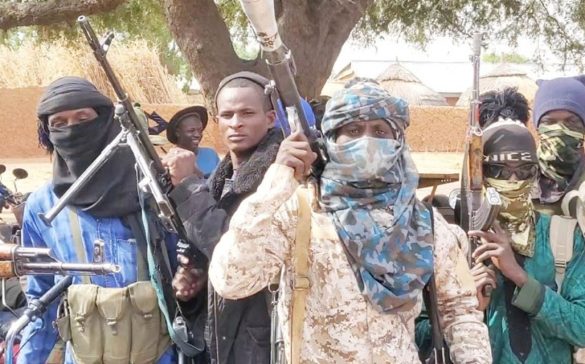
The protesters, many of whom have lived in makeshift shelters for years after fleeing repeated attacks, carried placards with inscriptions such as “Stop Agatu Killings Now,” “Save Agatu Land,” and “Let Us Return to Our Farms.” They accused armed Fulani militants of driving them from their ancestral villages and demanded urgent intervention from both the federal and state governments.
Their key demands included:
· Immediate deployment of adequate security forces to Agatu communities · The safe return of displaced farmers to their ancestral lands · The dismantling of armed groups operating in the forests and rural settlements · Government protection for farming activities ahead of the planting season
Agatu, a predominantly agrarian area in Benue State, has endured years of violent attacks linked to the broader Fulani militant attacks in Nigeria’s Middle Belt. The crisis has resulted in the destruction of villages, displacement of thousands and significant loss of lives over the past decade.
Reacting to the protest, Ejeh said he understood the frustrations of the displaced residents and acknowledged their right to demonstrate peacefully.
“I want to say that I understand why the protesters embarked on this peaceful action, and I wish to state that they have every right to protest and demand the opportunity to return to their ancestral lands,” he said while speaking to our correspondent.
The council chairman also revealed that concrete security measures were already underway to stabilize the area and restore confidence among displaced residents.
“As we speak, I have made available all the necessary arrangements to bring in a military base in Agatu and closer to the areas of conflict,” he said.
According to him, the proposed security deployment would not be symbolic but operationally robust.
“This military unit would be equipped with the latest kinetic and modern weapons. They will be armed with armoured vehicles, tanks and drones. Furthermore, they will not remain on the highways but will be embedded with the villagers in the affected communities.”
Ejeh added that the military would work closely with local security structures.
“The troops will operate in conjunction with local vigilante groups in Agatu to ensure that every community is adequately protected.”
He emphasized that the people of Agatu have endured too much violence and instability.
“We have had enough of bloodshed, killings and death in Agatu land,” he said.
Ejeh further disclosed that he had already consulted with key authorities regarding the plan.
“I have discussed with the state governor and the military officers in charge of Operation Whirl Stroke, and they have agreed with my plans to strengthen security in the area.”
Observers note that the chairman’s response reflects growing pressure on authorities to address the humanitarian and security crisis facing displaced communities across parts of Benue State.
In recent months, Ejeh has also taken a firm stance on the presence of armed pastoral groups in the area. Community leaders say he previously issued directives instructing Fulani herders operating illegally within Agatu territory to vacate the land in order to prevent further clashes and protect farming communities.
While the security situation remains fragile, many residents view the chairman’s proactive engagement with both the military and state authorities as a step toward restoring stability.
For displaced families who have spent years away from their homes, the hope is that the current momentum driven by both community advocacy and government response may finally pave the way for their safe return to the lands they have long called home.
A recent Punch report celebrated Nigerian soldiers for foiling a cattle-rustling attempt in Agatu Local Government Area of Benue State, complete with photographs of arrested men proudly displayed like trophies. The comments section was having none of it.
“This is the only thing the Nigerian Army knows how to do — guide Fulani terrorists to kill Benue citizens, then arrest innocent Benue youths and parade them as cattle rustlers to justify the killings,” one reader wrote.
That is not an exaggeration. That is a pattern.
The men arrested are not criminals by disposition — they are indigenes of a land soaked in the blood of their own people; survivors of years of Fulani terrorist massacres who have buried neighbours, fled burning homesteads, and watched their farmlands annexed by armed herders. The military knows this. It does not care.
These same soldiers — fully aware that Benue State has a legally operational anti-open grazing law — have deliberately looked the other way as Fulani herders brazenly violate that law, driving cattle across cultivated farmlands, destroying harvests and livelihoods, without a single arrest, a single query, or a single apology.
The selectivity is not incompetence. It is policy.
In Amadu, Taraba, soldiers ignored repeated community distress calls about Fulani attacks — then swooped in to arrest local men the moment Fulani complainants pointed fingers. In Abaji Kpav, troops deployed ostensibly against militants instead turned their boots on the very villagers they were sent to protect, beating elders and humiliating residents.
The Nigerian Army owes the Middle Belt an explanation. Who exactly are these soldiers serving — the Nigerian constitution, or the herdsmen’s cattle?
On December 12, 2025, Nigerian security operatives arrested a group of armed Fulani militants in Ifelodun Local Government Area of Kwara State. What followed should have triggered an immediate national security emergency.
In a video recorded during interrogation, one of the suspects calmly explained that the AK-47 rifles and patrol vehicle in their possession were supplied by officials of the Kwara State Government. According to him, they had been operating in the area “for a while” under the guise of patrol duties. “Ilorin government na him give us this motor and the weapons,” he said. “They were the ones that gave us the rifles.”
This was not the rambling of a cornered criminal improvising a story. Days later, the Kwara State Government itself issued a clarification confirming that the arrested armed men were members of Miyetti Allah, the Fulani socio-cultural organization, and that they were participating in a federal security operation coordinated through the Office of the National Security Adviser (ONSA).
In one stroke, Nigeria crossed a line that should alarm every serious observer of national security, human rights, and national stability: armed ethnic militia members linked to a group repeatedly accused of terrorism were officially embedded into state-backed “security operations.”
This is no longer about incompetence. It is about institutional collapse.
Vigilantes or Proxies?
Kwara State is not Fulani territory. It is a predominant Yoruba state, notwithstanding the historical emirate structure imposed during the 19th-century jihad of Usman dan Fodio. Over the past six months, Yoruba farming communities in Kwara have increasingly come under attack by Fulani terrorists.
Against this backdrop, a fundamental question arises: why are Fulani “vigilantes” deployed in Yorubaland to provide security for Yoruba communities while those same Fulani militias are widely implicated in the violence those communities are fleeing?
Where are the Yoruba vigilantes? Why are local populations excluded from securing their own communities, while an armed ethnic group with an established record of violent expansionism is empowered, armed, and legitimized by the state?
This is not community policing. It is demographic and security engineering.
A Pattern, Not an Incident
What happened in Kwara is not an isolated scandal. It fits a disturbing and well-documented pattern.
In January 2024, Miyetti Allah leader Bello Bodejo announced the formation of an armed Fulani militia of 1,144 fighters, euphemistically labeled a “vigilante group.” The launch ceremony took place in Lafia the Nasarawa State capital had among its invited guests the Governor of Nasarawa, Abdullahi Sule as special guest.
Nasarawa State has long been accused by survivors, journalists, and international monitors and even neighbouring state officials of hosting Fulani terrorist camps from which attacks against Plateau, Benue, Taraba Southern Kaduna, and other Middle Belt communities are launched.
When Bodejo was eventually arrested and charged with terrorism, his confessional statement reported by Punch newspaper in April 2024 contained an explosive allegation: he claimed that Governor Sule pressured him to form the militia group known as Kungiya Zaman Lafiya.
Bodejo was later released without trial.
The alleged architect of his release? Nigeria’s National Security Adviser, Mallam Nuhu Ribadu.
The 1,144 armed “vigilantes” subsequently disappeared into thin air. No disarmament. No accountability. No explanation.
From Appeasement to Empowerment
The Kwara arrests now place the Office of the National Security Adviser squarely at the center of another scandal involving armed Fulani operatives embedded in state-sanctioned security frameworks.
If confirmed, this represents a catastrophic breach of counterterrorism doctrine. No serious state fighting terrorism arms ethnic militias tied to insurgent violence. No professional security architecture outsources public safety to groups accused of mass atrocities. And no responsible National Security Adviser permits such an arrangement.
Yet this is precisely what Nigeria appears to be doing, repeatedly.
This pattern lends overwhelming credence to growing national and international calls for Nuhu Ribadu’s immediate removal as National Security Adviser. National security cannot be entrusted to an individual who repeatedly champions peace deals, protection, or legitimacy for armed groups responsible for spreading terror among citizens.
The Matawalle Question
The crisis deepens further with renewed allegations surrounding Bello Matawalle, Nigeria’s Minister of State for Defence.
In recent weeks, Matawalle has been implicated by his former aide in allegations of sponsoring key bandit leaders in Zamfara State. These claims resurrect older, widely circulated videos in which notorious bandit leader Bello Turji openly stated that Matawalle, then governor of Zamfara paid some bandits with public funds in the name of “peace.”
Turji is not a misunderstood local actor. He is a terror commander linked to the killing of hundreds, possibly thousands, of farmers across the North-West.
Matawalle denies wrongdoing, arguing that payments and negotiations were part of a peace strategy. But peace bought with impunity, cash, and legitimacy for terrorists is not peace, it is state-funded terror management.
When combined with the Kwara revelations, the allegations against Matawalle reinforce a chilling conclusion: Nigeria’s defence and security leadership is populated by individuals whose policies consistently reward, empower, and normalize terrorism.
This alone justifies Matawalle’s removal.
“Bombs Cannot Penetrate Forests”
Perhaps nothing illustrates the depth of rot more than the parting statement of Nigeria’s immediate past Defence Minister, Abubakar Badaru, who reportedly remarked during the week of his resignation that “bandits live in forests where bombs cannot penetrate.”
This is not merely false, it is professionally disqualifying.
Modern militaries conduct forest warfare across the globe. Nigeria’s armed forces have done so successfully outside Nigeria. The claim that bombs “cannot penetrate forests” is not a tactical assessment; it is an excuse, one that exposes a leadership class more interested in rationalizing failure than confronting terror.
Why the World Is Responding
In recent days, the United States announced visa restrictions affecting Nigerians. Predictably, outrage followed. Many Nigerians consider the decision unfair or excessive.
They are wrong.
The United States, like any rational state, has a duty to protect itself from countries where terrorism is being mainstreamed into governance structures. When armed ethnic militias tied to terror networks are armed by the state, embedded into official security operations, shielded from prosecution, and rewarded with political appointments, terrorism is no longer an aberration, it is policy-adjacent.
Visa restrictions are not punishment. They are self-defense.
Recommendations: What Must Be Done Immediately
If Nigeria wishes to arrest its rapid descent into international isolation and internal collapse, urgent action is required:
Nuhu Ribadu must resign or be removed as National Security Adviser. His continued tenure undermines confidence in Nigeria’s counterterrorism commitment and poses a grave risk to national cohesion.
Bello Matawalle must be relieved of his defence portfolio pending an independent investigation into allegations of terrorist sponsorship and appeasement.
Miyetti Allah-linked armed formations must be formally investigated for terrorism-related activities and barred from any security role.
Security appointments must prioritize professional competence over ethnic, religious or political proximity. National security is too serious to be managed through sentiment.
International partners must escalate targeted sanctions and visa restrictions against officials credibly linked to terror appeasement.
Conclusion: A State at a Crossroad
The arrest of armed Miyetti Allah operatives in Kwara State is not merely another scandal. It is a warning flare.
Nigeria now stands at a crossroad: continue mainstreaming terrorism through appeasement and ethnic favoritism, or reclaim the basic function of the state, protecting citizens without fear or favor.
The world is watching. And increasingly, it is acting.
Whether Nigeria chooses reform or further collapse will determine not just its security future, but its standing among nations that still believe terrorism must be confronted, not accommodated.
…Steven Kefas is an investigative journalist, Senior Research Analyst at the Observatory for Religious Freedom in Africa, and Publisher of Middle Belt Times. He has documented religious persecution, terrorism and forced displacement in Nigeria’s Middle Belt for over a decade.
An investigation into Colin Ikin’s operations in Southern Kaduna reveals a troubling pattern of alleged bribery, forged documents, and community manipulation that mirrors his catastrophic corporate history in Australia—raising urgent questions about Nigeria’s mining oversight.
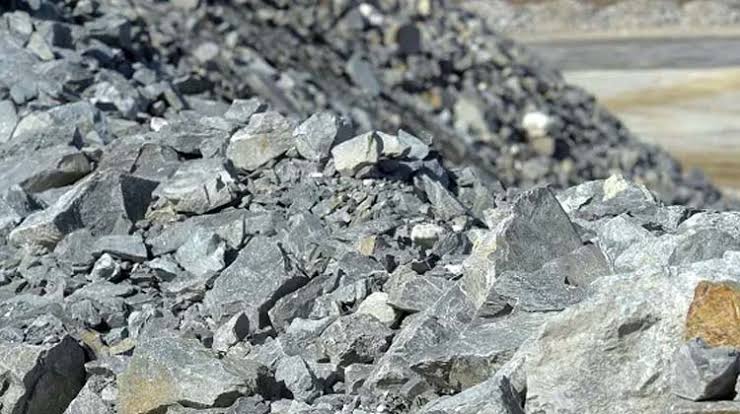
(Kaduna), In the mineral-rich hills of Southern Kaduna, Northwest Nigeria where lithium and nickel deposits lie beneath Kaninkon land, a familiar story of grand promises and questionable tactics is unfolding. At its center stands Colin Ikin, the Australian mining executive whose corporate failures cost investors nearly $750 million in his homeland, and now, allegedly using cash payments and false governmental connections particularly at the presidential level, to gain control over Nigeria’s valuable mining concessions.
Recent investigations in Jama’a Local Government Area of Kaduna state, where Ikin’s Atlantic Mining Techniques Limited has been attempting to operate, reveals a pattern of activities that community leaders describe as manipulative and potentially fraudulent—allegations that gain credibility when viewed against Ikin’s documented history of corporate catastrophe in Australia.
The Southern Kaduna Operations Community leaders in Bakin Kogi, Dangoma and surrounding areas paint a troubling picture of Ikin’s methods. According to sources who spoke on condition of anonymity due to fear of intimidation, the Australian executive has been using cash payments to secure local support while making claims about high-level government connections.
“In December last year, he gave out millions of Naira to buy loyalties from people who were willing to sell,” revealed a community leader from Bakin Kogi.
“Some group of elders, a few of them were given 10 million naira in December 2024 by Colin Ikin. That is strange to me because Australians are known to be well-behaved people in business. I have worked with them when I was much younger and I can tell you that they hardly do bribes.”
The source’s concerns extend beyond the alleged payments to Ikin’s intimidation tactics and grandiose claims. “Colin Ikin boasts so much of having connections to the presidency, and with that claim, he is bullying our people into accepting his own terms and surrendering our lands to his company, Atlantic Mining Techniques, for peanuts. Unfortunately, some of our elders, like I said earlier, have fallen for his tricks.”
What particularly alarms community leaders is the absence of standard mining industry practices. “What baffles me most is that Colin isn’t talking about anything like a Community Development Agreement; no clear blueprints for our communities, unlike what we have seen other mining companies do in recent years,” the source explained.
Another community leader from Godogodo expressed deep concern about the state government’s apparent endorsement of Ikin’s operations: “The ongoing romance between the Kaduna state government and Colin Ikin will only lead to chaos in the communities as we do not trust the Australian. His methods are not what we have seen from other mining companies operating in our area.”
Federal Ministry Denies Ikin’s Claims
Despite his alleged boasts about presidential connections and his meetings with state governments, independent investigations reveal that Ikin lacks proper authorization from federal authorities. Kayode Ogunbunmi, a media consultant purportedly linked with the Nigerian Mining Office in Abuja, categorically denied any record of Ikin’s applications in a response to an earlier article accusing the mining office of inadequate oversights.
“The glib reference of Kefas to a Mr Colin Ikin allegedly ‘wanted’ in Zimbabwe and being embraced here is nothing short of a stupor induced hallucination. Truth is, there’s no record of any such Mr Colin’s application or titles in the Federal Ministry of Solid Minerals till date!” Ogunbunmi had stated.
This revelation raises serious questions about how Ikin has been operating in multiple Nigerian states—including documented meetings with officials in Kaduna and Nasarawa—without proper federal licensing. It also raises questions about Ikin’s support network in Nigeria that allows him to perpetuate fraudulent claims. Who are his backers? Who owns Atlantic Mining Techniques Ltd?
The Zimbabwe Connection
Nigeria’s failure to conduct proper due diligence on foreign mining operators becomes more concerning when viewed against experiences elsewhere in Africa. Zimbabwe’s former Chairman of Mines and Energy, Temba Mliswa, has documented similar patterns of exploitation by questionable foreign operators.
“A peculiar case of Colin Ikin, a dodgy mining mogul, has raised my interest. Why does the government seem hell-bent on protecting rogue white business people in this country?” Mliswa questioned, highlighting regulatory capture that has become endemic across African mining sectors.
According to Mliswa’s documentation, Ikin faces serious allegations in Zimbabwe, including criminal activity reported to police, forgery of bank documents, and illegal withdrawal of funds. “This time around, he is alleged to have forged bank documents and went ahead to illegally withdraw US$10,000 from an Afrocash Micro NMB account,” Mliswa noted, describing police cases for fraud and forgery of company documents.
Mliswa’s broader observation resonates with Nigeria’s current situation: “It seems we are intent on becoming a safe haven for foreign criminals, while our own people are constantly faced with the rough edges of the law to the point of being second-class citizens.”
Community Resistance and Formal Complaints
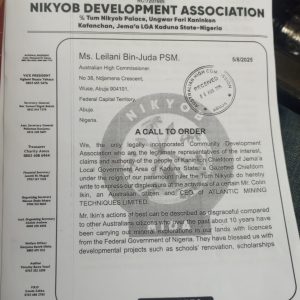
The Nikyob Development Association (NIDA), representing the mining communities in Kaninkon land, has taken formal action against Ikin’s activities. In August 2025, NIDA wrote to the Australian High Commissioner in Abuja, Ms. Leilani Bin-Juda, requesting intervention.
The letter, obtained through this investigation, details a pattern of alleged misconduct: “Mr. Colin Ikin and his company have been involved in forgery, bribery and intimidation of locals who do not support their ‘land grabbing’ scheme. The situation is tense, to say the least.” NIDA’s complaint highlights the contrast between Ikin’s methods and those of legitimate mining operators: “Other Australian citizens who over the past 10 years, have been carrying out mineral explorations in our lands with licences from the Federal Government of Nigeria… have blessed us with developmental projects such as schools’ renovation, scholarship assistance for students, agricultural support, electrification, water boreholes and other interventions as provided for in our Community Development Agreements.”
A copy of the letter obtained by MBT
The association accused Ikin of attempting to “grab our lands… from the rightful owners and from other licence holders including Basin Mining and Range Mining with the Jupiter Lithium project,” using forged consent documents after the traditional council withdrew its original approval which was obtained with misleading information.
The community leadership has recently written to the Minister and the DG-MCO declaring the community will not give consent to any new company the Ministry or MCO sends to the community seeking for consent. The community wants continuity and consistency in the development of the mineral assets on their traditional land.
“Whatever consent Mr. Ikin has or is parading is a forged document,” NIDA stated, adding that “Atlantic Mining Techniques limited and Colin Ikin are the ones sponsoring” court cases against existing licensed operators.
The Australian Track Record
Ikin’s Nigerian operations become particularly concerning when viewed against his documented corporate history in Australia. As Executive Chairman of Preston Resources, Ikin presided over one of the worst corporate disasters in modern Australian mining history—a spectacular collapse that wiped out nearly $750 million in investor funds.
The Preston Resources saga began when the company, under Ikin’s leadership, acquired the Bulong nickel project for $319 million—money the company didn’t have. Shareholders were effectively held hostage by a $10 million break fee commitment when Preston only had $2 million in the bank.
Despite Ikin’s promotional materials describing Bulong as “an outstanding opportunity” that would make Preston “a significant international nickel producer,” the reality proved catastrophic. The Bulong plant never met production forecasts, cash flow projections failed to materialize, and by 2000, Preston had accumulated losses of $497 million with liabilities exceeding assets by $430 million.
Financial columnist Trevor Sykes, an award-winning journalist with 61 years of experience, documented how investors who had paid $1.50 per share to support the Bulong purchase were “financially disemboweled.” The aftermath saw Preston’s board, including Ikin, proposing to hand over 95% of Bulong to note holders, leaving shareholders with assets worth just $787,000 against liabilities of $5 million.
Regulatory Failures and Systemic Vulnerabilities
The Ikin case exposes critical weaknesses in Nigeria’s mining sector governance. Despite the federal government’s push to diversify from oil revenues and develop the solid minerals sector, the country appears to lack robust systems for vetting foreign operators with questionable backgrounds.
State governments, eager for investment and job creation, appear to be making commitments to operators without proper federal coordination or due diligence. The disconnect between Ikin’s state-level meetings—documented in Kaduna and Nasarawa—and the federal ministry’s denial of any licensing applications reveals dangerous coordination gaps.
This regulatory vacuum creates opportunities for operators like Ikin to exploit Nigeria’s mining potential while potentially exposing communities and investors to the same risks that devastated Preston Resources shareholders in Australia.
A Continental Pattern of Exploitation
Nigeria’s experience with questionable foreign mining operators reflects broader continental challenges. From the Democratic Republic of Congo to Tanzania, African nations have struggled with operators who make grand promises but lack the financial backing or technical competence to deliver sustainable mining operations.
The difference between legitimate operators and questionable ones often becomes apparent in community engagement. Legitimate mining companies typically invest heavily in community development agreements, environmental impact assessments, and stakeholder consultation before beginning operations. They also secure proper licenses and maintain transparent financial backing.
By contrast, operators following the pattern allegedly exhibited by Ikin—cash payments to local leaders, claims about political connections, operations without proper federal licensing, and absence of community development frameworks—represent exactly the kind of extraction-focused approach that leaves host communities worse off than before mining began.
Conclusion: Protecting Nigeria’s Mining Future
As Nigeria seeks to diversify its economy beyond oil dependency, the solid minerals sector offers genuine opportunities for sustainable development. However, realizing this potential requires partnerships with operators who bring not just promises but proven competence, financial backing, and commitment to responsible mining practices.
The Colin Ikin case serves as a powerful reminder that not all foreign investment is beneficial investment. Operators with histories of corporate failure and alleged misconduct in other jurisdictions pose risks not just to investors but to the communities whose lives and lands become entangled with their operations. Nigerian authorities at federal and state levels must recognize that protecting the country’s mineral wealth requires saying no to questionable operators, regardless of their perceived promotional skills or their claimed political connections. The stakes are too high—and Nigeria’s mining potential too valuable—to risk on operators whose track records suggest they are more likely to leave behind devastation than development.
The communities of Southern Kaduna, like investors who lost fortunes in Preston Resources, deserve better. Nigeria’s mining revolution should create lasting prosperity, not expensive disappointments orchestrated by operators whose previous ventures collapsed in spectacular failure. Learning from other countries’ mistakes isn’t just good governance—it’s essential towards ensuring that Nigeria’s mineral wealth truly serves its people’s interests.
(Gusau) Civilian vigilante forces in Shinkafi Local Government Area have successfully eliminated notorious bandit kingpin Kachalla Yellow Danbokolo alongside 173 of his fighters in a weekend operation that lasted several hours, community sources told MBT
Kachalla Yellow Danbokolo, widely regarded as the most dangerous bandit leader in the Northwest and described by locals as even more ruthless than his cousin Bello Turji, was killed alongside more than 173 of his fighters during coordinated attacks by Shinkafi volunteer forces over the weekend.
The operation, which security many describe as a “huge surprise,” has brought unprecedented relief to communities that have lived under the terror of Danbokolo’s reign for years. Unlike previous military operations, this civilian-led initiative appears to have struck at the very heart of the bandit hierarchy.
“The killing of Danbokolo will bring some peace and stability to Shinkafi and Zamfara at large,” said Abdullahi Shinkafi, a community leader who has witnessed the devastating impact of banditry on local populations. “This represents a turning point in our fight against these criminals who have held our communities hostage.”
Danbokolo, who sustained critical injuries during the initial assault, reportedly died over the weekend and was buried on Saturday. His death has triggered massive celebrations across Kurya District in Shinkafi Local Government Area, where residents had endured months of terror under his command.
The success of the civilian forces has particularly resonated with local communities who have grown frustrated with conventional security approaches. Mallam Salisu, a resident of Shinkafi, expressed his admiration for the vigilante forces’ achievement.
“These brave men have done what the military couldn’t do for years,” Salisu stated. “They have shown that when communities unite and take decisive action, even the most notorious criminals can be defeated. We are eternally grateful to these heroes who risked their lives for our freedom.”
The operation’s impact extends beyond Danbokolo’s elimination. Intelligence sources reveal that known loyalists of Bello Turji are now in disarray, with many seeking to surrender as they witness the collapse of their network’s leadership structure. Some foot soldiers have reportedly begun desperate attempts to negotiate amnesty deals.
Residents describe Danbokolo as “the man behind the “mask”—the true architect of terror operations while Turji served primarily as a spokesperson. His elimination has effectively decapitated the command structure of one of the region’s most organized criminal enterprises.
The volunteer forces’ success comes at a time when farming communities are preparing for the planting season. Local farmers have expressed hope that they will no longer be forced to pay “taxes” to bandits—a practice that has crippled agricultural productivity in the region.
A Case for Community Policing
The remarkable success of Shinkafi’s volunteer forces comes at a time when security experts are increasingly advocating for community-based policing models across Nigeria. Last week, during a roundtable dialogue organized by the Para-Mallam Peace Foundation in partnership with The Plateau Peace Practitioners Network in Jos, former Inspector General of Police Dr. Solomon Arase made a compelling case for regional policing that integrates local knowledge with national standards.
Delivering the keynote address, retired Inspector General of Police, Dr. Solomon Arase, advocated a regional policing model that blends national standards with localized knowledge to improve response time and community trust. Arase emphasized the critical importance of strengthening police-community relations as the foundation for effective security management.
The Zamfara success story validates Arase’s vision. Where conventional military operations had repeatedly failed to neutralize Danbokolo and his network, locally-organized civilian forces achieved decisive results within days. This outcome underscores the power of intimate local knowledge, community trust, and grassroots coordination that characterizes effective community policing.
Governor Caleb Mutfwang of Plateau State, speaking during the same Jos dialogue themed “Dialogue on Community Policing as a Panacea for Insecurity in Nigeria: The Case of Plateau State,” argued that Nigeria’s security challenges are fundamentally elite-created problems that require community-driven solutions.
“Communities that have lived peacefully together can suddenly be torn apart when the minds of the people are poisoned,” Mutfwang warned, emphasizing how elite manipulation often undermines natural community cohesion. His observation resonates with the Shinkafi experience, where local communities, when empowered and properly coordinated, demonstrated remarkable capacity for self-defense.
The governor’s emphasis on community ownership of security aligns perfectly with what unfolded in Zamfara. Rather than waiting for external intervention, Shinkafi communities took ownership of their security challenges and achieved results that had eluded conventional approaches for years.
As celebrations continue across affected communities, the success of Shinkafi’s volunteer forces provides compelling evidence for accelerating community policing initiatives nationwide, demonstrating that locally-driven security solutions can achieve what centralized approaches have struggled to accomplish.
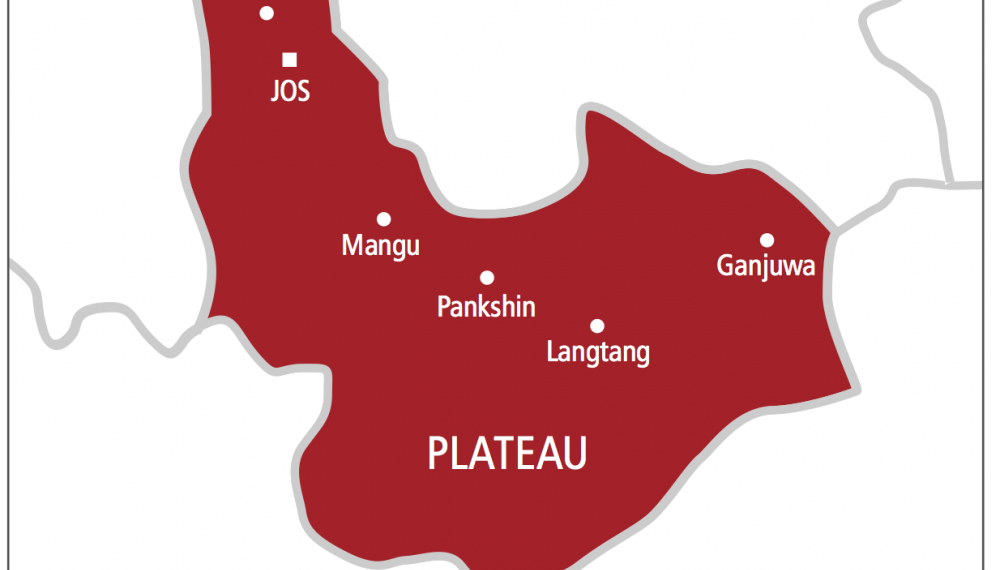
Jos, Plateau State— In a dramatic confrontation that eerily mirrors the security situation in the state, the Secretary to the Government of Plateau State, Mr. Samuel Jatau, narrowly escaped an ambush by terrorists suspected to be Fulani Ethnic Militias (FEM) on Sunday during a humanitarian visit to communities devastated by recent attacks in Bokkos Local Government Area.
The incident, which unfolded near Hurti community in Monguna district, stands as a stark reminder of the persistent security challenges in Nigeria’s Middle Belt region
As Mr. Jatau’s convoy approached the area, gunmen concealed in surrounding terrain opened fire, likely planning to execute another devastating attack. However, unlike countless previous incidents in the state, the security team’s swift and effective response forced the attackers to retreat into nearby mountains, a security personnel who witnessed the incident told MBT.
“I lack words to express my sorrow and anger. We just tested what these communities are feeling,” recounted a visibly shaken Jatau. “I was looking at my phone in the car when I suddenly heard gunshots. When I looked up, I saw two young men running into the bush, armed with guns.” Jatau told journalists after the incident.
The attack came just days after a deadly raid that claimed over 40 lives in the same area, part of a troubling pattern of violence that has plagued several regions in Nigeria’s Middle Belt. Yet security experts note that the quick repulsion of the attackers demonstrates a marked improvement in tactical response—similar to developments that have helped stabilize Southern Kaduna after years of devastating conflict.
“We saw the destruction firsthand. Over 40 people were killed, homes were destroyed, and entire livelihoods were wiped out,” Jatau continued, describing the aftermath of the previous attack. “The terrorists looted essential goods like 26 bags of potatoes worth N80,000 each from one home. These are peasant farmers; how do they recover from this? We must do better than this as a country.” The SSG said.
Bokkos local government has come under sustained deadly attacks by terrorists in recent months. In December 2023, over 200 people, including women and children, were brutally murdered by FEM militias who launched coordinated attacks across 25 villages on Christmas Eve.
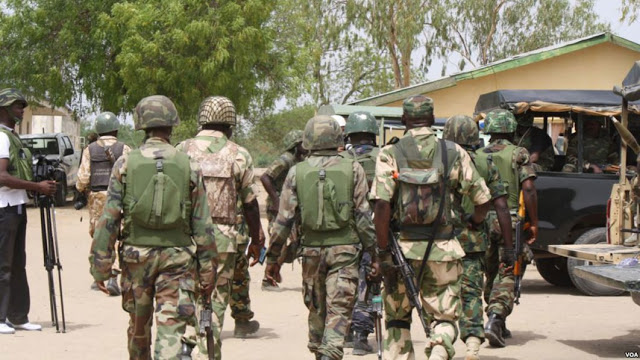
(Jos), Troops of 3 Division and Operation safe haven, under Operation LAFIYAN JAMA’A, have eliminated two kidnappers, apprehended suspected gunrunners, and seized arms and ammunition in Plateau and Kaduna States.
According to Major Samson Zhakom, Media Information Officer of Operation SAFE HAVEN, troops launched an offensive operation on March 12, 2025, targeting criminal hideouts in Kuru and Turu, Jos South LGA, Plateau State.
During the operation, troops engaged armed kidnappers and terrorists near the high grounds of Kuru, successfully eliminating two suspects. A search of the area led to the recovery of 18 rounds of 7.62mm (Special) and 9 rounds of 5.56 x 45mm ammunition.
Later that day, troops set up snap checkpoints along the Bokkos-Bot-Mangu road in Bokkos LGA, following intelligence reports on arms smuggling.
The operation led to the arrest of 21-year-old Sengi David, a known gunrunner from Kopal Village in Panyam District, Mangu LGA. Troops recovered one AK-47 magazine and 48 rounds of 7.62mm (Special) ammunition from the suspect, who is now in custody for further investigation.
In another covert operation on March 11, troops successfully arrested a notorious kidnapper, terrorist, and gunrunner, identified as Mr. Blessed Paul, 22, in Garaje Community, Jema’a LGA, Kaduna State.
The suspect, who had been on security agencies’ wanted list, had previously escaped to Abuja to evade arrest. Troops lured him by posing as buyers interested in purchasing an AK-47 rifle for N1.5 million.
“A search on the suspect led to the recovery of one AK-47 rifle, one AK-47 magazine, and 2 rounds of 7.62 mm (Special) ammunition. The suspect and recovered arms and ammunition are in custody,” Zhakom stated.
According to the military, the suspect is cooperating with interrogators, providing useful information to help security forces track down other members of his syndicate.
On March 12, 2025, troops of 3 Division/Operation SAFE HAVEN conducted a rescue operation at the outskirts of Josho Village, Daffo District, Bokkos LGA, Plateau State.
”The operation followed credible intelligence that kidnappers were keeping some abducted victims in the area. Upon sighting troops, the kidnappers abandoned their victims and fled,” Zhakom explained.
Following a search of the hideout, troops rescued two female victims:
– Miss Nanbam Adamu, 11 years old and
– Miss Dorcas Wantu
Both victims are indigenes of Mbor Village in Mushere District, Bokkos LGA.
“The rescued victims have been debriefed and handed over to their families. Troops are currently conducting follow-up operations to intercept and neutralize the fleeing kidnappers,” the military spokesman added.
General Martin Luther Agwai, one of Nigeria’s most distinguished military officers and global peacekeeping figures, is set to chair the 2024 House of Justice Summit and Golden Ball Banquet scheduled for November 29 in Kaduna. The event, themed “Security, Justice & National Re-orientation,” will take place at the Epitome Events Center on Ethiopia Road, Barnawa.
The selection of General Agwai as chairman couldn’t be more fitting for an event focused on security and justice. His journey from a young scout in Zaria to becoming one of the world’s most respected military leaders and peacekeepers embodies the summit’s aspirations for national reorientation.
Born in Kaduna on November 8, 1948, Agwai’s path to military excellence began unusually—with a congress of baboons. As a young mining team leader at Ririwai, an encounter with these primates sparked his decision to enroll at the Nigerian Defence Academy, where he would later distinguish himself as an outstanding cadet in both military and academic subjects.
His early life showed promising signs of leadership, from serving as President of the Fellowship of Christian Students at Government Secondary School, Alhudahuda Zaria, to representing Northern Nigeria at a Boys Scout jamboree in Scotland in 1966. This event proved pivotal, not just for his athletic achievements in football and racing but also for his first encounter with television technology in Belfast.
After joining the Nigerian Armed Forces in 1972, Agwai’s career trajectory was nothing short of meteoric. His educational pursuit led him through prestigious institutions, including the Nigerian Command and Staff College, the British Army Staff College, and the U.S. Army Armor School. He later earned a Master’s degree in National Resource Strategy from the National Defence University in Washington, D.C., where he received the Ambassador’s Award for Excellence.
Perhaps his most significant achievement came with his leadership of the UN-African Union Mission in Darfur (UNAMID), one of history’s largest peacekeeping operations, coordinating personnel from 48 countries. His approach to peacekeeping was captured in his memorable words: “We are not here to impose peace; We are not here to fight anybody.”
Even in retirement, General Agwai continues to champion peace through the Martin Luther Agwai International Leadership & Peacekeeping Centre. His life’s work and achievements are documented in his biography, “Iconic Soldier and Peacemaker.”
The upcoming House of Justice Summit, which offers free attendance with mandatory registration, will be followed by the Golden Ball Banquet, featuring tiered ticket options ranging from N10,000 for Silver to N400,000 for Executive Corporate Tables of eight.
“General Agwai represents the perfect blend of military excellence and diplomatic finesse,” noted a House of Justice spokesperson. “His perspective on military diplomacy and its relationship with governance and food security as crucial elements of national stability is particularly relevant to our current national discourse.”
The summit comes at a crucial time when Nigeria faces various security challenges, making General Agwai’s expertise and insights particularly valuable. His emphasis on studying military diplomacy and understanding the connection between bad governance, food insecurity, and national stability resonates strongly with current national concerns.
Beyond his professional achievements, Agwai is known for his personal qualities—his brilliant mind, professional demeanor, and sensitivity to human needs and suffering. He credits much of his success to the support of his wife, mother, and three daughters, demonstrating the importance of family values even in military leadership.
The House of Justice Summit and Golden Ball Banquet promise to be significant events in Kaduna’s civic calendar, offering participants the opportunity to engage with one of Nigeria’s most accomplished military leaders. Those interested in attending the summit or banquet can reach out through WhatsApp, phone, or email for registration and ticket information.
This year’s House of Justice summit boasts many distinguished guests, including the Executive Governor of Kaduna State, Senator Uba Sani, Professor Chidi Odinkalu, a former Chairman of the National Human Rights Commission, former minister of water resources, Hon. Sarah Ochekpe, Ph.D, former director general of the National Orientations Agency, Dr. Mike Omeri, OFR, the Country Director of the United States Institute for Peace, Dr. Chris Kwaja, Group Captain Sadeeq Garba Shehu Rtd. African Union Security Expert, Adudu Maikori, Esq, founder, Chocolate City Group, and many other distinguished Nigerians.
As the “City of Crocodiles” prepares to welcome this distinguished son of the soil, the event stands as a testament to the enduring impact of leadership that combines military excellence with a commitment to peace and justice.
The Chief of Defence Staff, General Christopher Musa, has announced a cash reward of N1 million for the troops involved in the recent successful operation in Zamfara State, which led to the elimination of Halilu Sububu Buzu, a notorious bandit leader responsible for numerous attacks and kidnappings in the region.
General Musa commended the bravery and precision of the troops, emphasizing their critical role in dismantling a major threat to the security of the North West. He added that the reward is to honor their dedication and encourage continued excellence in their duties.
SaharaReporters had earlier reported that troops from the Joint Task Force Northwest Operation Hadarin Daji (OPHD) had reportedly neutralized Kachallah Buzu, a notorious bandits commander, along with several of his fighters in Mayanchi village, Zamfara State.
The operation took place on Thursday during a nighttime raid, where the troops killed the bandits and recovered weapons and motorcycles. According to a counter-insurgency expert in the Lake Chad area, the ambush was highly effective, resulting in the elimination of numerous bandits, including their leader, Buzu.
The operation, which followed a planned ambush, was based on intelligence about the bandits’ movements. In addition to the significant loss of lives on the part of the insurgents, the troops seized 30 motorcycles and a substantial cache of weapons.
The successful operation marks a critical blow to the bandit group’s operational capabilities and underscores the ongoing efforts of the Nigerian military to combat terrorism in the region.
On Thursday, SaharaReporters reported that the group of terrorists had blocked the busy Gusau-Funtua highway in Zamfara State and abducted an unspecified number of travellers on the road. This was confirmed to SaharaReporters during a telephone conversation with the State Police Command Spokesman, Yezid Abubakar.
The police spokesperson said the command had deployed several personnel to the scene of the attack and was yet to be briefed on the exact number of the people kidnapped by the terrorists.
“It is true but we are on top of the matter. Our men have been deployed to the place but they are yet to come back so I don’t know the exact figure of the people that were kidnapped. I will get back to you when I get the information,” the police spokesman had told SaharaReporters.
The Chief of Defence Staff (CDS), General Christopher Musa, has vowed to bolster security for farmers in Zamfara State, ensuring they can cultivate their land without fear of bandit attacks.
During a visit to the state on Friday, Musa assured the Zamfara government and its citizens that the Armed Forces of Nigeria (AFN) will implement necessary measures to ensure farmers can work their land safely.
The Defence Chief’s visit is part of a comprehensive effort to address insecurity in the region and restore peace to affected communities.
Musa met with Governor Dauda Lawal at the Government House in Gusau, expressing gratitude for the governor’s support to the AFN and other security agencies operating in the state. He commended the noticeable development in Zamfara over the past year, despite ongoing security challenges, and assured the governor of the military’s commitment to restoring peace.
“Ensuring the safety of farmers from bandit attacks is a priority,” Musa stated. “The AFN will provide the necessary security to guarantee a successful farming season, easing the current hardships faced by citizens.”
The Defence Chief also appealed to the people of Zamfara to cooperate with security agencies by refraining from aiding bandits and instead providing vital information to support ongoing military operations.
He announced a strategic change in military operations, renaming it Operation FANSAN YAMMA and upgrading it to a Theater Command with General Officers Commanding as component commanders to improve coordination between security actors.
Musa also reaffirmed his commitment to collaborating with state-owned security establishments, stressing the importance of community involvement in achieving lasting peace.
Addressing troops from the 1 Brigade Nigerian Army, who had earlier ambushed and neutralized scores of terrorists, the CDS praised their bravery and assured them that all necessary tools and support would be provided for the continued fight against terrorism.
Governor Lawal, in his response, thanked the CDS for his dedication and expressed optimism that the new military measures would bring peace to the state. He noted that General Musa’s presence had already boosted the morale of Zamfara’s citizens, who now feel hopeful about an end to the insecurity.
In a related development, the Sector One Joint Task Force (NW) Operation Hadarin Daji recently ambushed a terrorist escape route along the Gusau-Funtua Road, neutralizing 40 terrorists, including the notorious bandit kingpin Halilu Buzu, and recovering arms and motorcycles.