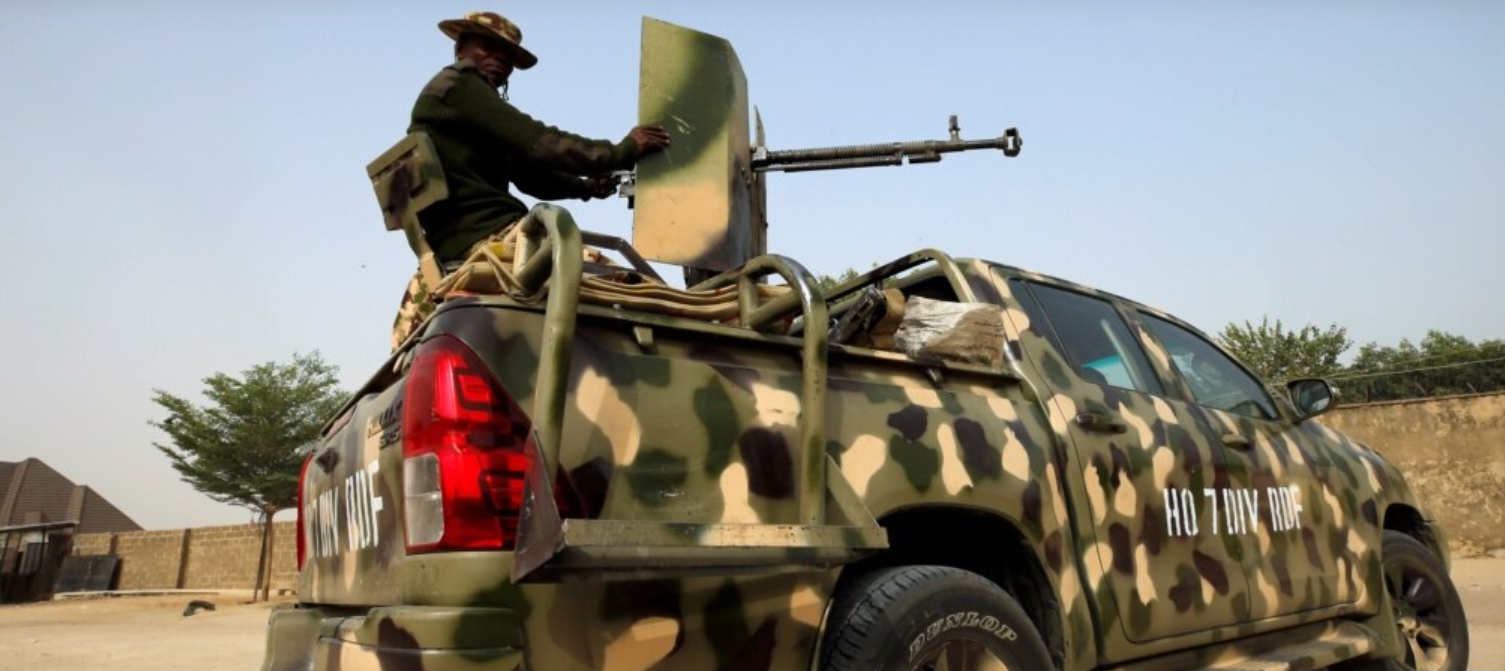
Army of Nigeria accused of extrajudicial killings of vigilantes in Mangu

Army Says Vigilantes Who Were Killed Were “Terrorists”

According to reports by Truth Newspaper, residents of Central Plateau State and human rights watchers from as far away as Washington, D.C. have expressed indignation over the execution of three neighborhood watchmen by Nigerian military.

The Nigerian military which did not dispute the deaths and declared on July 12 that the three armed individuals who were murdered in Panyam, a town 42 miles southeast of Jos, were terrorist bandits who set up an ambush in the Ampang East neighborhood of Mangu County.

However, Truth Nigeria is told by witnesses to the killings who chose not to give their names out of concern for reprisals that the young men killed were valiantly fighting off terrorists. Locals refer to them as “vigilantes,” but they are actually neighborhood watchmen who only defend their towns with weapons when they are attacked.

During a normal patrol, the vigilantes were attacked after getting off a broken-down motorcycle on a nearby roadway, according to the witnesses. Since May 16, more than 350 people have died as a result of Islamic terrorist strikes across the Central Plateau counties, according to town authorities.

A leader of the Plateau State Assemblyman was compelled by the occurrence to demand a public investigation into the killings. In a one-on-one interview with Truth Nigeria, Del. Dewan K. Gabriel demanded “a thorough and impartial investigation into the alleged human rights violations committed by the Nigerian military in central Plateau State,” referring to what he called “the recent reported murder of three self-defense volunteers, who were shot while courageously protecting the villages from terrorists.”

“One thing is certain, the Nigerian military is not empowered to commit street-side execution of suspects whether they are terrorists or vigilantes,” said Dede Laugesen, executive director of Save the Persecuted Christians in a text to Truth Nigeria. “This case demands immediate international attention and review by the U.N. Special Rapporteur on Extrajudicial killings,” Laugesen added. “The embattled people of Plateau—mostly Christian populations enduring officially unrecognized Islamic jihad—deserve far more professional concern, compassion, and response from Nigerian security forces who unfortunately are often compromised and complicit with the terrorists bent on their exile and extermination.”

Gov. Mutfwang addresses military leaders directly

The Nigerian Army boasted of neutralizing three “bandits” after “gallantly fighting through an ambush” in Mangu on July 12, as the newly elected Governor of Plateau State, Caleb Mutfwang, met with the nation’s newly appointed Chief of Defense Staff (CDS), Christopher Musa, in Abuja to plead for an end to ongoing terror raids in the State.

On July 12, Mutfwang paid a personal visit to the CDS to appeal to the generals because he appeared to be tired of making public statements for the military to step in and put an end to the killings.

The army authorities in Abuja said they killed terrorists in the village of Perr and collected weapons in a statement released that day’s evening by their Director of Public Relations, Brigadier General Onyema Nwachukwu.

Residents of the neighborhood, which is in the Ampang East District of Mangu County, however, claimed to Truth Nigeria that the vigilantes posed no danger to them or the military and that they voluntarily surrendered when they were stopped by soldiers on a local highway.


“They were just pushing their motorcycle which had broken down during a routine patrol of the area,” said one witness on background for fear of retaliation by the military. “The soldiers bumped into them and arrested them without resistance,” the source said in a telephone interview. “They laid them down on the ground and shot them one after the other,” said the source.

Since huge attacks by radicalized mercenaries started setting Plateau towns on fire, dozens of neighborhood watchmen, sometimes known as “vigilantes,” have perished.

State in a wide area starting on May 12. Two vigilantes were buried five miles away at the time of the murder on July 12 at 2 p.m. local time, according to Jethro Jacob, a youth leader in Mangu. According to Jacob, the memorial service was held for two vigilantes who were killed in an ambush in the terror-infested village of Perr. But according to Jacob, the Secretary of the Mwagavul Youth Movement, a local tribe organization, their bodies had remained unburied at the scene because of persistent threats.

“We had to beg for the soldiers and police to give us protection to bury them,” said Jacob in a telephone interview. “All the people living in the village were displaced when they attacked and they are the ones controlling the area,” he said, refuting the military’s claim the three vigilantes killed on 12 July were terrorists. “There was no distress call whatsoever from that area. We are usually the first point of contact for the villagers, so if there was any problem, we will be the ones to relay it to the military. But there was nothing like that,” Jacob told Truth Nigeria.

“There was no distress call whatsoever from that area. We are usually the first point of contact for the villagers, so if there was any problem, we will be the ones to relay it to the military. But there was nothing like that,” Jacob told Truth Nigeria. “The terrorists have killed more than 350 of our people and taken over 50 of our villages in just two weeks. All along, the military never responded to any distress calls. Even when they did, they were either overpowered or unwilling to pursue them. But all of a sudden we hear of terrorists killed after a distress call. Something doesn’t seem right to me,” Jacob said.

“The terrorists have killed more than 350 of our people and taken over 50 of our villages in just two weeks. All along, the military never responded to any distress calls. Even when they did, they were either overpowered or unwilling to pursue them. But all of a sudden we hear of terrorists killed after a distress call. Something doesn’t seem right to me,” Jacob said.

Vigilantes Felled in Multiple Engagements Three days prior to the killing of the three vigilantes, 14 people including vigilantes were killed in the west of Mangu County. An evening attack by a band of 200 terrorists armed with assault rifles led to the killing of six vigilantes and eight other residents in Sabon Gari village according to witnesses. A group of 20 vigilantes battled in vain to push back the attack, which was preceded by a series of advance notices, including some by Truth Nigeria. The Nigerian authorities did nothing to prevent the attacks which later spread to the southwest of Jos the following day, killing nine other residents including a vigilante member, Truth Nigeria has reported. For persecuted Christians in Nigeria’s war-torn Middle Belt, their only hope for survival are the volunteer neighborhood-watch forces. These brave community members, often untrained and carrying homemade rifles, put their lives on the line every day, facing off against superior numbers of terrorists armed with assault rifles. Many have lost their lives in combat, paying the ultimate price for their bravery. But tragically, a growing number have been cut down deliberately by the Nigerian soldiers themselves, Truth Nigeria has learned. Solomon Dalyop, a human rights attorney told Truth Nigeria while the Nigerian laws prohibit the use of automatic firearms for self-defense, the increasing sophistication of the attacks has called for extreme measures. “These terrorists attack with highly sophisticated weapons including machine guns,” said Dalyop in a telephone interview. “The law allows the use of proportionate force to defend against any attack,” said Dalyop who is also a tribal leader in Plateau State.

The Dilemma of Nigerian Army’s Credibility: Dissecting the Twitter Account Incident in Mangu

by Mary Vou

In a recent development that took place on July 12, 2023, the official Twitter account of the Nigerian Army announced a significant accomplishment in Mangu, a region located in Plateau State within the Middle Belt of Nigeria. The tweet highlighted the successful operation carried out by the army, resulting in the elimination of three notorious bandits and the recovery of various weapons. The accompanying photos showcased the lifeless bodies of the deceased criminals, along with the assortment of confiscated items, including AK-47 rifles, a significant quantity of 7.62 mm special rounds, a motorcycle, and even a Constabulary Police Identity Card.

However, beyond this particular incident, it is crucial to delve deeper into the prevailing issue at hand. By examining the response from local inhabitants and considering the broader context, we encounter the troubling matter of public mistrust in relation to the Nigerian army. This article aims to shed light on these multifaceted aspects, seeking to provide a comprehensive analysis of the situation.

The recent social media post triggered a wave of outrage due to the widespread awareness regarding the identities and motivations of these groups. To gain a better understanding of the situation, it is necessary to examine the statements made by the governors of Bauchi, Katsina, and Kaduna in the past. These regional leaders have been explicit about the groups’ affiliations and underlying motivations, providing crucial context to the current discourse.

Moreover, prominent figure Sheikh Gumi has been vocal in discussing these groups and shedding light on the ideological factors that inform their actions. With such authoritative voices bringing attention to these issues, it becomes evident why the aforementioned post has ignited a strong sense of indignation among the public.These armed groups are not unfamiliar to us; their language of communication and their physical attributes are well-known.

Attempting to twist facts that have already been established, documented, and published is futile and serves no purpose. These militias, who do not originate from the affected areas, mercilessly slaughter people in their own homes. They launch sporadic heavy artillery attacks and employ individuals armed with machetes to finish off any survivors. What term should we use to describe such actions? Moreover, let us not forget the presence of another group that stands by, waiting for both factions to wreak havoc, setting fire to entire community structures using petrol as their weapon of choice.

The reality is that these individuals are terrorists, and it is crucial not to shy away from this fact for the sake of political correctness. Coordinated and preemptive attacks targeting a specific demographic can be categorized as genocidal, and all groups, such as Miyetti Allah and others, who claim responsibility for such heinous acts should be identified as such without any apologies.

Furthermore, on March 7, 2010, at around 2 am, locals identified a group of strange Fulani men who invaded the community, resulting in the slaughter of numerous children, infants, and elderly individuals, while many others were severely injured. Shockingly, the operation was executed flawlessly, despite the imposition of a curfew at the time, and neither the police nor the military intervened throughout the three-hour massacre.

This is deeply insulting because the locals could always identify these invaders as Fulani. These instances highlight the gravity of the situation and the urgent need for effective intervention and justice.

In discussing the concerning issue of Fulani ethnic militias, it is important to acknowledge that even Miyetti Allah, the umbrella association of cattle breeders in Nigeria, has taken responsibility for some of the attacks. In Plateau State in 2018, they claimed that their actions, which resulted in the deaths of over 100 individuals, were merely retaliatory measures against the persecution of their members.

What becomes evident from this latest social media post is that it will only serve to exacerbate the existing mistrust that citizens have towards law enforcement agencies in the country. General Theophilus Danjuma (retired) previously expressed his belief that the army lacks impartiality, alleging that certain elements within the military colluded with the bandits. Similarly, Colonel Adewunmi echoed these sentiments by highlighting how the Department of State Services (DSS) possesses a wealth of information and documents regarding the situation, implying that the government is fully aware of the sponsors behind these acts of violence and possesses the capability to resolve the issue if they have the determination to do so.

It is highly deplorable that someone responsible for managing the official Army Twitter account would seek to ignite ethnic tensions and intensify the blame game among the different groups within the Middle Belt. It has become evident that these conflicts reach far beyond the grassroots level and involve high-ranking officials, with security experts during the previous administration revealing that government officials may be implicated in sponsoring these conflicts.

This incident is just one example of how the Nigerian army has further eroded public trust. Another notable incident was the attack in Owo, which resulted in the loss of many lives and was initially attributed by the government to the Islamic State West Africa Province (ISWAP).

However, numerous analysts cautioned the government against hastily assigning responsibility to the group. This was primarily due to several discrepancies surrounding the government’s narrative concerning the involvement of ISWAP.

Vincent Foucher, a respected research fellow at the National Centre for Scientific Research, was among those who emphasized the need for caution and urged the government to carefully consider the complexities of the situation.During an interview with Al Jazeera, another expert named Hassan raised doubts about the authenticity of the government’s claims regarding ISWAP’s involvement in the recent church attacks. Hassan expressed concerns and questioned whether the officials might be attempting to quell the rising threat of reprisal attacks that followed the bloody incidents that occurred that fateful day.

The Nigerian government is facing a mounting case of inconsistencies and discrepancies between civilian and military accounts, as well as conflicting research findings. One notable analysis conducted by the International Crisis Group highlighted that ISWAP primarily targets military installations and avoids attacking civilians or local groups such as vigilantes, politicians, or informers. This assessment contradicts the government’s attribution of the Owo church attack to ISWAP, which was clearly aimed at civilians, thereby raising further doubts.

Several incidents demonstrate the disparity between the actions of ISWAP and the government’s narrative. For instance, the attacks on Kangwara, a major army base on Lake Chad, between August 2016 and January 2017, the assault on an army battalion in Jilli Yobe in July 2018, the takeover of the towns of Gudumbali, Baga, and Doro Gowon on December 26, 2018, all indicate a divergence from ISWAP’s usual targets.

Moreover, when ISWAP claims responsibility for its attacks, it is typically a display of bravado, as they have no motive to withhold such claims. Analysts have also pointed out the high cost of training their fighters, suggesting that they would not risk sending only a few operatives to enemy territory where their lives could be lost. Instead, they prefer to showcase their full force during operations, as seen in the notable incident at the Kuje prison.

These discrepancies between ISWAP’s actions and the government’s account reveal a pressing need for greater transparency in reporting conflicts by the Nigerian army and other law enforcement agencies. The local communities affected by the atrocities perpetrated by Fulani militias in the Middle Belt continue to demand that the government thoroughly investigate these cases and hold the perpetrators accountable.