General Musa’s Rising Charisma: A Strategic Asset for President Tinubu and a Political Advantage the APC Cannot Ignore

In every political era, certain personalities rise above the noise not because they shout the loudest, not because they seek attention, but because their character, competence, and calm presence resonate with the public in ways the political class often fails to anticipate.

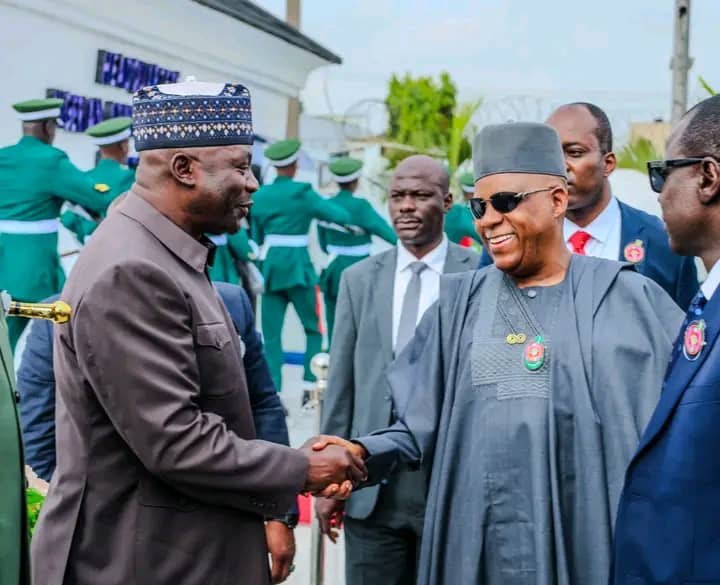
In Nigeria today, that figure is General Christopher Gwabin Musa (Rtd.), the Minister of Defence and one of the most unexpectedly influential personalities in the Tinubu administration.

His influence is not formal.
It is not partisan.
It is not manufactured.

It is rooted in earned trust built over decades of military service and now crystallizing into a quiet yet powerful political force.

This article examines the extraordinary rise of Musa’s charisma, its implications for the Tinubu administration, and why the APC may be sitting on one of its most significant political advantages heading into the coming years.

A Reputation Built on Service, Not Politics

Unlike many public figures whose reputations are shaped in the arena of political bargaining, alliances, and media engineering, General Musa’s national appeal is a by-product of his professional journey.

From his days at the forefront of counter-insurgency operations to his tenure as Chief of Defence Staff, Musa became synonymous with discipline, integrity, humility, operational excellence, and national service above personal ambition.

These qualities have followed him into the Federal Executive Council.

In a period when Nigeria continues to grapple with insurgency, banditry, regional tensions, and organized criminal networks, Musa’s appointment was a deliberate signal by President Tinubu to anchor national defence in competence rather than politics.

That decision is now yielding political dividends.

Why Musa’s Charisma Is Different

In Nigeria, political charisma is often loud, theatrical, combative, and attention-seeking. Musa’s charisma is the opposite. It is quiet, steady, and deeply persuasive.

It is the charisma of competence, not performance.

His public appeal rests on four pillars:

1. Calm Demeanor
At a time when public communication is often emotionally charged, Musa speaks with measured precision. He avoids sensationalism and speaks to citizens with respect. His clarity inspires confidence.

2. Authentic Humility
He does not project himself as a politician hungry for relevance. He carries himself as a custodian of responsibility. This humility makes him relatable and trustworthy.

3. Record-Backed Authority
Musa does not need political propaganda to legitimize his views. Nigerians remember his frontline contributions from overseeing the mass surrender of insurgents to stabilizing military operations in difficult theatres.

4. A Non-Partisan Reputation
Though a key figure in the Tinubu administration, Musa is viewed as above partisan politics. He is seen as a national asset, not a party operative. This gives him credibility across political divides.

This combination of attributes is incredibly rare and politically invaluable.

A Strategic Win for the Tinubu Administration

President Bola Ahmed Tinubu has long demonstrated an ability to recognize and elevate credible technocrats whose work bolsters the image of his government. Musa’s appointment fits this strategic pattern perfectly.

Through Musa, the administration has achieved the following:

1. Restored Public Confidence in Defence Leadership
After years of skepticism toward Nigeria’s security system, Musa’s reputation reassures citizens that competent hands are steering the sector.

2. Strengthened Internal Stability
His leadership provides stability and continuity within the military hierarchy, reducing internal friction and strengthening operational cohesion.

3. Projected Professionalism Over Politics
Musa symbolizes the administration’s preference for expertise over political interference a key narrative as Tinubu implements complex reforms.

4. Enhanced the APC’s National Appeal
A credible, widely respected figure in a politically tense environment helps soften public criticism toward the government.

These advantages are not symbolic they are strategic.

A Political Advantage the APC Cannot Ignore

The APC currently faces a difficult communication environment due to economic reforms, subsidy removal impacts, and rising living costs. In moments like this, political parties need figures who inspire trust.

General Musa fits that profile.

He is a:

credible spokesperson
national unifier
trusted public face
competent operator
reassuring communicator

He reduces political hostility without engaging in politics.

This is political capital rare, powerful, and often decisive.

A Bridge Across Nigeria’s Divides

One of Musa’s most remarkable strengths is that he appeals to voters across ethnic, religious, and regional lines.

Across the North, he is respected for professionalism and results.

Across the South, he is admired for his articulate communication and unassuming leadership style.

Among Christian communities, his presence in a high-security office is seen as reassuring and inclusive.

Among Muslim communities, his military reputation commands respect.

Among the youth, he represents discipline, intelligence, calm, and a non-corrupt public image.

This broad appeal is politically significant. Very few figures in Nigeria today can draw admiration across such diverse constituencies without controversy. Musa is one of them.

Media Visibility and Rising Public Trust

In recent months, Musa’s visibility has increased not because he is seeking attention, but because:

he is central to resolving critical national issues
he communicates effectively
media platforms find him credible
citizens trust him instinctively

His statements often go viral because Nigerians yearn for leadership that sounds both competent and sincere.

Public discourse on national security, governance, and leadership quality increasingly references him as a stabilizing figure.

This organic rise is the clearest proof that his political value is expanding naturally.

A Nightmare for the Opposition’s Strategy

Opposition parties typically rely on portraying government officials as incompetent or corrupt. But attacking Musa is politically risky because:

he has no corruption scandals
no record of ethnic or religious bias
no political baggage
no history of public misconduct
no reputation for disrespect or arrogance

He is difficult to discredit.

Any attempt to malign him risks alienating neutral Nigerians who view him as one of the few credible figures in government.

This gives the APC a protective shield and forces the opposition to rethink its messaging strategy.

Could Musa Become a National Political Force?

Not necessarily in the electoral sense though in politics, anything is possible but in terms of influence, Musa is already becoming a defining figure.

He strengthens:

public trust
institutional legitimacy
inter-agency cooperation
national confidence in security leadership
APC’s perception across key demographics

In previous administrations, figures like Dora Akunyili, Lamido Sanusi, and Attahiru Jega became national stabilizers. Musa fits into this lineage.

His influence, if strategically harnessed, could reshape the APC’s national image ahead of the next election cycle.

Conclusion: The Era of The Musa Effect

General Christopher Musa may not be a traditional politician, but he represents the kind of leadership Nigerians crave competent, calm, sincere, and unifying.

He strengthens the Tinubu administration.
He boosts the APC’s credibility.
He reassures investors, communities, and citizens.
He elevates the public perception of Nigeria’s security leadership.
He bridges divides in a polarized nation.

In an era where political noise often disguises a lack of substance, Musa’s quiet strength is refreshing. Nigeria is noticing. The political establishment is noticing. And the ruling party, if strategic, will recognize that it has in Musa one of its most valuable assets.

The Musa Effect has begun.
Its implications will be felt for years to come.

By Samuel Ateh Stephen
Digital Strategist & Public Affairs Commentator
Focused on National Development
19/01/2025
THE MIDDLE BELT QUESTION: HISTORY, POWER, AND THE CURRENT REALITY


By: Dr. Pogu Bitrus


It has become imperative to respond decisively to a mischievous and intellectually dishonest article circulating under the headline “The Manufactured Middle Belt: The Untold History, Foreign Backing and the Agenda to Fracture Northern Nigeria,” authored under the pseudonym Safyan Umar Yahaya. Far from being a work of history and of social concern, the piece is an alarmist pamphlet—animated by fear and bigotry not facts, all aimed at delegitimizing the rising social and political

consciousness of the Middle Belt.


The anxiety beneath the essay is unmistakable. For over a century, certain ruling blocs have exploited the Middle Belt economically, subordinated it politically, and tried to diminish it culturally. Today, as the people of the region reclaims its history, pride and asserts its unity, anger and blackmail is the response of the losers.


The central claim—that the Middle Belt is a recent political fabrication without historical roots—is not merely false; it is a deliberate distortion built on colonial convenience and selective amnesia.


WHAT THE MIDDLE BELT ACTUALLY IS


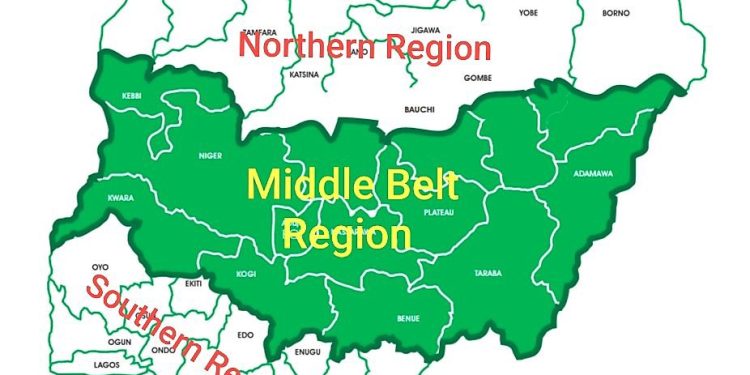
The Middle Belt refers to the vast geographical and cultural zone inhabited by indigenous ethnic nationalities of the former Northern Region—now spanning 19 Northern states and the Federal Capital Territory—who were never conquered or where never largely ruled by the Sokoto Caliphate or the Kanem-Borno Empire prior to British colonisation.

Put plainly: the Middle Belt consists of the autochthonous peoples of Northern Nigeria who are neither Hausa, Fulani, nor Kanuri, and who historically existed outside the authority of Islamic caliphates, notwithstanding some pockets of Emirate enclaves among it. This is not opinion; it is an established historical fact.


Long before colonial rule, the Middle Belt was home to sovereign empires, kingdoms, chiefdoms, and complex stateless societies whose political systems predated the 19th-century jihads by centuries. Among the most prominent was the Kwararafa Confederacy, centred in the Gongola – Benue Valley. Between the 18th and 19th centuries, Kwararafa repeatedly defeated and humiliated Hausa city-states such as Kano and Zaria and even challenged Kanem-Borno—long before Usman dan Fodio’s jihad of 1804.


Other well-documented polities include the Igala Kingdom, Jukun states, Nupe Kingdom, and countless Tiv, Idoma, Gbagyi, Birom, Angas, Lelna, Bwatye, Eggon, and Goemai societies among hundreds of others — each with distinct political traditions, land tenure systems, and military histories. They had a common solidarity hinged on wading off Islamisation and genocidal slave raids.


COLONIAL CONQUEST AND FORCED SUBORDINATION


The author inadvertently exposes his argument’s weakness when he ignores a crucial colonial reality: the British conquered the Muslim emirates with relative ease, largely by co-opting existing centralized hierarchies. In contrast, Middle Belt societies resisted British conquest fiercely.


British colonial records—by administrators such as Frederick Lugard and C.L. Temple—document prolonged military campaigns, punitive expeditions, and scorched-earth tactics used against Middle Belt communities from the early 1900s to the 1920s. This resistance is precisely why the British imposed Indirect Rule by force, subordinating Middle Belt peoples to Fulani and Kanuri emirs they had never known, accepted, or recognized.

That imposition,nnot foreign conspiracy, is the historical root of Middle Belt political consciousness.


THE COLONIAL FALLACY OF “NON-EXISTENCE”


The article’s reliance on colonial maps and constitutions to argue that the Middle Belt did not exist before the 1940s is intellectually indefensible. Colonial documents recognized what served imperial administration, not indigenous reality. By that logic, countless African nations and identities would vanish simply because Europeans failed—or refused—to acknowledge them.

Even then, the claim is factually weak. The term “Middle Belt” appears descriptively in colonial correspondence as early as the first decade of the 20th century, used by administrators and missionaries to describe the non-emirate central zone of Northern Nigeria. The British deliberately refused to create a Middle Belt Region, not because it lacked coherence, but because doing so would weaken the numerical and political dominance of the Hausa-Fulani-Kanuri oligarchy that sustained Indirect Rule.

The agitation for recognition therefore predates independence; it merely became organized in the 1950s.


THE UMBC AND THE MYTH OF FOREIGN MANIPULATION


The United Middle Belt Congress (UMBC) under Joseph Sarwuan Tarka did not invent the Middle Belt identity. It articulated long-standing grievances: land dispossession, political exclusion, cultural suppression, force labour, and religious discrimination.

To dismiss the UMBC as a tool of missionaries or foreign interests is not only false but insulting. Middle Belt people and leaders were among the most educated and politically sophisticated Nigerians of their generation, many trained in Britain and elite Nigerian institutions well before independence. They required no NGO or missionary to understand injustice they lived daily.


The historical record—petitions against Native Authority abuses, resistance to emirate taxation, land struggles, and demands for self-rule—is open to anyone willing to read honestly.


THE CONTEMPORARY MOMENT


Today’s Middle Belt movement is neither separatist nor violent. It is a demand for recognition, equity, and freedom from an imposed Arewa identity that neither reflects its history nor aligns with its values. The Middle Belt does not deny the existence of Northern Nigeria; it rejects the falsehood that Northern Nigeria is synonymous with the Middle Belt.

What has long been marketed as “Northern unity” has, in truth, been a forced political marriage, sustained by coercion rather than consent.

Increasingly, the Middle Belt is stating what history has always known: this union was never voluntary!

If language must be blunt, then so be it—this relationship has often resembled political rape, and the survivors have finally found their voice.


2027 AND THE PANIC OF DECLINING HEGEMONY


The fear driving this revisionist essay is understandable. The once-boasted “monolithic Northern voting bloc” is fracturing. Demographics, political awareness, and historical truth are converging.

For the first time, Nigeria’s political establishment is confronting an uncomfortable reality: the Middle Belt is the decisive factor in national politics.


THE MIDDLE BELT, RELIGION, AND THE COLLAPSE OF OLD MYTHS


A recurring propaganda tactic is to label the Middle Belt a “Bible Belt,” as though its political awakening is a sectarian religious project. This claim is demonstrably false. The Middle Belt has always been religiously plural, home to Christians, Muslims, and adherents of African traditional religions for centuries. Even institutionally, the Middle Belt Forum (MBF) disproves this caricature: its Board of Trustees and National Working Committee include Muslims, reflecting the region’s inclusive ethos. While it is true that the Middle Belt today is predominantly Christian—largely due to historical resistance to jihadist conquest and the voluntary embrace of Christianity—majority faith does not translate into religious extremism. The Middle Belt struggle is not about imposing religion; it is about ending political subjugation, cultural erasure, and systemic inequality. Reducing this legitimate quest to sectarianism is not analysis but propaganda.


Demise of the Hausa/Fulani Amalgam.


Equally misleading is the continued use of the term “Hausa-Fulani” as though it remains a coherent political or cultural bloc. Increasingly, Hausa intellectuals and opinion leaders reject this forced amalgam, insisting that there is Hausa land and there is the Middle Belt, but no natural or “Arewa” identity. The very terms “Northern Nigeria” and “Arewa” now irritate many enlightened Hausa voices who recognize them as tools historically used to sustain Fulani political dominance and economic exploitation. Recent events have further exposed this fracture: widespread violence by Fulani bandits against Hausa rural communities has shattered the illusion of a shared destiny. For decades, the Hausa masses were mobilized as demographic instruments against Middle Belt minorities; today, they are confronting the reality that they too have borne the costs of an unjust hierarchy. What is unfolding is not a Middle Belt conspiracy, but the collapse of an artificial political fiction. History, not agitation, has caught up with it.


Dr: Pogu Bitrus is the President of the Middle Belt Forum (MBF) and hails from Chibok, Southern Borno.

EVALUATING THE HOUSE OF JUSTICE IMPACT AT IBA 


The Aircraft glided its descent into Toronto Pearson International Airport at 20:02hrs – twelve minutes behind the estimated arrival time. The temperature outside was 9°C , the sun had set. Gloria Mabeiam Ballason Esq, Founder and Chief Executive Officer of the House of Justice set foot on the Great White North for the 2025 International Bar Association Conference which held at the Metro Toronto Convention Centre.

For the House of Justice, the purpose was beyond attending a conference to keep up with global legal trends or networking; it was for a mission much nobler: consolidating the public’s access to justice and finding effective methods of accountability against mass atrocities. The starting point for the intervention is Nigeria, her home country where political operations frequently affect terror crimes victims’ access to justice.

Building it Better Through Magnitsky Proceedings.

For a society that continues to evolve, it is imperative that accountability measures keep pace – and what better way than to explore the Magnitsky procedure.

After the death of Sergei Magnitsky, Sir Bill Browder, KCMG, curated the Global Magnitsky Justice Campaign.

Browder’s lawyer, Sergei Magnitsky, had uncovered a massive tax fraud of $230million by the Russian government. The innovative legal procedure which is named in honour of Browder’s lawyer, Sergei Magnitsky, enables accountability measures like asset freezes, disruption of access to western financial systems, restrictions on travel, banking, or ability to conduct businesses globally. The procedure creates significant personal and financial consequences and deterrence for sanctioned individuals.

The Global Magnitsky Act (2016) expanded its reach to target abusers worldwide with similar laws enacted by the EU, UK, Canada, and Australia. Time for the House of Justice to pitch in: ‘What is the legal framework and success rate of the Magnitsky procedure?’

Browder in reply said the Global Magnitsky Act had since sanctioned individuals from various countries including former Gambian president, Yahya Jammeh who was convicted for corruption and human rights abuses, Dan Gertler, an Israeli businessman, for corrupt mining deals in the Democratic Republic of the Congo, Abdulaziz al-Hasawi who was implicated in the 2018 assassination of journalist Jamal Khashoggi,

Chen Quanguo and other Chinese officials sanctioned in 2020 for human rights abuses against Uyghurs in Xinjiang, China and

Filipos Woldeyohannes, the Eritrean military leader, sanctioned in 2021 for war crimes in Tigray.

If Eritrea’s Filipos Woldeyohannes could be sanctioned under the Global Magnitsky Human Rights Accountability Act for leading an entity accused of “despicable acts” then surely, there could be individual accountability for terrorism and Mass Atrocities in the Sahelian states.

Ballason raised the stakes higher: In a private conversation with Sir Browder, she proposed an extension of Magnitsky accountability alongside International Criminal Law justice to terrorism and Mass Atrocities in Africa’s Sahelian countries. ‘Oh, brilliant! pleased to work on that; Browder replied, handing his contact card to Ballason for the continuation of engagement to actualize the idea.

In the course of the conference, the War Crimes Committee of the International Bar Association also explored the question of accountability.

Terrorism and war crimes continue in the 21st century despite a plethora of alternatives for war prevention and war crimes accountability. Ballason, whose life story is shaped by religious crisis that marred her childhood and terrorist attacks that have shaped much of her work as advocate, consultant and regional justice and peace worker, was fully engaged in the brainstorming:

‘The ultimate goal is to ensure war and terrorism do not take root as accountability cannot match the irreparable damage on humanity or resources; ‘ said Ballason. In the session which had in attendance Nigeria’s Dr. Babatunde Ajibade, SAN, Chair of the International Bar Association’s Section on Public and Professional Interest,

Ballason explained that the House of Justice position requires that governments unable to prevent war or terrorism have a duty to frame conflicts and crises for what they are: ‘ Call it ‘terrorism’ not ‘Farmer-Herder, Religious or Communal clashes’ if there is unlawful use of violence or threats that create widespread fear and intimidates government or civilian populations for the achievement of political, religious, or ideological goals; and by all means, call it ‘Genocide’ when there are killings and serious harm that inflict life conditions, prevents births, destroys in whole or in part, a national, ethnical, racial, or religious group. No government should sugar coat it. If it smells, feels, tastes, looks or is perceived as it, then it is it;’ Ballason said, her voice searing the room.

House of Justice: Rejecting Justice Rollback on Terrorism.

Why is House of Justice moving for justice for victims of Terrorism and Mass Atrocities?

Nigeria and the Sahelian countries fit Maximilien de Robespierre, the French revolutionary leader and political philosopher’s, description when he said: ‘when a person is killed, it is termed murder; when tens are killed, the killers are seen as lunatics and when thousands are killed, the killers are invited to the negotiation table.’

The psychic numbing illustrates how state accountability does not scale proportionally instead it often decreases with the scale of atrocities floating over politically transcendent or conventional laws.

The House of Justice galvanises the public to elevate their anger at injustice beyond their fears, to be uncomfortable with despots and to hold to criminal sanctions officials who through commission or negligence, are responsible for mass casualties.

The Only Way is Justice.

Since 2014, The House of Justice has continued to work on accountability measures against terrorism and Mass Atrocities through litigation, stripping corrupt leaders off public engagement and submitting petitions to ensure enablers and sponsors of terrorism are not appointed to political offices. One of such high ranking officials is Mallam Nasir Ahmad El-Rufai whose tenure as Governor of Kaduna state, Nigeria’s third largest state, was characterized by numerous murders, enforced disappearances, wilful destruction of cultural heritages, brutal persecution of critics and journalists and mass illegal destruction of houses and means of livelihood. President Muhammadu Buhari who led Nigeria, Africa’s largest country between 2015-2023 was egregiously negligent as Nigeriacontinued to feature in the rating of the top most terrorized countries in the world accounting for two top terrorist groups: Boko Haram and Herdsmen Terrorists – two groups the President was reluctant to declare as terrorists until the global community affirmed them as such.

The House of Justice continues to call for global collaboration in addressing root causes, provision of alternative narratives, terror and war financing disruption, actionable intelligence and multi-sector collaboration in preventing terror and where there are war and terror victims, that victims’ justice and resettlement should be prioritized by the state while those in the ecosystem of wars such as financiers, instigators, collaborators or executors of terrorism are held to account.

For the House of Justice, the mission is more than Law and Justice. The end point is the supremacy of the Rule of Law so there can be just societies and a safe world.