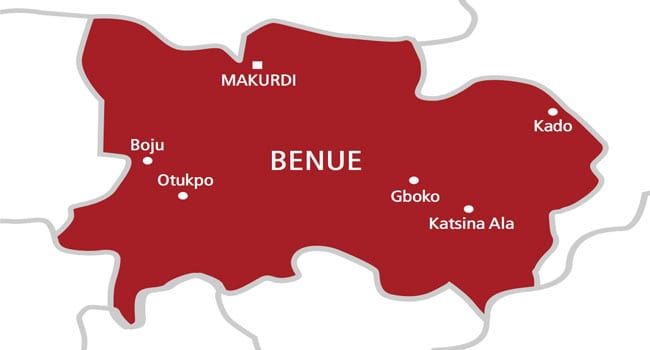
A dusk-to-dawn curfew has been placed on Ado Local Government Area of Benue State following brewing crisis among some villagers in the area.
The Chairman of Ado LGA, James Oche, announced the curfew at the weekend while urging security operatives to clamp down on offenders of the directive.
Oche based his action on the recent frenzied development among youths and the brewing tension in Agila district as well as its escalation to Apa ward in Ado Local Government Area.An official of the LG council told Daily Trust on phone that the brewing crisis was not unconnected with the age-long royal and non-royal palaver bedeviling the people of Agila district in Ado.
The official said the stereotyping of certain people in the area allegedly belonging to the non-royal class by those who claimed to have royal status had in the past created bitter rivalry which led to lost of lives and property.Meanwhile the council chairman in a statement indicated that the curfew was declared after consultation with the Ado Divisional Police Officer, Wards and Clan Heads, “to place a 6pm to 6am curfew in Agila District to take immediate effect from Saturday the 25th Day of September and to be in force till further notice.”He said, “The premises of Akpa Ofu Unazi and Jesus Cottage all of Apa Ward are sealed forthwith till further notice.
“That all gatherings of whatever sort or clustering for whatever purpose are hereby banned except with the permission of the Chairman first sought and obtained.
“That a 6pm to 6am curfew is hereby declared in the whole of Agila district.“That the Police, the Benue State Community Volunteer Guards and other Enforcement Agencies are by this notice directed to enforce these directives decisively.
“That all immigrants to Apa Ward within the last two months should immediately turn themselves in to the office of the ward head within the next seven days to report their presence or risk being arrested and dealt with appropriately.
“That all those harbouring persons not hitherto known to the communities must account for them when need be and all those whose premises are used for illegal congregation shall be arrested/prosecuted in accordance with the relevant state laws on criminality and such houses shall be destroyed.
“That violators will be brought to book in the manner most consistent with legal prescriptions as applicable, as there would be house-to-house arrest of violators.
He added that all travelers and transporters should take note that vehicular/motorcycle movement after 6pm to 6am to and fro Apa and Akpoge Ogbilolo are banned and violators would be treated in like manner as other violators.
Reminiscing on how young Nigerians in all six geopolitical zones united around a common goal to end police intimidation, oppression, and brutality, the leading Civil Society Group; HUMAN RIGHTS WRITERS ASSOCIATION OF NIGERIA (HURIWA) has condemned the illegal and gestapo operational modalities of the Economic and Financial Crimes Commission (EFCC).
In a statement issued by the National Coordinator; Comrade Emmanuel Onwubiko, the Rights group frowned at the new way officials of the EFCC chase after suspected criminals by breaking into people’s homes describing it as detrimental to the enjoyment of the constitutionally guaranteed fundamental human rights recognised in chapter four of the Constitution of the Federal Republic of Nigeria and all relevant international human rights laws just as the Rights group says the officials of the Anti-Graft Agency are by these provocative and illegal actions enticing Nigerians to stage a nationwide protests similar to the #ENDSARS PROTESTS against the misconducts of the EFCC.
HURIWA warned that the EFCC, being a creation of the law must be law abiding and so tagged the modalities of operations in which operatives armed to the teeth go into people’s houses in the dead of the night like armed robbers and kidnappers, breaking into people’s houses and climbing in through the fences like hired assassins are antithetical to the law and the principle of the rule of law.
“These unlawful actions are definitely aimed as triggers to instigate the masses to stage; the kinds of demonstrations that will be almost unprecedented in dimension and massive in scale.
HURIWA revealed that Section 36(5) of the constitution is very clear that even persons charged for criminal offence before the courts of law are deemed as innocent in the eyes of the law until a contrary determination is reached by a Court of competent jurisdiction.
“It is therefore unlawful that the operatives of the EFCC will continue to behave like outlaws or persons who are above the laws of the land. EFCC is subject to the law and must be seen to be operating in compliance with the precepts of the law and in strict compliance with the RULE OF LAW”, HURIWA averred.
Continuing, HURIWA expressed worries that there have been over a dozen clandestine operations by the EFCC in which these officials of the law have been seen defecating on the fundamental principles of the law, abusing with reckless abandon the Rules of Engagement as if Nigeria is a banana republic.
Noting that these kinds of crude, debased and bakward application of brute force by the operatives of the EFCC are absolutely condemnable, despicable, reprehensible, outrageous and provocative HURIWA warned that they be checked otherwise “the EFCC should watch and see that in the fullness of time the masses will demonstrate to say enough is enough.
“In recent times, several people have made complaints concerning officials of the EFCC barging into their homes and hotel rooms at odd hours of the day, unannounced. These men do not knock on doors or wait to be invited in, some do not come with warrants or any official notice, they just fly in, eyes darting about, and noses trying to pick the scent of criminals.
The Wednesday, September 22nd 2021 night invasion of the apartment of the Abia-based Journalist; Norah Okafor by operatives of the EFCC, which saw about 25 hooded EFCC operatives bursting into Norah’s apartment in the dead of the night, after disconnecting the wire used to electrify the fence, scaled the wall and broke the gate key to gain unfettered access into the building depicts a horror scene.
“After subjecting the poor lady and other occupants of the building to over two hours of grueling physical stress, emotional trauma and destruction of their properties in the name of searching for non-existent incriminating evidence, the operatives reportedly declared ‘we have just wasted our time’.
HURIWA sees this declaration as a wholehearted, voluntary expression and admission of a disastrous blunder of a mission; that they were in the wrong place clearly for the wrong reason and at the wrong time.
Furthermore, HURIWA recalled that on August 3, 2021, Big brother Naija (lockdown) celebrity; Dorathy Bachor had in a series of Instagram stories, narrated how at 4:45am, she ran out of her room after hearing a loud bang to find EFCC officials in her living room, who told her they were looking for someone who ran into her estate, and then asked her to stay in, lock her door and not say a word.
HURIWA again pointed out that in July 2021, filmmaker; Biodun Stephen also had narrated how officials of the EFCC, “dressed in black with wielding weapons”, barged into her hotel room at 3:00am claiming to be looking for someone, but later apologised because she turned out not to be who they were looking for.
“On February 4, 2021, a man reportedly jumped to his death from the 7th floor of a storey building when EFCC officials raided the 1004 estate in Victoria Island. There are also many other reports of EFCC officials forcing their way into hostels, people’s homes, into clubs, or disrupting night parties to round up people they think are internet fraudsters.
“On October 14, 2019, officials of the EFCC raided a nightclub in Oshogbo, Osun state and arrested 94 suspected fraudsters. On January 17, 2020, they rounded up 89 persons suspected to be involved in cybercrime at 360, a night club located at Ibadan.
“Observably, there is one word that is peculiar with all of these arrests: ‘suspected’. These people being rounded up are still suspected to be fraudsters, which means that investigations have not been carried out to pinpoint who, amongst them all, is the actual fraudster.
“So to get to the fraudsters, EFCC officials barge into innocent people’s homes and spaces, and leave a trail of panic-stricken, horrified, and emotionally traumatised citizens who came face to face with gun-wielding men in black, and perhaps watched their lives flash before their eyes.
“It is not even enough to have warrants or identify yourself after you have barged in, it is abysmal that security agents would even break down people’s doors, or jump people’s fences in the first place”.
Provoked that these days, it is difficult to differentiate between robbers and men of the EFCC as they seem to adopt the same tactics in carrying out their operations, HURIWA opined that EFCC is missing their job description while noting that looters are right in their faces but they are busy chasing regular folks.
“Today it’s N100m missing in a government office, tomorrow N40m, why don’t they go and catch those stealing the common wealth blind? Instead of bringing to justice suspected high profile politically exposed persons who jump from one political party to the All Progressives Congress and are given red carpet reception by the President, the EFCC has become agents of witch-hunt, targeting largely young people”.
Hence, HURIWA emphasized the need for the EFCC to be called to order and made to adopt law based procedures in going after suspected offenders while observing all the tenets and precepts of the fundamental human rights just as the Rights Group advised that the agency must adopt clinical and professional modus operandi that will be in compliance with all the rules of Engagement.
“Why not use surveillance and intelligence gathering to go after suspected offenders in the day time and make lawful arrests instead of behaving like armed robbers or armed Fulani militia members?” HURIWA queried.
Referencing the video released by the Dubai Police last year, which gave an account of the series of investigations carried out before the arrest of Ramon Olorunwa Abbas, known as Hushpuppi and his gang, HURIWA admonished that the EFCC can learn professionalism from the Dubai Police as actions such as breaking into people’s homes and parading those who are still suspects show the insensitivity afflicting the anti-graft agency. This is because, according to HURIWA, EFCC is meant to protect the people and the country against financial crimes, not terrorising people in the same breath
“Observably from the video, the investigation, dubbed Fox Hunt II, was carried out for about 4 months, during which his social media account, fraudulent activities, and the gang’s whereabouts were closely monitored. The Dubai e-police team were tracking Hushpuppi’s every move and taking notes of all his online activities, including all the fake pages of existing websites he and his team created to redirect their victims’ payment to their own accounts.
“They also found out all the corporate emails he and his team had hacked to send fake messages to clients to redirect financial details, and people’s bank details to their own account. Before his arrest, the Dubai police could tell exactly the number of people he had scammed and how much Hushpuppi had in his account.
“During the time of his arrest, they knew exactly where he and his team were, and at what time. They didn’t need to jump fences or break into innocent people’s homes to carry out the arrest. They knew their onions.
“There’s a peculiarity with which our security agents clamp down on those they perceive to be criminals, which includes inadequate investigation, violence, blood-shot eyes, high-pitched command voices, swiftness to inflict pain, and then for many, extortion.
“Perhaps, the EFCC is no different; their recent mode of operation in breaking-in, spreading panic, battering, bullying, and half-true accusations is consistently making a horseplay of an institution that is meant to operate with intelligence and facts.
“It is disturbing that EFCC has joined the bandwagon of uniformed men terrorising the Nigerian people”, Prior to now, waking up in the middle of the night or wee hours of the morning to see men clad in black with guns, one would assume being attacked by armed robbers. But with the increase in Controversial raids of public and private spaces by EFCC officers in recent months, it is might be apt to ask “who are you” when you see men jumping your fence, so they can introduce themselves and tell if they are thieves, burglars, or from the EFCC”, HURIWA concluded.
Honourable Cafra Boaz Caino popularly known as “The People’s Chairman” has suffered a humiliating defeat in the just concluded Kajuru local government Chairmanship elections held on Saturday.
Caino lost to the Peoples Democratic Party (PDP’s) candidate, Honourable Ibrahim Gajere who clinched the Chairmanship seat by a wide margin.
Announcing the results on Sunday in Kajuru, the Returning Officer, Dr Ibrahim DanMaraya said Ibrahim Gajere of the PDP polled 14,432 votes to defeat the immediate past Chairman and Candidate of the All Progressives (APC), Cafra Caino, who scored 9,095 votes.
The PDP also won nine councillorship seats, while the ruling APC won just one.
Cafra who many believe came to office in 2018 through the back door as the elections were said to have been won by the PDP but forces in the Kaduna state government House imposed Cafra against the will of the people.
It isn’t a list anyone would be proud of. In plain terms, it is a frightening list. But here it is in black and white: 6,319 persons arbitrarily and willfully killed; 3,672 kidnapped; N2, 805,049,748 paid as ransom; 6,483 widows and 25,050 orphans left behind by slain victims; 215,241 cows, 141,404 sheep, 20,600 of other animals (such as camels and donkeys) rustled; and 3,587 houses, 1,487 motor vehicles and motor cycles burnt.
Then a foot note to the list: Bandits operated 105 camps from which they launched deadly attacks on Zamfara, kill and steal the people’s properties at will; their leaders identified.
Grim figures, no doubt.
But this is just a small segment of the chilling report of the high wire banditry raging in Zamfara, but has now spilled into several states across the country, and consequently putting national security in jeopardy.
Other segments of the report include the indictment of several members of the traditional institution, top government officials and security forces.
As of the time Sunday Vanguard exclusively obtained the report last week, some of the men who engaged in the bloodletting Zamfara banditry had moved further North-West and North-Central, wreaking unprecedented havoc in Katsina, Sokoto, Kaduna and Niger states.
No white paper on the far reaching recommendations of the committee that wrote the report has been issued two years after the report was submitted to Zamfara State government.
The slightest hint yet that something was being done on the implementation of the recommendations was made during the celebration of Democracy Day on June 12, 2021, about one and a half years after the 279 page report had been submitted, when Governor Mohammed Bello Matawalle said, in a broadcast, that he had demonstrated commitment to the implementation of the report with the suspension of the emirs of Maru, Dansadau and Zurmi, who, among several others, had been indicted in the report of the panel for allegedly colluding with bandits to kidnap, collect ransom or even kill their people.
The report was submitted in October 2019 but the recommendations have largely not been implemented.
Had it been implemented, at least one former governor should be facing trial for alleged murder while several emirs, not just three who have been suspended, would have been deposed.
10 army officers would also have faced court martial.
A source close to the Government House, Gusau, however, said a panel was raised to review the recommendations and report back to government.
The committee, tagged Zamfara Committee for Finding Solution to Armed Banditry in the State, had been raised by Matawalle on his assumption of office in May 2019 to investigate the banditry that had blown into full scale war between indigenous Hausa farmers and Fulani herders in the state.
Specifically, the terms of reference included investigation of willful killings, kidnappings, destruction of properties and other related matters in Zamfara and to make recommendations to the state government on the appropriate actions to take, and investigation of the remote and immediate factors responsible for the unprecedented and wide-spread killings, maiming, kidnappings, rape, cattle rustlings, destruction of crops/grains and displacement in the state.
The investigation covered the period between June 1, 2011 and May 29, 2019.
The panel was headed by a former inspector general of police, MD Abubakar, and had diverse membership which included Senator Saidu Muhammed Dansadau, Hon. Justice Nasiru Umar Gummi (rtd), Alh. (Dr.) Sani Abdullahi Shinkafi (Wamban Shinkafi), CP Mamman Anka (rtd), Mamuda Aliyu Maradun (ex-Permanent Secretary), Alh. Ibrahim Bawa (Fulani representative), Alh. Mohammed Adamu, Perm. Sec. Home Affairs, Committee Secretary, and Barr. Aliyu Abdullahi Gusau, Director Public Prosecution, Assistant Secretary.
Co-opted members were DIG Mamman Ibrahim Tsafe (rtd), DSP Hardo Abubakar Abdulkadir, Alh. Imrana Ibrahim Aliyu and Usman Saidu Dansadau.
Promise
When the committee was submitting its report in October 2019, Matawalle had promised to implement the recommendations, assuring that he would not be diverted by any sentiment.
The governor was said to be in the entourage of President Muhammadu Buhari who was visiting the United States to attend the United Nations General Assembly last week, and his spokespersons could not be reached to speak on the status of the report.
Origin
To be sure, the Zamfara banditry, according to the report, started in a village called Dansadau.
Although there are conflicting accounts of how banditry turned deadly in the state, everyone quoted by the report seemed to agree it all began in the Dansadau village where the Hausa who, in their quest for farmlands, reportedly indiscriminately encroached into cattle routes and grazing reserves and that triggered friction between them and Fulani residents.
A member of the committee, quoted by the report, narrated that about 19 years ago, a former District Head of Dansadau, Alh. Shafiu Salihu, ignited the problem after he authorized a self-defense outfit called ‘Yan Sakai’ to kill any thief even if it was a goat he stole.
The report went on: “He (committee member) cited an example where a person was discharged and acquitted by a law of court but on getting back to Dansadau, this freed man was killed together with his father.
“This member further informed the committee that, out of brutality and inhumanity of man-to-man, he (victim) was asked to dig the grave where he was eventually killed and buried.
“The Emir of Birnin Gwari was also high handed and further fuelled friction and disharmony when he directed his subjects and other vigilante groups or ‘Yan Sakai’ to kill anybody that was found to have stolen anything.
“According to this member, that ugly scenario where people were allowed to take the law into their hands compounded the problems of mistrust and rivalry among Hausa and Fulani. In the same development, he stated that one Alh. Ishe, a Fulani man who championed the cause of Fulani, made the Fulani in Dansadau Emirate to rally behind him.
“This member added that about five or six years after Alh. Ishe took a seemingly leadership of Fulani in the area made ‘Yan Sakai’ aggrieved.
“The rivalry between ‘Yan Sakai’ and Fulani in the area under the leadership of Alhaji Ishe became so intensified and eventually Alh. Ishe was killed and his corpse was put on his car and burnt to ashes.
“Thereafter, the Fulani started launching reprisal attacks around Sangeku and Kabaro villages.
“According to the member, close relations of Alh. Ishe emphatically stated that the life of Alh. Ishe is equivalent to 1, 000 souls of Hausa men.
“Therefore, from that time, Fulani in the area started attacking Hausa communities especially in the rural areas and ‘Yan Sakai’ killing Fulani indiscriminately”.
This narration corroborated the committee finding that the first armed banditry took place late in 2009 in Anka/Maru Local Government along Anka/Dansadau Emirates’ border.
Multiple causes
The report found several causes as responsible for the Zamfara banditry.
The remote causes include institutional failure and blatant betrayal of trust by unscrupulous political leaders, traditional rulers, security officers and judicial officers; poverty, unemployment, indolence and frustration that led many youths to drug abuse and involvement in crime; influx into and settlement of illegal alien Fulani from neighboring countries in Zamfara who initially behaved and related with both indigenous Fulani and Hausa harmoniously and peacefully but later exhibited their true criminal tendencies by starting small scale armed robbery, followed by rustling of non-Fulani and indigenous Fulani cattle, and when herds of the locals were grossly depleted, they had no option but to join the gang of criminals to make a living and a means of replenishing their lost herds of cattle; proliferation of traditional rulers at all levels by successive governors with no regard to rules and regulations/due process; proliferation and widespread consumption of dangerous drugs; and high level corruption on the part of bad eggs in the security, judicial and law enforcement services.
On immediate causes, the report found indiscriminate allocation of virgin forest, forest reserves, game reserves, Fulani grazing areas, home settlement as farmlands to farmers by successive Zamfara governments from May 29, 1999, a situation which pushed the Fulani in the state to the wall and left with no option but to take the law into their hands for survival; attacks and counter attacks, reprisal and counter reprisal between Fulani and farmers on one hand and Fulani v. ‘YAN SAKAI’ on the other; injustice by some traditional rulers in land dispute management; and indiscriminate release of suspects by security agencies played varying degree of roles.
The report is unsparing of some former governors over the roles they allegedly played during their tenures which escalated banditry in Zamfara
On the alleged role of former Governor Ahmed Sani Yariman Bakura (May 1999 – May 2007), the report said: “When small scale armed robbery began to rear its ugly head in different parts of the state, he directed allocation of farmlands in government forest reserves along the major highways in order to create clear view for motorists and make it difficult for armed robbers to escape easily from the thick forest reserves.
“This policy sparked off agitation by farmers across the state for allocation of farmlands in forest reserves nearest to their respective areas.
“The governor bowed to the pressure, thus indiscriminate allocation of farmlands with no regard to Fulani interest began.
“Unscrupulous civil servants in the ministry of environment abused the policy, connived with some fraudulent traditional rulers and allocated almost as much as what was allocated officially by the state government”.
On former Governor Mamuda Aliyu Shinkafi (May 2007 – May 2011), the report has this to say: “During his four-year tenure, fraudulent civil servants enjoyed a field day.
“They allocated farmlands in government forest reserves at will without the knowledge of government.
“He too allocated some farmlands especially to some high profile individuals both within and outside the state of between 100 to 700 hectares per person.
“191 beneficiaries include legislators, political appointees and party officials”.
In the case of former Governor Abdulaziz Yari Abubakar (May 2011 – May 2019), the committee wrote: “The seed of security crisis planted during Governor Ahmed Sani Yariman Bakura’s tenure watered and nursed all through germinated fully three months into the tenure of Gov. Abdul’Aziz Yari Abubakar.
“Gov. Abdul’Aziz Yari’s failure or refusal to address the security crisis in the state at a very early stage, however, provided a fertile ground and enabling environment for the influx of bandits from other parts of the country and neighboring countries.
“This situation complicated and up scaled the armed banditry in the state to the extent of covering the entire 14 local governments of the state and spilling over to neighboring states of Kaduna, Katsina, Kebbi, Niger and Sokoto.
“The governor’s nonchalant attitude and unflinching absence from the state provided golden opportunity to fraudulent security agencies, judicial officers and department of public prosecution in the ministry of justice to compromise the call of their statutory duties in favor of extraneous personal benefits. “Management of security is time bound and expensive.
“The constant absence of former Governor Abdul’Aziz Yari rendered security agencies orphans with no master to report to on urgent security intelligence issues and with no source of funding to avert impending attacks.
“Failure to attend to urgent and important memos on security matters from relevant ministries and departments of government was one of the factors responsible for the inability of government to tackle the security challenges.
“His administration, like those of his predecessors, allocated farmlands to big time politicians in government forest reserves which worsened the predicament of the Fulani access to grazing areas.
“His deliberate refusal to receive report from a committee he personally set up that worked for two years on ways of finding solution to the unprecedented security challenges in the state is the peak of lack of concern for lives and property in the state.
“The preponderance opinion of witnesses, complainants, traditional rulers, security agencies and civil servants showed lack of attention to security issues brought before the former governor including formal and informal intelligence.
“In spite of the human and material losses, it could literarily be said that no aid was provided to the surviving victims (IDPs) or families of the deceased.
“In spite of his ardent opposition to the Yan-Sakai group (self defense outfit) from the beginning of the security challenges up to October 2018, when 2019 elections were fast approaching, the state government formally registered and employed 8,500 of them as informal security outfit in the name of assisting the military in their fight against bandits but with the alleged motive of using them as political army to rig the 2019 elections in the state.
“This notorious group used their new status as a license to kill and extort people especially Fulani and political opponents in broad day light on market days throughout the state. “There is in fact literarily no witness or complainant that appeared before the committee that did not lament the atrocities of the self defense group.
“They were mainly responsible for the escalation of killings, kidnappings and extortions in Zamfara State from November 2018 (when they were registered and employed) to May 2019.
“One of them was alleged to have killed not less than 30 innocent people within the period under review”.
According to the report, while all the abracadabra of illegal land allocation was going on at the state level from 1999 to 2019, local government council chairmen connived with some traditional rulers to allocate as farmlands all available forest reserves, grazing areas, and Fulani settlements under their jurisdictions to few farmers, largely to politicians and high profile personalities in the affected localities.
“This is the last stroke that broke the camel’s back which pushed the Fulani to the wall with no option but fight the battle of their lives for survival”.
Charges
Arising from the alleged roles of the former governors in fuelling banditry in Zamfara, the report said: “The committee recommends that the immediate past Governor Abdul’Aziz Yari Abubakar and his aides (immediate past Commissioner for Local Government and Chieftaincy Affairs, Hon. Bello Dankande Gamji, and Alhaji Sani Gwamna Mayanchi) be arrested and prosecuted for alleged multiple culpable homicide due to his acts of commission and omission”.
The committee established that whereas some traditional rulers were complicit in the escalation of banditry in Zamfara, many were negligent in their responsibility of ensuring security in their respective domains.
In fact, were the recommendations of the committee to be implemented to the letter, no less than 15 of the 17 emirs in the state would be deposed.
The story of the alleged collaboration of the Emir of Maru and a District Head with bandits was told by the Zamfara SSG, Alhaji Bala Bello Maru, in his testimony before the committee.
The report, quoting the SSG, narrated: “The Secretary to the State Government informed the committee that, they received a report that armed bandits had planned to attack some villages within the emirate and security operatives were informed accordingly.
“He further stated that, in that night, Rayau, Mahuta, Talli and Dutsin Gari villages of Kanoma District in Maru Emirate were attacked by armed bandits and 17 people were killed and many others injured.
“On the following day (5th June, 2019), all the Emirs in the State paid Sallah homage to His Excellency, the Executive Governor of Zamfara State, Hon. (Dr.) Bello Muhammad, MON, Matawallen Maradun.
“Thereafter, the Executive Governor stated that a visit to the affected villages which were all under Kanoma District should be made in company of the Honourable Member, Zamfara State House of Assembly representing Maru North, Hon. Yusuf Alhassan Kanoma, Alh. Bala Bello Maru, the Secretary to the State Government and all the security heads among other entourage.
“On arrival of the Executive Governor and his entourage, they headed to a primary school where the IDPs were accommodated. “Thereafter, the District Head of Ancient Kanoma on the hill made a welcome address and finished his speech accordingly.
“Then the suspended District Head of Kanoma below the hill was invited to make his own welcome address as his counterpart on hill made.
“As he started making his own welcome address, there were a lot of grumblings and shouting by the villagers.
“In the same development, the Emir was to make his speech and welcome address but there were a lot of shouting and disorder by the villagers and all efforts made to allow the Emir to speak failed woefully.
“On seeing the disorderly crowd, the Executive Governor addressed the gathering of the villagers and there was a lot of applauds and chanting of goodwill messages to him.
“After the Executive Governor and his entourage left for Gusau, the crowd of villagers attacked the District Head of Kanoma and injured him badly.
“It was for the timely intervention of the Hon. Member House of Assembly representing the area, the mob would have killed him. “Simultaneously, security operatives started shooting in the air and throwing teargas canisters to disperse the mob.
“The mob also started throwing stones at the Emir’s official car with a lot of commotion. “When the Governor arrived Gusau with his entourage, people started to allege that the Emir was collaborating with the suspended District Head of Kanoma and armed bandits.
“Therefore, according to the Secretary to the State Government, there were strong suspicions among public opinions that the Emir of Maru and the suspended District of Kanoma are in complicit in cases of armed banditry activities being perpetrated in the area. “Already, in the Governor’s entourage, there were the Commissioner of Police, Director of State Service, Brigade Commander who the Executive Governor sought for their advice of what to do in such ugly circumstance, which they unanimously pointed out that the episode was a big embarrassment to the government and there was the urgent need to take decisive action by suspending the duo (the Emir of Maru and the District Head of Kanoma South) pending the determination of investigation to be carried out.
“Three days after the killing of 17 people mentioned earlier, the armed bandits returned and burnt down the village.
“There was also the issue of 5 million naira ransom which was allegedly paid to HRH, the Emir of Maru through the District Head of Kanoma South.
“However, the Secretary to the State Government informed the committee there was no formal reports or petitions against the Emir from any quarter, but an isolated information from a member of the State House of Assembly, Hon. Yusuf Alhassan Kanoma, and other unspecified sources”.
Startling revelations
Zamfara State Commissioner of Police, CP Usman Nagogo, also indicted the Emir of Karu in his testimony to the panel, according to the report.
The report quoted him as saying that in 2016 when CP Shettima Istifanus was the Zamfara State Commissioner of Police while he (Nagogo) was the Zamfara State Deputy Commissioner of Police (Finance and Inspection), then government appointed him as the Peace Ambassador and Chairman to head Amnesty Committee.
“According to him, he visited Dokani forest where he saw arms and ammunitions with over 1, 000 bandits. Buhari Daji surrendered 13 AK47 assault rifles and a rocket launcher as a sign of his confidence in the amnesty programme”, the report said.
“He stated that his concern was not to wage war against the bandits but to enter into dialogue and reconciliation because even if government should deploy one million soldiers, they would not be able to defeat the bandits as they were so many with sufficient and sophisticated weapons to counter any attack on them.
“The bandits had informants everywhere and could pay as much as N500, 000 to an informant.
“He then advised then Executive Governor of Zamfara State that the government should direct the release of Buhari’s wife.
“According to him, then State Director, State Service truncated all efforts put in place by the Amnesty Committee.
“In his view, the main cause of the crisis was the Yan Sakai, Civilian JTF and vigilante groups in that whenever a Fulani man was killed, Fulani would attack the whole village killing several people and leaving scores injured.
“Finally, when he met with the Ardos and other Fulani leaders, their complaints were that they were deprived of attending markets, mosques etc. and whenever Fulani were killed, government did not visit and console them.
“However, whenever the Hausas were killed, the government visited and consoled them”.
Boko Haram/ISIS infiltration
Also testifying, DSP Hardo Abubakar Abdulqadir, Sector Commander in charge of Zamfara, Sokoto, Kebbi, Katsina and Kaduna states, according to the report, revealed that there was infiltration of Boko Haram and ISIS elements in Dangulbi and Dansadau forests.
“He informed the committee that his squad arrested an armed bandit at Danjibga village who had an ISIS head band and who informed the squad that there were 15 in number and were invited from Niger Republic”, the report said.
“According to the armed bandits, some of them had since moved to Sokoto, Tangaza, Gudu, Illela etc”.
17 District Heads
The report found most of the 17 emirs in Zamfara and several of their District Heads either neck deep in banditry activities or negligent in their responsibility of securing their people while others were interdicted for absenteeism.
In fact, one of them was accused of being away while 840 of his subjects were killed; two others to answer murder charge.
Only two of the monarchs got a clean bill, according to the report.
Whereas one was recommended for national honours in appreciation of his efforts to secure his subjects despite raging banditry, another was asked to be commended by the President for similar feat.
And to sanitise the traditional institution in Zamfara, the report recommended an overhaul and restructuring in such a manner that it will reflect the true tradition of the institution and be at par with its peers in north-western states with no regard to individual, group or political interests. The panel also recommended that emirates in the state be compressed from 17 to three.
Cover up
The report has no good words about the police as it noted that there was no witness that appeared before the committee who was asked about the cause of the escalation of the security crisis in Zamfara that did not point accusing fingers at the police for lack of diligence and thorough investigation, conspiracy to cover up suspects and indiscriminate and rampant releases of suspects.
It also slammed the military. It said: “It is ironic that when President Muhammadu Buhari deployed additional 1, 300 troops to Zamfara State early 2017 under the command of a Major General assisted by a number of Brigadier Generals in addition to 350 troops under the command of a Lt. Col, the security situation in Zamfara State worsened and became more complicated.
“A month before the deployment of the additional troops, a little over 100 people were kidnapped in Zamfara, while one month after their deployment, over 200 were kidnapped with owners of livestock complaining of the worst situation they ever found themselves. “Many Fulani and owners of livestock accused the troops of attacking, killing and impounding livestock of innocent Fulani and claiming success over bandits and recovering stolen cattle from them.
“Traditional rulers at different levels had complained bitterly about the sarcastical attitude of the soldiers that whenever they were directed to the point of potential attack by bandits, they deliberately divert to a different direction and attack innocent Fulani or give excuses of they had not been given order from above.
“This unpatriotic and unprofessional behavior, according to the accounts of many witnesses and complainants, complicated and worsened the security situation.
“There are also a number of complaints and allegations against the military personnel of fraudulent management of redeemed livestock from bandits and those impounded from innocent owners.
“The committee received many reports and allegations of conspiracy between some fraudulent military personnel, traditional rulers and Civilian JTF members of missing redeemed livestock; there abound, as well, complaints of fraudulent military personnel releasing bandits arrested by vigilante groups or Civilian JTF that were handed over to them.
“Such complaints and allegations came before the committee from across all the strata of the society”.
The report mentioned the case of one army captain who was handed over four arrested bandits by the vigilante group from a village in Zurmi local government Area, saying two days later, the handed-over bandits attacked the village of the vigilante group.
It noted another officer who witnesses in Zurmi accused of collecting regular levies of about N2million per bandit according to the account of a traditional ruler.
“He is obviously one of those officers accused of attacking innocent Fulani, killing, arresting some of them and commandeering some of their herds of cattle and claiming success in the fight against bandits”.
The report listed 10 military officers for “dirty involvement in escalating the menace of armed banditry, mismanagement of recovered livestock and unholy relationship with criminals”.
Three categories of bandits
It identified three categories of bandits as (a) Hardened criminals who, years before the advent of armed banditry in Zamfara, had been involved in armed robbery on the highways and other heinous crimes, (b) Those who have been forced into banditry by different circumstances, such as depletion of their herds of cattle and poverty, those whose herds of cattle had been rustled and had nothing for livelihood, those who had been pushed to the wall by atrocities of fraudulent traditional rulers, court officials and security agencies who regard banditry as easy means of building large herds of cattle, (c) Those invited from neighboring countries to assist indigenous Fulani in their battle for survival, saying about 90% of (b) above, have repented and very much desirous of integrating with their various communities to resume their normal and legitimate life and over 90% of (c) have since returned to their various countries.
“However, only a negligible number of (a) have or are willing to repent”, the report said.
It recommended the design of a special programme for rehabilitation of bandits and other repentant criminals in order to integrate them into the society and make them adopt legitimate means of livelihood while waging a serious war against unrepentant bandits/criminals.
Under its general observations and recommendations, the committee made 16 notable observations among which is that the usurpation of local government funds by state governors is substantially responsible for high level of poverty and unemployment at the grassroots level, adding: “This phenomenon has been identified as one of the major causes of drug abuse and armed banditry”.
Bandits have killed two persons and abducted an Arabic and Islamic studies teacher in Kuregu community in Zaria Local Government of Kaduna State.
The incident happened on Friday around 10:pm when the bandits stormed the community.
Daily Trust had reported on January 19, 2021 how Professor Aliyu Mohammed of Abubakar Tafawa University Department of Agriculture , Bauchi who live close to the community was abducted and how an undisclosed amount was paid as ransom before he regained his freedom.
A resident of Kuregu community, who craved for anonymity told Daily Trust that the two persons killed were members of the community.
He said the victims were just at the wrong place at the wrong time because the bandits came asking for the houses of wealthy individuals in the community when they came across the victims and shot them before abducting an Islamic studies teacher in the community.
The State Police Command Public Relations Officer ASP Jalige promised to call back after getting details from the area but didn’t do so as at the time of filling this report.
Gunmen have allegedly abducted a woman and her two children in Omu-Aran, Irepodun local government area of Kwara State.
The incident happened around 7pm on on Friday near a petrol station at Oko junction area in the ancient town.
The kidnapped woman, said to be the wife of the owner of the filing station, has a shop around the area, it was gathered.
The suspected gunmen were said to have invaded the area and fired gunshots sporadically into the air.
It was also gathered that stray bullets from the gunshots hit two commercial motorcycle riders in the process.
The wounded Okada riders said to have been rushed to an unknown hospital in the town, are recuperating.
As at the time of filing this report, it was not known if the alleged abductors of the woman and her two children had contacted the family for ransom payment.
Spokesperson of Kwara Command Ajayi Okasanmi told The Nation said: “I am not aware of the incident, but I will get back to you as soon as I am officially briefed of the development.”
A large group of Boko Haram terrorists have moved out of their base in North-East Nigeria to join forces with criminal gangs and bandits in the North-West where they are engaged in weapons training and kidnapping, military sources told Agence France Presse (AFP) on Friday.
Boko Haram’s Islamic State-allied rivals have been consolidating their grip on the North-East after the reported death of Boko Haram leader, Abubakar Shekau, this year, in a major shift in Nigeria’s 12-year insurgency.
Islamic State West Africa Province (ISWAP) has been moving into Boko Haram’s territory, fighting Shekau loyalists, assimilating some or forcing others to surrender to the armed forces, security sources say.
Details of the Boko Haram fighters moving could be the latest sign of cooperation between jihadists and criminal armed groups in the northwest, who raid and loot villages and conduct mass abductions for ransom.
Two military sources said a faction loyal to Shekau based in Borno State had dispatched two commanders and 250 fighters to the Rijana forests in Kaduna State.
Bandits operating in the North-West
Both commanders are allied with Bakoura Buduma, a Boko Haram chief who remains loyal to Shekau and whose fighters are resisting ISWAP consolidation, according to security sources.
“They are the masterminds behind some of the abductions in the northwest,” one of the military sources said.
Both sources said Boko Haram militants were also training the gangs, known locally as bandits, in the use of anti-aircraft guns and explosives and other weapons.
A military spokesman could not immediately be reached for comment. Kaduna State officials also did not immediately reply to a request for confirmation.
A Nigerian security agency communique earlier this month had warned that a Boko Haram commander and foot soldiers were moving across the country from their base in Borno State to Kaduna State and other Nnorth-West states.
Analysts say there have been growing signs jihadists and bandit gangs are developing deeper ties where both stand to gain: Jihadists supply arms while profiting from criminal activity.
North-West Nigeria has long been plagued by the bandit groups, but this year, attacks and kidnappings have surged as the economic fallout from the coronavirus pandemic feeds criminality.
Criminal gangs have targetted schools in a series of high-profile mass abductions of students and pupils for ransom.
Attacks have also become more brazen. Last month armed criminals assaulted the country’s elite military college in Kaduna and kidnapped one officer while in June criminal gangs shot down an air force jet conducting operations on their camps.
Northwestern Zamfara State, neighbouring Kaduna, earlier this month began a military campaign against bandits and ordered a complete telecoms blackout in a bid to disrupt bandit communications.
Some farmers in Katsina State have decried the negative impact of banditry on farming activities in the state.
According to them, bandits have stopped them from going to their farms to cultivate food items.
The farmers, in an interview with Daily Trust, stated that bandits stormed their farms to either abduct them, kill them or tax them before they could even cultivate on their farms.
They further said every household in the Batsarin-Alhaji area had to pay N500 to the bandits from the last farming season.
Thereafter, the bandits demanded that the villagers supply them with fertilisers.
The villagers had to tax themselves to purchase the fertilisers.
A 65-year-old farmer, Sa’adu Nuhu Batsari, said he stopped tilling three of his farms of 20 hectares each for over two years due to insecurity, lamenting that the heightened banditry is driving both big and subsistence farmers out of farming.
“Once you’re on the farm these people would come and abduct, kill or harass you. I abandoned my farms that are deep inside the bush and now work on the one close to town that is only two hectares. The constant threat stopped me from going to the farm,” he said.
The Chairman of Batsari Local Development Association, Sani Muslim Batsari, lamented that he has been forced to stop cultivating his big farms in the bush in the last two years due to the worsening insecurity situation in Batsari.
“I was harvesting almost 300 bags, but now I harvest only 50 bags or less in my small farm that’s closer to the town.
“Bandits have taken over many forests and cleared them for farming. Some of them can harvest 3,000 bags of grains. Some villagers confided in us that these bandits have hijacked their farms without paying a kobo to them.
“Their activities are taking a toll on our well-being; they have led to a shortage of food and skyrocketing prices and lack of menial jobs for your youth as the large-scale farmers that employ hundreds of them have since abandoned the farms.
“President Buhari had, during the onset of the rainy season, assured us that we would go back to our farms this season. Alas, that has remained a mirage! I can categorically tell you that now more than 70 per cent of farmers in Batsari LG have stopped farming,” he lamented.
Another farmer in Nahuta village, Muhammed Auwal, said from the last farming season, farmers in his village were asked to pay tax to bandits to access their farms but that didn’t protect them from attacks by the bandits.
“They’d seize our cattle or motorbikes. This season, they asked our neighbouring village, Kasai, to contribute money and buy fertilizer for them which they did.
“Last season, every household in Nahuta had to pay N1,000 and we contributed more than N2 million as tax for the bandits which we delivered to them before they allowed us to farm. But this season, we’re lucky because they didn’t ask for tax from us maybe because soldiers have been deployed to our community. But villages surrounding us are still battling with these insecurity issues.”
50-year-old Dahiru Usman Wada, from Kurawa community, confirmed that bandits confiscated his two hectares farm and planted on it.
“They made ridges and planted crops; their motive is to kidnap me if I went there, so I had to leave the farm to them. I have now relocated to Batsari town and got a small farm close to the town” he said.
At least 20 soldiers have been killed and several others missing after an ambush by militants from the Islamic State-backed faction of Boko Haram, the Islamic State West Africa Province (ISWAP), formerly known as Jamā’at Ahl as-Sunnah lid-Da’wah wa’l-Jihād in the Marte area of Borno State.
A military source told SaharaReporters gathered that the attack took place in Marte town on Friday.
According to him, the soldiers were on their way to Maiduguri, the state capital before the terrorists struck.
He also stated, “There was another ambush again on Friday. Ambush is the most difficult fight. We lost 20 soldiers. The ambush happened to Marte.”
The source added that two gun trucks were burnt and two others were stolen by the militants during the attack.
He said, “Two gun trunks were burnt, while two other gun trucks were taken by Boko Haram militants.”
Boko Haram and its offshoot, Islamic State West Africa Province, have killed thousands and displaced millions in northeastern Nigeria.
The Nigerian military has repeatedly claimed that the insurgency has been largely defeated and frequently underplays any losses.
In the past months, soldiers have been targeted by the insurgents.
Hundreds of soldiers and officers have been reportedly killed since January 2021.
Some soldiers were killed during the year when two explosive-laden vehicles rammed into a military convoy in Wulgo.
The suicide bombers were identified as Abu Bakr al-Siddiq and Bana Jundullah. The group also claimed four military vehicles were destroyed.
In February, about 20 soldiers were also killed in Malari, Borno State by the insurgents.
SaharaReporters gathered that the soldiers were on patrol to clear some Boko Haram elements in the area following credible intelligence when they were ambushed by the group.
Bandits in Zamfara State, Thursday evening attacked Shinkafi town, including two police facilities, shooting sporadically in the process, Daily Trust Saturday gathered.
The attackers were said to have carted away arms from the ransacked police stations.
Details of the incident were sketchy at the time of going to press, as Shinkafi, like the rest of the state, is not reachable by phone due to the shutdown of telecommunication network earlier this month.
But a resident of the town who spoke from Sokoto confirmed the initial social media report on the attack, Friday morning.
He said the armed men arrived the town when residents were observing the magrib prayer at sunset and operated for over an hour.
The source stated that the attack came following a threat letter to the community earlier that day, where two bandits’ leaders near the community, Kachalla Turji and Halilu Sububu, announced a joint mission to attack Shinkafi and its environs.
Shinkafi is the last major town on the road linking Zamfara with the neighbouring Sokoto State. Bandits had in the past attacked the town at various times.
The Zamfara State police spokesperson could not be reached due to the telecom shutdown, while the spokesman of the Nigeria Police Force, CP Frank Mba, said he had no information about the attack.