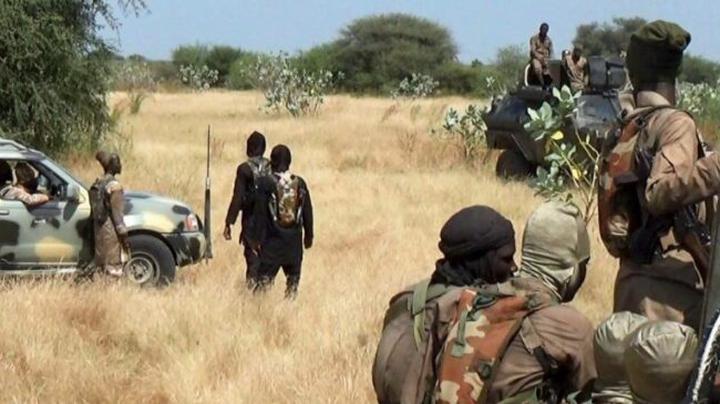
Gunmen suspected to be terrorist herdsmen operating in Southern Kaduna have attacked St. Albert the Great Institute of Philosophy, a Catholic run major seminary situated in Fayit community in Kagoma Chiefdom, Jama’a local government area of Kaduna state on Monday night.
The terrorists invaded the school at about 8pm Nigerian time and began shooting sporadically, causing a pandemonium in the area.
A source who stays close to the school told MBT that the operations lasted for over an hour before local hunters and vigilante intervened and “chased the terrorists away.”
Middle Belt Times gathered that some students were abducted by the terrorists while others sustained injury during the attack.
Efforts to speak to authorities in the school for comments on the exact number of students abducted proved abortive as at the time of filing this report.
Faults Barak Obama for Subverting War on Terror in Nigeria
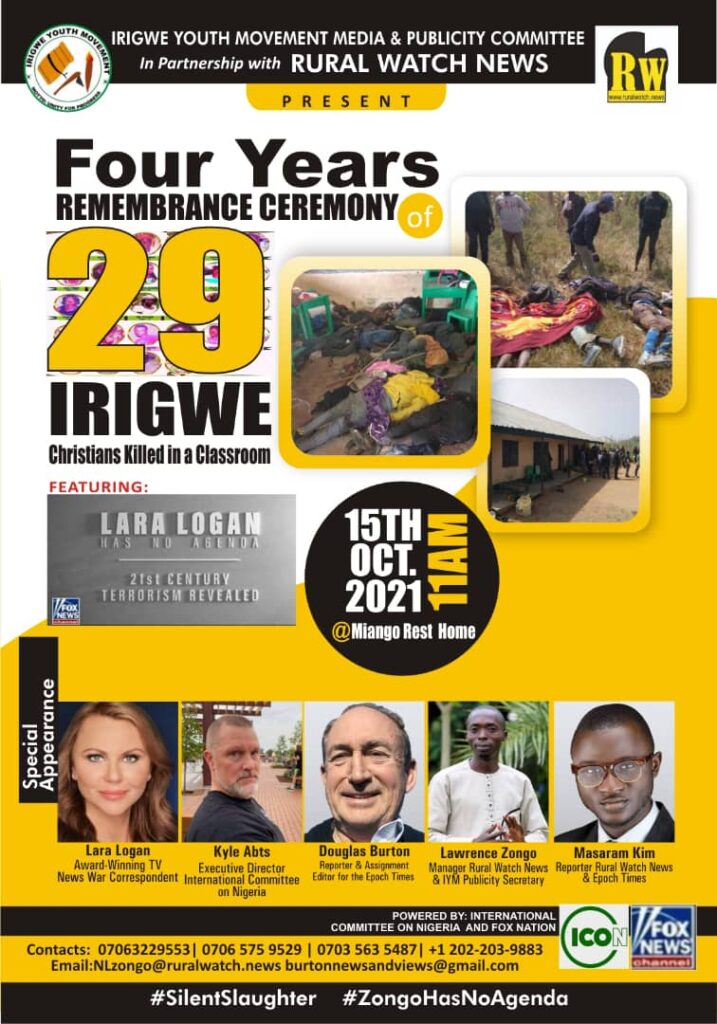
Self-taught journalists in the Jos metropolitan area are the featured truth tellers of a ground-breaking documentary on the Nigerian conflict produced by Fox Nation reporter Lara Logan. Lawrence Zongo and Masara Kim, Plateau State natives, collaborated for months with war correspondent Logan to make the 38-minute film, which is the Fox News corporation’s first in-depth examination of the tragic loss of life some call Nigeria’s “Silent Slaughter.”
It will be reported at an invitation-only Press Conference in Miango on October 15 where elected lawmakers and community leaders will acknowledge the Rural Watch achievement.
The film has been excerpted in segments on the YouTube channel of ICON PSJ media: https://youtu.be/94bVIPo5yPI
Logan, known in the United States as an award-winning war correspondent, delves deeply into the views and motivation of five reporters associated with a group Zongo created called “Rural Watch.” The mentor of the group is Washington-based editor Douglas Burton, who enables the Rural Watch writers to get published in The Epoch Times. Lawrence Zongo, a high-school history teacher and human rights activist, teamed with Masara Kim, a respected conflict reporter in Jos, Luka Binniyat in Kaduna, and Tom Garba in Adamawa as well as many others.
The film credits the Nigerian reporters for making the dangerous and painstaking trips into rural villages in the Middle Belt to get testimonies of the victims and their families. Logan takes pains to stir the conscience of the West, long accused of being a “conspiracy of silence.” “Masara Kim,” she says in her narration, is the “eyes and ears of a world that doesn’t care.” After months of interviews with the conflict reporters and Nigeria asylum seekers in the West, Logan cuts through the fog of war to show who in Nigeria is killing who and why. Dr. Sulieman Yahaya Kwande, a former Representative of Bassa/ Jos North from the ruling party of All Progressive Congress (APC), has said that “Killings of any religion or tribe is an evil act and against the will of God. Nigeria authority should take quick action and stop such killings, I appreciate Lara Logan and the team of Rural Watch News for the timely report.”
“This documentary has been produced to open the heart, eyes and conscience of an otherwise unperturbed world to the wanton cruelty of bands of murderous Jihadists. I strongly commend this great effort,” according to Dr. Pogu Bitrus, National President of the Middle Belt Forum.
A respected scholar in Washington D.C. has said the film exceeded her expectations. “Even for those of us informed about the Fulani and Boko Haram atrocities — this film is an eye opener,” wrote Nina Shea, director of the Center for Religious Freedom at the Hudson Institute.
Among several revelations in the film, Logan documents how Barak Obama rebuffed President Goodluck Jonathan when he needed arms to fight Boko Haram and put its weight behind the election of Muhammadu Buhari.
The press event coincides with the grim anniversary of a massacre of 29 Christian villagers in a classroom of LEA Primary School Nkiendoro, for which no one has been held accountable. “They were looking for refuge at a military base to hide from their attackers, yet they were locked in the classroom and killed by Muslim Fulani terrorists as a result of the negligence of the Military,” according to Zongo.
Bandits in Birnin Gwari Local Government Area of Kaduna State are now demanding cooked food as ransom for kidnapped victims.
The bandits were said to have retrieved from attacking communities since the state Government banned weekly markets as part of measures to tackle insecurity in the state.
A youth leader in one of the villages of Birnin Gwari, Babangida Yaro, told Daily Trust that since the ban, bandits operating along Damari, Kutemashi and Kuyello villages only asked for cooked food each time they abduct people.
According to him, the ban on sale of fuel in filling stations located in rural communities had also helped to restrict their movement.
“There is relative peace around Damari, kuyello, Kutemashi because the bandits have stopped attacking our communities. They usually stay in the forest and seiz food items mostly cooked ones from vendors,” he said.
He added that when they abducted two or three persons in farms, one is allowed to go and get them food from their relatives as ransom since there is no communication network to make contact.
The youth leader added that Dogon Dawa area is still not completely safe because villagers are still scared of accessing their farmlands. Babangida also lamented that the ban on use of private Motorcycles in the villages had increased hardship on the bandits as well as residents.
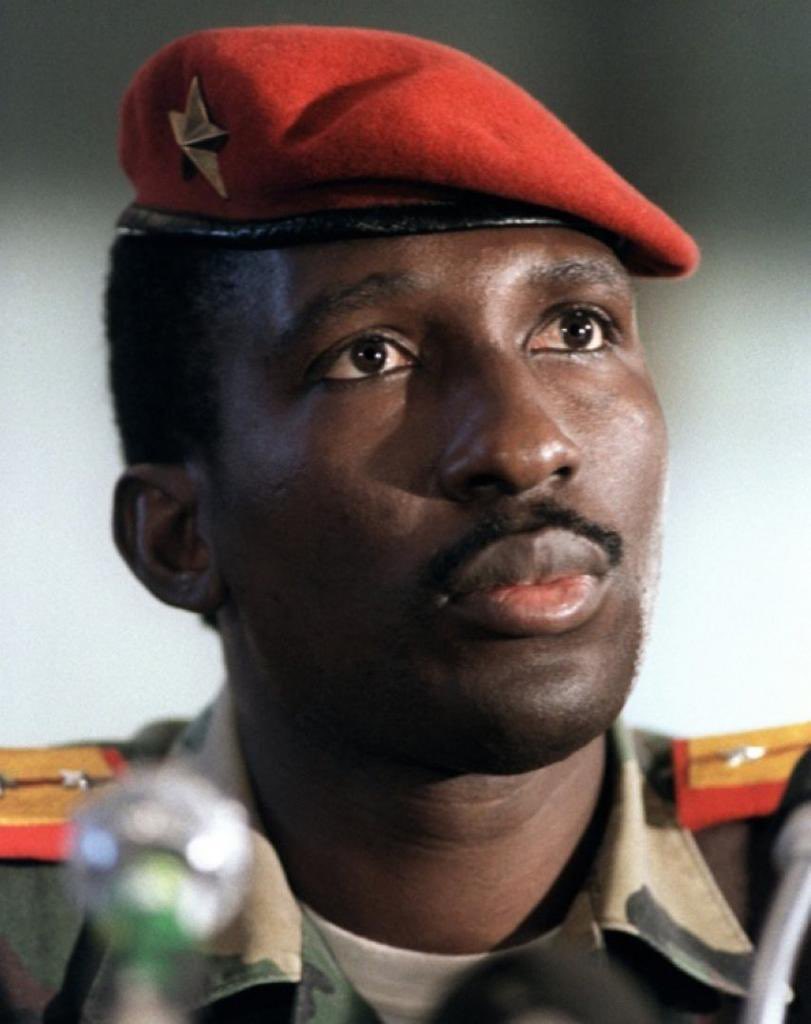
A military court in Ouagadougou on Monday began the long-awaited trial of 14 men, including the former president, accused in the assassination of Burkina Faso’s left-wing leader Thomas Sankara 34 years ago.
The slaying of Sankara, a pan-Africanist icon, has for years cast a shadow over the poor Sahel state, fuelling its reputation for turbulence and bloodshed.
Sankara and 12 others were riddled with bullets by a hit squad on October 15, 1987 during a putsch that brought his friend and comrade-in-arms Blaise Compaore to power.
Compaore, the chief accused, announced through his lawyers last week that he would boycott the trial.
He ruled the country for 27 years before being deposed by a popular uprising in 2014 and fleeing to neighbouring Ivory Coast, which granted him citizenship.
He and his former right-hand man, General Gilbert Diendere, who once headed the elite Presidential Security Regiment, face charges of complicity in murder, harming state security and complicity in the concealment of corpses.
Diendere, 61, is already serving a 20-year sentence for masterminding a plot in 2015 against the transitional government that followed Compaore’s ouster.
He appeared in court dressed in military uniform and looked relaxed.
Another prominent figure among the accused is Hyacinthe Kafando, a former chief warrant officer in Compaore’s presidential guard, who is accused of leading the gunmen. He is on the run.
Compaore has always rejected suspicions that he orchestrated the killing.
His lawyers last week announced he would not be attending a “political trial” that they said was flawed by irregularities, and insisted he enjoyed immunity as a former head of state.
A young army captain and Marxist-Leninist, Sankara came to power in a coup in 1983 aged just 33.
He tossed out the country’s name of Upper Volta, a legacy of the French colonial era, and renamed it Burkina Faso, which means “the land of honest men”.
He pushed ahead with a socialist agenda of nationalisations and banned female genital mutilation, polygamy and forced marriages.
Like Ghana’s former leader Jerry Rawlings, he became an idol in left-wing circles in Africa, lauded for his radical policies and defiance of the big powers.
Burkina Faso has long been burdened by silence over the assassination and many are angry that the killers have gone unpunished.
During Compaore’s long rule, the question of Sankara’s bloody death was taboo.
After his ouster, the interim government in 2015 launched an investigation into the episode, and the following year issued an international arrest warrant for him.
Sankara’s widow Mariam, who lives in southern France, came to Ouagadougou for the opening of the trial.
“This is a day of truth for me, my family and all Burkinabe,” she said, referring to the name of Burkina citizens.
The family’s lawyer, Stanislas Benewende Sankara — who shares the same name but is not a relative — said Compaore’ absence was a “slap in the face” to Burkina Faso’s justice system.
The trial “may not be the end of the tunnel, but we are reaching a very important phase, judicially speaking,” he said.
One of the world’s most impoverished countries, Burkina Faso has also been battling a jihadist insurgency since 2015 that has claimed more than 1,400 lives and forced 1.3 million people from their homes.
There is a new sheriff in town as far as the battles against the trafficking and wanton abuses of hard drugs in Nigeria are concerned. This sheriff as it were, is on a righteous rampage and the camps of drug barons are in trepidation. The new boss of the National drugs law enforcement agency used to be a military governor of Nigeria’s largest State Lagos and he is retired Brigadier General Mohammed Buba Marwa. Buba Marwa introduced the tricycle motorcycle transportation system in Lagos to bridge the gap between car owners and the large army of poor commuters who usually go through hell to move from point A to Point B daily and this novel transportation system was then named after him as KEKE MARWA. Since the last few months that he mounted the saddle as the Chairman, Chief executive officer, the modus operandi of that agency has witnessed revolutionary changes and if he continues with this speed for the next couple of years, he will make landmark achievements that will engrave his name on the sands of time. What he needs now are our prayers, support and for him to remain truly to his calling as a one man revolution squad. But there is one negative exception and that is exactly the Nigerian factor thus-: the institution which now has a proactive leader in the person of Buba Marwa and his able departmental heads, is still being grossly underfunded. It is inconceivable that a national agency fighting billionaires who are the drug barons and their deadly foot Soldiers who are the traffickers, is being treated merely as a parastatal under the ministry of Justice and therefore gets her funds through the usually backward envelope system whereby the ministry will first of all be cash backed by federal ministry of finance and budget and then the other agencies under it will be given fractions from what accrues to the ministry. It’s like waiting for the crumbs that fall from the master’s table. Right from my days as a journalist covering the judiciary for The Guardian in Abuja and by extension NDLEA, I have often wondered why Nigeria which is notorious and ranked as one of the most notable hard drugs transit camps in the World is waging war against such deadly menace and a hydra headed global crisis through a system of the envelope funded mechanism. I once asked the minister of justice as an active journalist long before now why NDLEA is not funded just like the judiciary so the funding will automatically drop to them from the main source and not being passed on through the Justice ministry. Also why has the Country been funding NDLEA just like boys brigade even when we send them to go after billionaires who can easily bribe their way out of any charges or kill them if they stand on their war to the illicit billions? Hard drugs business is a multi-billion dollars global industry. I did not get any meaningful response from that minister of Justice who felt that divesting him of the control of NDLEA is like a demotion. But the issue is about our national security and the fact that hard drugs pose some of the gravest challenges to our survival as a Constitutional democracy. Recently, my organization HUMAN RIGHTS WRITERS ASSOCIATION OF NIGERIA (HURIWA) visited the NDLEA and we broached the idea of the agency getting direct funding from the federation accounts. But the hierarchy personified by the Executive Chairman was silent may be because they do not want to be seen fighting the minister of Justice. But look, the issue is about us as a nation and so getting NDLEA to enjoy independence in terms of funding and operational scope would be one of the best ways to put a check to the rapidly expanding tentacles of drug barons. This is because, no matter how good the chairman and his team want to be, the temptation to give up on the fight may come if they are broke and so can not take some initiatives that are capital intensive without recourse to the bureaucracy. For instance the NDLEA does not fund activities of credible groups or supporting NGOs carrying out advocacy campaigns against drugs and drugs trafficking. At least the HUMAN RIGHTS WRITERS ASSOCIATION OF NIGERIA has received no penny or one kobo in support of our vigorous and dangerous campaigns against hard drugs business in Nigeria. Anyway, away from the institutional impediments constituting a cog in the progress of NDLEA, we will examine some themes that have resonated from the thinking cap of the leadership of NDLEA since the new man came on board. We are abandoning the issues of operational and funding independence because these key issues are within the reach of the National Assembly and the president to pursue if they truly wish to make good legacies for themselves. The first issue is about the debate on whether to legalize marijuana or not. On this issue I think all sides to the debate have valid points and so none should be shoved aside. The likes of the Ondo State governor thinks the use of Marijuana should be legalized so as to expand the revenue scope of the nation. HURIWA thinks it’s a good idea to legalize medical consumption of Indian hemp but the time isn’t ripe yet. But the Governor of Ondo State, Arakunrin Rotimi Akeredolu, urged the Nigerian Government to jettison traditional orientation and “archaic” sentiment that state that cannabis is a ‘devil’s plant’. Akeredolu, who spoke at a Stakeholders’ Roundtable on the “Benefits and Opportunities of Cannabis Plant in Nigeria” held at the International Culture and Event Center, urged the Nigerian government to give legal backing to cannabis to enable its use in Nigeria, saying “cannabis is a multi-billion naira industry that can help diversify the Nigerian Economy if judiciously utilised”. He said, “the medical and economic merits of the use of cannabis outweigh its demerits.” Akeredolu, a Senior Advocate of Nigeria and former president of the Nigerian Bar Association (NBA), stated that advanced research has shown that Cannabis has immense economic benefits if well utilized. On public perception trailing his advocacy for controlled cultivation of the cannabis plant, the governor stated that opinions against the legalization of the plant are as a result of the ignorance of people about the numerous benefits of the plant. “The planet earth has a constant period of darkness and light every 24 hours which we call night and day, in like manner, just like every other crop or plant, Cannabis Sativa has both CBD and THC content which we can put it to good and bad use,” Akeredolu said. “Products with extract of Cannabis Sativa are already in our pharmaceutical sales outlets across the country. They are being imported with foreign exchange, and sold at exorbitant prices with additional, but avoidable stress on our Naira.” Akeredolu stated that during his first term, he and other members of his cabinets made a trip to Thailand to understudy the legal reform carried out to facilitate the decriminalization of the cultivation, processing and export of Cannabis Sativa which gave him the opportunity to know the immense benefits that comes along from controlled cultivation of the plant. “My visit to Thailand was an eye-opener. We saw forest reserve used in the past to cultivate and process hard drugs transformed to be meaningfully utilized in an environmentally friendly way for healthy ventures. We saw people previously sold to hard drugs engaged in legitimate business ventures,” Akeredolu said. “What we are therefore advocating for in Nigeria is simply controlled cultivation of pharmaceutical standard cannabis strictly for medical purpose. I am saying necessary laws must be amended to give room for it. I am not saying it should be a free-for-all venture. Those investing in it must be licensed under strict control. “We must find a way to legalize the cultivation of cannabis for medicinal purposes. There is nothing wrong about it. We are only shooting ourselves in the foot. It is a foreign exchange earner for people outside the country. People want this. We ourselves, even our pharmacies want to develop.” Akeredolu further revealed that Ondo State has one of the best Cannabis in the world which is capable of creating a million dollars’ industry for the country. He explained that in 2019, the global market of Cannabis was put at 52.8 billion dollars and that the market forecast is an average 14.5% increase from the year 2020 to reach 103.9 billion dollars by 2024. Akeredolu urged members of the National Assembly, the NDLEA, the Pharmaceutical Society of Nigeria and Research Institutions to have a second and deeper thought on the issue, saying it holds great potential in solving the current economic woes in the country. The Chief Panelist at the Roundtable, Hon. Benjamin Okezie Kalu, member representing Bende Federal Constituency who doubles as the Spokesperson of the House of Representative, agreed with Akeredolu, stating that said it has become imperative for Nigeria to review the legislation prohibiting the farming and production of Cannabis for medicinal and industrial use in Nigeria. While applauding Akeredolu for leading the Advocacy for the legalisation of cannabis, Kalu posited that hemp is a viable prospect for Nigeria’s diversification efforts. The Chairman, House of Representatives Committee on Diaspora, Tolu Akande-Sadipe, who was also a panelist at the roundtable, expressed optimism that the passage of the Dangerous Drugs Act [Amendment] Bill 2020, currently at second reading, would usher in a new era on medicinal cannabis production and distribution in Nigeria. Chairman/Chief Executive of the National Drug Law Enforcement Agency, NDLEA, Brig. Gen. Mohamed Buba Marwa (Retd) has explained why proponents of the legalisation of cannabis sativa cannot have their way under the prevailing security situation in Nigeria today.
Gen. Marwa spoke as guest speaker at the 2021 Ulefunta annual public lecture organised by the Deji of Akure kingdom, the Ondo state capital, His Imperial Majesty, Oba Aladetoyinbo Ogunlade Aladelusi and chaired by the former Secretary to the Government of the Federation, Chief Olu Falae.
Laying the basis for his argument, the NDLEA Chief Executive said, the proliferation of illicit drugs often engenders a pattern of crime, chaos and conflict. In the advanced world, it is the driver of high crime rate and violent killings in the inner cities. In developing or Third World countries, it is the escalator of strife, pogroms and civil war, and has played a big role in countries torn to pieces by tribal war, such as it is playing our in Syria, which has become the hotbed of Captagon, and Afghanistan, which controls the opium trade.
“We have seen narco-terrorism in countries like Colombia and Mexico where drug cartels are law unto themselves and are as powerful, if not more powerful, than the State. So, there are real cases, not scenarios, of where and how illicit substances played a role in a societys rapid descent into chaos and tettering on the brink of a failed state.
“So the pertinent question for us today is: Has drugs played any role in the festering insecurity in Nigeria? The answer is yes. Of this we have ample evidence.
Represented by his Special Adviser on National Drug Control Master Plan, NDCMP, Otunba Lanre Ipinmisho, Gen. Marwa stated that considering the intractable burden of insecurity facing the country, “we do not have the luxury of allowing a narcotic economy to take root and thrive in our society. Africa, nay, Nigeria has enough problems without adding the burden of narco-terrorism.
“Of all the known illicit substances, Cannabis sativa is the only one that is native to Nigeria and it is the most abused of all illicit drugs, and from the findings of the National drug Survey of 2018, cannabis is becoming a national albatross
Warning that the population of Nigerians hooked on cannabis alone is more than the population of countries like Portugal, Greece or the Republic of Benin, he said as such the nation cannot afford to toy with the grim reality of the danger of legalising cannabis when all the needed infrastructure to monitor and control that are still far from being in place.
“Where cannabis is concerned, we should not by any argument allow ourselves to become the proverbial fool that rushed in where angels fear to tread. Countries like Canada, that are pro-cannabis have strong and efficient institutions that are way ahead of ours by long mileages. “Given the reality of our law enforcement, controlled cultivation of cannabis is a mirage. Arent pharmaceutical opioids controlled? Tramadol, codeine, rohypnol, benzopam, they are all controlled, yet, their trafficking and abuse is causing us unquantifiable human and economic loss. And for those who point at the inherent economic benefit that could accrue from legalisation of cultivation, in accordance with our reality, would you be comfortable, if by tomorrow, your 13-year-old son can easily access marijuana, or you find some wraps of weed in his pocket, or you learnt that someone has introduced your 16-year-old daughter to smoking Igbo under the pretext that it has medicinal value?
Our individual answer to that question will give us a public opinion of where we should stand as a country in the cannabis debate.
He warned that We should stop treating cannabis like some sweet candy without any side effects. Its repercussions outweigh the vaunted benefits. And legalising its cultivation for a country like Nigeria, is a shortcut to illicit drug Armageddon. At a time we are taking a forward march in the fight against drug abuse, attempting to paint cannabis in a favourable light is akin to taking backward steps.
“As far as NDLEA is concerned, cannabis remains an illicit substance. The Agency shall always canvass against its cultivation, possession, trafficking and sales, and use. And offenders will face the wrath of the law. And, if I may add, our conviction rate is 90% successful.” Both the protagonists and the antagonists have made solid good reasons but these options should be weighed against the backdrops of our current situations. Again the call for compulsory drug test for intending couple as made by the Chairman of NDLEA to me is misplaced. What is desirable is for NDLEA to be empowered to conduct DRUG TEST on all aspirants to public political offices so we stop drug addicts from gaining power as is the case previously and even today with the rate of corruption and all sorts of bad behaviours by political office holders. The NDLEA should rather campaign for the compulsory drug tests on politicians and they should leave intending couples alone because that’s not very important.
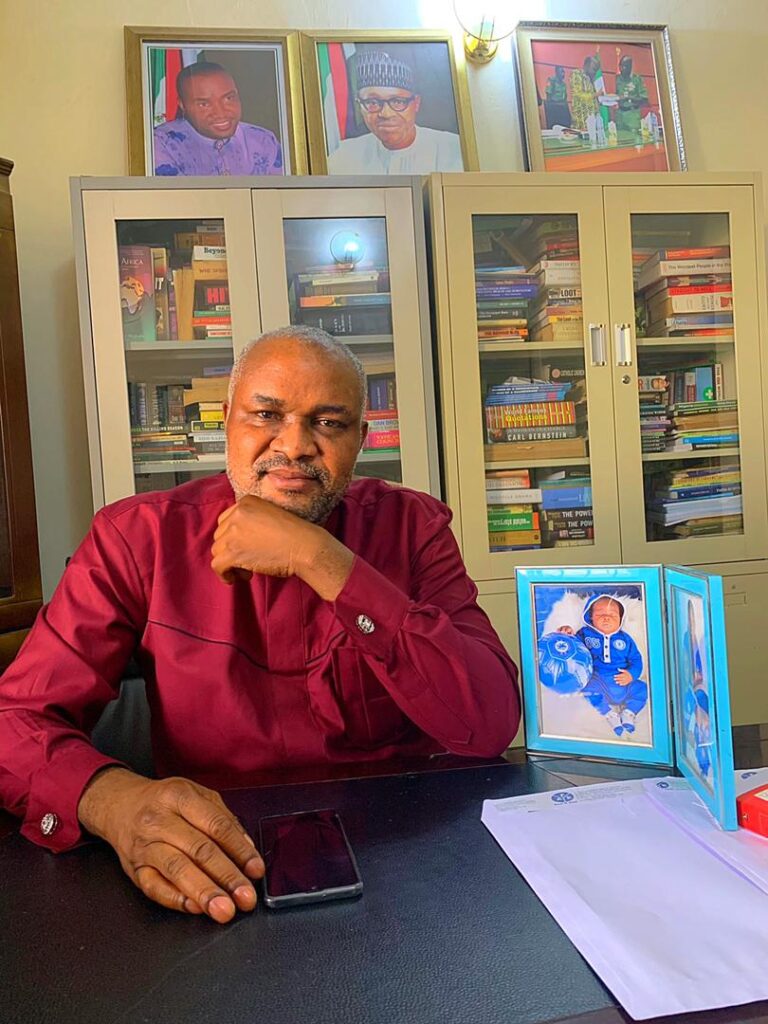
*EMMANUEL ONWUBIKO is head of the HUMAN RIGHTS WRITERS ASSOCIATION OF NIGERIA (HURIWA) and blogs@www. theingerianinsidernews.com, www.huriwanigeria.com.
Prominent Civil Rights Advocacy Group: HUMAN RIGHTS WRITERS ASSOCIATION OF NIGERIA (HURIWA) has described as ‘satanic’, grossly disturbing and a global embarrassment, the conspiratorial silence of the current federal administration to the damaging revelations disclosed about certain current political office holders (excluding Peter Obi) especially some of the Senators, Governors belonging to the All Progressives Congress (APC). The Rights group says it has studied the revelations in greater details and finds nothing wrong about the former governor of Anambra State Mr. Peter Obi who the Rights group described as a very clean, transparent and trustworthy self-made rich man who was already very prosperous before venturing into politics. The Rights group wonders why Premium Times spent undue time talking about Peter Obi and then before divulging other bigger fishes in the said scams. However the group said the total media black out and lack of any sort of executive or prosecutorial actions by the Economic and Financial Crimes Commission (EFCC) and the Federal Attorney General and Minister of Justice Abubakar Malami against his (Malami’s) Kebbi State governor and kinsman linked to the Abacha loots, the Acting managing Director of Nigerian ports Authority Mr. Mohammed Koko and the Anambra North Senator Mrs. Stella Odua who is about to be forgiven and granted soft landing by president Buhari for cross carpeting into APC from PDP that gave her mandate to represent her constituency in the Senate of the 9th session and importantly, the silence on the fact that the Osun State governor allegedly bought a London mansion belonging to Mr. Aluko implicated in the massive heists of NNPC’S resources by erstwhile petrol minister and fugitive Mrs. Allison Madulkwe, shows that there is no longer any crusade against corruption. HURIWA said it was scandalous that the President visited erstwhile Lagos State governor Bola Ahmed Tinubu reportedly in the same allegedly criminally acquired mansion in London. “We are even the more disturbed that rather than wage a clean war against corruption, the government is using carrot and stick approach to lure allegedly corrupt members of the previous government to cross carpet into APC and then receive political pardon. How then do you want the EFCC to work genuinely against corruption when the officials see their suspects dining and wining at the Presidential Villa with President Muhammadu Buhari who is the appointing authority of the EFCC’s hierarchy?”
HURIWA condemned the decision of the Federal Attorney General to look away from the revelations emerging from the Pandora papers but he has instead began a war of Vendetta against anti-corruption campaigner Mr. Siraju Olarewaju. HURIWA recalled with considerable consternation and shock that the Federal Government filed charges against Chairman of Human and Environmental Development Agenda (HEDA), Mr. Olanrewaju Suraju, for allegedly cyberstalking former Attorney General of the Federation (AGF), Mr. Mohammed Adoke. The suit marked: FHC/ABJ/CS/370/2021, at the Federal High Court, Abuja, is coming six months after Suraju was arrested by the police following a petition by the former AGF. The police had on April 15 interrogated Suraju over a forgery petition by Adoke, demanding probe of email evidence presented against him by prosecutors in the Malabu trial in Milan, Italy, admitting that the Malabu transaction was a scam. According to the lead prosecution counsel, Mr. A.O. Shaibu, the HEDA boss’ actions violate Section 24 of the Cybercrimes Act, 2015, with the aim to dent the image of Mr. Adoke. In count one, Suraju is accused of intentionally circulating an audio telephone interview between Ms. Carlamaria Rumur, a reporter with RIAReporter in Italy and Mohammed Adoke via his twitter handle @HEDAagenda, which he knew to be false, for the purpose of causing insult to Adoke and thereby committed an offence contrary to section 24 of the Cybercrimes (Prohibition, Prevention ETC) Act 2015 and punishable under the same section of the Act. In count 2, Suraju is accused of committing the same alleged offence in count one through the Twitter handle @HEDAResourcecentre. In count 3, he is accused of intentionally circulating an email dated June 21, 2011, alleged to have been sent with the email address agroupproperties@yahoo.com owned by A Group Properties and received by a certain Osoluke Bayo O. with the email address bayo.o.osoluke@ipmorgan, “which you knew to be false via your Twitter handle @HEDAagenda for the purpose of causing insult to Adoke and hereby committed an offense contrary to section 24 of the Cybercrimes (Prohibition, Prevention ETC) Act 2015 and punishable under the same section of the Act.” HURIWA has therefore asked the AGF to end the persecution of this anti-graft crusader but should focus on truly waging result oriented war against corruption. HURIWA recalled that the media reported that The acting Managing Director of Nigerian Ports Authority, Mohammed Bello-Koko, is allegedly involved in offshore shenanigans, hiding behind two shell companies incorporated in a tax and secrecy haven to anonymously invest in the United Kingdom property market, potentially violating Nigeria’s public service code of conduct laws, the ongoing Pandora Papers reporting has revealed. Mr Bello-Koko according to media estimation is possibly hoping to be confirmed the substantive NPA chief by President Muhammadu Buhari. The current substantive head of the agency, Hadiza Bala-Usman, remains on suspension following her disagreement with the transportation minister, Rotimi Amaechi. It is unclear if she would be recalled with a probe of her tenure seemingly unending. Mr Bello-Koko, with his wife, Agatha Anne Koko, enlisted the services of financial secrecy seller, Cook Worldwide and Alemán, Cordero, Galindo & Lee (Alcogal), an offshore law firm, to register Coulwood Limited (reg. number: 1487897) and Marney Limited (reg. number: 1487944) in the British Virgin Islands (BVI), one of the world’s most commonly used tax havens, in 2008. Both companies were registered the same day, June 19, 2008.
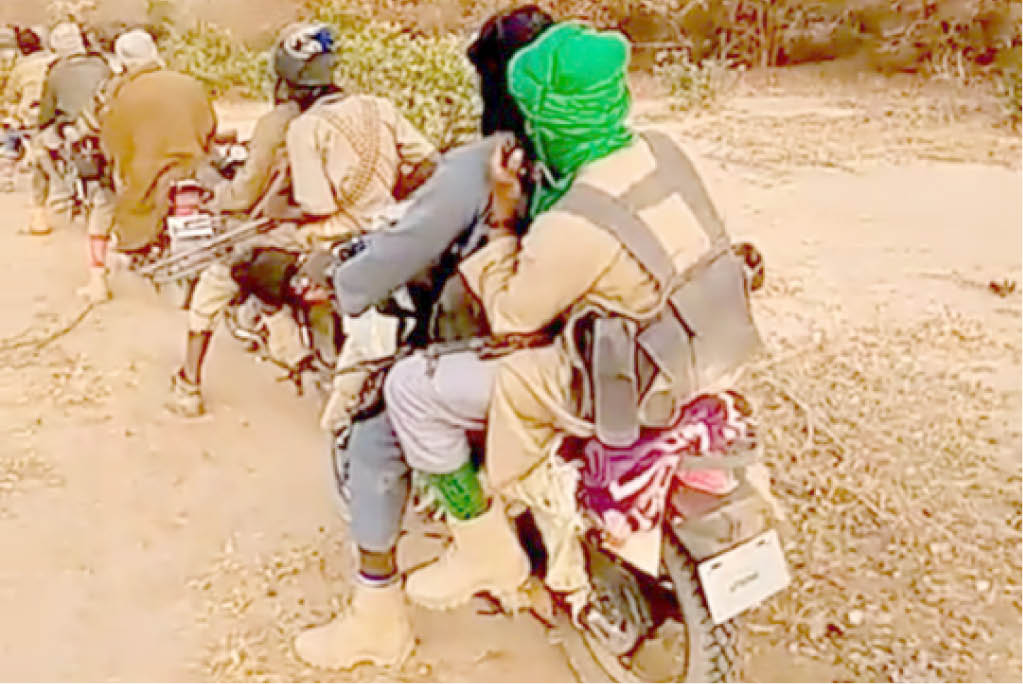
Nigerian joint security forces have killed 32 armed bandits fleeing from Zamfara in Niger State, PRNigeria learnt on Sunday.
This was after the bandits attacked a security post, and shot dead five policemen who attempted to confront them.
The incident occurred at Bangu Gari in the Rafi Local Government Area of the State.
A security source told PRNigeria that the armed bandits, who fled Zamfara State due to the ongoing military operation, had earlier wreaked havoc on the community.
“The bandits came in their large number with sophisticated weapons including rocket launchers after fleeing their camps at Danjibga and Munhaye in Tsafe Local Government Area of Zamfara State.
“They stormed the police station at Bangu Gari in Rafi LGA and killed five policemen during the exchange of gunfire.
“Immediately a signal was received and a detachment of joint security forces was despatched. The troops on reinforcement successfully ambushed the marauding bandits while attempting to escape through Tegina axis.
“At least 32 of the bandits were killed including their leaders, Karki Buzu and Yalo Nagoshi while another kingpin, Ali Kawaji sustained serious gun wounds,” the source said.
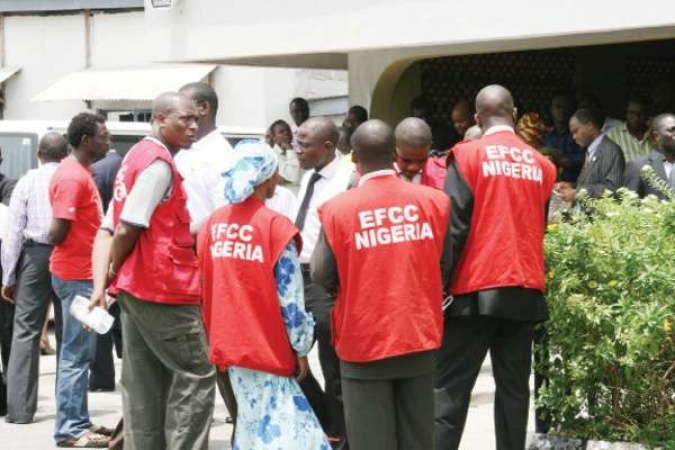
Officers of the Economic and Financial Crimes Commission (EFCC) on Monday stormed the headquarters of Kaduna State Urban Planning Development Agency (KASUPDA) and whisked away the Director General, Malam Ismail Umaru Dikko.
KASUPDA has gained the reputation of Kaduna’s most feared agency due to its demolition of properties across the state.
Its boss, Dikko, was a Special Assistant to Governor Nasir El-Rufai, before he was elevated to head the agency in 2019.
Daily Trust gathered that the DG was in a meeting with his staff when officials of the EFCC took over the office premises a few minutes after 10am.
Eye witnesses said there was some commotion before the DG entered a black hilux Toyota vehicle of the EFCC.
Sources said two EFCC officials in suit, with two police officers with rifles had accompanied the KASUPDA boss into the vehicle.
The source said the staff at KASUPDA had earlier tried to stop the EFCC from leaving with the DG and security at the gate had prevented the car from exiting.
However, the DG had asked the security to open the gate.
Our correspondent gathered that the DG has been taken to the Kaduna zonal office of the EFCC with sources saying that he had earlier been served several invitations but failed to honour them.
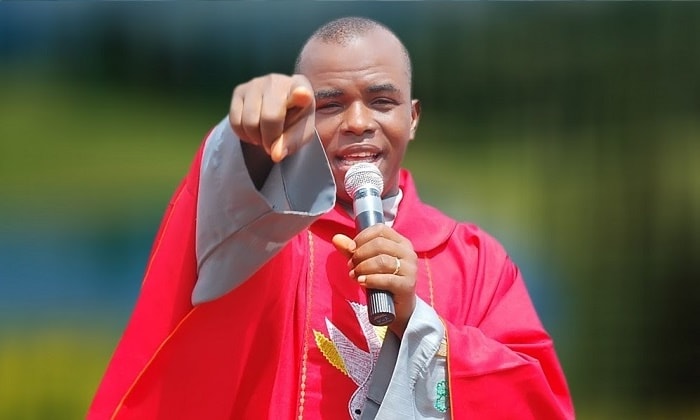
The Spiritual Director, Adoration Ministry Enugu, Rev. Fr. Ejike Mbaka, has warned President Muhammadu Buhari that the fighter jets he is purchasing will be used to destroy the country.
The cleric stated this during a sermon at his church on Sunday.
According to Mbaka, Buhari should rather focus on building more industries
“The jets you are buying are going to be used to collapse Nigeria.
“Please, the first person to meet President Buhari after this message, should tell him that all these jets he is buying will be used to destroy Nigeria.
“God told me to tell him that,” he said.
“Let him stop buying more jets and begin to build more industries.”
Buhari, speaking last week, confirmed that “we have received new equipment in our fight against any form of insecurity from our friendly countries.”
“These assets will be deployed to accelerate the fight against insecurity in all parts of the country,” he added.
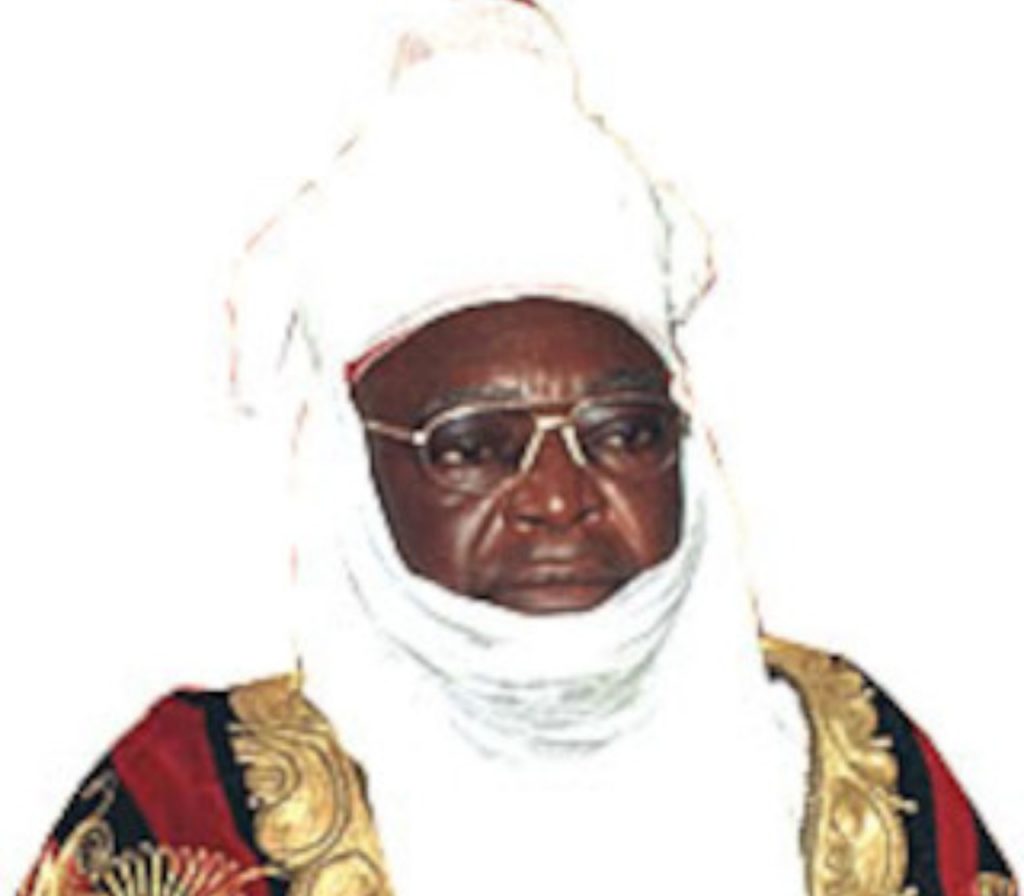
The paramount ruler of the Idoma nation, His Royal Highness, Agabaidu Elias Ikoyi Obekpa has gone on hunting expedition.
The monarch, a native of Ogbadibo and ascended the throne in 1996 following the exit of HRM Abraham Ajene Okpani.
Obekpa was born in December 21, 1944, in Otukpa, Ogbadibo LGA.
Before becoming paramount ruler, Obekpa was a trained teacher, business administrator, public servant and traditionalist.
He got married in 1969 and is blessed with about nine children.
When DAILY POST visited the Och’Idoma Palace on Sunday, a man who simply identified himself as Oji, claimed the news of the death of the king is untrue.
Oji insisted the king is hale and hearty and currently attending to some issues in the palace.
When sought to speak with the king, he said, “I told you he’s in a meeting and you want to disrupt his meeting.”
Another man who refused to identify himself, admitted the king has truly gone on hunting expedition, but it won’t be announced as tradition demands.
“In Idoma land, kings don’t die, they go on hunting expedition. Agabaidu will be right back,” he said.