Boastful Chinese Miners Storm Ambam Lithium Field with Armed Escort, Vowing Abuja-Backed Takeover and Ousting Rivals


By MBT Investigative Desk

December 1st, 2025, Ambam Community, Jema’a Local Government Area, Kaduna State

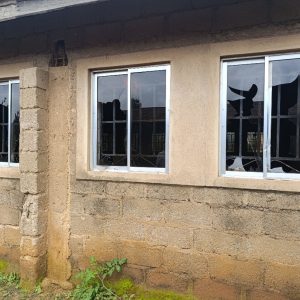
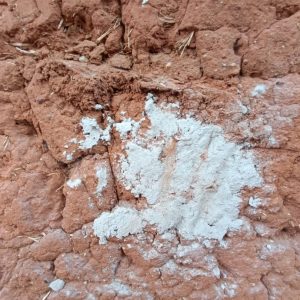
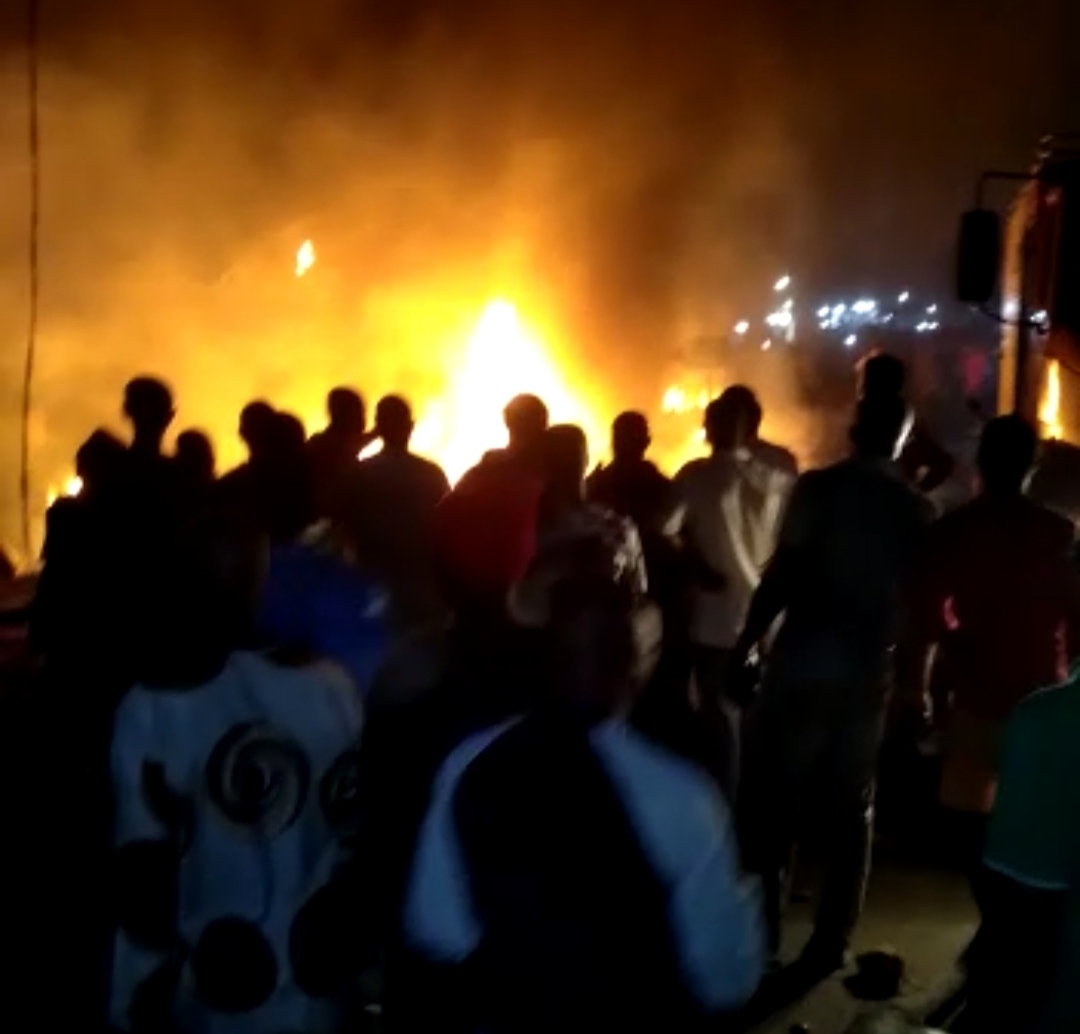
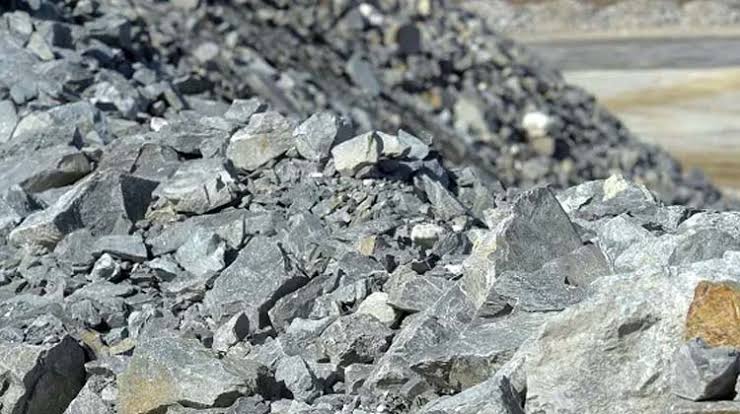
Beneath the tranquil farmlands of Ambam community in Kaduna State lies a treasure of the modern age: vast deposits of lithium, the coveted “white gold” powering the global revolution in electric vehicles. For two years, this potential wealth was managed under a peaceful and mutually beneficial coexistence, governed by a Community Development Agreement (CDA) between the residents and Range Mining Ltd, a Nigerian company with a UK parent. But that peace shattered on November 15, 2025, when a Chinese-owned company, Mystics Mining Resources Limited, arrived with armed security and a brazen claim of ownership, igniting a conflict that reveals a dark underbelly of Nigeria’s mining sector.

The arrival of Mystics Mining was not a quiet entry. Community sources describe a convoy rolling into the field where Range Mining was legally operating, escorted by armed personnel of the Nigerian Security and Civil Defence Corps (NSCDC). The show of force sent a clear and unsettling message: a new power had arrived, and it was not interested in negotiation.

When contacted by this newspaper, the State Commandant of the NSCDC, Mr. Panam Musa, who authorized the deployment, initially defended his actions. “The reason for deploying new security personnel on the mine field was because there are up to four companies claiming ownership of the field,” he stated. He promised to visit the site to resolve the matter.

However, the legitimacy of Mystics Mining’s claim quickly began to unravel. A source within the Ambam community, speaking on condition of anonymity, revealed that the Chinese company claimed to have the permission of the Kaduna Mining Development Company (KMDC). But when confronted with this claim, the Managing Director of KMDC, Engr. Shuaibu Kabir Bello, was unequivocal in his denial.

“I am telling you now that we don’t know Mystics Mining and I have ordered Civil Defense to stop them immediately. They will be arrested,” Bello declared, exposing a stark contradiction between the company’s assertions and official record.

The swift denial from the state’s own mining company raises a critical question: what was the basis for the NSCDC’s armed escort? Pressed on this, Commandant Musa offered a vague explanation. “Mystics Mining came to my office with some documents which warranted the deployment of armed personnel,” he said. He notably failed to specify what these documents were. “Later I found out that the field they were going to was the same being occupied by Range. As we speak now, I am on the site and have ordered them to stop work immediately.”

This reactive stance, coming only after the illegal incursion was exposed, points to a deeper problem: the alleged use of financial influence to bypass due process. A high-level security source, who also requested anonymity, disclosed that Mystics Mining Ltd had already engaged in a massive bribery scheme to gain access.

“As I am talking to you now, Mystics Mining has spent over 250 million naira bribing some key people in Ambam community,” the source revealed. “With that, they believe they can do and undo.”

This allegation of a N250 million bribe is at the heart of the community’s new turmoil. It suggests a deliberate strategy to create division and sideline the established, lawful agreement with Range Mining Ltd. Another community source, fearing persecution, confirmed the aggressive posture of the Chinese firm. “They boasted to us that whether we like it or not, they will soon be in charge of all the mining lands here. They told us that they have backing from the top in Abuja and that they will surely kick every other company out.”

The CDA: A Broken Covenant and a Community Torn Apart

The CDA between Ambam and Range Mining was more than a contract; it was a covenant that outlined tangible benefits, jobs, infrastructure, and social services, in exchange for the community’s most valuable asset: access to their land. The arrival of Mystics Mining, with its alleged cash injections, has violently ruptured this social fabric.

“This N250 million is a poison,” laments a community elder who pleaded for anonymity for fear of reprisals. “It has divided our sons and daughters. Where we once had a collective agreement for our future, we now have whispers, suspicion, and the violence of silence. Those who have taken the money are now agents of a company that does not know our name, only our resource.”

This internal conflict is a classic tactic observed in resource-rich but governance-poor regions. The large, upfront sum from Mystics Mining creates a powerful, immediate incentive for a few, effectively dismantling the collective bargaining power of the community and undermining the long-term, structured benefits of a formal CDA.

Landowners Cry Foul: “The Chinese Lied to Us”

The depth of what now looks like Mystics Mining’s deception has now become painfully clear to those who initially engaged with them. In a revealing development, landowners who received N50 million each from the Chinese company are now expressing deep regret and alleging they were deliberately misled.

Two landowners, speaking on condition of anonymity for fear of reprisals, confirmed to this newspaper that they were told a fundamentally different story. “The Chinese told us they have an agreement with Range Mining for some form of collaboration. That was why we listened to them. But now we know they lied to us,” one landowner stated with evident frustration.

The landowners were adamant about the nature of their transaction with Mystics Mining. “There’s no agreement between the landowners and the Chinese. They are telling people that we sold our land to them. That is not true,” the source emphasized. “Tell the Chinese to show the land document. We didn’t sign any agreement with them.”

This revelation exposes a calculated strategy by Mystics Mining: rather than pursuing legitimate land acquisition through proper legal channels, the company allegedly used cash payments to create the appearance of authorization while falsely claiming partnership with the legitimate title-holder, Range Mining. The landowners now find themselves caught between the promise of immediate financial gain and the realization that they may have been used as pawns in an illegal takeover scheme—without even securing the legal protections that a formal land sale agreement would provide.

A National Pattern of Predatory Mining

The drama in Ambam is a microcosm of a national crisis. Research into the activities of Chinese mining companies in Nigeria reveals a consistent trail of legal breaches, environmental degradation, and community conflicts.

Federal Government Crackdowns: In recent years, the Nigerian Federal Government has repeatedly called out and taken action against illegal Chinese miners. In May 2020, former Minister of Mines and Steel Development, Olamilekan Adegbite, explicitly stated that “a lot of illegal mining is being done by Chinese companies in the country.” He highlighted their tactic of operating with fake licenses or none at all, precisely the allegation facing Mystics Mining.

The Akwa Ibom State Government closed Ruitai Mining Company in August 2023 after the Chinese-owned firm failed to produce valid operating licenses. Uno Etim Eno, the state’s Commissioner for Environment and Mineral Resources, announced the shutdown during a press conference in Uyo. He explained that Ruitai Mining, which operated a titanium ore extraction facility in Ibeno community, could not provide the necessary authorization documents required for its mining operations. The closure highlighted ongoing regulatory enforcement challenges in Nigeria’s mining sector, particularly regarding foreign-owned operations and compliance with federal licensing requirements.

The “Backing from the Top” and a Flawed Security Apparatus

The most chilling aspect of the Ambam case is Mystics Mining’s alleged boast of having “backing from the top in Abuja.” This claim, whether bluff or reality, points to the high-level corruption that enables such brazen operations. It suggests a network of complicity that reaches into the federal ministries and regulatory bodies tasked with overseeing the sector.

The initial compliance of the NSCDC, a federal security agency, adds credence to this fear. The fact that armed state personnel were deployed based on unspecified “documents,” directly contravening the rights of a title-holder and the knowledge of the state mining agency, reveals a critical vulnerability in the nation’s resource governance framework. It underscores how easily security apparatuses can be weaponized by private interests with deep pockets, turning state-protectors into facilitators of illegal takeover.

The Verdict: Status Quo Ante and the Rule of Law

The investigation reached a critical juncture on Friday, November 28, when the Commander of the NSCDC Mining Marshals, John Onoja, convened a meeting with representatives from both Mystics Mining Resources Ltd and Range Mining Ltd. Onoja, a no-nonsense, award-winning officer known for his commitment to the rule of law, delivered a decisive ruling that exposed the fundamental flaw in both companies’ claims.

“By the submission of both parties and their respective presentation, none possess the requisite documents for mining in the disputed area,” Onoja stated in his official assessment to this newspaper. “Same was confirmed and admitted to by both parties. Both parties also stated that they are still in the process of obtaining necessary licence from Mining Cadastre Office. Hence, it was only normal to resolve that all parties should suspend mining activities pending when requisite documents to do so is gotten. So none are to work in view of the indication of the preliminary investigation conducted with both parties. Further investigation continues.”

However, Onoja’s ruling made a crucial distinction between the two companies’ positions. While neither possessed a valid mining license, Range Mining’s activities on the site were deemed lawful and beneficial to national security efforts.

“During the meeting with both parties, it was confirmed that Range was not mining on the field but was providing security while awaiting their mining license,” Onoja explained. “That is a welcome development we encourage from citizens. It is on that basis that I advised that status quo be maintained until either of the companies is able to secure a license to mine.”

This ruling effectively validates Range Mining’s presence on the site as a security measure against illegal mining—precisely the activity that Mystics Mining’s armed incursion on November 15 had threatened to enable. The decision to revert to “status quo” (the situation before November 15) means that Mystics Mining’s controversial entry, backed by alleged N250 million in bribes and armed NSCDC personnel, has been officially rejected as having “no business on the controversial minefield.”

When asked if the directive to revert to status quo has been followed, Onoja indicated that compliance is being monitored. “That is being looked upon at the moment and I assure you that everything will be alright,” he said.

A Victory for Due Process, But a Community Still Divided

The ruling represents a significant victory for the rule of law in Nigeria’s troubled mining sector. It confirms that neither deep pockets nor alleged connections in Abuja can substitute for proper licensing procedures. The exposure of Mystics Mining’s lack of documentation vindicates the concerns raised by the Kaduna Mining Development Company and validates the suspicions that the Chinese company’s “documents” shown to the NSCDC were insufficient or fraudulent.

But for the people of Ambam, the battle is far from over. The N250 million that allegedly changed hands continues to divide the community. Range Mining’s Community Development Agreement, once a source of unity and hope, now competes with the immediate cash that has already been distributed to select individuals and landowners who now express regret over being misled.

The landowners who received N50 million each have been vindicated in their claim that they signed no formal agreement with Mystics Mining and were deceived about the Chinese company’s relationship with Range Mining. Yet the money they accepted has already complicated the community’s solidarity, even as they now distance themselves from the Chinese firm.

The lithium field remains a flashpoint—a test case for whether Nigeria can enforce its own mining regulations against well-funded interests that employ bribery, deception, and the weaponization of state security forces. Commander John Onoja’s decision to prioritize legal compliance over competing claims is a rare bright spot in a sector plagued by corruption and regulatory capture.

The battle for Ambam’s lithium is more than a corporate dispute; it is a critical test of Nigeria’s political will to govern its resources, enforce its own laws, and protect its most vulnerable communities from the predatory forces of illegal, often foreign-backed, mining conglomerates. The outcome will resonate far beyond Kaduna, signaling to other would-be predators whether Nigeria’s “white gold” rush will be governed by law or by the highest bribe.

For now, at least, the law has spoken—but whether it will be obeyed, and whether the community of Ambam can heal from this divisive episode, remains to be seen. As Commander Onoja’s investigation continues and authorities monitor compliance with the status quo directive, the residents of Ambam wait to see if their lithium wealth will finally deliver the promised prosperity, or if it will remain a source of division and conflict.
 

INVESTIGATION: How Armed Fulani Militants Executed Coordinated Attack While Nigerian Army Allegedly Provided Safe Passage

Part One of Two-Part Investigation

By Middle Belt Times Investigative Team

A Community Under Siege

The morning sun stretched long shadows over what was left of Rev. Davou Musa’s house in Bindi village—a stark reminder of the nightmare that struck in the early hours of July 15, 2025. This quiet Christian farming community sits in the green plains of Riyom Local Government Area, Plateau State, but now the air hangs heavy with the bitter smell of smoke and destruction, leaving behind too many unanswered questions.

When Middle Belt Times (MBT) arrived in Bindi on Monday, July 21, the village bore the hallmarks of a community traumatized. Only men remained on the grounds, their weathered faces etched with grief and anger. The women and children had fled after the devastating attack that claimed 27 lives, leaving behind a ghost town of mud houses and shattered dreams along the Jos-Abuja highway, just 30 miles from the state capital.

A Community’s Peaceful Existence Shattered

Bindi Tahoss community, home to approximately 1,000 residents living in 160 mud houses—some crowned with traditional thatch roofs—had been a picture of rural tranquility. The temperate climate, reminiscent of European cities, created ideal conditions for diverse vegetable cultivation, sustaining a population of subsistence farmers who had coexisted peacefully with their surroundings for generations.

A vegetable nursery bed in Bindi- Credit: MBT

“We have never had any misunderstanding with the Fulani,” Simon Davou told MBT, his voice carrying the bewilderment of a man whose world had been turned upside down without warning. “They graze around our community, but we have never had any reason to disagree with them over the years. Sometimes they graze into our farmlands and destroy our crops, but that is a reality we have learned to live with over the years.”

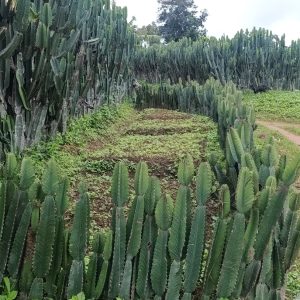
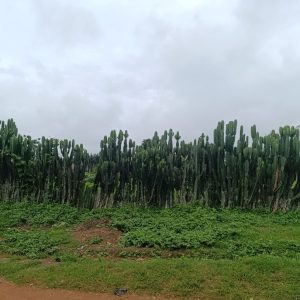
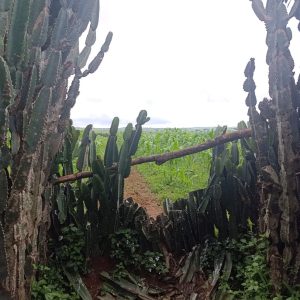
The community’s only protection came from an unusual source—cactus walls encircling the small settlement. “These cactus plants are our only form of security,” Rev. Davou Musa explained to MBT, gesturing toward the thorny barriers that had proven tragically inadequate against the coordinated assault that would follow.

Simon Davou’s words reveal the resigned acceptance of a vulnerable community: “There are times they attack our people in their farms, but what can we possibly do? We are a small community of about 160 houses. There is no police station or any security agency stationed here, so we overlook most of these issues by the Fulani herdsmen.”

Cactus wall fence – Credit: MBT

The Calm Before the Storm: July 14 Warning Signs

The sequence of events that led to the massacre began on July 14, when women and children working their farms spotted an unusual gathering. Large numbers of Fulani herders were accompanied by unidentified men dressed in black clothing—a sight that immediately triggered alarm bells in the peaceful community.

“The women screamed to draw the attention of members of the community, whistles were blown across the community, and the herdsmen fled,” Rev. Musa recounted to MBT. “When they fled, we all thought they had gone, but by 4 pm, they returned, and the information went round our community that there was a threat in the community, and they were identified as Fulani from Hayin Bangai, a community about a mile from our community. You can see the community from here, over there.”

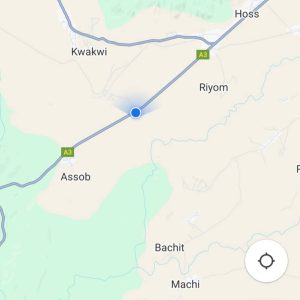
Google map obtained by MBT confirms Bangai’s proximity—less than a mile south of Bindi. More significantly, MBT investigations revealed that a prominent leader of the Miyetti Allah Cattle Breeders Association of Nigeria (MACBAN) maintains a house in Bangai of Bachit district, raising questions about MACBAN’s role in the attack among residents of Bindi.

Google Map showing Bachit district, where Bangai is located

The community’s response to the threat was swift and followed proper channels. “On that evening of July 14, we tried and informed the security about the movements of people that we don’t understand in our community,” Rev. Musa explained. “We called our Ward councillor, who then called the guard commander of the Nigerian army immediately. The commander sent some soldiers at about 5 pm on 2 gun trucks. We were all happy and confident since we saw the army in our community, and we went about our activities.”

The Army’s Brief Presence Hours before Attack

The arrival of Nigerian Army personnel brought temporary relief to Bindi residents. The sight of two gun trucks and soldiers patrolling their community provided a sense of security that would prove devastatingly false. At approximately 7 pm on July 14, the first signs of trouble emerged.

“At about 7 pm, we began to hear gunshots from the major road that passed through our community,” Rev. Musa recalled. “It was from the armed Fulani herdsmen. Then we also heard response from the soldiers, and we felt better because the soldiers responded to the gunfire from the herdsmen. Then the gunfire ceased, and everywhere became quiet. We went to bed trusting that the soldiers would be on ground to forestall any further threat that may arise, but we were wrong.”

3 AM Assault

At 3 AM on July 15, the nightmare began in earnest. “We started hearing gunshots again, this time around there was no response,” Rev. Musa told MBT. “It was just the herdsmen shooting sporadically. They cut down some cactus fence and came into our community through the direction of Bangai.”

Community’s breached security – Credit: MBT

Ezekiel Yakubu, the youth leader of Bindi, provided additional context to MBT: “They came in from Hayin Bangai to attack our village. They had in the past accused our community of killing a young herder, an accusation they couldn’t prove. The government knows the people carrying out these attacks against us and must be decisive, go into Bangai and ensure that the arms are recovered from the herdsmen and the perpetrators of this atrocity are brought to book.”

Sacred Ground Desecrated: Attack on the Community Church

Among the most disturbing aspects of the assault was the deliberate targeting of the community’s spiritual center. The Church of Christ in Nations (COCIN), the only church in Bindi and the spiritual heart of this Christian community, was systematically vandalized during the attack. Windows were shattered, chairs were broken, and the public address system along with other musical instruments were destroyed—a calculated assault on the community’s faith and identity.

Community’s Church Shattered Windows—Credit: MBT

Rev. Davou Musa, who serves as the resident pastor of the COCIN church, witnessed firsthand how the attackers sought to destroy not just lives and property, but the very soul of the community. The targeting of religious infrastructure alongside residential homes suggests a coordinated effort to drive the Christian population from their ancestral lands permanently.

Explosive Evidence: Sophisticated Weapons and Tactics

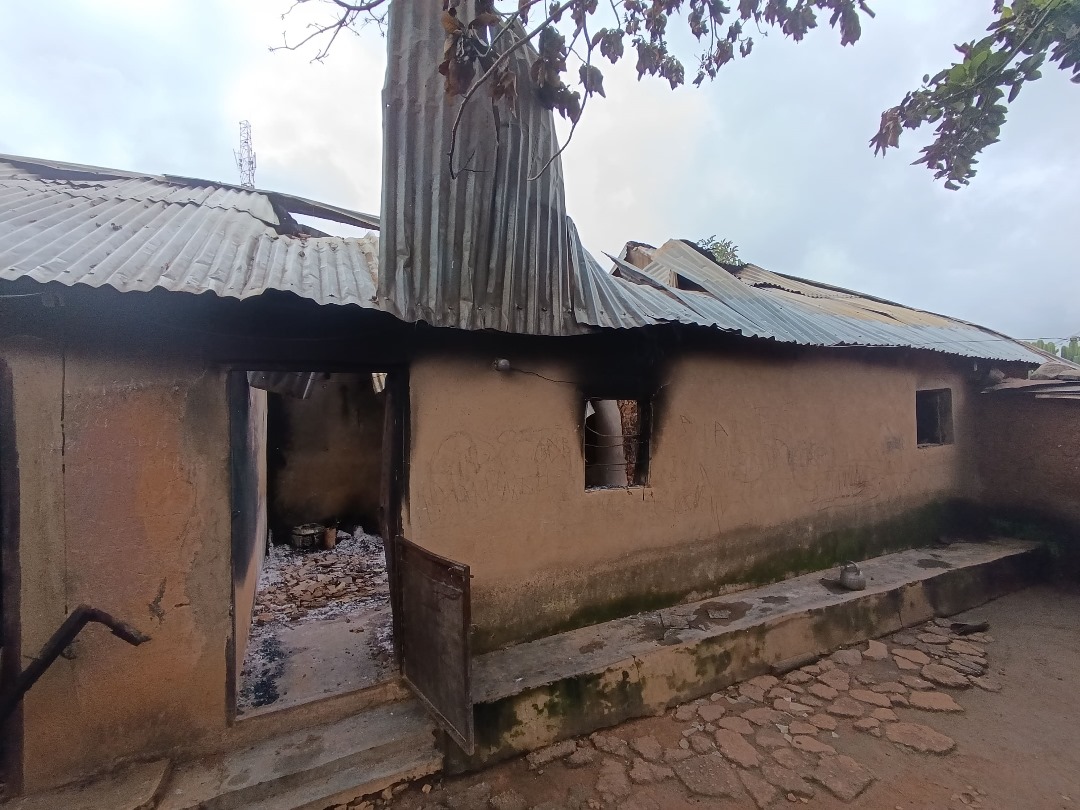
MBT investigations revealed the sophisticated nature of the attack. Eighteen houses belonging to 27 families were destroyed using explosives believed to be calcium carbide—a substance that causes explosions on contact with damp air, water, or fire sparks. The use of such materials indicates a level of planning and resource access that goes far beyond spontaneous violence.

Calcium carbide used by the attackers – Credit: MBT

The impacts of these explosions were devastating and visible. Building roofs were completely blown off, leaving concrete evidence of the attackers’ intentions to cause maximum destruction. This marks a disturbing escalation in the weapons and tactics used against Middle Belt communities.

Impact of explosion on one of the destroyed houses- Credit: MBT

A Pastor’s Harrowing Testimony

Rev. Davou Musa’s account of the attack provides perhaps the most chilling insight into the attackers’ methods and knowledge. Having lost nine family members in the assault while witnessing the desecration of his church, his survival allows him to bear witness to the calculated nature of the violence.

“When they got to my house, which is the pastorium of the Church, they started hitting the gate for several minutes before they gained access to the compound,” he told MBT. “We had been hearing all the gunshots, weeping, and screaming from other victims being killed for over an hour. My house was the last they entered.”

Rev. Davou Musa standing at his destroyed home- Credit: MBT

The pastor’s decision to hide in a room with goats, while his wife and another woman concealed themselves in an outside bathroom, proved life-saving. “One of the attackers came into the room I was hiding and saw the goats. He was excited, telling his other colleagues that he had seen some goats in Fulfulde. I understand a bit of Fulfulde, so I heard what he was saying. I believe God saved my life so I can tell the story of what truly happened on that day.”

The most damning revelation came from what Rev. Musa overheard: “When it was 5 am, they spoke in Fulfulde that ‘it is 5am, soldiers,’ meaning they knew exactly when the soldiers were going to show up in our community. And indeed, few minutes later the soldiers came in after over two hours of killings.”

[Part Two will examine the military’s controversial response, allegations of complicity, and the broader implications for security in Nigeria’s Middle Belt region.]

The Review

Unveiling the Growing Resentment Towards President Tinubu: An In-Depth Analysis

By Samuel Ateh Stephen
stevesam644@gmail.com

Introduction
President Tinubu of Nigeria has recently faced significant public backlash and protests characterized by intense resentment and dissatisfaction. This article delves into the reasons behind this widespread discontent, focusing on the underlying issues that have led to a polarized public sentiment.

The Core of the Issue: Mismanagement and Insensitivity
President Tinubu’s presidency has been marked by several controversial decisions and actions that have directly impacted the lives of ordinary Nigerians. The primary source of public resentment stems from the perceived worsening of their living conditions under his leadership, rather than political or electoral outcomes.

Economic Policies and Living Standards


1. Petrol Subsidy Removal and Its Impact

Immediate Economic Consequences: Rising Fuel Prices: The removal of petrol subsidies has led to a significant increase in fuel prices, affecting transportation costs and raising the prices of essential goods and services. This has made it increasingly difficult for Nigerians to maintain their standard of living.

Impact on the Poor and Middle Classes: The poor and middle classes, who spend a larger portion of their income on basic necessities, have been disproportionately affected. Many are struggling to afford even the most essential items, leading to a decline in their quality of life.

Long-term Economic Implications:

Fund Allocation: The government’s intention to free up funds for other areas of the economy through subsidy removal has not been transparent or effectively communicated, leading to a loss of trust in the government’s economic policies.

Economic Stability: The sharp increase in fuel prices has contributed to economic instability, with higher inflation rates eroding the value of salaries and savings, creating a sense of economic uncertainty.

2. Inflation and Cost of Living

Erosion of Purchasing Power:
Minimum Wage Increase by Tinubu: In 2024, President Tinubu increased the national minimum wage for federal workers in Nigeria to 70,000 Nigerian naira (NGN), which equaled about 44 U.S. dollars based on the current exchange rate. However, this increase did not match the rate of inflation, leading to a decline in real purchasing power.

Comparison to Previous Wage: Prior to Tinubu’s presidency, in 2023, the minimum wage was N30,000, which equaled 65 U.S. dollars at the exchange rate of 460.702 (USD/NGN) in May 2023. Despite the nominal increase in the minimum wage, the real value had diminished due to inflation and a weakening currency.

Impact on Living Standards: The increased minimum wage has not kept pace with inflation, leaving many households financially strained. The cost of basic goods and services has risen sharply, making it increasingly difficult for average Nigerians to afford even the most essential items. This has led to a decline in the overall quality of life for many Nigerians.

Poverty and Inequality:
The combination of high inflation and stagnant wages has exacerbated poverty and income inequality. Many Nigerians are finding it increasingly challenging to cover their basic needs, leading to a sense of desperation and frustration. The gap between the rich and the poor has widened, contributing to social unrest and dissatisfaction with the government.

Healthcare and Education:
The rising cost of living has also affected access to essential services like healthcare and education. Many families are now forced to make difficult choices between meeting their basic needs and investing in their health and education. This has led to a decline in the overall quality of life for many Nigerians.

Social Safety Nets:
The lack of effective social safety nets has further compounded the problem. Vulnerable populations, including the elderly, the unemployed, and those living in poverty, are particularly affected. The government’s failure to provide adequate support has left these groups in a precarious situation, deepening the sense of economic insecurity.

Government Expenditure and Priorities (Luxurious Spending)

Presidential Jet: The purchase of a $150 million presidential jet has been widely criticized as an extravagant and insensitive move, especially given the economic hardships faced by the public.

First Lady’s Office: The allocation of billions of naira for the office of the First Lady has also fueled public anger, as these funds could have been better utilized to improve public services and infrastructure.

Pilgrimage Funding: The budget of 90 billion naira for pilgrimage, described as a “fruitless pilgrimage,” has been criticized as wasteful, especially considering the pressing needs of the Nigerian population.

Lack of Empathy and Communication

Inconsiderate Actions:
The president’s decisions, such as using 21 billion naira to renovate the residence of his vice president, have been seen as inconsiderate and wasteful, further alienating the public.

    Poor Communication:
    President Tinubu’s failure to directly address the public and explain his policies has deepened the sense of mistrust and frustration. The use of intermediaries to communicate with the public has been perceived as a lack of genuine concern and engagement.


    Public Protests and the Call for Change
    The public protests against President Tinubu are not merely symbolic; they represent a collective demand for better governance and a more compassionate leadership. Nigerians are voicing their discontent through demonstrations, highlighting their struggles and calling for immediate action to improve their living conditions.

    The Way Forward: Rebuilding Trust and Addressing Core Issues
    To regain public trust and stabilize his presidency, President Tinubu must take concrete steps to address the root causes of the public’s discontent. This includes:

    Revisiting Economic Policies: Re-evaluating the removal of petrol subsidies and finding more equitable ways to manage the economy, ensuring that the benefits trickle down to the masses.

    Prioritizing Public Welfare: Redirecting government spending towards critical sectors such as healthcare, education, and infrastructure, which directly impact the quality of life for Nigerians.

    Enhancing Communication and Transparency: Engaging more openly with the public, explaining policy decisions, and listening to their concerns. Transparency in governance can help rebuild trust and foster a more collaborative relationship between the government and its citizens.

    Conclusion
    The level of resentment towards President Tinubu is a reflection of the deep-seated economic and social challenges facing Nigeria. It underscores the urgent need for a leadership that is responsive, empathetic, and committed to the welfare of its people. By addressing these core issues and working towards a more inclusive and equitable society, President Tinubu can begin to mend the fractured relationship with the Nigerian public and steer the nation towards a brighter future.

    EXCLUSIVE: How Attack Helicopter Secured Terrorists And Sprayed Southern Kaduna Villagers With Bullets

    By Beevan Magoni & Steven Kefas

    I woke up on the 5th of June to see “Owo” trending on Twitter, thinking maybe the governor of the state Rotimi Akeredolu had done something a typical Nigerian government official would do, which would not surprise me, and, to which I didn’t care to take a look at. I found the real story after going through my WhatsApp status updates from contacts. Indeed, it was a horror, the pictures that confronted me.

    Two days later, I found out that, three hours after the Owo attack, something worse happened in one of our villages in Southern Kaduna. The military shot at unarmed villages that were under Fulani militia’s attack and secured the militia. 

    THE JOURNEY

    As is the norm with me, some stories strike more than just a chord. Some things should not happen in a democratic society, and even if not so, the 21st century should present us with better opportunities for conflict resolution.

    I left Abuja a couple of minutes to 7 PM after the day’s tasks have been completed and headed to Kaduna. One notable thing on the road that night was an accident with survivors in it, but no one dared stop to help them, because of the fear of kidnappers and the elements of destabilization in that death trap called Abuja-Kaduna Express Way. Even my soul felt pity for those trapped in that vehicle.

    Minutes later would be our turn. We were two in the vehicle when at 9:45 PM, we had a flat tyre that left us stranded on that road for an hour. I got to Kaduna minutes past 11 PM, crashed at a friend’s place, and continued my journey to the destination where a Nigerian Military helicopter was said to have shot and killed people.

    KADUNA-CROSSING-MAIKORI VILLAGE

    At first, I thought the attack happened somewhere close to Kaduna city, and at most, somewhere around Kajuru which is about 60KM from the city. Wrong!

    First, my guide told me he was not in the village where the attack happened any longer. He had moved on to be with the IDPs in Kaduna and asked me to contact another survivor who would lead me to the village. The second guide was in Kachia, and had to take a cab to Crossing where we met.

    “Oga Sir, are we leaving the car here?” he asked.

    “No! Why should we leave it here bro?” I inquired.

    “It is because the road is not good and the place is far…” 

    We would go on to travel in the car for convenience, but the motorable road came to an end at Maro which is about 25KM at least, from Crossing. We crossed into Ugakala, drove past quite a number of settlements for almost an hour, and decided to park at Chibiya village when our guide noticed how difficult it was navigating such a jungle. He pleaded with his kinsmen he met on bikes, borrowed their bikes, and rode on one with the cameraman while I and one passenger of the other bike rode on the other for another 30 minutes till we got to Maikori village.

    HOW THE ATTACKS HAPPENED

    A Sunday is a resting day for these agrarian communities. After Sunday service, it is a well-known fact that Southern Kaduna Christian communities see Sunday as a holiday where you don’t have to work or toil for anything. It is mostly all about going to Church, fellowship, coming back home, resting, or going to the village markets to relax and, or catch up with old friends and families.

    According to one of the eye witnesses from Maikori Village,

    “We were resting under a tree when we heard gunshots from Ungwan Sarki. We immediately mobilized to know what was happening and were told Fulani men had attacked the village. In the process of mobilizing ourselves to go help our brothers, we saw an influx of men on motorbikes. There were over 100 motorbikes carrying two people each, at least!”

    Eyewitness

    Another eyewitness said,

    “They came in their large numbers. They were many, with sophisticated weapons and we were ready to confront them. It is our village. It is our streams and rivers. It is our farms. It is our bushes. Even though they used to graze here, they don’t know these places better than we do. So we were strategizing on how to defend ourselves when all of a sudden a helicopter came and started to shoot at us, while the attackers were left to burn our houses!”

    Eyewitness
    Mass grave of the victims

    An elderly woman in her 70s said, “We thought the helicopter was there to help us but it was not. It opened fire on us as we ran. We were running and hiding under shrubs. If this were to be a dry season, the casualty figure would have been worse than this.

    “Up till now, we don’t stay in our houses anymore. We are here because we are hungry. We stay in the bushes and not in the houses. We just came to get some corn to grind and then go back to the bushes where we are hiding. We fear they would come back.”

    70 years old survivor

    Multiple eyewitnesses confirmed the helicopter chased them into the bushes, shelled them, and left the terrorists to loot their barns and burn any structure they could. This operation that lasted for two hours had two people killed and one injured. Maniya Inuwa was killed by the terrorists, while Titus Yusuf was shot and killed by the helicopter. Shadrach Joshua was also shot by the helicopter.

    A white Rooivalk Mk1 attack helicopter for illustration purpose. Credit: Australian aviation

    Every effort to see Joshua was not successful, but luckily, he called me on the phone past 8PM just as I had arrived in Abuja. Apparently, Joshua woke up that morning, was taken to the hospital for treatment, and later hidden in the bush perhaps the Fulanis come back to re-attack the village again.

    The attack on Ungwan Sarki claimed two lives, at Maikori two lives and one injury from the helicopter’s shelling, and thirty four lives at Dogo Noma. 

    ECWA Church Maikori after the attack

    The people at Dogo Noma were in a market square having a good time when two men arrived on bikes, surveyed the environment, and left. Minutes later, they were rounded up in the market. Those who tried to escape were shot down while quite a number of them were captured numbering twenty-nine. To date, others cannot be accounted for.

    KADUNA STATE GOVERNMENT’S ACCOUNT

    The Kaduna state government had kept mum for four (4) days since the Sunday, 5th of June’s attack in Dogon Noma, Maikori, and Ungwan Sarki communities. The government only decided to speak when it became obvious that Southern Karuna was trending on Twitter and other social media platforms. The helicopter story was also spreading like wildfire. 

    The government speaking through its Commissioner of Internal Security and Home Affairs, Samuel Aruwan acknowledged that there was an attack on Sunday 5th June but didn’t explain why it took her four days to comment. The government took time to mention the names of the victims killed during the attack but denied that the helicopter shot at the villagers. It said the helicopter belongs to the Nigerian air force and was on the ground to engage the terrorists.

    What the state government has not been able to show to the world is proof that terrorists were killed by the so-called military helicopter. It is baffling to say that a military attack helicopter was on the ground to repel terrorists yet not a single terrorist was killed.

    This is not the first time victims of Fulani terrorist attacks are alleging sighting helicopters during attacks. In 2018, communities in the same Kajuru local government area of Kaduna state narrated how they sighted a white-painted helicopter landing in the bushes near them prior to the attacks. There was a video to that effect, where community members narrated their ordeals in the hands of the terrorists.

    In June 2020, a captured terrorist confessed during interrogation in a viral video that a certain white painted helicopter was supplying them with weapons for operations.

    In February 2022 a certain helicopter flying at low level shot a teenage boy in Kagoro, a community near Kafanchan, the boy survived with an injured arm.

    The onion of proof that the terrorists are not in possession of air assets lies in the Nigerian Air Force. The Air Force must as a matter of urgency clear the air with satisfactory evidence otherwise the testimony of victims and survivors will continue to shape public discussions on terrorist attacks in Nigeria as it has never been heard that terrorists used planes or helicopters to visit their victims.

    Two weeks before the Sunday 5th June attack, a retired senior intelligence officer had told MBT in confidence about the presence of a certain white painted helicopter which he said was suspicious and that it might be used for nefarious activities. 

    He said the white chopper is often seen landing at the Air Force Base in Kaduna. Even though he could not tell much about the ownership of the chopper, he said going by its flight nature and timing, he suspects the chopper was being used to either provide cover or facilitate the operations of terrorists or used to kill targeted people in the state.

    With the statement earlier released by the Kaduna State Commissioner for Internal Security and Home Affairs, Samuel Aruwan crediting the Nigerian Air Force Base with the helicopter being a rescue helicopter, it is left for them to verify who was the pilot of the helicopter, who gave the command for the helicopter to go to the rescue of the people which ended up killing one person and injuring another person and also providing cover for ground terrorists to kill and burn down houses.

    Also, every helicopter has a visible number for easy identification, but this specific helicopter which is white in color does not fly close to the ground as would do other military helicopters. In Zangon Kataf for instance, the presence of the same white helicopter signals that an attack is imminent. This can be confirmed by residents of the local government which leaves us with no option but to request the Nigeria Air Force Base to do a proper investigation to identify this helicopter and its owner.

    If the Nigerian Air Force Base cannot investigate, then we call on the Nigeria College of Aviation Technology to do due diligence. Both NAF-Base and NCAT are in Kaduna and are supposed to be privy to information on any flight within the territory in question!

    RECOVERED HIGH CALIBRE AMMUNITIONS FROM TERROR SCENE

    Middle Belt Times correspondent came in contact with some high calibre ammunitions recovered from the scene of the attack by the villagers. The sizes and shapes of the ammunition look different from the conventional AK-47 bullet shells usually found after attacks in southern Kaduna and elsewhere. These ammunitions look bigger than normal.

    High calibre ammunition recovered from Maikori community

    Middle Belt Times reached out to a retired senior Air Force  officer who agreed to share his views on the matter on condition of strict anonymity. When he sighted a photograph of one of the ammunitions recovered from the attack site, he said the bullets are either 30 or 50mm calibre round mostly fired by machine guns mounted on attack aircrafts. Speaking on the yet to be identified attck helicopter alleged to be providing cover for terrorists, the retired Air Commodore said the government could deny such allegations as long as no clear evidence to hold onto.

    The government could deny the helicopter because there are many around. Even the Nigerian Air Force has had some close incidents with unknown aircrafts. What would be overwhelming is the aircraft shot down else anything you put out can be denied.

    Retired Air Force officer.

    He went further to state that such ammunitions have no business in a rural community not at war.

    Such high calibre weapons do not have any business in Kajuru except if the terrorists were also flying attack aircrafts or riding on armoured vehicles.” He said.

    Retired Air Force officer…

    Middle Belt Times carried out further checks on the 30 and 50mm calibre round and discovered that such ammunitions are typically not used  against personnel, but rather as an anti-materiel or armor-piercing round. “Rounds of this size can be effective against lightly armored vehicles as well as fortified bunkers. 30 mm is also a popular calibre for shipboard close-in weapons systems, such as the Russian AK-630 and Dutch Goalkeeper CIWS.” [Wikipedia].

    MBT reporter holding a recovered high calibre ammunition

    Similarly, the 50mm calibre round is used typically as anti-materiel or armoured-piercint ammunition mostly mounted on attack aircrafts. The question begging for answer is, what could such dangerous weapons be doing in an agrarian community not at war with anybody?

    CONCLUSION

    While this investigation may not go down well with the powers that be, Middle Belt Times is not out to foment trouble. We are asking every stakeholder to get to grips with themselves and do the needful. Yesterday, it was AK47 riffles. Today, it is a helicopter. We do not know what befalls our communities tomorrow, maybe, chemical or biological weapons.

    A stitch in time saves nine!

    EXCLUSIVE: Kaduna Community Accuses Nigerian Military of Burning Their Houses & Churches

    …Ward Councillor Said army had confrontation with Boko Haram terrorists in the area

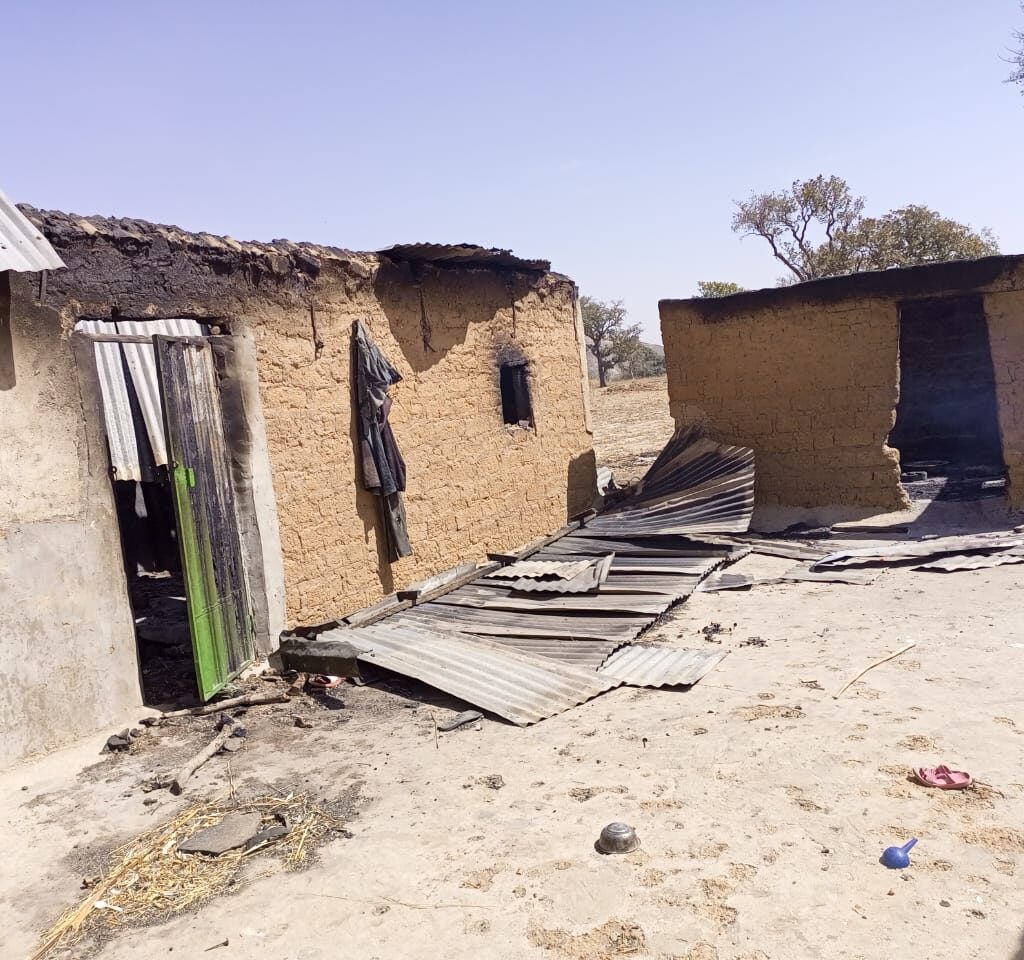
    Residents of Galuwyi in Kunai Ward of Chikun local government area of Kaduna state have accused the Nigerian army of carrying out what they described as arson in their community on January 29, 2022.

    A resident of the community who spoke to this newspaper on condition of anonymity, citing fears to his life and safety, recounted his terrible experience on the day of the ugly incident.

    “It happened on the 29 of January at about 12:25pm while we were in our respective houses relaxing.

    “Suddenly we began to hear gunshots in our community close to the river that is between us and the neighboring community, Kabrasha. We saw men of the Nigerian army coming into our community in large number. People began to run helter skelter for their lives.

    “Later we got to know that the army were exchanging gunfire with bandits, the army obviously overpowered the bandits and the bandits ran away while the army crossover into our community.

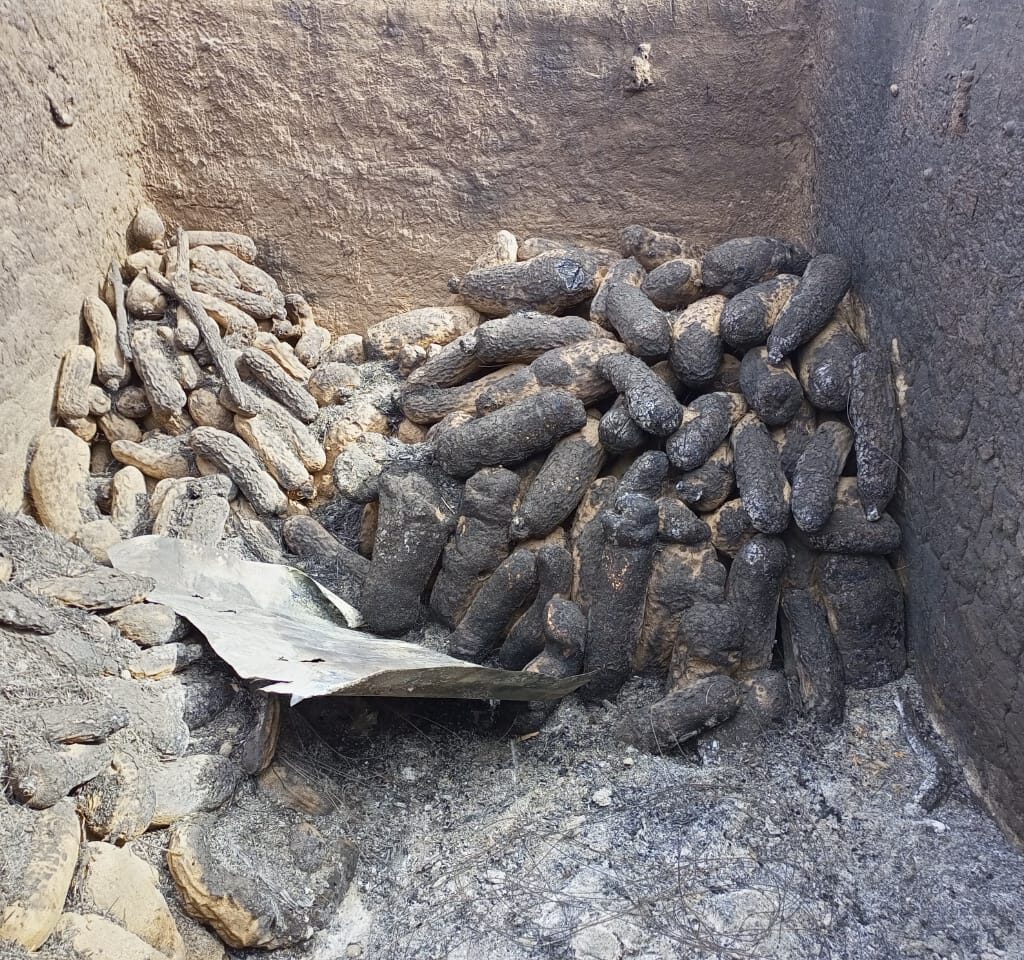
    “When they got into our community, they began to set our houses on fire.” He recounted

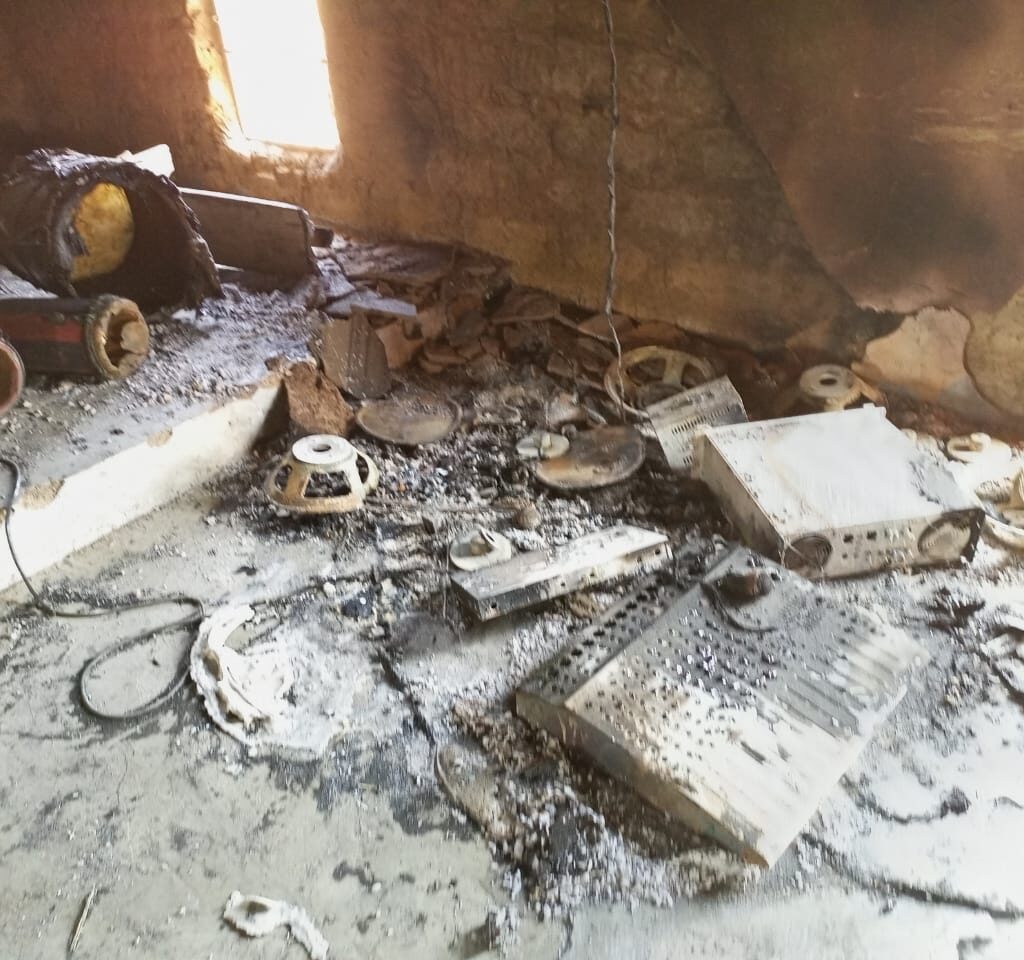
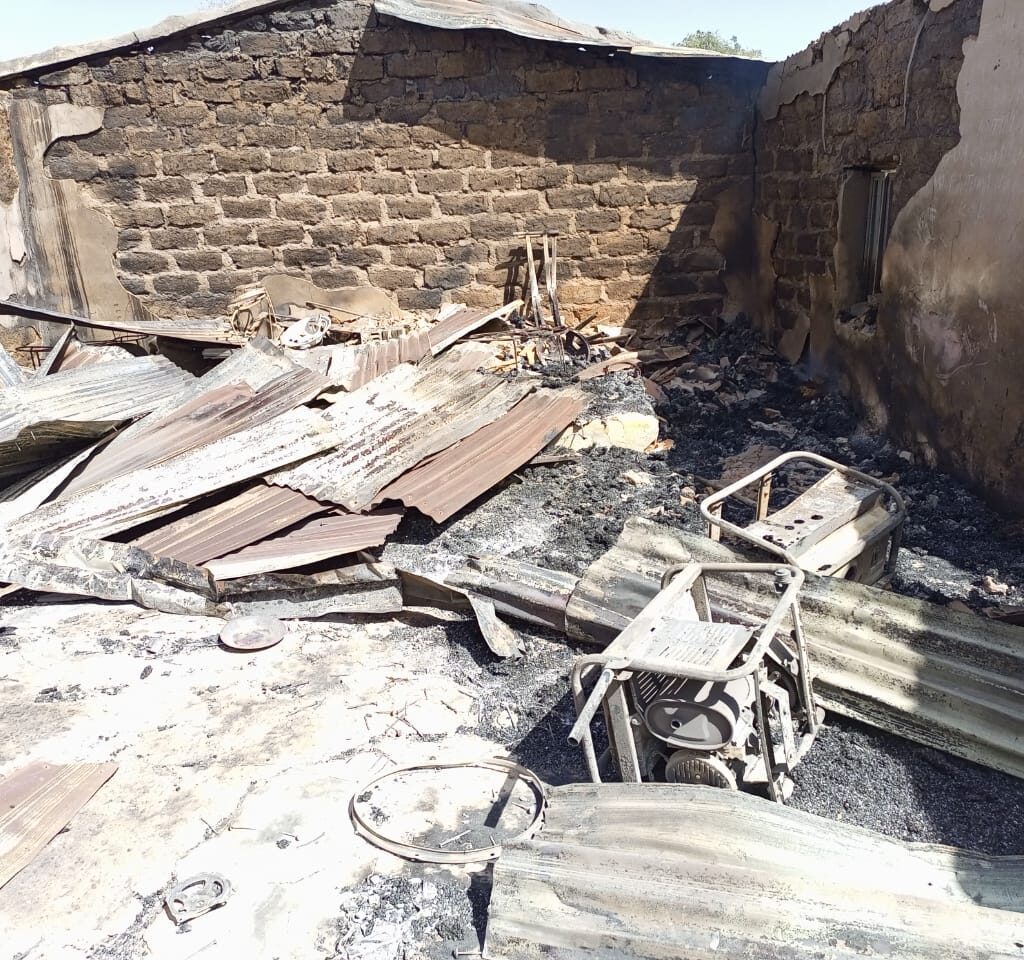
    The source further recalled that after setting their houses, stores and even animals on fire, the army went to two Churches in the community; Baptist and Assemblies of God Churches and set both ablaze.

    The burnt Assemblies of God church, showing burnt musical instruments

    “After setting our houses, stores and cattle on fire, the military shifted to the two churches in the town Jimrewa Baptist church and Assemblies of God church. In the assemblies of God church, they gathered all the musical gadgets and burnt them down while the Baptist church was burnt down completely leaving nothing to be removed from it.” He said

    This reporter also gathered that residents of Galuwyi are currently seeking refuge in Sabon Gaya, a suburb of Kaduna while a few aged men and women who couldn’t leave due to their old ages are left in the burnt community under harsh weather conditions.

    This reporter reached out to the Ward Councillor of Kunai Ward, Honorable Lawal Danjuma who also confirmed the incident but claimed that the military were chasing terrorists in the area.

    “I don’t have much details but what i can tell you is that there was a confrontation between the soldiers and Boko Haram in the area which led to the military allegedly burning down the communities to avoid the terrorists from hiding there.” Danjuma said.

    Burnt yam ban in the community

    When asked about the burning of two churches in the community, the Councillor said he doesn’t have much information on that but promised to speak to a local vigilante member from a nearby community who was with the military on the day of the operation.

    Efforts to get more information from the Ward councillor proved abortive as he claimed he hasn’t been able to reach the vigilante official whom he claimed was with the military on the day of the incident.

    Galuwyi community is situated around the Kaduna river which shares boundary with Niger state, a state where Boko Haram terrorists hoisted their flag last year.

    The burnt Baptist church

    This is not the first time a community in Chikun local government is accusing the Nigerian Military of destroying their homes and churches.

    In December 2020, Kasnawi village in Chikun ward accused the Nigerian Airforce of carrying out aerial bombardments on their community, killing six people and injuring four. Several houses were also destroyed by the Airforce on the same day.

    Recalled also that in May 2020, an Assemblies of God Church was hit by an Airforce munition in Kabarashi community.

    Reacting to the incident, the Kaduna State Government said that the damage done to the Assemblies of God’s Church, Kabarashi village in the Chikun Local Government Area of the state was not intentional. The commissioner of Internal Security, Samuel Aruwan said the munitions that hit the church were targeted at bandits terrorising the state and said that Governor Nasir El-Rufai, had directed that the damage be assessed for necessary action.

    EXCLUSIVE: Binniyat’s Health Condition Worsening in Prison: Prison Source

    …Now uses crutches in prison says wife

    By Steven Kefas, Kaduna

    70 days after the arrest and detention of Epoch times reporter, Mr Luka Binniyat at the kaduna convict prison without trial, the deteriorating health condition of the 2017 award winner of the Nigeria union of journalist (NUJ) “The torch Bearer of Nigeria journalist” seem to be getting worse, prison source told our reporter.

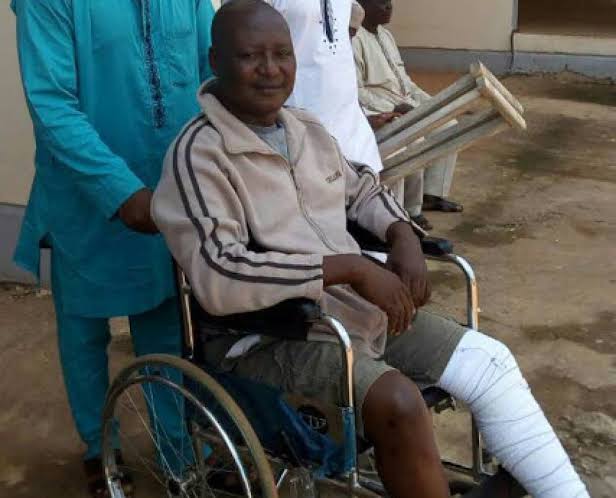
    Binniyat was seen being pushed on a wheel chair in the prison premises on Monday as the source said that the former chairman, correspondent chapel of the NUJ, kaduna state chapter, was battling a crippling leg infection.

    This was even after it was reported last week that Binniyat was rushed to the prison clinic which had no drugs nor qualified and competant health workers after his inmates where alarmed by the suffering he went through over many nights.

    The source said of Binniyat as fearing for his life remains unattended to by a qualified doctor as he has been unable to have any good sleep which May have dangerously heightened his blood pressure.

    When contacted, his wife, Gladys Binniyat said that she has been unable to see her husband being the only visitor that is allowed to bring him food twice a week.

    “I have not been able to see him since 2nd January, 2022″she said.

    “He called me on Monday using the official prison number to my surprise and said that the prison officers in the clinic said that he should buy crutches,”she said.

    “I bought the crutches and I have taken them to the prison, yet they didn’t allow me to see him.

    “I am very disturbed over his health condition.” she said.

    Binniyat’s lawyer, Barrister Ehizogie Fidelis Imadojemu, who also confirmed his deteriorating health conditions to this reporter, said he is worried about the journalist’s condition in prison nwith regards to the snail speed of his trial.

    “Luka called me on Monday and told me about the condition of his health in prison, he told me he now uses wheelchair provided by the prison authority.

    Barrister Imadojemu also expressed dissatisfaction with the way and manner his client’s case is going after 70 days in detention.

    “During one of my regular visits to see him at the Kaduna Minimum Security Custodial Centre, he told me of pains he felt in his legs. In recent time, the pains have increased so that he now moves in a wheelchair.

    “From what he told me, it’s an ailment that predates his recent arrest, detention and remand. He has not seen a Doctor. His only contact with a Health care provider in the Custodial Centre to examine the legs was not a Doctor or a Medical Practitioner, properly so called.

    “He has had little or no medical attention. I am trying to speak to the authorities at the Custodial Centre so that he meets with a Medical Practitioner immediately as his health is deteriorating very fast.” He said

    Barrister Imadojemu further said that charges were filled against Luka at the Federal high court in December but the case is yet to be assigned to s judge.

    “Although Charges have been filed against him since early December of 2021, in Case Number: FHC/KD/79c/2021, the case before the Federal High Court, Kaduna, has not been assigned by the Presiding Judge or Senior Judge who normally assigns fresh cases. Consequently, no date has been fixed for his arraignment.

    “His bail application filed after the Charges were filed, has also suffered the same fate. Hopefully, when he is arraigned, his bail application will be heard.” Imadojemu said.

    Recall that Journalist Luka Binniyat was arrested by men of the Kaduna state Investigation Bureau (SIB) on November 4 2021 over a news article he authored for New York based online newspaper, Epoch times.

    Binniyat was alleged to have quoted Senator Danjuma La’ah, the Senator representing Southern Kaduna Senatorial District in a publication on the killings of 38 people in Madamai and Abun communities in Southern Kaduna in September 2021, a publication the Kaduna state commissioner of Internal Security perceived defamatory.

    Network Shutdown: Terrorists Kill Two In Kaduna Community

    Terrorists on Sunday night killed two people in Maskoro Goriko under Ligari in Kakau Ward, Chikun local government area of Kaduna state, North west Nigeria.

    The Councilor representing Kakau Ward, Honorable Richard John Kpedason who confirmed the attack to Middle Belt Times said the attackers arrived the community at about 11:30pm local time and began shooting sporadically.

    “They came in around 11:30 in the night and shot two people dead. one person is still missing as i speak to you.” Kpedason said

    The Councilor who visited the community on Monday morning further said that the network shutdown in the area is making things more complicated both for the security forces and the residents.

    “The attack in this my Ward are getting too much and the network shutdown is making it impossible for the people to call for help whenever they sight the bandits nunlike before.

    “Same thing happen last Sunday when 66 members of the Baptist church where kidnapped.

    “When the people saw the bandits they couldn’t call the military for help despite the fact that the military is not too far from the area.” He said

    Honorable Kpedason also called on the state government to deploy more security personnel to the area to forestall future attacks.

    The names of the persons killed were given as Daniel Ishaku and Mallam Ali while one Bamaiyi Bawa was still missing as at the time of filling this report. call the military

    It will be recalled that Middle Belt Times reported yesterday that two of of the 66 church members were killed by their captors under unclear circumstances.

    Gunmen attack church, abduct three worshippers

    There was pandemonium in Obada Oko in Ewekoro local government area of Ogun State following the kidnapping of three worshippers in a Cherubim and Seraphim Church, along Railway station in the early hours of Sunday.

    The victims, according to a source, who pleaded anonymity, included; Ifeoluwa Alani-Bello, Adebare Oduntan and Mary Oliyide were said to have been taken away by unknown gunmen while holding a vigil in the aforementioned church.

    It was gathered that the abductors had demanded for ransom of N6 million before they can be released.

    According to the source, “the incident took place at Cherubim & Seraphim Church, Ona-Ara, Oju-Irin in Obada Oko in the early hours of today (Sunday) during a night vigil held by the said church”.

    Confirming the incident, Police Public Relations Officer (PPRO), Ogun State command, Abimbola Oyeyemi, said the state command anti-kidnapping unit has been dispatched to the area to partner with the Obada Oko Division of the police to rescue the victims

    He added that, it should also be noted that the police had also warned members of the public from having vigil and religious activities in areas considered to be isolated and that if at all such places of worship want to have programme, they should inform the police so that police patrol could be extended to such area and adequate security provided.

    (Vanguard)

    Kanu’s Trial: SSS denies lawyers, journalists access to court

    The State Security Service (SSS) has blocked all access to the Federal High Court sitting in Abuja to prevent lawyers and journalists from attending the trial of separatist and leader of the Indigenous People of Biafra (IPOB) Nnamdi Kanu. 

    Other litigants who have court hearings scheduled for today are also not being allowed entry into the court by the SSS Peoples Gazette gathered on Thursday morning. 

    The secret police has denied Mr Kanu access to his lawyers and family since he was abducted and brought back to Nigeria by state operatives in Nairobi, Kenya, with many people questioning the legality of the manner in which he was rearrested. 

    Mr Kanu was initially charged for terrorism, however, in an amended charge sheet, the SSS said he was now being arraigned for calling President Muhammadu Buhari an idiot, a terrorist, and “embodiment of evil.”

    Spokesman to the SSS, Peter Afunnaya did not respond to calls and messages from The Gazette seeking comments on the blockage of the courts.

    (Gazette)