Sheikh Gumi, Usman Yusuf, and the Dangerous Politics of Sympathizing With Terror in Nigeria

By Nasiru I. M. Jagaba

21 December 2025

jagabanasiru@gmail.com

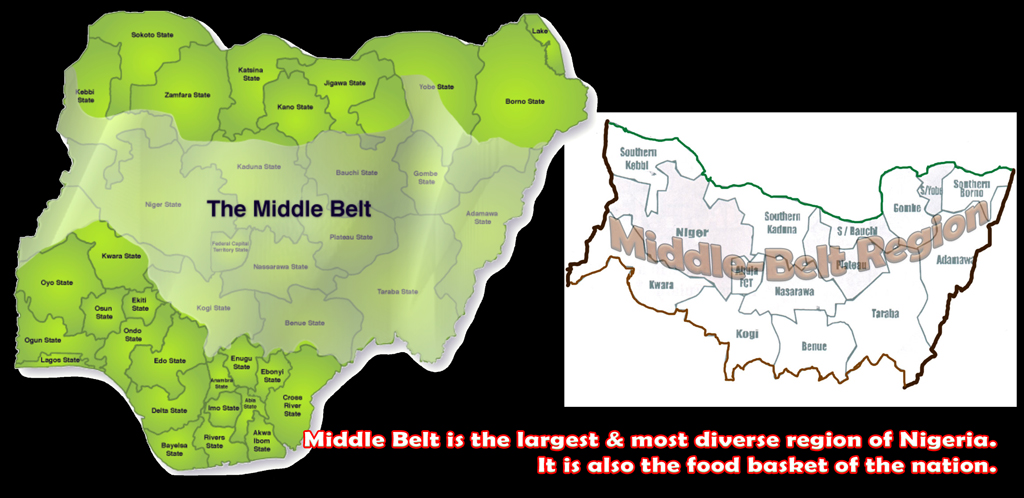
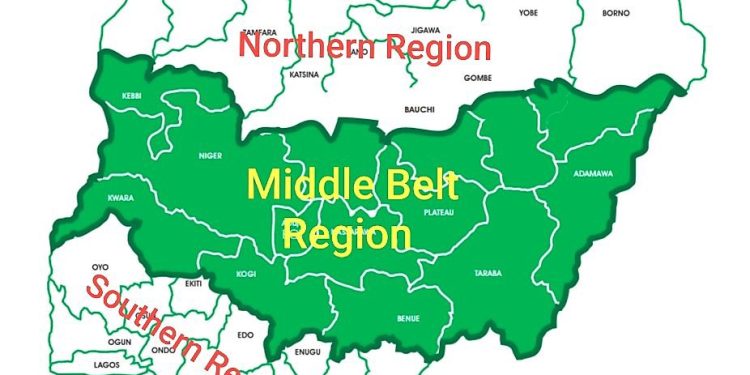
For over a decade, Nigeria has endured an unrelenting wave of terrorism and large-scale banditry that has claimed tens of thousands of lives, displaced millions, and devastated entire regions. From the abduction of schoolgirls in Chibok to mass killings in the Middle Belt and the bombing of the

Abuja-Kaduna passenger train, the victims have overwhelmingly been ordinary, unarmed citizens.

Nigeria’s tragedy is not rooted in a lack of military capability. The country possesses trained forces, intelligence assets, and international partnerships. What has consistently failed is political resolve, compounded by the role of influential voices who have normalized, justified, or indirectly shielded terrorists under the language of dialogue, ethnicity, or religious fraternity.

At the heart of this troubling pattern are Sheikh Ahmad Gumi and Professor Usman Yusuf, two public figures whose words, actions, and associations demand scrutiny rather than reverence.

Documented Presence With Terrorists in Their Havens

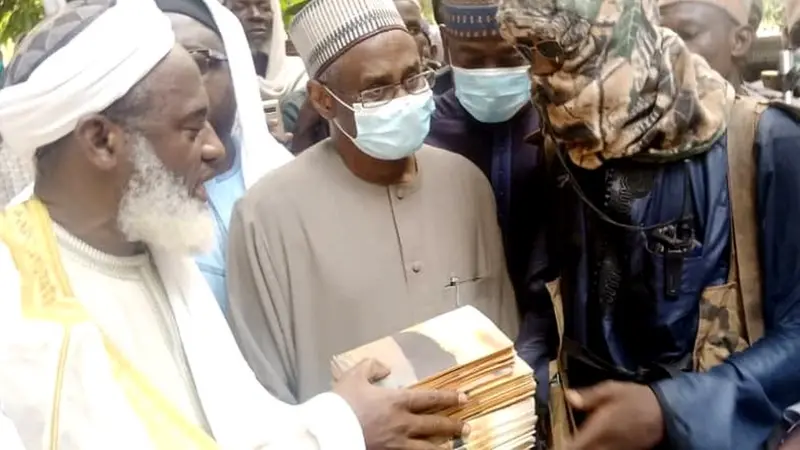
Before any discussion of motives or rhetoric, one foundational fact must be stated plainly: Sheikh Ahmad Gumi and Professor Usman Yusuf have, on multiple occasions, been seen in photographs and video footage holding court with armed terrorists inside their forest havens across several Nigerian states. These were not accidental encounters or second-hand claims; they were direct, documented meetings conducted deep within territories controlled by bandit and terrorist groups.

Such repeated access establishes an unavoidable reality: anyone who can consistently meet terrorists in their strongholds knows who they are, where they are located, and how to reach them. In a country where security agencies often cite intelligence gaps as a constraint, this level of familiarity raises grave questions. If these individuals possess such access and knowledge, Nigerians are entitled to ask why this proximity has not translated into the exposure, disruption, or dismantling of terror networks, but instead has coincided with public advocacy that appears to soften, excuse, or rationalize their violence.

From Mediation to Legitimization: The Gumi Question

Beginning around 2020, Sheikh Ahmad Gumi publicly ventured into bandit-controlled forests across Zamfara and neighboring states, presenting himself as a mediator. These visits were not clandestine; they were widely broadcast and documented by BBC Hausa (June 2021), Channels Television (July 2021), and Daily Trust (2021).

Crucially, these encounters produced photographs and video footage showing Gumi sitting openly with armed bandit leaders in their forest enclaves. These images carry unavoidable implications: anyone who repeatedly meets terrorists in their strongholds knows who they are, where they operate, and how to reach them.

Yet rather than use this access to expose terror networks, Gumi consistently positioned himself as their public interpreter, often describing them in collective, possessive language such as “our boys” or “our warriors” (mayakanmu) in televised interviews.

In any counter-terrorism doctrine, such language blurs the line between mediation and moral endorsement. It raises a fundamental question Nigerians deserve answered:

If these men know the terrorists so well, why has the nation never been told, clearly and unequivocally, why these groups attack villages, massacre civilians, and wage war on the Nigerian state?

Negotiating for Killers, Silence for Victims

Despite repeated “peace engagements,” violence did not decline; it escalated. Kidnappings expanded from remote villages to highways, schools, and rail infrastructure, culminating in the Abuja–Kaduna train attack of 28 March 2022.

Instead of disarmament, terrorists gained:

Public visibility

A sympathetic national voice

Political and ideological cover

If negotiations are conducted with murderers, a basic moral question arises: Who accounts for the blood already spilled?

When Sheikh Gumi and his allies speak of bandits using inclusive Hausa pronouns, “we” and “us”, they unintentionally frame mass atrocities as collective grievances rather than criminal acts.

Such framing risks converting terror into an ethnic or communal cause, rather than what it is: organized violent crime and war against civilians.

Associations That Deepen Concern

Public concern intensified with the arrest of Tukur Mamu, a close associate of Gumi and a self-described negotiator. On 7 September 2022, Mamu was arrested in Cairo, deported to Nigeria, and detained by security agencies. Authorities stated he was found with items allegedly linked to terrorist logistics (Premium Times, September 2022; Channels TV, September 2022).

Mamu had repeatedly appeared beside Gumi during “peace meetings” with bandits. Yet kidnappings continued unabated throughout this period. This inevitably raises a disturbing question:

Were these engagements aimed at ending terrorism, or managing it?

Earlier, Sheikh Gumi himself had drawn international attention. In 2010, Saudi authorities detained him following intelligence concerns linked to Umar Farouk Abdulmutallab, the Nigerian involved in the failed Christmas Day airline bombing (The New York Times, January 2010). More recently, in May 2025, Saudi Arabia reportedly denied him entry for Hajj.

Such actions by foreign governments may be disputed, but taken together they form a pattern that merits investigation, not dismissal.

Usman Yusuf and the Ethnicization of Terror

Professor Usman Yusuf, former Executive Secretary of the National Health Insurance Scheme (NHIS), has emerged as a vocal critic of military operations against armed terrorist groups.

In opposing decisive action, Yusuf has framed counter-terror efforts as an attack on “Fulani people.” This argument is not merely flawed; it is dangerous.

Northern traditional rulers, security briefings, and multiple media investigations have repeatedly acknowledged that a significant proportion of bandit groups identify as Fulani, without suggesting that Fulani identity itself is criminal.

Terrorism is not an ethnicity; it is a crime.

By Yusuf’s logic, opposing military action against armed militias because of their ethnic identity implies that such groups possess an implicit right to raid villages, displace other ethnic communities, and commit mass killings without resistance. This is a moral and legal absurdity.

Selective Compassion, Selective Justice

Professor Yusuf’s public record also invites scrutiny. During his tenure at NHIS, he faced allegations of financial mismanagement reported by Premium Times (October 2018) and The Punch (December 2018). While he denies wrongdoing and no final conviction has been recorded, these unresolved issues remain part of the public record.

It is therefore legitimate to ask: Why does a former public official, facing unresolved accountability questions, now position himself as a defender of armed groups, while civilians continue to die?

When Terror Becomes a Political Asset

Media investigations by Daily Trust (June 2020) and Premium Times (February 2021) documented state-level arrangements where bandit leaders were paid or settled in exchange for temporary ceasefires. Security analysts cited by The Guardian (August 2021) and the International Crisis Group (2020–2023) warned that such deals often preserved terror networks as political leverage, especially during election cycles. If armed groups are maintained as bargaining tools, terrorism ceases to be merely a security failure and becomes a political strategy, a profound betrayal of the Nigerian people.

Tinubu’s Moment of Truth

President Bola Ahmed Tinubu faces a defining test. Ending insecurity requires placing national survival above political calculations, resisting elite pressure from those threatened by peace, and supporting professional military leadership without equivocation.

The Defence leadership under General Christopher Musa emphasizes coordination, discipline, and results. Such efforts cannot succeed while influential voices undermine operations through ethnic or religious narratives.

A Call for Investigation and Accountability

Criticism alone is no longer sufficient. Investigation is imperative.

Nigeria’s security and justice institutions must examine:

Public advocacy that appears to normalize or defend armed groups

Financial and logistical networks sustaining terrorism

The role of intermediaries who claim peace while violence persists.

International partners should also review credible evidence under frameworks such as the Global Magnitsky Act and Leahy Laws, where terror facilitation is established.

Holy robes must not become shields for unholy alliances.

Conclusion:

Stop Bargaining With Violence

The victims of Nigeria’s terror war, schoolchildren, farmers, commuters, worshippers, were not combatants. They were citizens. This war will not be won by ethnicizing crime, romanticizing killers, or negotiating from moral weakness. It will be won by truth, accountability, and political courage.

Nigeria must stop bargaining with terror, and start defeating it.

An Open Letter to His Excellency, Professor Babagana Umara Zulum, Executive Governor of Borno State.

By Suleman Ayuba


Your Excellency,


I write with profound respect and genuine gratitude for your latest act of leadership and compassion: the decision to give every family returning from Cameroon the sum of Five Hundred Thousand Naira (₦500,000) as repatriation support. This is not just money; it is a loud declaration that the people of Ngoshe, Kirawa, Attagara, Agapalawa, Ashigashiya, Warabe, Gwoza hills, Pulka, and every other mountain and valley community are still sons and daughters of Borno, not forgotten refugees. For this, Sir, accept my deepest thanks and the thanks of every family now preparing to cross the border back home.


But Your Excellency, gratitude must walk hand-in-hand with truth.


The same communities they are returning to Ngoshe, Kirawa, Attagara, Agapalawa, and so many others still lie in ruins. Houses are burnt shells. Schools are without roofs or teachers. Health posts are empty. Farmlands are overgrown or mined. At night, fear still rules because insurgents have not been completely pushed out of the surrounding hills. Five hundred thousand naira is a powerful seed, but it cannot grow where the soil has not been prepared.


I have spoken to returnees who are already back in Ngoshe and Kirawa. They tell me the money helps them buy food and a few zinc sheets, but after that, they sleep in church buildings or under trees because there is no coordinated reconstruction. Children in Attagara and Agapalawa are eager to resume school, yet the classrooms remain destroyed. Mothers in Warabe and Ashigashiya are afraid to farm far from the town because there is no guarantee of safety.


Your Excellency, you have rebuilt thousands of homes, schools, and hospitals across the state. We have seen the miracle in Kawuri, in Bama, in Konduga. Now the people of the Mandara Mountain axis Ngoshe, Kirawa, Attagara, Agapalawa, and beyond—need that same miracle. Without it, the ₦500,000 risks becoming not the beginning of a new life, but the end of hope.


Our returning brothers and sisters deserve more than transport fare and cash. They deserve: Reconstructed homes in Ngoshe, Kirawa, Attagara, Agapalawa, and every affected ward, with government-supplied blocks and roofing materials so that the ₦500,000 becomes a contribution, not the entire burden. Immediate rehabilitation of schools in these communities and free enrolment plus feeding for returnee children who have lost over ten years of education. Permanent security posts and regular patrols so families can sleep without one eye open. Seeds, fertilisers, and farming tools distributed before the next planting season, so the money can be invested in land instead of consumed in hunger. Mobile clinics and trauma counsellors deployed to these mountain communities, because the wounds of war are not only physical.


Your Excellency, the world is watching Borno’s repatriation effort. Let us make it a complete success not just bringing people back from Cameroon, but bringing life back to Ngoshe, Kirawa, Attagara, Agapalawa, and every village that once echoed with children’s laughter.


Thank you again for the ₦500,000 per family. Now let us match that generosity with the roofs, classrooms, and security that will turn repatriation into true restoration.


With highest regards and unwavering hope,


SULEMAN AYUBA

Concerned citizen,victim of the circumstances.

Archaeology of a Reflex (II)

By Ahmed Yahaya Joe

“Diplomacy is the art of telling people to go to hell in such a way that they ask for directions.” – Winston Churchill, British Prime Minister 1940-1945 & 1951-1955

What subtlety in statesmanship can President Bola Tinubu grasp from the recent detente between Donald Trump and Zohran Mamdani?
The American president’s “exceedingly warm reception” of the Mayor-elect of New York at the Oval Office was quite surprising even for close watchers as the duo have hitherto had a very vexatious relationship that even descended to constant name-calling and frequent taking swipes at each other. Despite the lack of parity between Tinubu and Trump as commanders in chief as Mao reminds us “Politics is warfare without bloodshed,” against the background of Clausewitz’s “war is the continuation of politics by other means.” If so, “The target of your strategy should be less the army you face than the mind of the man or woman who runs it.” – p.165 33 Strategies of War (2006) by Robert Greene

Little wonder, Ms. Onubogu entitled her November 21 presentation to the US House of Representatives Subcommittee on Africa, “A Serious, Well-founded Wake-up Call” – a rapprochement that should collectively jolt us to recover the pan-Nigerian story. More so, President Tinubu, as she had prior highlighted Nigeria’s unnecessarily longstanding ambassadorial vacuum in Washington DC, a huge challenge in bilateral relations albeit the recent better late than never foreign service nominations.

Interestingly, the Wikipedia page of our “master strategist” states that he got admitted into Chicago State University in 1975. This was when Henry Kissinger (1923-2023) was still in office as the 56th Secretary of State during which he famously enunciated “Diplomacy is the art of restraining power,” adding that “when statesmen want to gain time, they offer to talk.”
How could Asiwaju’s handlers whilst formulating the “Renewed Hope agenda” have missed that Kissinger in his 1994 912-page book simply entitled Diplomacy, states that “Military men are just dumb, stupid animals to be used as pawns in foreign policy”?
Again, if so, why are Nigerians getting so worked up over President Trump’s sabre rattling when, as we have already encountered in Part I, how Nigeria deftly outflanked an entrenched Italian position during the late 1960s?

The “12 disciples of Nigeria” were the pacesetting career diplomats who formed the nucleus of Nigeria’s foreign service ahead of national independence. These pioneers were recruited and trained by the British purely based on merit after rigorous vetting, a series of qualifying examinations, and extensive interviews that took place in Lagos and London in 1957.
They were as follows in alphabetical order of surnames: Phillip Asiodu, Chike Chukwura, John Garba, Adedokun Haastrup, Leslie Harriman, Chukwuemeka Ifeagwu, Dickson Igwe, Omotayo Ogunsulire, Olumide Omololu, Aminu Sanusi, John Ukegbu and Soji Williams.

Hear the Igbobi oldboy in his own words on that select group;
“We came from all parts of the federation with vastly varying degrees of years in the public service, and also a variety of academic backgrounds. All of us were put through the same furnace of training and were expected to emerge at the end of the conveyor belt as accomplished diplomats (and without any attempt at self-adulation), I could assert that by the time of our independence three years later, we were more or less reduced to a common level of awareness. We had brought to our new vocation, different ideas of what it meant to us, and what were our obligations, towards it. – pp.371-372

After the demise of Ambassador Omotayo Ogunsulire (1930-2023) leaves Chief Phillip Asiodu b.1934 as the last surviving of those magnificent men. Then there was Ambassador Aminu Sanusi (father of Khalifa Muhammadu Sanusi II), the only other Northerner apart from Old Grammarian Garba in that distinguished seemingly pan-Nigerian line-up regardless.

Arguably, no proudly Nigerian icon abroad is as symbolic as the Nigeria House along Second Avenue in Midtown Manhattan, New York. Built and commissioned in 1992 at a reported cost $32 million the 22-storey skyscraper wrapped in green reflective class was designed under the watch of President Shehu Shagari in 1982 by the now rested Kano architectural firm, Ella Waziri & Associates but delivered by the Lagos multinational outfit, AIM Consultants.
It remains mindboggling that such a massive investment in the financial capital of the US with over 90,000 square feet of letable space would not have since 2023 the compliment of hosting any Permanent Representative from Nigeria at the United Nations headquarters just next block on First Avenue. Unfortunately;

“The Office of the Auditor-General of the Federation has advised that since the New York edifice is strategically located, deteriorating and underutilized, it should as a matter of urgency, be comprehensively rehabilitated before it constitutes an embarrassment to Nigeria.” – Nation newspaper edition of September 5, 2022

Apparently, Ambassador Garba and Ms. Onubogu are not the only Nigerians at a precarious junction of inter-communal existence. Hear the 81-year-old ace columnist, Debo Sobowale, who puts it that;

“Irrespective of who is making the one-sided narrative regarding religious conflict in Nigeria, people like me feel cold. In the storm of national controversies ignited by President Trump’s threat to invade Nigeria, I am one of a very tiny minority of Nigerians caught in all the crossfire – whether religious, political, ethnic or just mischievous.
On my father’s side in Lagos, Christians constitute about 85 per cent of the people I serve as Head of Family. By a twist of fate, it is the same side of the family which, has linked me/us to the North. My paternal grandmother – Aisha — was a Fulani born and raised in Shinkafi, Zamfara State.
My grandfather was a Muslim and an Imam. His vault is still in our family house at Agbowa-Ikosi. My father, his only surviving son, was forced to convert to Christianity when he was dragged off to war in Europe. That was how generations of Sobowales became Christians. Muslims are in the overwhelming majority in my mother’s side of Lagos Island. My grandmother, also a rebel, married a Christian and had only one daughter, who also married a Christian. I was brought up as a Christian. But, my wife was the daughter of a chief imam in Lagos Island.”
– Vanguard newspaper edition of November 16, 2025

Now a final word on Ambassador Garba’s parental background in his own words but not before some more on his extraction. This writer believes such to be salient as we are all members of an increasingly cosmopolitan village in Nigeria. While how Nigerians would wrestle the behemoth of “politicization of religion” to the ground and exorcize the demon of the “religionization of politics,” is mainly left to us it is not entirely to the 47th President of the United States or the 119th Congress on Capitol Hill.
As Nigerians, we must endeavour to remain vigorously tolerant, positively optimistic, and overly inclusive in our national project lest we take that a tortuous road to Sudan. Unfortunately, Ambassador Garba’s book reprinted in 1998 is again out of print again. Sadly, many Nigerians have not benefitted from his vicissitudes;

“My people were originally Kanuri who lived in some unspecified part of the present-day Borno State. Owing to untoward circumstances, there was a large exodus a long time ago, which included members of my family. They moved westward until they reached Katsina. When my people reached Katsina, they were not allowed to settle within the city walls, being foreigners, but had to camp some distance outside it.
They eked out an existence through pursuits peculiar to rural dwellers, namely hunting and farming. My ancestors became great hunters, and it is a well-known fact in the Hausa social arrangement of earlier days, the hunting class formed the backbone of the army whenever there was war; and there were quite a few of these.

My people, being as renowned great hunters were invited from time to time by Sarkin Katsina to help him in his various wars against his numerous enemies, which ranged along all the four cardinal points of the compass. Having proven their prowess on the battlefield in the various campaigns over the years, Sarkin Katsina, on an occasion, in recognition of his appreciation and as a mark of gratitude, invited the elders among my people to nominate a leader who would be titled.
According to family legend, the title of Kauran Katsina (Chief Warrior of Katsina) was bestowed on our chosen leader, and this title was held by us until shortly after the Jihad of Shehu Usumanu dan Fodio.

Later on, Sokoto had appointed a Pullo (Fulani) Sarkin Katsina whose appointment had been rejected by a section of the Katsina community, including our own faction. Instead, we had appointed a rival Kado (Hausa). We rose in revolt but were worsted by the Fulani in the encounter by the Fulani and their supporters.
Our people had to flee westwards, once again and took refuge in places (in today’s Niger Republic) such as Damagaram, Tasawa, and Maradi. It is significant that the Chief (Emir) of Maradi, even today, which is a little short of two hundred years after the departure from Katsina, continues to style himself Sarkin Katsina, while the erstwhile French colonial rulers refer to Maradi as Katsina.” -pp. 1-2

In conclusion;

“My father (born in Gazawa near Maradi) spoke Hausa, Kanuri, Fulfulde, Shuwa-Arabic, and Sara-Kabam fluently. But this resourceful man had also taught himself English sufficiently as to bear the title of ‘Tafinta’ (Interpreter) at the Provincial Office, Nassarawa, Kano, between the years 1929-1930, and with the UAC at Gusau, from 1930 to 1934.
He had no formal education but never missed the opportunity to learn, to which I had contributed in no small measure. In the early years in Maiduguri, his Kanuri companions called him Garba Jibdama (Garba of the Jibda, or civet cat). Later in life, when he had risen to be foreman and lining-sinker in the well sinking section of the Geological Department, they called him Garba Baramma (Garba of the Wells).

He addressed himself as Mallam Garba Katsina throughout his life. Only after he had gone to the Hajj in 1960 did he change his name to Alhaji Garba Muhammadu, assuming his father’s name.
From 1939 to 1943, he worked for the Kano Local Authority, sinking wells mainly in the Hadejia, Gumel, and Kazaure emirates.
He retired in 1944 but continued to live in Kano City. During the years that he had been in and out of Kano, he had lived at Yakasai, Dan-Agundi, Gwangwazo, Tudun-Wazirci, and finally back to Kofar Dan-Agundi ward where he lived his last days on earth.
Here, he died on 13th March 1972, at the age of about eighty-seven years. My mother had left my father when I was about six years old. There was never a formal divorce. Before I was born, my father had married Fatu, a Fulani from the same Geidam where he had married my mother.” – pp 13-14

Concluded.

Archaeology of a Reflex (I)

By Ahmed Yahaya Joe

“Truth is found neither in the thesis nor the antithesis, but in an emergent synthesis which reconciles the two.” – Georg Hegel (1770-1831)

What is the moral for Nigeria from the Sudanese conundrum?
The question is pertinent because neither Sudan nor Sudan Sudan have known sustainable peace, significant progress, or any meaningful development ever since those nations parted ways in 2011;

“With its people deeply divided along ethno-geographic and religious fault lines, under a tense socio-political atmosphere arising from heightened insecurity, the situation in Nigeria today reads like a tragic plot from the Sudanese playbook. Like Nigeria, Sudan was a British colonial creation, in which the colonials lumped ethnic and religiously diverse peoples together in a self-serving scheme of nation-building experimentation. Nigeria, like Sudan, is almost evenly split into predominately Muslim North and Christian South.”
– Nigeria: On the Road to Sudan by Majeed Dahiru posted 5/28/2021

Yet, here we are in a protracted battle for the soul of our nation, of which according to Ignatius Kaigama, Prelate of Abuja, “God has nothing to do with it.” It has always been about power and control he opines on the recurrent strife bedevilling the presumptive capital of the Middle Belt, “No crisis in Jos is religious. The real issue is the competition for who owns Jos.”
The insight of then Archbishop of Jos and more are contained in the 2016 book by Tom Burgis entitled The Looting Machine: Warlords, Tycoons, Smugglers, and the Systematic Theft of Africa’s Wealth pp.175-187

Using Jos as a microcosm for Nigeria, irrespective of our polarized opinions on the “Christian genocide” thesis and the “religion is not the key driver in the attacks” antithesis, it is noteworthy that one of ours, senior fellow & Africa program director, Center for Strategic and International Studies, Oge Onubogu presented what Hegel describes as “sublation” – a synthesis.
In her must-watch presentation to the Africa Subcommittee of the US House of Representatives, Ms. Onubogu carefully reconciled the truths in the thesis with the shortcomings of the antithesis by transcending the limitations in both entrenched positions asserting;
“In Nigeria today, ethnicity, religion and language – not nationality – remain the benchmarks for identity for the country’s highly diverse population.”

While she warned against reducing the prevailing thesis to “a single story” she nonetheless admitted that the antithesis is laced with “religious extremism,” but she still deliberately glossed over the virulent marginalization and systematic oppression by Muslims against non-Muslims and vice versa as the case may be.
Overtly her testimony was a conciliatory beacon for a way forward. It is still however afflicted the selective amnesia on how the fallout of Muslim-Muslim rhetoric of 2023 had deepened the political fault lines still reverberating to date.
Regardless, every discerning Nigerian knows that the root cause of the very challenged inter-communal relations in our nation is variously the “politicization of religion,” and “religionization of politics,” across the board.
Here, The Manipulation of Religion in Nigeria Today: Its Social and Political Basis, published in New Nigerian newspaper edition of 13th- 14th January, 1978 by Dr. Yusufu Bala Usman remains instructive after 47 years and still counting.

Ms. Onubugo was probably not even born when, in the mid-1960s – twenty years prior to the heated Organization of Islamic Controversy (OIC) controversy of 1986 under General Ibrahim Babangida, when religion was on the front burner.
But she grew up “In Jos, Plateau State, an area that has been plagued by ethno-religious violence. Her upbringing in this complex environment profoundly shaped her understanding of conflict dynamics. Growing up in Jos during periods of recurring violence gave young Oge a front-row seat to the devastating impact of governance failures on ordinary communities.”

In looking back, the must-read memoirs of John Mamman Garba (1918-1989) entitled The Time Has Come: Reminiscences and Reflections of a Nigerian Pioneer Diplomat (1989) is collector’s item for us particularly for us in the present-day.
A book full of painstaking details drawn from his personal diaries spanning nearly a 60-year period is included a minutiae of when then military governor of the Eastern regional government in 1967 wrote the Italian Prime Minister and the Vatican City horrendously claiming that;

“Weapons and planes manufactured by Catholic Italy, were being sent to Muslim Northern Nigeria to be used in killing the Catholic Ibos of Eastern Nigeria….
In the beginning, a good number of Italians had been led to believe that the conflict between the federal government and Colonel Ojukwu was based on religious differences.” – pp. 291-293

As the babel of voices on “Christian genocide” continue to divisively rage in our polity the need to reflect upon Churchill’s maxim of “The farther back you can look, the farther forward you are likely to see” cannot be overemphasized particularly with a man in the middle of sorts who introducing his recollections writes;
“Dedicated to my grandfather, Muhammadu Sarkin Hako, who died at Maisandari on the outskirts of Maiduguri town in July 1931, and had vowed, I would never attend the Whiteman’s school while he lived.”

Ambassador Garba then goes on to give a glimpse on how the worst fears of Sarkin Hako were processed in the overall context;

“My father did not receive the news of my having embraced Christianity in good spirit. This was as expected. When he and his friend, retired Regimental Sergeant Major Sule Gumsuri took me along to the Church Missionary Society (CMS) bookshop school at Kano in 1926, such an eventuality of turning a Christian had never crossed their minds even for a moment.
They were then solely preoccupied with the thought of placing me in an institution that would prepare me for a better place than they themselves had had the privilege of attaining in our society.
No more, no less.
There was a serious rift between me and the family, or rather my father, for some years after my conversion. But neither of us wanted to see this as the permanent parting of ways. My father eventually accepted the situation as ‘Kaddara’ (fate, already predetermined by God).
He did not die until forty years after I had been baptized into Christianity, and he, as well as my mother, two brothers and one sister, and all their children and grand-children were and have remained today, professed Muslims.” – pp. 384-385

This writer encounters in Garba and Onubogu (even Kaigama) not only unique perspectives but what Bernard-Henri Levy describes as the “archaeology of reflex” which in the trio is neither “an immutable automatism,” nor “immune to learning,” in the Nigerian project as that French public intellectual puts it in 2021 book entitled The Will To See: Dispatches From A World of Misery and Hope.
Outstanding is how Ambassador Garba was able to reclaim the Nigerian story in Italy and Vatican City. This hugely contrasts present-day diplomatic vacuum during the gestation period of the “Christian genocide” more so that quite recently Prime Minister Giorgia Meloni of Italy has become the second G7 leader to internationally subscribe to that thesis as Mallam Garba goes on in retrospect;

“The Italians were made to believe that Colonel Ojukwu’s succession attempt and declaration of total war on his fatherland represented the manifestation of the determination of ‘the very progressive, intelligent, Westernized and hardworking Roman Catholic Ibos to live their own existence in peace and prosperity, free from domination and annihilation by the backward Hausa/Fulani Moslems of the North.’” – p.293

Ambassador Garba, a scion of al-Barnawi and al-Kashinawi, “that is a Bornoan and also a Bakatsine, at one and the same time,” not unlike Abu Abdullahi b. Masanih b. Nuh also known as Dan Masani (1595-1667), further puts it;

“As part of the counter for the expressed suspicion that the civil war had a religious undertone, the federal government decided to send to Rome from time to time some leading members of our government who were of the Catholic congregation so that these highly-placed persons could speak to the Holy Father as one Catholic adherent to his Pontiff.
Amongst those who came to Rome for this purpose may be mentioned Louis Orok Edet, first Nigerian inspector-general of police; Federal Commissioner Joseph Serwuan Tarka; Federal Commissioner Anthony K. Enahoro; Admiral Joseph E. Akinwale Wey; and the military padre, Monsignor Colonel Pedro Martins.
As I had the duty of arranging the audiences for these senior representatives of our government with the Holy Father, I had opened a corridor of communication with the Vatican. I found the Papal Secretary of State – the Pope’s prime minister, as it were – Cardinal Amleto Cicognani, a man of friendly disposition and charming personality.” – p.294

The veteran diplomat whose fluency in Latin eased Nigeria’s access in the Vatican kick-started the acquisition after a 21-day trek from Maiduguri to Kano. He then attended middle school in Zaria before proceeding to CMS Grammar School Lagos, where he picked Greek. He was eventually admitted into Igbobi College, where he fine-tuned his French and bagged the Latin prize sitting for his Senior Cambridge in 1934 but not before attending the World Scout Jamboree in the United Kingdom in 1929.
After an extensive training and brief working career in the British colonial agricultural value chain, he proceeded to the London School of Economics, graduating in 1950.
Ambassador Garba rose to the position of Executive Director at the World Bank in 1963 when Ngozi Okonjo-Iweala was still in primary school, a good 44 years before she became Managing Director there in 2007.
Ambassador Garba became Nigeria’s envoy to Italy with accreditation to Vatican City, Spain, Greece and Cyprus in succession eventually the United States in 1972 from where he eventually retired from public service in 1975 living out the rest of his idyllic days in quiet contemplation in Kano.

Ambassador Garba’s tour of duty based in the “Eternal City” between 1966 and 1970 was peculiarly challenged against the background that;

“Immediately after the military incidence of July 29, 1966, Colonel Ojukwu’s agents had launched an extensive propaganda campaign in Italy as they did in other places. Because of the understandable sensitivity of the Italians to religious matters, this wicked and erroneous interpretation of our crisis was accepted even in some responsible circles. The rebel camp had certain advantages in this regard in Italy.
As the late Dr. Nabo Graham-Douglas, onetime Attorney-General of the Eastern Region, and later of the federation as a whole, had pointed out in his well-written pamphlet: Ojukwu’s Rebellion and World Opinion, the intention of the Catholic church was to constitute the Eastern Region into a Catholic state.” – p.293

While this writer has not been able to actually go through any copy of the erstwhile Biafra insider’s 1968 publication to independently verify the details on the reported clamour for a faith-based breakaway entity from Nigeria, the following under the title Clandestine Role of Religious Bodies in the Nigerian Civil War 1967-1970, beggars the question: if history is apparently repeating itself currently?

“In a bid to attract sympathy and support of the international community, the Biafran government hired Markpress, a Geneva-based public relations firm. The public relations firm constantly used genocide and religion as its propaganda themes.” – pp. 78-85 American Journal of Humanities and Social Sciences Research (AJHSSR) Vol. 3, Issue 12, 2019

It, therefore, remains to be seen if there are any lessons for the recent ambassadorial nominees of President Tinubu from Ambassador Garba’s capacity and cognition.
One thing fundamentally remains;
“There was once a country.”- Chinua Achebe (1930-2013)

Continued in Part II

FULANI SETTLERS SHOULD STOP HIDING BEHIND AREWA AND ISLAM TO MESS UP OUR COUNTRY 

By Col Gora Albehu Dauda Rtd.

For a start “Arewa” as many of our southern friends usually describe those of us from the Northern part of the country should rather be called “Hausaland” after the owners of the lando. Arewa means North, therefore it ought not be deployed to describe any part of this country specifically.or its population. Wherever you stand on the planet there is a north as one of the cardinal points of a compass much in the same way as there is a South, East and West, The Fulani settlers in Nigeria have classically boxed themselves in, as they cannot fail to remember that they do not belong here. They know too well from whence they came because written History has already chronicled that. They know also the tones of lies they have told over time some of which was recorded as History and thought in Northern Schools for a long time. In due time the truth has come to the fore and before our own eyes . They ought to know that they are now boxed in on all fronts and not too long from now they wil be frying in their own oil.


Let us examine some of the nonsense and falsehoods which was chronicled as History. First, dubious lies that the Fulani came to Nigeria as learned Islamic preachers. The truth is that they arrived Gobir as gypsies as has always been their culture to move about in search of pasture for their cattle. This is to say that they have always been nomadic by nature. History though, has nor recorded whether or not Usman.Dan Fodio’s forebears came along with any cattle to Nigeria. It was upon their arrival that they embraced Islam as a religion from their Hausa benefactors.


After many years of association with the Hausa hosts and because they were in search of land and power, they came up.with the ploy that the Hausa leaders were brutish in the treatment of their subjects and that the subjects were being overtaxed against the teaching of Islam. Additionally, they accused the Hausa of corrupting Islam by observing pagan practices.These were the principal excuses that were advanced to justify the rebellion which culminated in the Jihad of 1802-1804.


The Jihadists overthrew the Hausa rulers of that period and established a bridgehead in Hausa land. They took over and occupied Palaces built by the Hausa people and installed Fulanis as Emirs to this day. Because they did not have the numbers to make any noticeable difference aside the fact that they were in power, they had to attache themselves to the Hausa majority to make meaning. Meanwhile, the Hausa people and owners of the vast northern landscape became subjects of the settlers on their own land and that has also continued to the present time. The Hausa technically became a marginalized people on their own land.


Wherever you can find a Fulani, all he craves about is to occupy a position of leadership or power even when such may not actually be qualified for such positions. They have personalized Islam to themselves which is why in almost every mosque not limited to the core North, no other clerics are worthy to lead prayers if not themselves. They are to be followed but not for them to follow as a people, they have rubbished the well known thinking that one must be ready to follow if such expects to be followed in due time. The Fulani settlers over time have over exploited the peaceful nature of the Hausa people to such a level that they have lorded it over them since the dubious Jihad. Let nobody be deceived, the Fulani are not in anyway better Muslims than the others yet, they will not follow others as their religious leaders.


There are essentially 2 classes of the Fulani, the first being the elites who are mainly those who chose to abandon the nomadic way of life for a settled lifestyle. This class has produced the educated group who acquired Western Education and have gone into intermarriages with the Hausa and perhaps other indigenous peoples. These intermarriages birthed the fraud called Hausa Fulani. This coinage was on purpose as to creat a close bond between the Fulani and the Hausa people. The coinage ended up benefiting only the Fulani as the Hausa people remained abandoned. The benefits for the Fulani accrued in a number of ways, first, it provided them a willing host and a much larger space to operate. Second, it provided them the opportunity to usurp much of what would have benefited the Hausa owners of the land. On the political part in modern times, they have latched on the huge Hausa votes to access political power and other influences. Quite paradoxical that the Hausa contribute the votes, yet the Fulani coast home with the victories.


Here is how the Fulani have manipulated the Hausa people politically. The Fulani always made sure that only Fulani candidates emerge to contest any election in almost all the political parties from the Councilors, Chairmen Members of the State Houses of Assemblies, Governordship and up to the National Assembly. The only role left for the Hausa people is for them to cast their votes for Fulani candidates. The moment the victory is won, the Hausa electorate are abandoned to their uncertain fate. Once in their offices, the Fulani will always be focussed on their kinsmen when it comes to appointments and contract awards. It has therefore been a deliberate policy of ensuring that the Fulani continue to exploit the Hausa such that they are always relegated to the background.


The situation is set to change in the years to come thanks to the Hausa Renaissance currently underway. Some folks may be holding the Hausa to blame for their condition in Nigeria politically and otherwise because of their state of inertia or atrophy for this long since the dubious jihad. The activism of the Hausa heroin Hajiya Khaltum Allumbe Jitami of Jaruma Hausa TV 24 is providing the spark or igniting the Hausa into realizing that the balance of political power in Nigeria lies with them as they have the numbers to effectively turn the tables against the Fulani settlers. To succeed the Hausa must not allow the imposition of candidates at all levels in all the political platforms. This way, it will be practically impossible for the Fulani settlers to extend their political hegemony over them. Put simply, let the Hausa votes go to Hausa candidates. That done, the Hausa would be in a position to reclaim their lost glory.


The Fulani settlers have positioned themselves in positions of authority politically as Councilors, Council Chairmen, Members of State Assemblies, Members of the National Assembly, Governors and Ministers but the current advantage will expire if elections do hold come 2027. The agencies the Fulani are using to plough their way into positions of authority include the impotent so-called Arewa Consultative Forum that does not consult anybody, and the equally impotent Northern Governor’s Forum almost populated by Fulani settlers as members. There is also the Northern Traditional Rulers body which ironically has a religious leader as its Chairman. What is the Sultan of Sokoto doing in such a forum? Is he also a traditional ruler aside the religious portfolio he is holding? All these worthless bodies should be scrapped as they are creating more problems than they are solving.


Religion is a personal relationship between an adherent and the Creator. Not so in Nigeria for religion has from time been a formidable tool for oppression. There is no issue of National importance that is not given a religious coloration. Religion, rather than bringing the people together is putting them asunder. The place of religion in our lives has been elevated to a ridiculous level as it is being used to discriminate against other faiths. As the opium of the people (apologies to Karl Marx) it is religion that was deployed to producing the Tinuku leadership. Can you now see the relevance of the Muzilim Muzilim ticket? The truth remains that those guys high up the political ladder are not so concerned about religion, all that they care about is to flaunt religion for the oppressed masses to kill themselves over. The next Constitution that is if we get to having one, should relegate religion to where it belongs that is in the minds of the practitioners.


If Islam as a religion was practiced in Saudi Arabia where that faith originated the same way it is practiced in the North of Nigeria, the KSA would long have disintegrated. There are many Muslims.in the Southwest of Nigeria and in almost every family BUT you never will hear acrimony, violence or riots on account of religion. Had Islam originated in the North of Nigeria, a curious observer could understand in part why these guys up here are so fanatical about the faith but it did not. To the extent that faithfuls cannot practice Islam in their own language but only in Arabic and given that so many faithful rely on barely learned Muslim scholars to interpret the text for them, many understand differently. Many from the Fulani stables still hold on to the falsehood passed on to them into believing that Usman Dan Fodio bequeathed Nigerian territory to them as a Fulani homeland, a land to which they are settlers.


Generally speaking, the Fulani settlers have applied a strangulating hold on the throat of Nigeria for far too long. From the colonial period during which they were the next in command to the British exploiters through to the Independence era, the period of Military rule till date the Fulani settlers have eaten their cake and they still have it. The time has therefore come for the people who have suffered under the yoke of the Fulani oppression to say NO, IT IS ENOUGH and we cannot take more. They must be made to abandon the spurious tale of the territory of Nigeria being a Fulani homeland they must also be reminded that they left their homeland, back in Fouta Djalon and Fouta Toro. Nigerians must be mindful of the fact that the Fulani settlers have not completely given up on Usman Dan Fodio’s fraudulent dream of dipping the Quran into the deep blue waters of the Atlantic which he failed to do. Realising that they do not have the numbers to militarily achieve that bogus dream, Muhammadu Buhari sought to achieve it through a more subtle manner which was why he prioritized the Ruga and Grazing reserves Bills. Knowing that his kinsmen were armed to the teeth with arms from the fallen Libyan regime of Muamar Gaddafi and exploiting the ECOWAS Protocol on free movement Fulani tribesmen from everywhere were to move with their cattle and to occupy other peoples lands and forests. Before the hosts communities would realize what was going on, it would have been too late as Fulani AK 47s would already be pointing to their heads. Thank God, Allah, Chineke, Oluwa, Agwazah that the bills were defeated in Parliament. Nigeria did live to fight someday as we are into that right now.


The ongoing insurgency in Nigeria is understandably the last kicks of the Fulani settlers in Nigeria.Tinuku obviously committed a huge blunder by appointing the likes of Nuhu Ribadu, Badaru Abubakar and Bello Matawalle into strategic positions in his government. The counter insurgency operations were deliberately frustrated because of these characters who were playing the role of moles or fifth columnists to the effort. As this essay was being concluded, news came through that the Defence Minister Badaru Abubakar has resigned his appointment. Good news, 2 more to go. Further down the line, Tinuku must ensure that the security forces keep an eye/ear on Sheikh Dr Gumi, Yahaya Jingre as well as many other extremist Islamic clerics muddying the waters in Nigeria. To God Be The Glory.


Gora Albehu Dauda

2 December 2025

Some mixed metaphors on the rumours of war (II)

By Ahmed Yahaya Joe

“History is a vast early warning system.” – Norman Cousins (1915-1990)

President Bola Tinubu might be a consummate champion in local politics but obviously a very poor student (despite his numerous visits to France) of how Bonaparte elaborately describes a sandwich of distraction and flanking as “manoeuvre sur les derrieres.”
The moral here is even brilliant men are capable of blunders as famously exemplified at the epic Battle of Isandlwana fought between the armies of the Zulu nation commanded by their warrior-king 1816-1828, Shaka kaSenzangakhona and that of the British led by Lt. General Lord Chelmsford (1827-1905) along the plains of Nqutu and Angua valley of present-day South Africa nearly 150 years ago.
The timeless adaptable lesson involved should be very instructive to not only Asiwaju, his handlers and support base but also to a motley of his opponents including the rest of us from useful idiots to useful innocents.

On January 21, 1879 the Zulus headed into battle deploying what they had conceived as the “horns, chest, and loins,” of a metaphoric buffalo;
“The chest was the central part of the battle line, which would hold and pin the enemy force.
Meanwhile, the horns to either side would encircle it, moving in to the sides and rear. The tip of one horn stayed hidden behind tall grass and boulders; when it emerged to complete the encirclement, it gave the British a nasty psychological shock.
The loins were a reserve force kept back to be thrown in for the coup de grace. These men actually stood with their backs to the battle, so as not to grow overly excited and rush in before the right moment.”
– p.247 33 Strategies of War (2006) by Robert Greene

On the CPC designation of Nigeria by the US leader the “chest” that held and pinned down the Tinubu administration is inadvertently the increased practice of cartel politics by the ruling behemoth APC in the build-up of 2027 against the background of a spate of dysfunctional opposition parties in Nigeria’s political terrain;
“A cartel political party is a party which uses the resources of the state to maintain its position within the political system, colluding with other parties in a way similar to a cartel.
The premise is that the parties do not compete with one another being post-political, but rather collude to protect their collective interests and keep outsider parties from being viable.”
– Democracy and the Cartelization of Political Parties (2018) by Richard Katz and Peter Mair

Meanwhile, the bespoke “horns” are twofold.
First, was “hidden behind the tall grass” which shows that open-source intelligence analysis by various credible bodies have now established with accompanying forensic evidence that many social media networks and quite a number of self-styled influencers affiliated to the Indigenous People of Biafra (IPOB) played a very prominent role in pushing the “Christian genocide” narrative in Nigeria from as far as back as 2016.
Take for instance the findings by TheCable;
“Data from X (formerly Twitter) between January 1 and October 1, 2025 showed over 165,000 mentions of the topic reaching an estimated 2.83 billion people worldwide a figure more than 12 times the Nigerian population.”

The second horn is the March 12, 2025 Capitol Hill testimony of the Guma-born Bishop Wilfred Anagbe, Catholic diocesan of Makurdi beside Tony Perkins, a former chair of the US Commission on International Religious Freedom – the very State Department body responsible for the global due diligence before any nation is designated CPC or not. Anagbe was at the House Foreign Affairs Committee over prior attacks 3 months before that of June 13-14. Notably, his appearance on February 14, 2024 was when he quite elaborately described the situation in Benue and others parts of Nigeria’s Middle Belt as “genocidal persecution of Christians” in his detailed testimony. Why wasn’t the Nigerian mission in DC present at both hearings to offer the counter-narratives as being presently touted by the federal government?

Then came an Isandlwana-like “coup de grace” delivered via the Angelus from the Vatican, a 12-noon prayer led by any given Pope every Sunday from a window at the Apostolic Palace St. Peter’s Square since 1954 under Pope Pius XII. That of Pope Leo XIV on June 15, 2025 was no different televised across the globe to millions of the Catholic faithful probably even including US Secretary of State Marc Rubio, Ted Cruz among others;
“During the night between 13 and 14 June, a terrible massacre took place in the city of Yelwata, located in the local administrative area of Guoman (Guma) in the state of Benue, Nigeria. Around two hundred were killed with killed with extreme cruelty.”
The onetime Francis Cardinal Prevost who was billed to visit Nigeria in July before he was elected as Pontiff on May 8, 2025 after a brief exhortation concluded;
“I pray that security, justice and peace prevail in Nigeria, a beloved that has suffered various forms of violence. I pray in particular for the rural communities in the state of Benue, who have increasingly been victims of violence.”

Perhaps if Nigeria had had an ambassador to Italy with a letter of credence to the Vatican, His or Her Excellency would have promptly notified President Tinubu of the obvious diplomatic red flag of His Holiness mentioning Nigeria ahead of the atrocious situation in Sudan in his Angelus. Such a monumental lacuna is unforgivable in international relations. Is the Villa even aware that between November 2001 and September 2016 the Pope had visited 9 times each time travelling extensively across Nigeria?

Recall the future Pope first visited barely a month after the Sharia riots in Kano also a year or so after previous Sharia riots in Kaduna. He was present at the episcopal ordination of the Catholic Bishop of Kano then under the Sharia dispensation of Mallam Ibrahim Shekarau. His next visit back then was after the 2011 post-election fallout and Christmas Day bombing of St. Theresa’s at Madalla.
Even without an ambassador to Italy accredited to Vatican City the federal government would have sent a special envoy to directly engage the Roman Curia to salvage the diplomatic collateral damage before the situation culminated into a CPC designation across the Atlantic. Shuttle diplomacy is obviously not part of Tinubu’s governance modus operandi.

“We have no eternal allies and we have no perpetual friends. Our interests are eternal and perpetual, and those interests it is our duty to follow.”
– Lord Palmerston, British Prime Minister 1855-1858, 1859-1865

Palmerston was not a man of religious faith. Rather he worshipped at the altar of gunboat diplomacy who as a foot soldier of imperialism, he was able to deftly kill three birds with one stone in pre-colonial Lagos.
This was by skilfully aligning British commercial interests of abolishing the extremely lucrative trade in slaves that was the oxygen of the local economy with that of the power tussle between Obas Kosoko and Akitoye all the while factoring the evangelical aspirations of the Church Mission Society (CMS) and visceral fears of the “Saros” – a very marginalized and deeply prosecuted minority in Lagos. Palmerston then as Foreign Secretary had no compunction in ordering the British consul to the Bight of Benin and Biafra (now Gulf of Guinea), John Beecroft (1790-1854) to unleash a very horrific cannonade on Lagos still described in local parlance as “Ogun Agidingbi” between 26th-28th December, 1851.

Oba Akitoye (d.1853) who was monarch in 1841 until after his dethronement in 1845 by his nephew Oba Kosoko (d.1872) had prior written the British from exile at Badagry pleading;
“My humble prayer is that you would take Lagos under you and plant the English flag there, and that you would re-establish me on my rightful throne at Lagos.”
While Kosoko was in turn dethroned in 1851 by British fiat elsewhere;
“Eight years after being admitted into the ministry as a priest by the Bishop of London, Crowther was received by Queen Victoria and (her husband) Prince Albert in November 1851 at Windsor Castle. Both the Queen and the Prince studied a map showing Lagos and Abeokuta and displayed great interest in the area’s trade. When Queen Victoria asked what the solution could be for slave trade in the West African coast, Ajayi replied, ‘Seize Lagos by fire and by force.’”

In conclusion, the moral of history here is as sentinel warning. President Trump’s sabre-rattling within the context America’s grand strategy should be a wake-up call for much needed introspection in our nation. This in retrospect it points directly to the missing ingredient during the power tussle between Obas Akitoye and Kosoko. Their mutual lack of consensus made the resort to “by fire and by force” inevitable. Perhaps why we still retain the name NNS Beecroft as “cradle of service” of the Nigerian Navy in Lagos as a metaphor lest we forget Kristin Mann writes in her 2007 book entitled Slavery and the Birth of an African City “The British bombardment opened Lagos to Christian missionaries.” -p.93

This writer therefore reckons just like Palmerston needed an intractable pretext to deploy British firepower 174 years ago to Lagos, for Trump to protect his nation’s strategic interests in present-day Nigeria, he similarly needs “useful innocents” that irreconcilable circumstances have pushed to the wall by local dynamics.

Concluded.

Mixed metaphors on rumours of war (I)


By Ahmed Yahaya Joe

“The spider has no need to hunt; it simply waits for the next fool to fall into the web’s barely visible strands.”

– The Controlled-Chaos Strategy, p.77 33 Strategies of War (2006) by Robert Greene

According to William D. James, “A close examination of the history of statecraft reveals that grand strategy works best when competing ideas collide, and rigorous processes challenge prevailing orthodoxies.” – The Key to Grand Strategy (2025)

If so, why is there more gaslighting than enlightened debate resonating from the high-decibel “Christian genocide” babel of discordant voices?

Anyway, ESL is the United Kingdom acronym for English as a Second Language that formed the kernel of “Mind Your Language” an immensely popular bygone era British comedy series that ran from the late 1970s to early 80s on Nigerian national television. For those old enough to remember the program brilliantly captured the struggles of an assorted group learning the twists and turns including nuances and idiosyncrasies of the English language.

“Mind Your Language” featured memorable characters like the amiable Jeremy Brown played by Barry Evans who passed in 1997, the habitual parodist Ranjeet Singh (Albert Moses passed in 2017) and the utterly exasperating Ali Nadim (Dino Shafeek passed in 1984) not forgetting the racy French Danielle Favre (Francoise Pascal surprisingly from the African island nation of Mauritius) and the dry humoured stern Miss Courtney, a taciturn feminist and proud spinster played by Zara Nutley (1924-2016) among others.

But underneath all that entertaining laughter in that TV show the producers neatly camouflaged many prejudices including false dichotomies and selective framing.

Little wonder one gets a sense of déjà vu of that sitcom from our halcyon days against the background of the quantum of dissimulation recently in our public space concerning the raging “Christian genocide” narrative and counter-narratives.

By the way how imprudently different is the conditional military ultimatum of Mr. Trump to Nigeria with the kind of war mongering in President Bola Tinubu’s letter to the National Assembly read at plenary in the Senate chamber on August 4, 2025?

“Following the unfortunate political situation in Niger Republic culminating in the overthrow of its President, ECOWAS under my leadership condemned the coup in its entirety and resolved to seek the return to a democratically elected government in a bid to restore peace.”

Didn’t the Nigerian leader go even ahead to demand from the legislature the necessary approval for a Nigerian, “military build-up and deployment of personnel for military intervention to enforce compliance of the military junta in Niger should they remain recalcitrant”?

Curiously, Mr. Trump’s claims of “White genocide” in South Africa did not come with military threats. Or any grandiloquence. This is obviously because Pretoria’s Union Buildings atop Meintjeskop resorted to diplomatic proactiveness. The Sarcastic Sunday offering of November 9, 2025 speaks presumptive volumes on the Villa’s template;

“With no ambassadors across 109 countries. Welcome to Nigeria’s foreign service where diplomacy is outsourced to Twitter spaces and YouTube channels. Other nations send ambassadors. We send prayers, acting officers, and PowerPoint slides. And yet, the Presidency insists there’s no diplomatic vacuum. Of course not. Abroad, we used to have envoys who wrote policy memos. Now, we have TikTok warriors who write threads.” – Mohammed Bello Doka

Discerning Nigerians wonder with consternation on the abysmal lack of continuum for a decade from 2015 to 2025 particularly against the background of Tinubu’s 2023 presidential campaign promise “We will continue with the developmental program of APC. It will not stop.”

How so?

The Wall Street Journal (WSJ) is the second largest circulating newspaper in the United States with an average of 4.1 million and 473,700 digital and print subscribers daily. Published 6 days weekly in New York, WSJ extensively covers international news, business and finance to a global readership for the last 134 years.

In its 20th December, 2019 edition the French public intellectual, Bernard-Henri Levy stated in his column;

“Nigeria’s Christians are under siege. And the world pays no attention. Few in the United States or Europe have reported on it. Shall we wait, as usual, for the disaster to be done before waking up? These are the stakes behind my voyage to the heart of Nigerian darkness. This is the meaning of the campaign to save Nigeria’s Christians that I hope I am launching today.”

These same words were reproduced worldwide in various prominent publications including Levy’s own 2021 book entitled The Will to See: Dispatches from a World of Misery and Hope pp. 93-104

Fast forward to the Truthsocial.com comments of President Trump of Friday, October 31, 2025 reportedly posted after watching a Fox News TV broadcast on the plight of Nigerian Christians. Even if it is more than a coincidence that WJS and Fox News are both owned by the same News Corp conglomerate owned by the 94-year-old Rupert Murdoch, what if “when pigs fly” (apologies to one of my takeaways from Mind Your Language) and American troops eventually deploy to Nigeria?

While the question is more hypothetical than even the kind of diplomatic posturing embedded in our title by Churchill it remains more of political hyperbole than involving any strategic substance or even military relevance. That notwithstanding the answer is obviously that Americans of Nigerian extraction would be deployed in various combat and non-combat capacities.

That is what should frighteningly worry each and every one of us irrespective of our polarized positions in the “Christian genocide” debate.

Back in 1993 when the US then under President Bill Clinton intervened in Somalia under the auspices of UNOSOM (United Nations Operations in Somalia) a certain artillery subaltern, Hussein Farah Aidid of the 2nd Battalion, 9th US Marine Regiment was among the first boots on ground “guns-a-blazing,” paradoxically the Somali-Born son of the main antagonist, General Mohammed Farrah Aidid.

How did the Americans get to pit a son against his father one of the major factional leaders?

A Somali adage speaks volumes;

“I and Somalia against the world. I and my clan against Somalia. I and my family against the clan. I and my brother against the family. I against my brother.”

Will the application of the immediate foregoing Horn of Africa dictum be any different when the boots of Nigerian-American service men and women hypothetically land in Nigeria?

The question is pertinent against the background of the open confession of US Marines Major-General Smedley Butler in his 1935 treatise entitled War is a Racket;

“I spent 33 years and four months in active military service and during that period I spent most of my time as a high-class muscle man for big business, for Wall Street and the bankers. In short, I was a racketeer, a gangster for capitalism.”

Who are the Nigerians reminiscent of Hussein Aidid likely to be deployed to Nigeria for by Pentagon for “fast, vicious, and sweet,” operations?

Between the Odocha siblings in the US Army as subalterns Chioma, Tochi, and Kelechi are US Marines Halima Hussein and Shamsiyya Jibo respectively from Imo and Kano States. Elsewhere beyond the attached picture are also the very high ranking likes of Kelechi Ndukwe, Commanding Officer of a US Navy guided-missile warship now a Commodore and Amanda Azubuike a Brigadier-General in the US Army.

Reminiscent of the younger Aidid and Smedley are they not all also uniformed muscle men and women defending American big business interests in the overall context?

The designation of Nigeria first by the 45th President of the United States as a Country of Particular Concern (CPC) in 2020 subsequently in 2025 as America’s 47th did not both just fall out of the sky. It took “thinking strategically and acting tactically” completely missed by President Tinubu and his insiders perhaps why Senator Mohammed Ndume in not too complimentary terms describe Villa apparatchik as “kakistocrats and kleptocrats.”

Apparently, the current chief tenant of the Villa has increasingly become too distracted with the political build-up of 2027 to closely monitor the international dynamics around him.

The glaring contradiction between Levy’s 2019 “voyage to the heart of Nigeria’s darkness” and the “The slaughtering of Christian worshippers’’ post on President Tinubu’s verified handle dated 29th January 2014 in retrospect currently locates him between a rock and hard place not only in the international arena but also domestically .

The Nigerian Foreign Affairs minister’s recent embarrassing attempt to internationally roll back the “Christian genocide” narrative on Piers Morgan Uncensored has already produced an embarrassing blowback currently trending.

Though not a career diplomat albeit Nigeria’s ambassador to Germany 2017-2023, Yusuf Tuggar did not need to box himself into such a controlled-chaos corner on his X handle post-interview by co-guest Goldie Ghamari.

While the insults she heaped on the honourable minister need not be reproduced here there is need to nonetheless properly understand that all over the world;

“Grand strategy sits at the highest level of national security decision-making, where judgements over a state’s overarching objectives and interests, as well as its security environment and resource base, are made.”

If so, does Nigeria have any such template under Tinubu?

The Americans obviously do under Trump.

Continued in Part II


The Hypocrisy That Keeps Nigeria Bleeding

By Samuel Ateh Stephen

There is a kind of hypocrisy that kills faster than bullets, the hypocrisy of selective outrage. It does not pull the trigger, yet it creates the emotional climate in which murder becomes ordinary. It numbs the conscience, erodes shared humanity, and replaces moral judgment with identity based loyalty. Nigeria has become a nation where the value of a human life fluctuates depending on the victim’s ethnicity, religion, or region. Once empathy becomes tribal, morality becomes political, and a society where morality is political is already in decay.

When sixteen northerners were killed in Edo State, the reaction was swift and coordinated. Northern elders voiced outrage. Delegations traveled. Traditional institutions were stirred. The Governor of Edo State, Monday Okpebholo, traveled to Kano to meet with families and northern leaders. The killings were framed as an assault against identity. The value of the victims was elevated not simply because lives were lost, but because those responsible were perceived as coming from another side of Nigeria’s divide.

A similar pattern emerged when Fatima and her four children were murdered in Anambra by suspected IPOB elements. The state government moved quickly to calm tensions. Security efforts were strengthened. Leaders spoke firmly across ethnic and religious lines. And when a northern dominated market in Ibadan was attacked, the reaction from northern governors was immediate. The late Governor Rotimi Akeredolu responded with empathy, arrests, and reconciliation. These moments show that Nigeria is capable of moral clarity when it chooses to be. They demonstrate that the country can act decisively when violence threatens established boundaries.

Yet the same nation becomes quiet when the victims are from Southern Kaduna, Benue, Plateau, or Taraba. Entire villages are wiped out in cycles of violence. Families are buried in mass graves. Children are left without parents in numbers too large to count. These tragedies pass as routine news. There are no national delegations. No unified outrage. No sustained public grief. The silence reveals a dangerous truth. Some lives are implicitly considered less worthy of mourning.

Why does outrage depend on who the killer is, rather than the fact that a life was taken? A nation that mourns selectively has lost its sense of moral order. This is not justice. It is a collapse of conscience.

When perpetrators share our ethnic, religious, or cultural identity, many suddenly become restrained and diplomatic. The same people who demand justice in one circumstance immediately demand nuance or silence in another. Violence becomes tolerable if it comes from our own. But when the roles are reversed, the same individuals rediscover moral clarity and the language of condemnation. This shifting morality is the machinery that sustains cycles of revenge.

No society can endure when truth itself is filtered through ethnic or religious loyalty. If the killers are Muslims, they must be condemned. If the killers are Christians, they must be condemned. If they are Igbo, Hausa, Yoruba, Tiv, Fulani, Jukun, Bachama, or from any other group, they must be condemned. Silence, excuse, or justification is complicity. Evil has no tribe. Evil has no religion. It only has defenders.

The real threat to Nigeria is not the bandit in the forest or the terrorist with a rifle. The real threat is the citizen who excuses him, protects him, rationalizes him, or refuses to condemn him because of shared identity. Healing will begin the day Nigerians mourn every victim as though the victim came from their own family.

Until then, the country will continue to bleed from wounds we refuse to acknowledge, from injustices we refuse to confront, and from a conscience that speaks only when it is convenient.

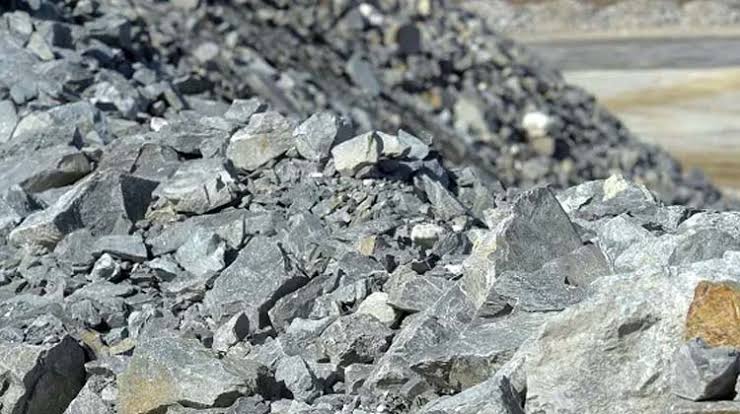
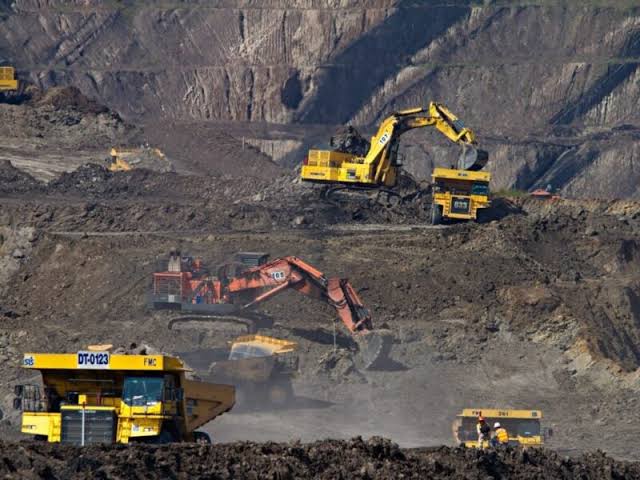
Nigeria’s Mining Policy Failures: A Sector Tilted Toward China, Strangling Small Miners and Fuelling Illicit Operations

By Biliyaminu Suraj

biliyasuraj247@yahoo.com


Introduction

Nigeria’s mineral wealth — highlighted by lithium, gold, tin, and rare earths — has the potential to diversify the economy beyond oil. Yet despite high-profile policy announcements and international investment pledges, the country’s mining sector remains mired in structural contradictions: rising foreign dominance, weak enforcement, and an increasingly hostile environment for domestic small-scale miners.

Under Minister Dele Alake’s tenure at the Ministry of Solid Minerals Development, policy reforms have been headline-grabbing and frequent, almost to the degree of weekly announcements. They are invariably framed as transformative but lack detail and wreak of a poor understanding of the mining industry. Critics argue the so-called policy reforms are reinforcing dependency on Chinese capital, penalising local miners through excessive regulation and fees and failing to stem a surge in illegal mining and attendant insecurity.

There are four critical fault-lines that define Nigeria’s current mining policy confusion.

1. Policy Failures Favouring Chinese Interests

Since 2023, the Nigerian government has aggressively courted Chinese investors in the mining and mineral-processing sector. During a recent visit to China, Minister Dele Alake announced that Chinese-backed companies have invested over US $1.3 billion in Nigeria’s lithium-processing industry since September 2023. According to Ministry-sourced reports, Nigeria was expected to commission four major Chinese-funded lithium-processing plants by 2025 representing a combined investment of about US $800 million.

While the investment figures are large in headline terms, the actual number of plants currently built and operating remains very limited. One facility in Nasarawa State has been commissioned — a Chinese-led plant processing lithium at “4,000 metric tonnes per day” capacity was inaugurated. Its likely capacity is closer to 3,000 tonnes per day if and when it reaches full production. At this point it is not in production.

But many of the other announced plants — such as the US$600 million facility near the Kaduna-Niger border and the US$200 million outside Abuja — are still described as “slated for commissioning this quarter” or “nearing completion”. To be clear, they are not yet in production and, if they are anything like the Chinese processing plants in Australia, may never come into economically viable production. Australia has been badly caught out by the promises of large-scale Chinese mineral processing facilities. Australian companies have invested billions of dollars in Chinese technology to process critical minerals only to now find that their investments may have to be written off.

In effect, Nigeria’s mineral governance model risks sliding into what analysts describe as neo-extractivism: the state aligning with foreign capital to extract rents, without building sustainable domestic capacity or transparent oversight. Meanwhile, local and small-scale operators continue to face bureaucratic hurdles. “We have seen preferential treatment for Chinese firms, while local miners struggle to get licences or financing,” said a member of the Miners Association of Nigeria.

2. Licence Revocations and the Expansion of Illegal Mining

The Alake-led ministry’s campaign to “sanitise” the sector through aggressive licence revocations has generated uncertainty. Hundreds of exploration and small-scale mining titles have been revoked on technicalities or administrative delays, often without due consultation. While the government insists this will curb speculative holding and non-compliance, the result has been the opposite: a vacuum in tenure security that has encouraged illegal mining and worsened insecurity in mineral-rich regions.


Displaced operators and unemployed artisanal miners are migrating into informal mining camps, some of which are now dominated by Chinese buyers and middlemen.

3. Inflated Chinese Lithium Investments and the Mirage of Local Value Addition

Nigeria’s lithium boom should be a strategic opportunity to enter the global electric-vehicle supply chain. However, the scale and structure of the Chinese-backed investments invite scrutiny.

The announced figures — US$800 million for four processing plants, plus the broader corporate claim of over US$1.3 billion invested by Chinese firms — are large. Yet comparators suggest that many of these plants are not yet fully built or operational. The publicly-known, functioning facility is the one in Nasarawa, and even that raises questions about transparency of terms, local-content obligations and community benefit.

Analysts at the Natural Resource Governance Institute (NRGI) warn that the Nigerian government has not published the contracts, environmental-impact assessments or local-content rules tied to these deals. Without such transparency, inflated valuations may conceal excessive profit repatriation or tax waivers favouring the investors.

The contradiction is stark: while the government revokes hundreds of local mining licences in the name of efficiency, it signs opaque, billion-dollar deals with foreign conglomerates that may offer minimal technology transfer or local capacity-building.

Nigeria risks falling into a pattern familiar across resource-rich African economies — outsourcing its industrial future to external partners while celebrating “investment” headlines that disguise long-term dependency. Worse still, history across Africa and Asian countries tells us that massive scale Chinese infrastructure development comes with massive repayment obligations which, when defaulted, see national assets under Chinese ownership.

4. Small-Scale Miners Punished by Escalating Tenement Fees

In mid-2024, the Ministry announced a sweeping revision of mining-licence fees and annual service charges hitting small and indigenous miners hardest. For example, the annual service fee for a Small-Scale Mining Licence (SSML) jumped to ₦260,000, while renewal fees rose to ₦420,000.

For artisanal and small-scale miners – who produce over 70 percent of Nigeria’s solid minerals – the impact has been devastating. Many operate on thin margins and lack access to formal finance. “These new rates are impossible for us,” said a gold miner from Niger State. “They want to push us out so the big companies can take over.”

Industry lawyers have also criticised the abrupt fee escalation, warning it could drive legitimate operators underground and worsen illegal mining. By making formalisation unaffordable, the policy undermines its own objective of bringing artisanal and small-scale miners into the regulated economy.

Meanwhile, Chinese-backed operations appear largely unaffected, as their capital base allows them to absorb or negotiate favourable terms. The asymmetry reinforces perceptions that Nigeria’s mining reforms are designed to privilege Chinese state-owned investors at the expense of Nigeria’s domestic enterprise.

Conclusion: Reform or Regression?

Nigeria stands at a crossroads. Mining reforms under Minister Alake have been long on rhetoric and short on delivery. The government’s mining policies, though couched in the rhetoric of reform and industrialisation, risk deepening structural inequities. The tilt toward Chinese capital — with announced investment amounts well into the billions but very few operational processing plants so far — is a key concern. Coupled with opaque licensing decisions and punitive costs for small miners, the reforms collectively undermine the stated goal of building a resilient, inclusive mining economy.

For Nigeria to truly benefit from its mineral wealth, three principles are essential: transparency, local empowerment, and institutional capacity. Contracts with foreign investors must be publicly disclosed; fee regimes must reflect economic realities, not bureaucratic revenue targets; and the state must strengthen regulatory oversight to curb illegal mining rather than punish small-scale operators. Without such shifts, the mining sector will remain a cautionary tale-–of a nation rich in minerals, yet poor in governance.

Nigeria, Listen!: Your Walls Have Cracked Wide Enough For Foreign Boots To Land

By Luka Binniyat

“America only cares about its personal interest… any country they invade is left worse.” That’s the new hymn of social media patriots and half-informed commentators who believe repeating clichés equals wisdom and hindsight.

“Look at Libya, Syria, Afghanistan and Iran and see how the U.S messed them up! … it’s all about Nigeria’s oil, Solid minerals and envy” they scream, beating their chests online as if hashtags could resurrect the thousands of dead killed by Islamists. Some, probably high on something, swear they’ll defend Nigeria from any “invading ‘imperialist’ force”, with what?

Nonsense!: Whoever has seen American Corporations dropping by parachutes anywhere and start drilling resources!

To me, these scare mongering and bravados are not just empty; they are insults. I take it as deep, stinging insults to the survivors of genocide I’ve covered since 2012. They reek of persons of privilege untouched and immuned of the pains the millions whose lives are being wasted in affected areas of the on going genocide in Nigeria.

Yes, there is Genocide against ethnic Chritians in Nigeria Middle Belt by Islamists! I am a witness to that evil.

So, come closer. Let’s leave Twitter. Let’s walk through what’s left of the parts of the Middle Belt, through the smoke, ruins and the silence where laughter once lived.

If your father and mother were slaughtered like rams before your eyes, killers screaming “Allahu Akbar,” your siblings cut down, your home torched, and your village erased, folks, what the heck do you care about sovereignty? If you’ve ever buried the charred remains of toddlers and grandmothers whose only crime was to be Christian, to be native, to be alive, then maybe, just maybe, the sound of an American helicopter hovering over to terrorists camps might not strike you as ‘imperialism’ but as overdue justice.

From Southern Kaduna to Plateau, from Benue to Niger, from Southern Kebbi to Kwara, and down to Southern Borno — I have covered stories of blood and betrayal. These are areas I can speak for having been on ground there.

I’ve walked through bubbling communities that exist now only on old maps. I’ve interviewed mothers clutching photos of daughters still missing after mass abductions. My team was in Chibok. We heard it all!

What of cases where entire communities were flattened, their ruins claimed by the bush and their ancestral lands now owned and occupied by the terrorists. If it’s in the Middle Belt, Nigeria Press called it “Banditry.” But, to God be the Glory: The world calls it by its real name today: Ethnic cleansing; Christian genocide! – selective elimination of a people as a result of their faith, race, ideology et al.

And what of the survivors? Visit the Internally Displaced Persons (IDP) camps — those unending rows of misery in the Middle Belt. There you’ll meet children who were six when the first attacks came in 2010. They are 26 now, still uneducated, still in tents, still watching politicians fly over their heads to campaign rallies. Their memories are sharp as blades: the night raids, the gunfire, the screams, the running barefoot into the dark. They have become adults in a country that forgot them.

You think they care about sovereignty?

Now imagine the final insult: the Nigerian government spending billions of naira to “rehabilitate” the same terrorists who wiped out their families. Men who emerged from forests, tired of killing, are cleaned up, dressed up, and declared “repentant.” They are given homes, trained, and paid monthly stipends — all while their victims rot in forgotten camps. I saw it myself in Maiduguri, May 2023, with my colleague Mike Odeh. Government officials smiled for the cameras as “former” Boko Haram fighters were reintegrated into society – sometimes to the same communities they once burned. Some of these “repentant” men now live with the Christian girls they kidnapped, raped, converted by force, and impregnated and raise a family with in government provided homes in Maiduguri. The parents of the girls, scattered to the four directions of the winds, can do nothing. The story is even more heartbreaking than this. Can there be a greater mockery of justice?

Even our gallant troops — the true patriots — feel betrayed. Many of them fought in the forests and mountains, losing comrades in battles against the same terrorists now embraced by the state. Soldiers have whispered to me in bitterness and disbelief: “We watched our friends die fighting these killers. Now the government calls them good guys and pays them maybe as much as we earn.” Their morale bleeds. The army’s honour is humiliated by a system that rewards terror and punishes sacrifice. The have an annoying phrase for it – Non Kinetic! Imagine facing gunfire in Zamfara or Borno, only to see your enemy pardoned, housed, and celebrated at a “peace talk.” Some of these killers even flaunt their weapons at government-sponsored parley events, strutting before police, DSS, and politicians who dare not raise a finger. What message does that send to the soldiers risking everything on the frontlines? What do the civilians that the most vulnerable think of their country. They are not thinking of it as sovereign. It’s captured! and by rag-tag illiterate Islamists fighters, not the U.S Army!

So tell me — if you were a survivor, a displaced farmer, a widow, or even a disillusioned soldier — how would you receive the news of America declaring Nigeria a “Country of Particular Concern” and hinting at intervention? Would you beat your chest in defence of sovereignty? Or would you whisper a prayer that someone, anyone, might finally bring order, justice, and peace to this bleeding land?

Because here’s the truth: Nigeria has failed millions of its citizens. The state has become a spectator to its own disintegration. When governors in the North West hold peace talks where mass murderers attend fully armed with the approval of Office of the National Security Adviser; when killers and génocidiars become celebrities of “repentance” and “rehabilitation” — sovereignty becomes a cruel joke in the psyche of all men and women of conscience.

Those shouting “no foreign boots on our soil” should first visit the ashes of Gwoza, mass graves in Bokkos, the tragedy of Guma, the mass waste of human and material in Wasagu/Danko, the cruel living conditions of our IDPs Cameroon; in the FCT.

Let them stand among these ruins, conjure the wailing souls of the innocent and ask themselves: whose soil is left to protect?

What is sovereignty worth when it shelters genocide and rewards impunity?

Make no mistake: when I say survivors will welcome the Yankees, it’s not a cry for colonisation. It’s a cry for help. It’s the plea of people abandoned by their own nation. For them, the U.S. flag on terrorists sites would not symbolize imperialism — not exploitation, but the faint hope of justice.

Nigeria must wake up!.

It must choose to defend its citizens, not their killers. If it doesn’t, the cracks in our national wall; in our hearts, will widen until foreign powers walk right through them — not with necessary with armour tanks, but with moral authority that traumatized citizens approve.

As someone who has walked through the smoke, heard the wails, and seen the graves, I can tell you this without hesitation: the survivors — millions of them — and millions more who stand in solidarity, will not cry over lost sovereignty. They will whisper, “At last, someone came.”

And when that happens, don’t be surprised if they stand at the roadside, waving at the incoming foreign troops — not as conquerors, but as deliverers — and say with quiet relief, “Welcome, Yankees