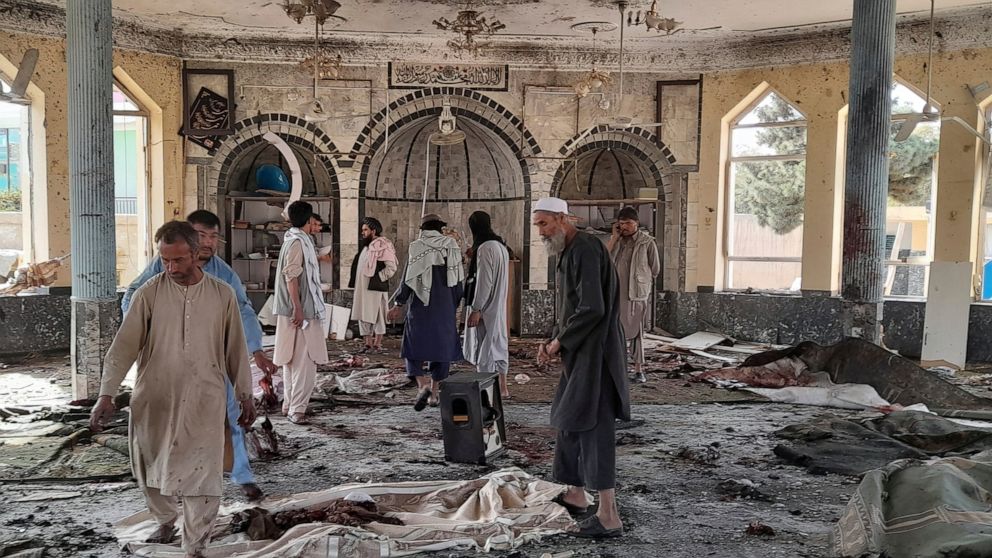
No fewer than 20 people were reportedly killed and 90 others injured in a mosque explosion during Friday prayers in Kunduz city, capital of Afghanistan’s northern Kunduz province.
Asuicide bomber was said to be responsible for the blast, CNN reports.
An official with Doctors Without Borders (MSF), Sara Chare noted that some of those killed and wounded were brought to the NGO’s facility in the city of Kunduz, and that the number of dead could be higher.
A Taliban spokesman, Zabihullah Mujahid on his Twitter handle said “security forces are at the scene, and investigation is underway,” noting that no group has yet claimed responsibility for the attack.
Mujahid also said “a number of our compatriots were martyred and injured.”
The explosion took place around 1pm at the Sayedabad Street.
The bombing attack on the Shiite mosque inflicted serious injuries on many people.
A Kunduz resident named Hafizullah who lives near the mosque described the incident as a total disaster stating that, “All the windows of houses close to the mosque have been shattered and I see pieces of flesh on the street.”
Wall Street Journal reports that while there was no immediate claim of responsibility, Islamic State’s regional affiliate has carried out a series of attacks targeting the country’s Shiite community in recent years.
The group, Islamic State-Khorasan Province, or ISKP has organised a series of attacks since the US withdrawal in August, targeting Taliban officials at a mosque in Kabul last Sunday.
The Taliban and ISKP both seek to implement strict Islamic rules in Afghanistan; the two groups have profound religious and political differences.
Though the Taliban had previously persecuted Shiites when they ruled the country in the 1990s, their current government includes a member of the Hazara Shiite community as a deputy minister.
Islamic State, by contrast, views all Shiite Muslims as heretics who should be exterminated.
At least eleven persons have been reported killed after deadly armed bandits launched an attack on Yasore community in Batsari local government area of Katsina state, North West Nigeria.
The attack was made known by Activist Yusuf Anka who has been consistently reporting the activities of bandits in the North-West region of Nigeria.
According to a tweet put forward on his twitter handle, Anka reported that the bandits also injured ten villagers during the deadly attack. He further said that houses were destroyed by the bandits.
Again Armed Bandits have killed 11 people in Yasore Community of Batsari in Katsina, injurying 10, burning down houses. The speed and which the terror is taking lives is unprecedented, the governments must act with sincerity and commitment to save our people. pic.twitter.com/iRd4n2PHGU
This attack is coming barely 24 hours after bandits killed 18 people in Kuryan Madaro communit in Kaura local government area of neighboring Zamfara state.
Katsina the home state of President Muhammadu Buhari has been under repeated armed bandits attack with almost a dozen local government area alleged to be under the control of the bandits despite ongoing military operations in the region.
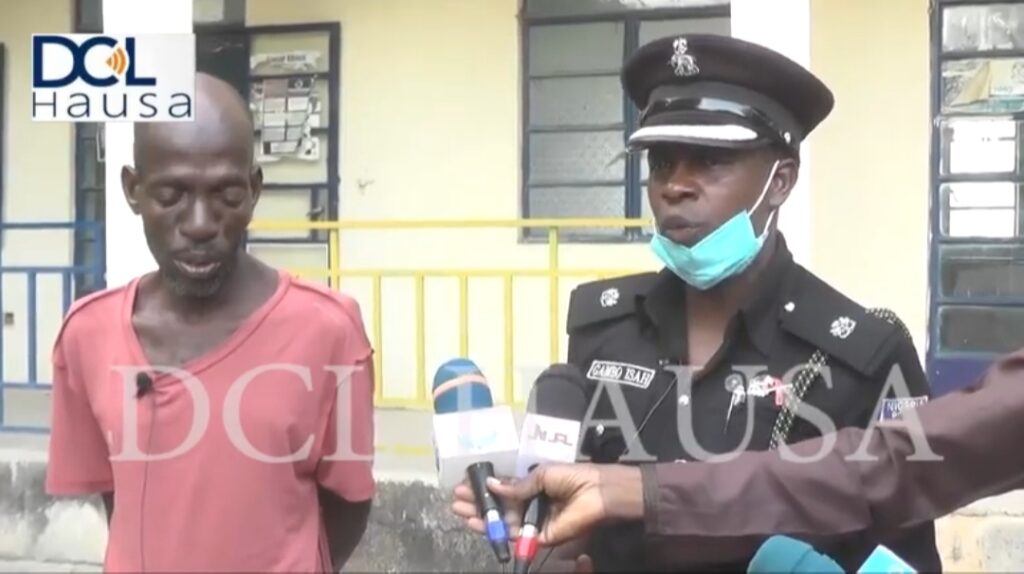
Ado Namarai and the Katsina state police PRO, Gambo Isah during the the fresh Interrogation in Katsina
A new twist has emerged in the interrogation of Ado Namarai, an arrested bandit from Katsina state who was part of a deadly bandits gang operating in Kaduna state, North-West Nigeria.
Middle Belt Times on Saturday exclusively reported that the bandit during interrogation indicted the Kaduna state Governor for “knowing about the place” where the bandits operate in a village called Sabon Filli in Giwa local government area of Kaduna state.
In a new video obtained by MBT, the bandit was seen speaking during a fresh Interrogation organized by the Katsina state police command where he was asked to clarify on his comment indicting El-rufai during his previous interrogation. The bandit speaking in Hausa language then said he didn’t mean that the governor was supporting the bandits activities.
The reason why I said El-rufai knows about the place is because last year, over a year and some months ago, I did 28 of the Ramadan fasting there in Sabon Filli before I came back here to Katsina and did the 29th and since then God hasn’t given me the grace to return there.
Certainly the reason why I said El-rufai knows where the bandits are is because, if El-rufai wants to work sincerely because of God like the Katsina state Governor is doing, he would have done so.
An airplane came to Sabon Filli and was releasing bombs, there were 4 Hilux vehicles on the ground, I was in my farm working that day. The aeroplane was shot and it managed to return back to the airport.
I hid in my farm and saw when one of the Hilux driver was shot, the others turned and left. This battle went on from 8am to 4pm. After the battle, the Hilux was burnt by the bandits. If you go there now you will see the burnt Hilux.
That is just what I meant by saying El-rufai knows about the place where the bandits are, because in his position as governor, he has the capacity to send in security to clear the place.
Am sure where he is seated now, in my own thinking, he is aware and sees everything that is happening
It would be recalled that Middle Belt Times on Saturday placed a call to the Katsina state police PRO, Gambo Isah to comment on the bandit’s indictment of El-rufai but he refused saying;
I cannot comment on the matter
As at the time of filing this report, MBT could not ascertain why a fresh interrogation was organized for the arrested bandit and under which circumstances he was brought to talk to the press.
Kaduna state has been ravaged by insecurity in the last decade with the situation becoming worse since the coming of the current APC administration in 2015. Several communities have been sacked by rampaging Fulani herdsmen and bandits while thousands have been killed along the line.
It would also be recalled that in 2016 the Kaduna state Governor during an interview session on Channels TV, confessed to offering the herdsmen carrying out killings of genocidal proportion in Southern Kaduna monetary compensation to stop the killings in the region, an action that further intensified the killings in the area.
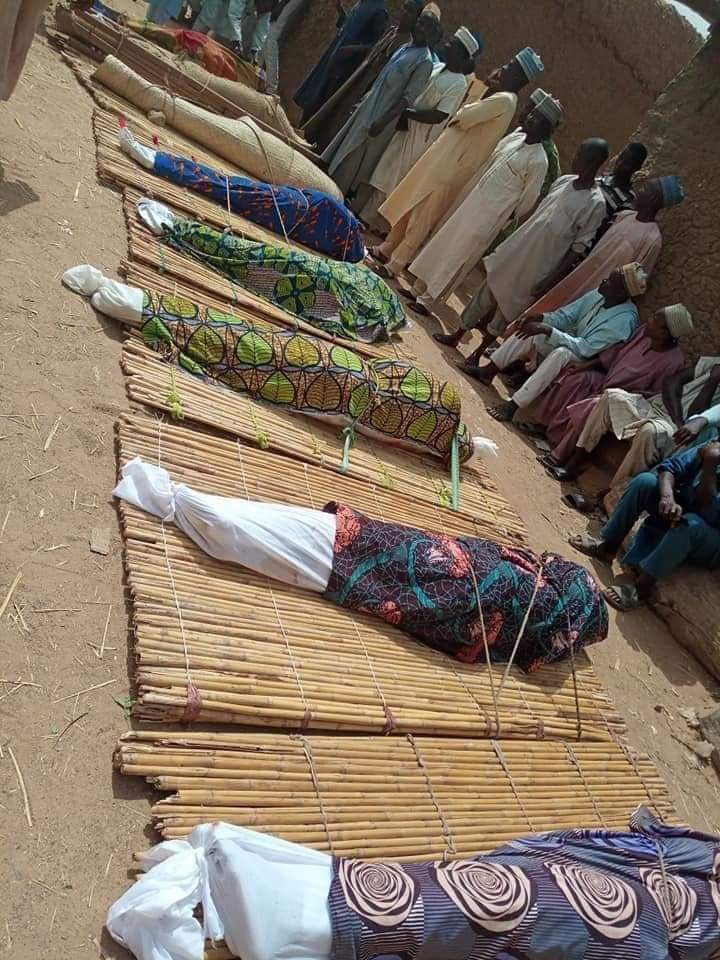
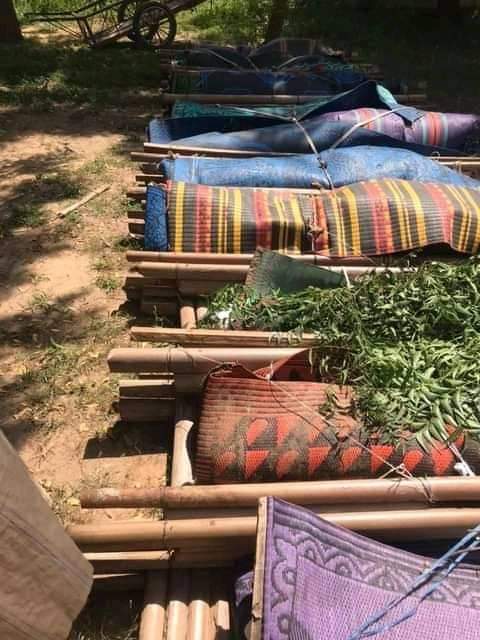
Last Thursday, 38 victims of Fulani terrorists attack in Madamai and Abun communities were laid to rest during a mass burial covered by MBT.
Bodies of the victims prepared for burial according to Islamic rites
No fewer than 18 people have been killed by daredevil armed bandits during a Tuesday night attack in Kuryan Masari community in Kaura local government of Zamfara state, North West Nigeria.
The bandits invaded the community in their usual manner and began shooting sporadically. 18 vehicles including a police patrol vehicle were also destroyed during the attack.
The attack was revealed by Zamfara Activist, Yusuf Anka who tweeted about the ugly incident on his twitter handle, @ankabiy.
18 people have been killed last night in Kuryan Madaro of Zamfara by armed bandits burning down homes, businesses and 18 Vehicles including a police patrol vehicle. The deaths and destructions are too many for the people.?
18 people have been killed last night in Kuryan Madaro of Zamfara by armed bandits burning down homes, businesses and 18 Vehicles including a police patrol vehicle. The deaths and destructions are too many for the people.😢 pic.twitter.com/fM1BVrSaZj
Yesterday’s attack is one of many attacks carried out by bandits in Zamfara since the Nigerian government announced the shutdown of telecommunication networks in the state, a decision many Nigerians including Anka have continued to question it’s sincerity of purpose in the ongoing military operations in the state.
A clash between terrorists belonging to the Ansaru group and bandits has reportedly claimed the lives of at least 30 bandits around the Damari axis of Birnin Gwari Local Government Area of Kaduna State.
Multiple sources confirmed to Daily Trust that the two criminal groups started a battle for supremacy last week.
The report came three weeks after terrorists fleeing military onslaught in Zamfara State took refuge in Saulawa and Damari villages of Birnin Gwari LGA, where they hoisted their flag.
Following telecommunication shutdown in some LGAs of Kaduna, including Birnin Gwari, a resident, Samaila Yakubu, who spoke with Daily Trust from Zaria, said the crisis between the two criminal groups followed an order by the terrorists.
He said the terrorists had restricted bandits from abduction and invasion of communities.
Yakubu said the bandits had resisted the law, which led to a wrangle that claimed the lives of four bandits and one member of Ansaru group last Tuesday.
He said a tit-for-tat attack had ensued between the two groups which climaxed with the killing of about 30 bandits last week.
Also corroborating the incident, Hassan Ibrahim from Giwa LGA, said the terrorists had warned bandits to desist from rampant abductions, adding that the warning had not been heeded by the bandits which led to the clash.
Ibrahim said, “The killings between the two groups are ongoing but abductions are on a decline. The focus of the terrorists is now on how to get fuel and money from travellers.
“Two days ago, they ambushed my nephew along the Birnin Gwari- Zaria road on a motorcycle and they emptied his fuel tank.
“They then collected his phone and money he had on him and set him free. I believe the new security measures are working,” he said.
When contacted, Kaduna State Police Public Relations Officer, ASP Mohammed Jalige, asked for time to clarify the situation from the DPO in charge of the area but hours later, he did not respond to calls to his phone.
There is panic in some rural communities of the Federal Capital Territory (FCT) following reports that fleeing bandits from the North are setting up camps in forests of the territory.
Daily Trust gathered from some locals that the bandits have set up camps around Zukpatu, Gadoro, Achimbi, Pesu, Duda, Pani, Gaube and New Gwombe communities in Kuje Area Area Council.
Most of the communities share boundaries with Nasarawa State.
Daily Trust reports that Kuje has over 400 communities not connected with any road network.
It was further gathered that the bandits are taking advantage of the rocky hinterlands to establish their bases.
According to some villagers, who spoke with our reporter, although the bandits have not started attacking them, they have been warning them against exposing their hideouts to security agents.
A resident of Gaube, who simply identified himself as Ibrahim, said the setting up of the camps by the bandits had caused panic, adding that residents, especially, farmers, now went to their farms in fear.
Ibrahim said, “Whenever the bandits come across locals in the farms or streams, they only caution us not to report to security agents their locations.”
He further said the bandits sometimes gave money to residents to buy them foodstuff and other items.
A rescued kidnap victim in Pegi axis of Kuje, who preferred anonymity, while lamenting his experience in the hands of the bandits, said they had set up camps at the bases of rocky hills.
He said, “Government needs to do something quickly before the situation gets out of hand because of what I saw. I wonder how these criminals were able to get to such places with arms.”
A resident of Gwombe who gave his name simply as Alhassan said bandits had taken over the forest around the community.
Alhassan said, “I think since they attacked and kidnapped some people in our village early this year, they don’t attack our people again, except that they send our people they come across on errands and warn them against telling security agents of their hideout.”
A traditional ruler in the FCT, who preferred anonymity, said the setting up of camps by bandits in some forests in rural communities posed serious threat to lives and property.
He recalled how bandits attacked commuters and villagers on the Gaube-Kuje road last year, which informed the setting up of a joint task force around the community.
He said, “But today, the task force has left the area and the kidnappers have returned, picking people around Gaube axis.”
The chief further said hunters and farmers usually came across the bandits but they were afraid of exposing them.
He, therefore, appealed to the federal government to take immediate action, while collaborating with traditional rulers in order to tackle insecurity in the territory.
The spokesperson of the FCT Police Command, DSP Adeh Josephine, asked our reporter to give her time to make enquiry about the development.
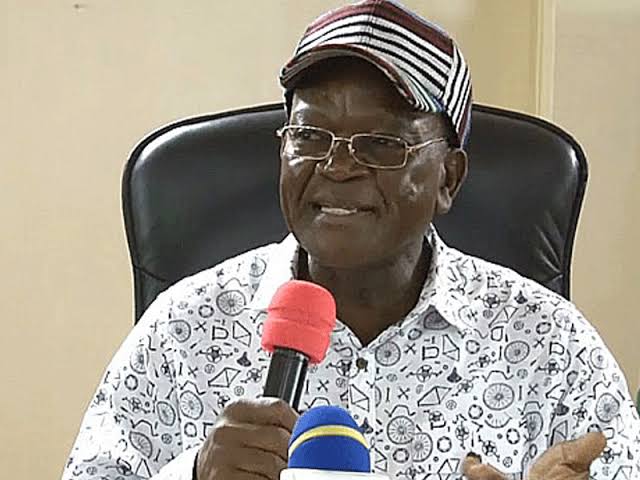
Governor Samuel Ortom of Benue state on Sunday, October 3, claimed that some persons are plotting to assassinate him.
Orton made this allegation at the Sesugh Maria Pilgrimage Center Ayati, Gwer East local government area of the state, AIT News reports.
The Benue governor also claimed that those who are behind this plot are planning to hire killers from Sudan to attack him.
However, Ortom said he has made up his mind to serve the people of the state even if he dies in the process.
He stated:
“No going back on this matter. It doesn’t matter; if I perish I perish. With all the threats against me. If I perish, I perish. I’m just like Shedrack, Mishack and Abednego.
“Last week I was told that people were hired from Sudan to come and eliminate me…”
“I remain committed to the service of my people. I’m committed because they elected me and I will do their bidding. No one will intimidate me. and make me stop until justice is given to our people in Benue state.”
President of the Southern Kaduna Peoples Union, SOKAPU, Comrade Jonathan Asake has given an eyewitness rundown of the activities of bandits and kidnappers in Kaduna State in 2021.
Asake described the security situation in the State as strange and pointed to the alleged insensitivity of leaders to the plight of most communities.
According to Jonathan, children in some communities have been out of schools for the past five years due to the atrocious activities of terrorists, while mainly communities have been chased out of their original communities by armed terrorists and most of these attacks and displacements go unreported in the media.
Comrade Asake spoke at the 2021 human rights lecture organised by the Human Rights Writers Association of Nigeria, HURIWA, with the theme: “Nigerian School Children; Insecurity and Human Rights”, held in Abuja.
“In line with the topic, our children, particularly school children, and what insecurity has caused in their rights,” he began.
“I’ll make no attempt to talk about last year or the year before or attempt to go out of Kaduna State.
“I’ll only say what is happening in Kaduna State and this year alone. And you will be able to put them up together.
“On the 30th of January this year, kidnappers went into a school just very close to Kaduna called Good Shepherd Seminary and kidnapped 4 seminarians there.
“One of them was killed because the kidnappers wanted to show that if ransom is not paid, they’re very serious, they’ll kill the rest. The dead body was kept on the roadside. Ransom was paid and the others were freed.
“On the 11th of March this same year, kidnappers went to the school of forestry where 39 students were kidnapped and on the 20th of April that the students of Greenfield University were kidnapped.
“On July 5, they went to a town called Danutshi and kidnapped 126 Bethel Baptist Students and it’s been over two months now. They’ve released many of them. They’re releasing them in batches. The first payment was N100m paid by the parents totally abandoned by the government.
“They have 11 of them two months after. Now if you think this picture is a very gorry one, this is just a tip of the iceberg. This is just the ones you’ve heard being reported of the atrocious activities of what we call bandits and kidnappers in Kaduna State.
“But on a daily basis, communities are being chased out and chased into neighbouring communities and for some it has lasted for over five years with all the children being out of schools.
“Most of these communities are being chased into IDPs camps, no schools, no facilities, no food and imagine children that have been out of school for five years running. And this is the story. Farmers have also been chased out.
“Farming communities have left their schools and schools have been shut down for a very long time in Kaduna State. We don’t get to hear this in the media. The ones we hear are when schoolchildren are kidnapped .
“And oftentimes these people are arrested, paraded and interrogated and that’s the end. Some of them the’re paraded and you see the video going viral in the media social media and after that you see the same person being paraded again. So something strange is happening.
“The rights of children are being violated. It Is insensitive on the part of some of our leaders where we know that people have been displaced and there is no facilities and nothing is done.
“Journalists that have attempted to report the atrocities that have been going on have been arrested and thrown into detention. That’s why I said this is just a tip of the iceberg.”
Nigeria’s organised Islamic terrorism problem did not start in 2009. It’s a lot more insidious than you think.
David Hundeyin
In May 2021, a 96 year-old businessman died in Rome, Italy. In his lifetime, Ahmed Idris Nasreddin might have amassed a personal fortune of close to half a billion dollars, but the death of NASCO Group’s multimillionaire founder barely made the news. At first glance, the only extraordinary thing about his life story was that it embodied the African entrepreneurship dream.
Nasreddin was an Eritrean who moved to Jos in Nigeria’s Plateau State, and grew his father’s small manufacturing business into a $460 million conglomerate involved in everything from breakfast cereal and confectionery to pharmaceuticals, real estate and energy. After many years of growth and success, he eventually handed his sprawling business empire over to his son Attia Nasreddin, and retired at an old, satisfied age.
In an official statement released after Nasreddin’s death in March, Plateau State governor Simon Lalong said:
“NASCO has over the years remained a major employer of labour in Plateau and continues to contribute to the economic prosperity of the State and Nigeria at large through tax revenue and corporate social responsibility.”
Well that was the cover story, anyway.
In reality, as is so often the case in Nigeria, the gap between the facts and the information released to the public is so wide as to be scarcely believable. What on earth could this shrewd, respectable businessman who looked like he could not hurt a fly have done, to put him in the same article as a story about the world’s deadliest terrorist organisation? Why would the brand he built, which to many Nigerians evokes memories of a beloved childhood breakfast staple, appear in the same sentence as Boko Haram?
To answer these questions, our story begins on another continent in 1955, some 8 years before his father would move to Nigeria and establish NASCO Group.
A Scholar From Zamfara
The year is 1955, and a 33 year-old Islamic scholar from Gummi in modern day Zamfara State has made his way to Mecca for his first Hajj pilgrimage. Alongside him is a certain Ahmadu Bello, who is the Premier of Northern Nigeria. During this trip, the scholar impresses both Ahmadu Bello and the Saudi King Sa’ud with his Arabic translation skills. He rapidly makes a big impression on many locals and clerics in Mecca.
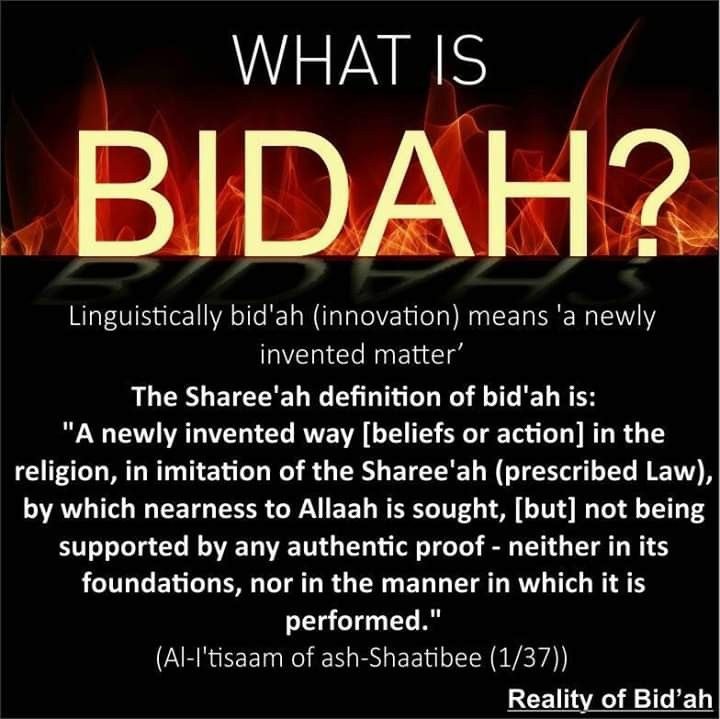
These relationships will later become his most valuable asset following the events that take place after his subsequent return to Nigeria. Upon returning to Nigeria, he takes up positions teaching Arabic Studies at Islamic schools in Kano and Kaduna. His style of teaching focuses on educating his students about the differences between Islamic religious doctrine and local customs. Based on his strict Sunni understanding of the Qur’an, he teaches his students to adopt a ‘pure’ Islamic identity at the expense of practises that he considered bid’ah (roughly translated as ‘innovation’ or ‘corruption’).
What is a bidah? | Hadith quotes, Islamic teachings, Islamic messages
He also becomes the first Islamic scholar to translate the Qur’an from Arabic into Hausa, which puts him in a uniquely influential position comparable to that of Ajayi Crowther in 19th century southwestern Nigeria. Using this leverage, he becomes an increasingly powerful figure in Northern Nigeria, with his essentialist views on Islamic doctrine gaining popularity. To him, the existing Sufi orders of Northern Nigeria are polluted with bid’ah and unfit for purpose. He becomes well known for attacking the Tijaniya and Qadriyya brotherhoods during his appearances on Radio Kaduna, while advocating for a ‘return’ to ‘Islamic purity.’
Following the death of his friend and benefactor Ahmadu Bello, the scholar finds himself in a precarious situation. The new Nigerian federal government led by soldiers has a motive to crack down on anyone who is outspoken and influential. He may be a giant in Northern Nigeria, but he is a giant with feet of clay. His solution is to seek financial, doctrinal and political help from his friends in Mecca. The Saudis, as always, are ready to help.
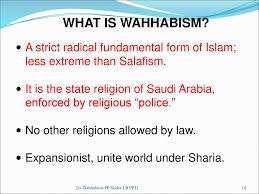
His Saudi backers are keen to use him to espouse the Saudi Arabian state’s official interpretation of Islam, which is based on the work of 18th century Islamic scholar Muhammad ibn ‘Abd al-Wahhab. This fundamentalist doctrine, often known as Wahabbism fits very closely with the teachings of our hero in Northern Nigeria, and he enthusiastically sets about gathering support for this new Saudi-funded project. In the 2009 book ‘The Wahhabi Mission and Saudi Arabia,’ historian David Commins says:
“The [Saudi-funded Muslim World] League also sent missionaries to West Africa, where it funded schools, distributed religious literature and gave scholarships to attend Saudi religious universities. These efforts bore fruit in Nigeria’s Muslim northern region with the creation of a movement (the Izala Society) dedicated to wiping out ritual innovations. Essential texts for members of the Izala Society are Muhammad ibn Abd al-Wahhab’s treatise of God’s unity and commentaries by his grandsons.
Reaching out to his erstwhile students across Kaduna and Kano over the course of the 1970s, the scholar-turned-politician slowly builds a coalition of strategically-aligned individuals who will someday become very powerful people in Northern Nigeria. In 1978, one of his prominent students, Sheikh Ismaila Idris takes charge of this increasingly powerful but somewhat unofficial movement, and calls it Jama’atu Izalatil Bid’ah Wa Iqamatus Sunnah (Society of Removal of Innovation and Re-establishment of the Sunnah), also known as JIBWIS.
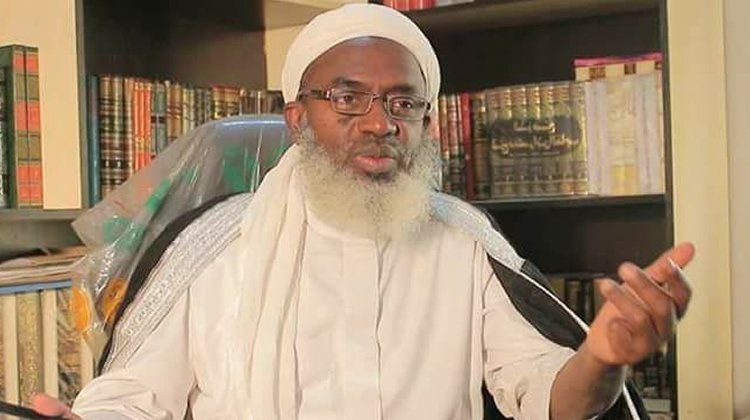
Sheikh Ahmad Gumi
Based in Jos and known colloquially as the Izala Movement, this organisation will go on to become the most influential Islamic body in Nigeria over the next few decades. Its members will become some of Nigeria’s most revered Imams and clerics. They will achieve high ranks in the Nigerian Armed Forces.
Banditry: Taliban victory warning for those considering military onslaught -Gumi – Punch Newspapers
They will sit on the Federal Executive Council.
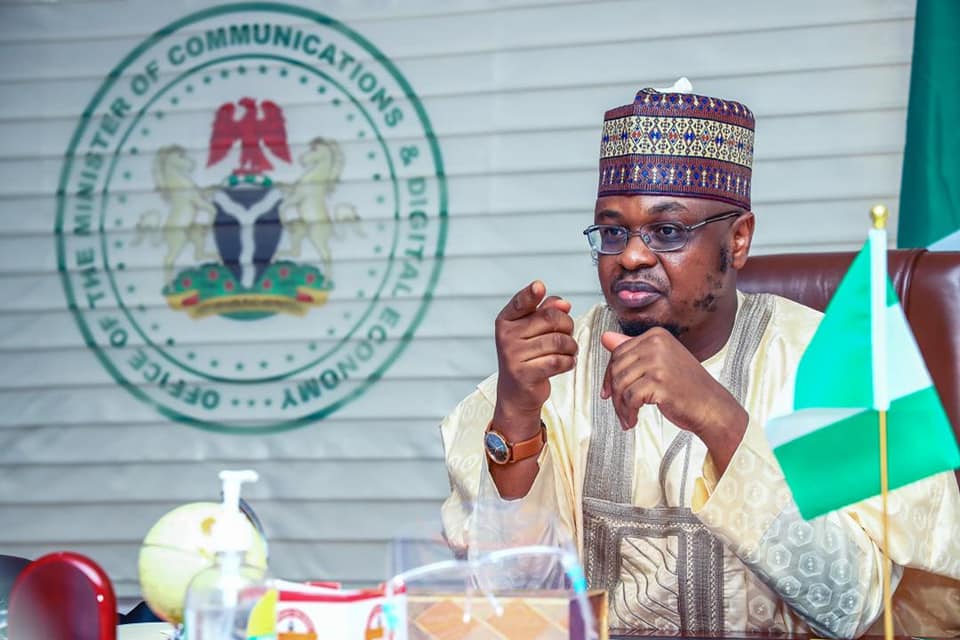
Isa Pantami
JIBWIS will come to exert a level of influence over Nigeria’s national politics and governance that is unprecedented for a religious body in Nigeria. Soon, it will become almost impossible to achieve power in many parts of Northern Nigeria without identifying with the Izala Movement.
Among other things, the scholar states that Muslims should never accept a non-Muslim as ruler, which can be interpreted as a call for insurrection against a Christian Nigerian president. He is never held to account for this statement. In any case, he no longer believes that writing books or teaching people about Islam will on their own, lead to an Islamic renaissance in Northern Nigeria. Now he is all about partnership and politicking. He maintains his membership in Northern Nigeria’s legacy Islamic group, Jama’atu Nasril Islam (“Group for the Victory of Islam”), but he is unmistakably the beating heart of the new Izala Movement. To all intents and purposes, this is the birth of modern Salafist Islam in Nigeria.
Without firing a shot or winning an election, this Islamic scholar has become one of the most powerful men in Northern Nigeria
His name?
Abubakar Mahmud Gumi
The Clerics, The Saudis and What Happened in Algeria
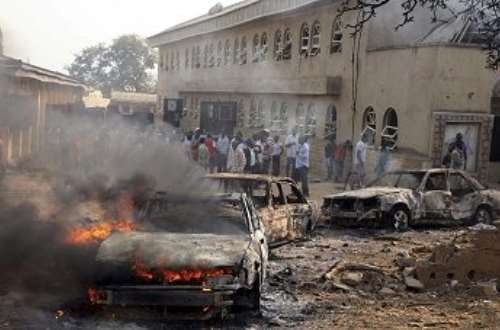
Fast forward 33 years. It is Christmas Day in 2011 and Abubakar Gumi has been dead for over 19 years. A bomb suddenly goes off at St. Theresa Catholic Church, Madalla, on the outskirts of Abuja, killing 35 people and wounding a further 52. Almost simultaneously, a series of coordinated bomb attacks and shootings take place at churches in Jos, Gadaka and Damaturu. An obscure Islamist group calling itself Boko Haram claims responsibility for the attacks.
During the trial of the main suspect Kabiru Umar A.K.A Kabiru Sokoto 2 years later, a masked witness claims that an Algerian Islamist group provided funding and support worth N40,000,000 ($250,000 at the time) to carry out the attacks. To the general public, it is unclear what the link is between Islamists in Northern Nigeria and well-funded terror groups in North Africa.
St. Theresa Catholic Church Madalla
To those in the know however, the incidents of December 25, 2011 are not only expected, but are likely to intensify and become more regular. This is because while the Nigerian public up to this point has been fed with what amounts to a tiny percentage of the actual story behind the Boko Haram group, this group has in fact been incubating and nurtured at the highest levels of the theological, economic and political spaces in Northern Nigeria. Boko Haram in reality, is so much bigger than Mohammed Yusuf and Abubakar Shekau that reducing it to those 2 men serves to miss the actual story spectacularly.
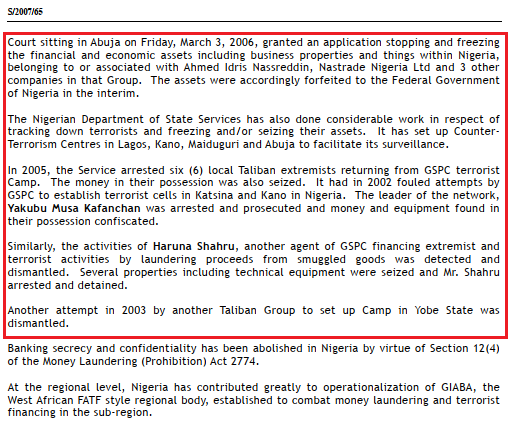
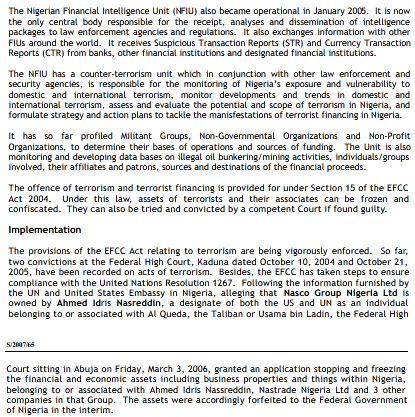
To start to get some of the picture of what Boko Haram is and where it came from, let us retreat from 2011 to 2006 to read an excerpt from a letter written by the Permanent Representative of Nigeria to the United Nations, Aminu B. Wali, addressed to the Chairman of the Counter-Terrorism Committee. This letter is available in full here from the official repository for UN documents. Written by the Nigerian government to the UN, it lays out the measures it has taken to fight terrorism in Nigeria. Take special note of the names mentioned in bold.
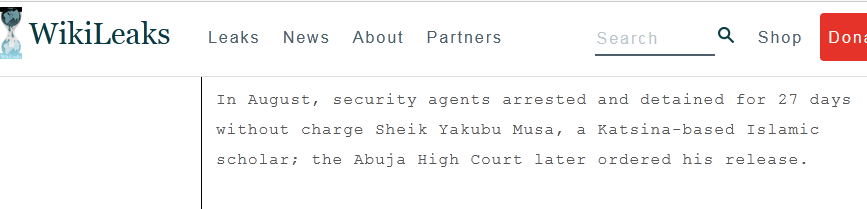
A Wikileaks cable from 2002 confirms that this arrest actually did take place, only for the suspect to be released inexplicably after 27 days in detention.
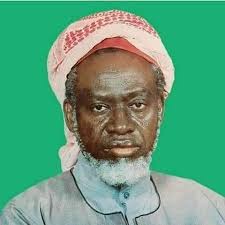
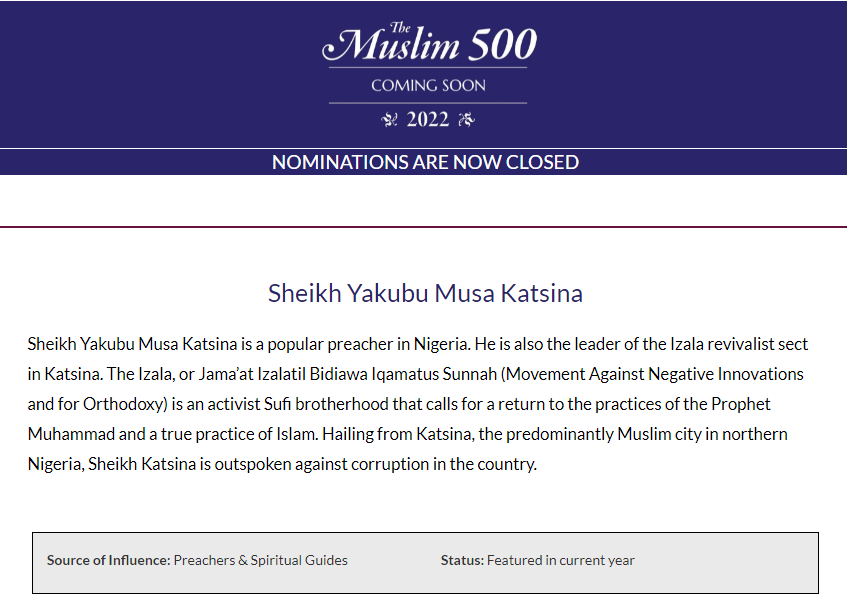
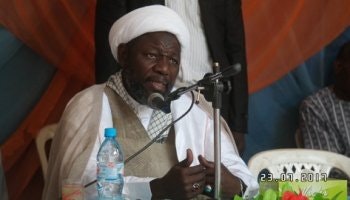
For those who are not aware, Yakubu Musa Kafanchan, also known as Sheikh Yakubu Musa Katsina and Yakubu Musa Hassan is a founding member of the Izala Movement (JIBWIS), and is in fact, the current Chairman of its board of trustees and the Chairman of the Katsina State JIBWIS chapter. He is a widely respected Islamic cleric and a very close personal friend and public associate of – no prizes for guessing – Isa Ali Pantami. Yes, that Isa Pantami.
Official Visit to Elder Statesman, Sheikh Yakubu Musa Hassan Katsina, shortly before proceeding for the formal launch of the National Emergency Toll-Free Number (112) and the Commissioning of the Katsina State Emergency Communications Center.@DrIsaPantami#FMoCtoday#FMoC19pic.twitter.com/g4i336XUie
— Fed. Min. of Comms, Innovation & Digital Economy (@FMCIDENigeria) September 23, 2019
Mr. Kafanchan was even recently named as one of the 500 Most Influential Muslims in the World by The Royal Islamic Strategic Studies Centre, a Jordanian government-affiliated NGO. More on that later.
Apparently Mr. Kafanchan has been known to the Nigerian security forces as the leader of a terror network trying to set up terror cells in Katsina and Kano as far back as 2002. Keep that date in mind because it will become even more important as we unravel this further. According to official Nigerian government communication to the UN, this real-life Islamic terror organiser is known to have affiliations with a certain ‘GSPC’ group trying to carry out terror attacks in Nigeria, and he was even arrested for it in 2005 – 4 whole years before the world ever heard of a “Boko Haram.”
Sheikh Yakubu Musa Kafanchan
Yet in 2021 he is not only a free man, but a powerful free man, with access to federal ministers, state governors and President Muhammadu Buhari himself.
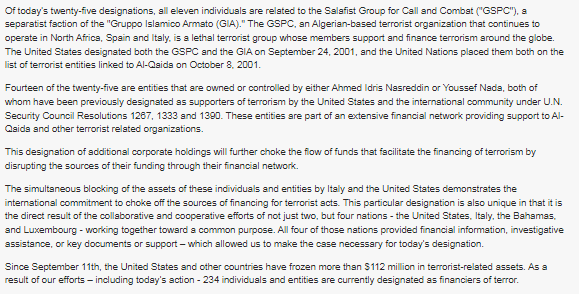
And then there is the GSPC angle. ‘GSPC’ stands for “Groupe Salafiste pour la Prédication et le Combat” (Salafist Group for Preaching and Combat). A full primer on the origin of the group and what it stands for is available here. Cliff notes summary: It is an illegal Salafi terrorist organisation based in Algeria which is affiliated with Al-Qaeda and the Taliban. It specialises in providing training, funding and support to Islamists and jihadi fighters around the world using a vast global network of smugglers, money launderers and rat lines.
Which brings us to the second name in the above letter excerpt. Alhaji Shahru Haruna, in the Nigerian government’s own words, is a GSPC agent who funds the activities of people like Kabiru Sokoto by laundering proceeds from smuggled goods. He too, was arrested and held on terror financing charges. Somehow he too, is not only a free man today, but a powerful one in his own right too.
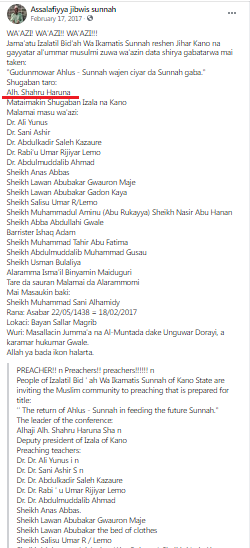
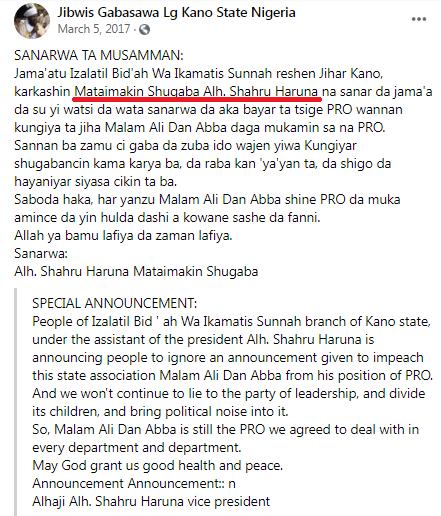
It will not surprise the reader to find out that Alhaji Haruna is also a ranking member of the Izala Movement. According to these posts I dug up from Facebook accounts linked to the Kano State Izala Movement chapter, Alhaji Haruna is the Deputy President of the Kano State chapter of JIBWIS. Like Yakubu Kafanchan, this indicted terror funder not only retains his position in Nigeria’s most influential Muslim body, but is also a respected Islamic preacher with access to the Who’s Who of Nigerian politics and governance.
Even more interestingly, when I do some digging into Mr. Haruna, I discover something potentially even more alarming. It will be recalled that in September 2021, CBN Governor Godwin Emefiele claimed that a significant portion of dollars bought by Bureau de Change (BDC) operators in Nigeria goes into illegal importation of arms. Speaking at the end of the monthly Monetary Policy Committee meeting, he said:
“Whether it’s Boko Haram, kidnapping and all sorts of nefarious activities, BDCs take our country’s dollar and sell to people to go and buy arms and ammunition to come and hurt us. That’s what people want us to continue to do. We cannot do that any longer. We can’t. If you have any legal, legitimate business you want to conduct, please take your business to a bank, they will sell you forex.”
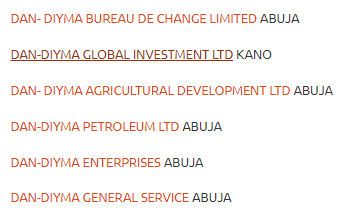
A search of Nigeria’s Corporate Affairs Commission database for the name “Shahru Haruna” turns up a plethora of companies registered under the “Dan Diyma” name.
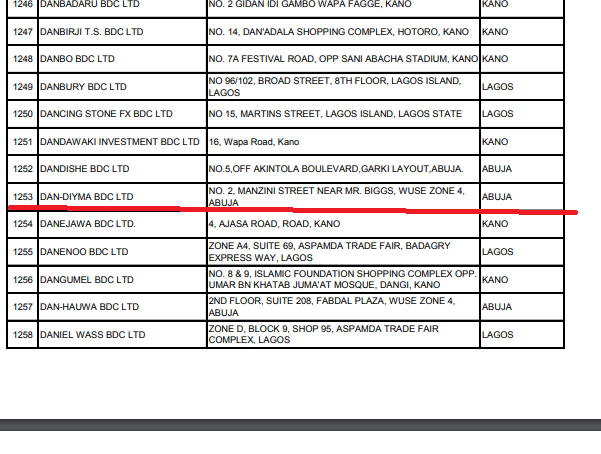
A man identified by the Nigerian government itself as a security threat for funding terror via money laundering was somehow allowed to own and operate a BDC, which according to the CBN governor, could well have been doing precisely that. A CBN circular from October 2020 confirms that at least as recently as last year, Haruna Shahru was allowed to run a BDC in Nigeria, potentially giving him access to the very funding infrastructure that he should not have under any circumstances.
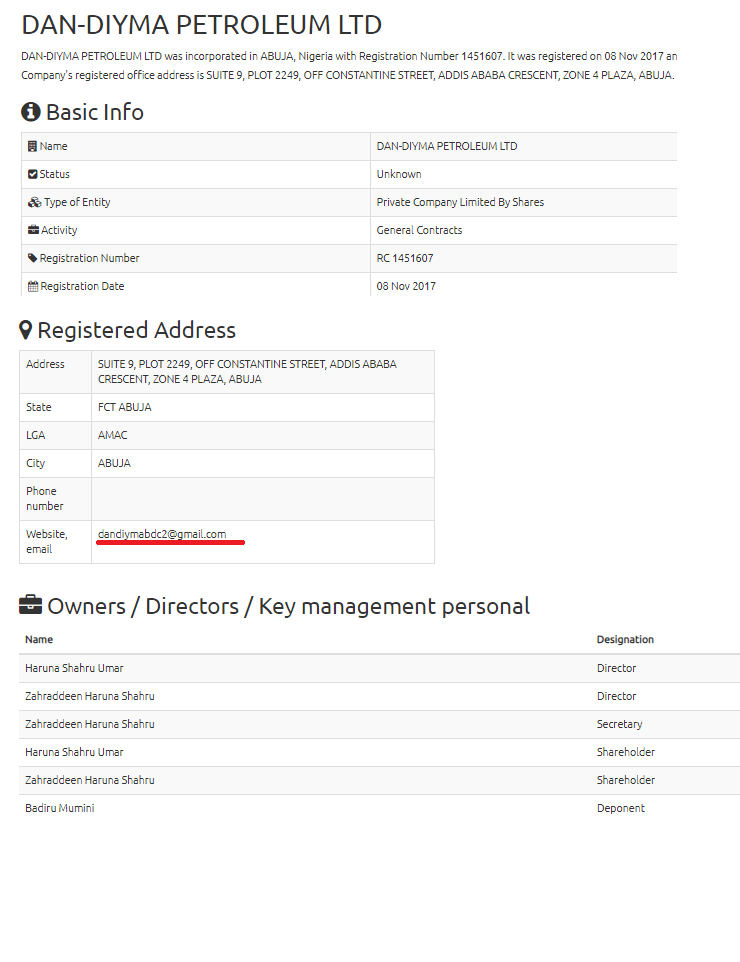
A glance at one of the other “Dan Diyma” business entities shows that even the email address used to register this entity – purportedly a petroleum company, albeit one with zero identifiable corporate footprint – belongs to Dan Diyma BDC, which says everything about how important the BDC is to Haruna Shahru. The question left unanswered is “Why?”
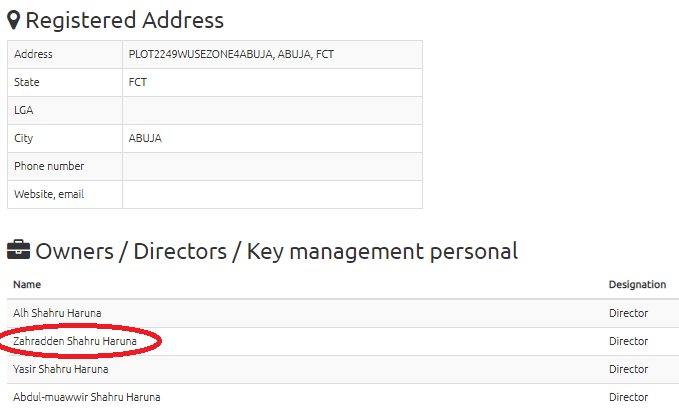
In case the reader is wondering if this picture can get any worse, the answer is yes. It can, and it will. Take note of the name circled in red below.
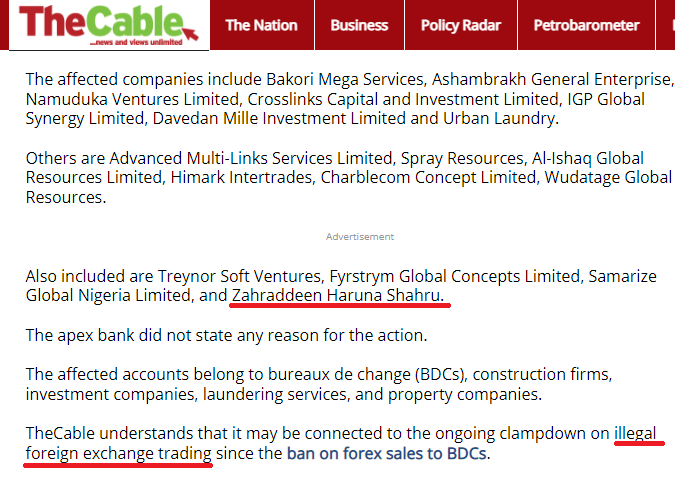
Zahraddeen Shahru Haruna is Shahru Haruna’s son, so it is no surprise for him to show up as a director on his father’s BDC registration documents. There’s just one problem. Remember Emefiele saying that BDCs facilitate terror financing? Well just a month before he made that comment, a circular was sent out to banks by the CBN with the names of 18 companies and individuals whose bank accounts were to be frozen with a PND (Post No Debit) mandate. Very unusually, no reason was given for the instruction, and also unusually, on a list made up of corporate accounts, there was an account belonging to an individual. His name?
From Eritrea With Love
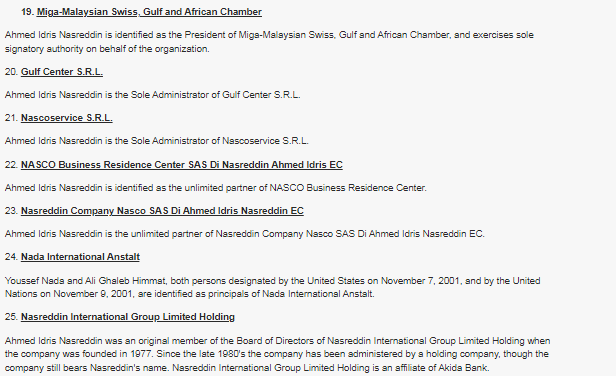
We now rejoin our Eritrean friend in the year 2006. The Nigerian Financial Intelligence Unit (NFIU) has recently been gazetted, and one of the first things its counter-terrorism unit does is to freeze all assets linked to NASCO Group Nigeria Limited. Apparently, Mr. Nasreddin has been doing some creative accounting to hide the fact that he is moving money around the world to fund Islamist terror organisations. Or at least, that was what the Nigerian government itself wrote to the UN in the same letter.
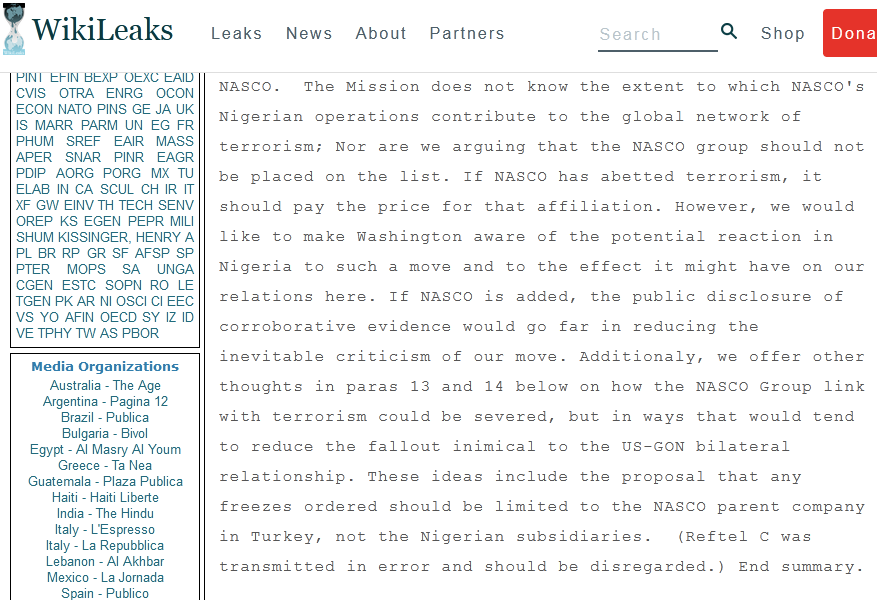
A Wikileaks cable from 2002 hints at American hesitancy on the subject of freezing NASCO’s Nigerian assets due to the economic implications for Plateau State and political implications in Nigeria.
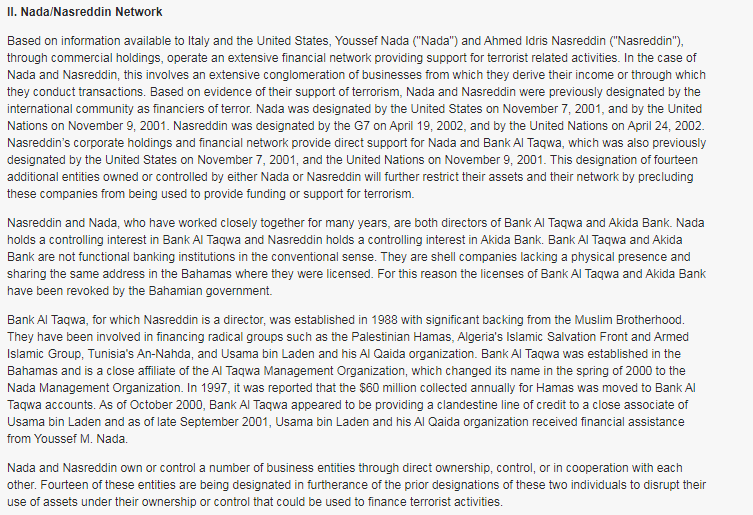
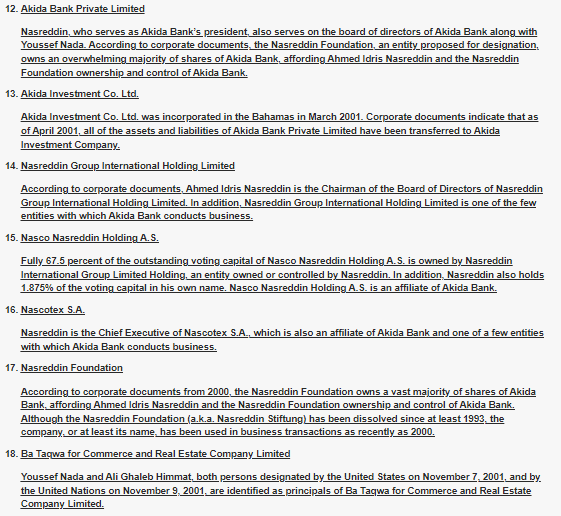
The real proof of Nasreddin’s double life however, comes from the US Treasury Department which publishes a comprehensive account of how he launders and moves money around the world for terrorist entities. Want to hear the real kicker? Nasreddin has been funding and laundering money for none other than GSPC – the Algerian terrorist group which Yakubu Katsina and Shahru Haruna are also involved with at the exact same time.
The Nigerian jihadis being trained in Algerian camps in 2002 will later return to Nigeria and make up the core of what will later become known as “Boko Haram.” And – what a coincidence – NASCO is also based in Jos, which so happens to be the headquarters of the Izala Movement and its many North African dalliances.
Using money made from selling market-leading FMCGs to Nigerian consumers, a cross-border network of terrorism is being nurtured that will someday kill the very kids eating NASCO cornflakes every morning.
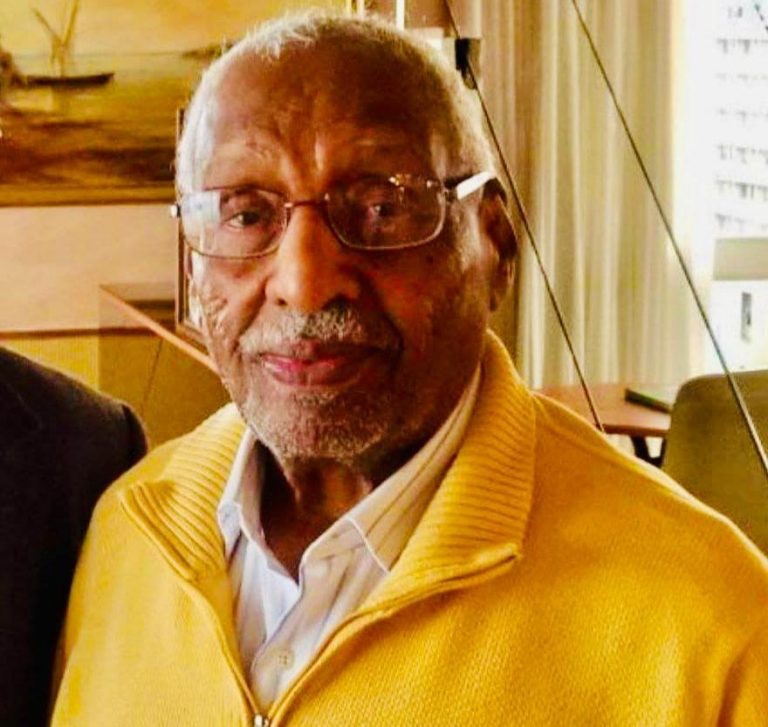
And it’s all thanks to this nice gentleman from Eritrea.
Ahmed Idris Nasreddin
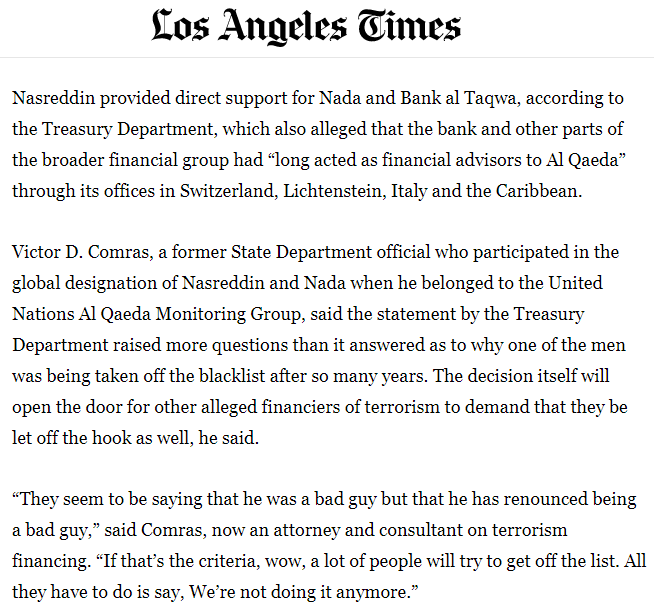
Nasreddin however, is a very rich man. Like all very rich men, he appears to have a way around problems that would ground other people. In 2005, Lisa Myers and Aram Roston of the NBC News Investigative Unit discover that despite his designation as a terror financier in the US, Nasreddin’s Nigerian business empire and his Italian hotel are still operating as normal. Quoted in the story, Victor Comras, a former terror-finance expert at the State Department says:
“This isn’t a loophole, this is failure to implement the sanctions appropriately. He’s been involved in terrorist financing. Let’s put him out of business.”
That would prove easier said than done because just 2 years later in 2007, the LA Times publishes a story indicating that – to all intents and purposes – Nasreddin has cut some kind of deal with the US government, likely involving asset forfeitures, to get his name off the list of terror financiers. He has been indicted for funding terror, some of which has found its way into the lives of the Nigerian consumers who have made him fabulously wealthy, but he is off the hook.
For the people who have died in the Madalla Christmas Day Bombings facilitated by the people he funded and supported, there will be no justice. Nasreddin gets to hand over NASCO to his son, and he lives out the rest of his life in peace and comfort, dying at the ripe old age of 92.
Friends and Alliances in High Places
I mentioned earlier, that the date of Yakubu Katsina’s initial attempt to establish terror cells and Taliban training camps in Kano and Katsina was important. Here is why. Remember Abubakar Gumi’s stated position that Muslims should never accept a non-Muslim as ruler? It just so happens that the concerted push for Sharia Law across 12 of Northern Nigeria’s states lines up perfectly with the election of Olusegun Obasanjo as president in 1999.
Examining the eras of Shehu Shagari, Muhammadu Buhari, Ibrahim Babangida, Sani Abacha and Abdulsalam Abubakar as consecutive Muslim Nigerian heads of state, it is nearly impossible to establish the existence of directed and coordinated push for Islamic law in that area. Following Obasanjo’s entry however, Zamfara, Kano, Sokoto, Katsina, Bauchi, Borno, Jigawa, Kebbi, Yobe, Kaduna, Niger and Gombe decided in quick succession to embrace a separate penal code from southern Nigeria, based on Sharia law.
Understanding the political resonance of the Izala Movement in Northern Nigeria and the power wielded by the indicted terror financiers and terrorists who still sit on its board is key to understanding 2 things about terrorism in Nigeria.
Boko Haram is a logical development growing out of the rise of political Islam in Nigeria, with its roots in Salafism, popularised by Abubakar Gumi and his ideological heirs. It is impossible to divorce Abubakar Gumi’s use of Saudi money and Wahhabi indoctrination in the 1970s, from the adoption of Sharia Law in Northern Nigeria, the rise of violent Salafists like Abubakar Shekau and Isa Pantami, and the eventual inevitable mass uprising against the Nigerian state that will take place in the north.
While the Boko Haram brand is an unattractive one, the goals of Boko Haram are by no means unattractive to those who make up the ideological core of the Izala Movement, which is Nigeria’s most influential Islamic sect. Aminu Daurawa who famously praised the September 11 attacks in a 2001 sermon with a quote claiming that “Allah is a suicide bomber,” is today the head of Kano’s Hisbah police and a high ranking Izala Movement member. With sympathisers and collaborators up to and including President Buhari himself, the Izala Sect has no incentive or reason to fundamentally rethink or change its ideology – which is directly and provably linked to Salafist terrorism.
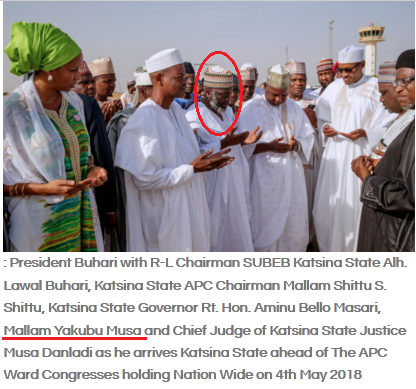
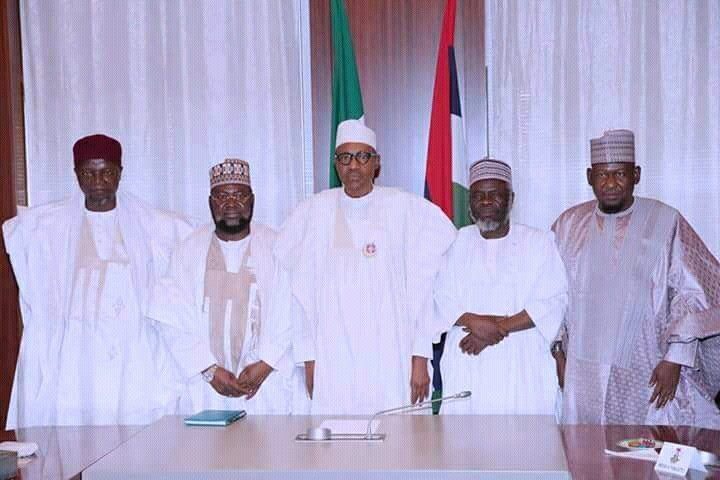
As long as Isa Pantami’s “Mr Zero Zero” (a reference to an ideologically pure Muslim with zero tolerance for bid’ah. i.e a hardline Salafist) retains his obvious and unapologetic sympathy for an organisation with clear and ongoing links to the enemy he claims to be fighting against as Nigeria’s president, the Izala Movement has no incentive to reinvent itself. There is no way that the Nigerian president is not aware of Yakubu Musa Hassan Katsina’s history as a known terrorist, as well as the Izala Movement’s extremely problematic history and current composition. And yet, as recently as 2018, President Buhari was pictured in Aso Rock meeting with Izala Movement president Abdullahi Bala Lau, Yakubu Musa Hassan Katsina, Kabiru Gombe and Ibrahim Jalo Jalingo.
It is either I have more access to information about his friends and associates than the Nigerian president does, with a plethora of intelligence and information gathering agencies at his disposal, or he knows all this already and he has chosen a side. Clearly, to the Izala Movement, this picture taken in 2018, was a statement. An Obasanjo government may have arrested Yakubu Katsina and his likes in 2005, but 13 years later, Katsina’s ideological ally is in office standing solidly next to him, as he stood solidly next to Isa Pantami. The Izala Movement has won and everybody else has lost.
The only other angle of high level involvement not yet addressed is that of the Jordanian government. Recall that Yakubu Katsina was named among the world’s 500 Most Influential Muslims by a Jordanian state-backed NGO? Well it turns out that the NGO in question – The Royal Islamic Strategic Studies Centre – is itself affiliated with the Royal Aal al-Bayt Institute for Islamic Thought. A visit to this institute’s website reveals something strange.
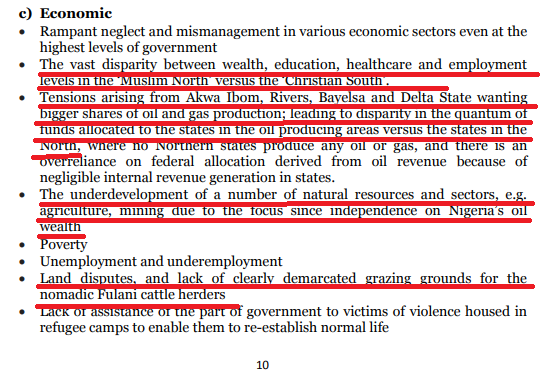
One of its publications titled ‘Report on the Inter-Religious Tensions and Crisis in Nigeria’ published in May 2012 has the following to say about ending violence between Muslims and Christians in Nigeria.
This report, produced by a state-funded NGO in Jordan as far back as 2012, is prima facie evidence of a coordinated international campaign of strategic disinformation for the purpose of framing the reality of terrorism in Nigeria in a way that is completely dishonest. Making reference to alleged income disparity between Nigeria’s “Christian South” and “Muslim North,” the report attempts to portray the latter as the victim of economic bullying and poverty, without citing data to support this conclusion.
Very tellingly, at a time when conversations about violence related to nomadic cattle herding were not yet present in Nigeria’s political equation, a Jordanian organisation with links to Yakubu Katsina – a known Nigerian terrorist – was already recommending “grazing routes” as a solution for a problem that for the most part, did not actually exist yet.