OPINION: Why Danjuma La’ah Shouldn’t Return to the Senate Again

By:
Habila Zabrang Kantyok

In 2015, the people of Southern Kaduna unanimously voted for Mr Danjuma Tellah La’ah, a former F.C.D.A official to represent her at the National Assembly, Senate to be precise. Expectations were high on the senator who as at then was the 5th to be elected by the region since the return of democracy in 1999.

La’ah got to the Senate but like the popular idiom which says that ‘a man cannot give what he does not possess’, this has been the fate of the Southern Kaduna people who had to ensure a Senator emerge but hasn’t been able to articulate their issues as they ought to be on the floor of the Senate. After his first tenure, La’ah again made history by breaking the one term jinx in the area, this was partly due to the fact that the people thought he could improve in his second term in the Senate.

Unfortunately, they were wrong as La’ah was to embark on a journey of failure and misrepresentation at a time Southern Kaduna needed a voice to speak, articulate, and propagate the issues affecting the region. La’ah went hibernating and was never to be seen contributing to discuss of national importance.

This is evident in the fact that in over seven (7) years on the floor of the Senate, Danjuma La’ah has only sponsored one failed Bill and that was in his first tenure. This is not only shocking but unacceptable considering the fact that even lawmakers from the most educationally backward parts of the country have sponsored successful legislations.

For the purpose of this article I would be highlighting little among Senator La’ah’s many political blunders and why he shouldn’t be reelected. I was born and raised up in the village by my grandparents in Zangon Kataf Local Government Council, so I know what it means to elevate the poor ones to prominence especially, those of us who have to undergo commercial farming to be paid in order to pay our school fees due to Poverty.

  1. Recently I stumbled upon the approved constituency projects allocated to Senator Danjuma La’ah’s Southern Kaduna for 2021 and on it I saw a project tagged “Installation of Solar Street Lights in Dogon Kurmi, Katugal and Kushe – Fada” all in Kagarko Local Government Council .In Kushe located in Kagarko, my maternal local government for instance, such can only be described as a white elephant project as such doesn’t exist, same also in Katugal. In Dogon Kurmi I confirmed that a few substandard sola Street lights were installed. 2021 is long gone yet Laah is yet to complete the purported projects.
  2. A while ago, the Small and Medium Enterprise Development Agency of Nigeria (SMEDAN) made disbursement of funds for development of small and medium scale businesses in Southern Kaduna, rumors have it that La’ah diverted the funds instead to buy cars and other inducements to party officials just to get reelected in 2023.

Southern Kaduna citizens were shortlisted for the Empowerment scheme by SMEDAN, certificates offered but were held by the senator just to make sure the diversion remains a secrete.

  1. Diabolical sacrifices in all parts of Southern Kaduna with the aim of winning election at all cost. Reliable information at my disposal reveals that in a desperate attempt to get reelected, Senator La’ah has also engaged the services of marabouts who have also embarked on humans and animals sacrifices across southern Kaduna.

4.Most of the contracts executed by Danjuma La’ah didn’t pass through the legal processes as the Senator used phony companies some of which belong to him and his cronies.

  1. Tribalism: Southern Kaduna has never had a sectional leader like Senator La’ah. Since he became senator, he made it a point of duty to ensure that all opportunities are allocated to his tribal men, family members and friends. This is a tribal project he had obviously promised the Atyap nation to execute at the detriment of other southern Kaduna tribes if back up by his kinsmen.

Since he became a senator, all his children, nephews and nieces have all gained juicy Federal government employments, some even switch from one jobs to the other on his bill while many qualified Southern Kaduna youths are roaming the street of Abuja jobless.

There was a story an aide to a former senator who served alongside Danjuma Laah between 2015 and 2019 told me. He said his Principal got some job slots and gave his friend Senator Laah 10 from it. After some days, Laah told him he only utilized 8 slots, the senator was dumbfounded and asked him in astonishment “you mean Southern Kaduna with the high number of educated young people, you couldn’t get 10 people to fill these slots?”. Later the senator realized that the 8 people Laah presented for the employment opportunities were all from his family and tribe, since then he started looking down on the Senator.

Just recently, a close friend of mine from the South who works with NIMASA told me how some job slots were given to senator Laah in the Nigeria Maritime Safety Administration NIMASA but instead of scouting for qualified youths from across Southern Kaduna, as usual Danjuma Laah distributed the slots to his friends including a former GMD of the NNPC who was insisting that his son who is yet to complete the mandatory one year NYSC duty be employed, this didn’t go down well with NIMASA as it is illegal and unconstitutional.

It is worthy of note that Senator Danjuma Laah was the Immediate Past Senate Committee Chairman on Federal Character, a position he assumed in 2019 untill recently that he was made a Principal Officer of the Senate. The Federal character commission under his oversight function has been reduced to a family and friend business as the woman heading the commission has turned herself into a mini – god. Even the few people senator Laah engineered their employment at the Commission have had to resign due to persecution by the Head. These irregularities have repeatedly been reported to Laah yet he was not been able to summon the woman before the Committee.

In conclusion, there are also unproven allegations from job seekers who have accused senator Danjuma Laah’s aides of extortion and sometimes sexual harassments in the name of providing them with employments. A lady once told me how one of the Senator’s uncultured aides told her point blank that she will have to grace his bed to get employment. The lady left and vowed never to return. There is a saying that there can never be smoke without fire. So far, Senator Laah has not debunked these allegations, an action many including myself believe to be tacit support to his aides immoral and criminal activities.

The good people of Southern Kaduna especially party delegates whom he Laah defrauded for votes in 2019 with bogus promises he never fulfilled must rise in one accord and say no to misrepresentation and poor leadership.

Today Danjuma Laah cannot call a meeting of State lawmakers not to talk of federal lawmakers from Southern Kaduna because the lawmakers do not have regard for him due to his very bad leadership style of exclusion and tribalism.

Habila Zabrang Kantyok writes from Kpunyai Village, Zangon Kataf local government area of Kaduna State.

Why Are Indigenous Politicians Helping Armed Fulani To Overrun Nigeria?

Ndidi Uwechue

21 May 2022

Just as there is no debating that the Hutus of Rwanda carried out a deadly onslaught against the Tutsis, so also in Nigeria there is no debating that the Fulani are carrying out an ethnic cleansing-genocide against indigenous people so as to grab their rich lands, and permanently change the demographics, culture, and name of the country known as Nigeria. Survivors of armed Fulani attacks have told us so. So too have armed terrorists revealed that their reward for killing is to be given land, and for Nigeria to become the “Islamic State of West Africa” (viz the fallout from the recent Abuja-Kaduna train attack). 

The motives of the Fulani are understandable. They are non-indigenous immigrant settlers and Nigeria is a land filled with natural resources which they covet. Moreover, their Ahmadu Bello in 1960, declared to them that their mission should be to “ruthlessly” make Nigeria their “estate”. This Fulani Caliphate Agenda would be impossible to get off the ground though, if not for the key ingredient: INDIGENOUS POLITICIANS. So, why are indigenous politicians helping armed Fulani to overrun Nigeria?

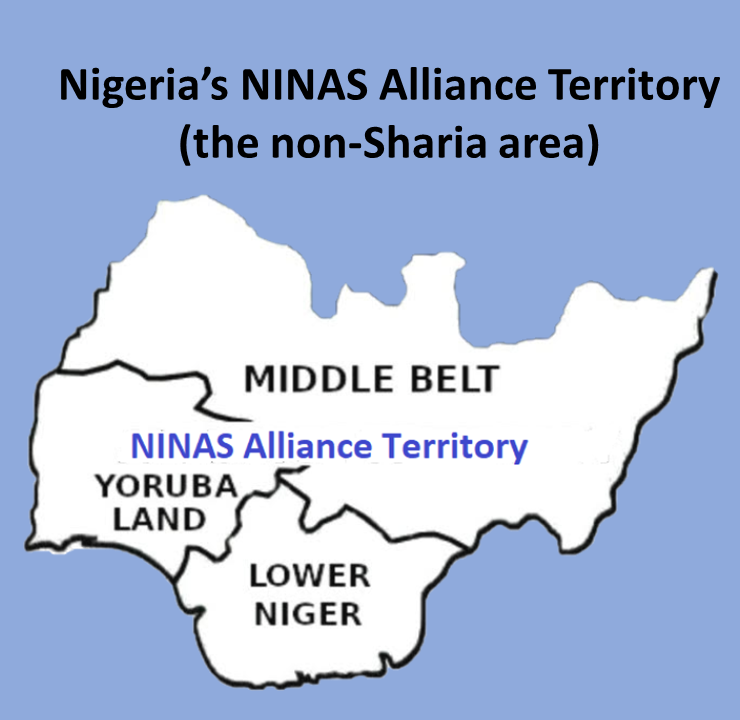
THE BIG ISSUE – is that indigenous politicians from the NINAS Alliance Territory are playing the role of Judas Goat. This is the animal that leads sheep or goats to the abattoir and is rewarded by its master with much food, and with its life spared. If not for indigenous politicians upholding a document they know is a Forgery called 1999 Constitution, the Fulani would have no access to the ancestral lands of the indigenous Ethnic Nations of the South and Middle Belt (NINAS Territory). That illegitimate 1999 Constitution is the illegitimate “Entry Visa” of the Fulani. All political parties subscribe to that Forgery. Then, the declared winner of elections swears an Oath Of Office to uphold, defend, and govern by that Forgery. In so doing, indigenous politicians give life to, and empower what is actually a Forgery, opening the door for Fulani to enter the ancestral lands of indigenous peoples, saying that they are entitled through the provisions of the 1999 Constitution.  

To stop these Fulani, some State Governors had passed anti-open grazing laws, but which cannot be enforced. For, while the Fulani invaders come armed with AK47s and AK49s, under the 1999 Constitution, Governors cannot arm their people for self-defence. 

THE REASON – that indigenous politicians uphold the illegitimate 1999 Constitution, the Entry Visa for Fulani, is because they do not care about their people. They have no vision for their people’s welfare. They want money and the power of impunity, so as Judas Goats for the Fulani they get to live, and to live lavishly.

Therefore Elections 2023 are of utmost importance for the task assigned to indigenous politicians. It is the means of renewing the life of the 1999 Constitution when the Oath of Office is taken by the declared winner of elections. That gives the Fulani Caliphate and armed Fulani more time to make Nigeria their “estate”. For playing such a crucial helping role, indigenous politicians are rewarded with more years to acquire money and riches from the public purse.

THE SOLUTION – has been placed on the Table by the non-violent NINAS Movement since 16 December 2020 when a Constitutional Force Majeure was Declared to Terminate the operation of the illegitimate 1999 Constitution in the NINAS Territory. Indigenous politicians in defiance of the will of their people who have Repudiated the sham, genocide-enabling 1999 Constitution, but with the false confidence that comes from having access to public money, and being protected by troop-loads of armed police and soldiers, have been wasting time (even though their defenceless and unprotected are people being slaughtered by armed Fulani, and farms destroyed), aiming to run down the time clock, then claim that there is no time left to do anything before Elections 2023. 

There IS time left before those elections to do the right thing, and to do the right thing the right way. The PRIORITY now is to protect indigenous communities. Relying on Buhari has proven to be futile, and no wonder, he has been judged by local as well as foreign observers as being complicit in the deadly onslaught against indigenous peoples by his Fulani compatriots. Politicians from the NINAS Territory should therefore know that any decision by them or their political parties to go for Elections 2023 will be interpreted as a clear-minded choice to help the enemy preserve the 1999 Constitution and this will mean sabotaging their own people, and being directly responsible for bringing armed Fulani upon them. Instead, serving officials should even at this stage have some sense to retreat from the treasonous path that will bring calamity upon them, for they would certainly face the fury of their people for upholding the Fulani invader-enabling sham 1999 Constitution.

Transitional Government is needed right now! The matter is too plain for any kind of confusion: the 1999 Constitution creating the (false) Union as well as creating all tiers of government, is a Forgery. It is a Fraud. It is a Deception. It is a Scam. It is Make-believe. It has therefore been REPUDIATED, viz the Solemn Assemblies of the Lower Niger, the Yoruba, and the Middle Belt Blocs; plus other joint assemblies, and the Constitutional Force Majeure (CFM). With their inalienable right of Self-Determination made possible by the CFM, indigenous Ethnic Nations of the NINAS Territory should be taking fuller charge of their various spaces. It is impossible to expect indigenous peoples to sit still while armed Fulani destroy their farms, violate their daughters, and then slaughter everybody. More and more individuals and groups across the NINAS Territory are stepping forward to embrace the DIAGNOSIS, PRESCRIPTION and TREATMENT Proposition of the non-violent NINAS Movement. The main task of NINAS is to lead the dismantling of the fraudulent 1999 Constitution to end the degenerate Unitary Union it creates, and to champion the processes of Self-Determination by which Sovereignty is restored to the constituent Blocs of the NINAS Territory. The Union Dispute that the Fulani Caliphate has been imperiously avoiding since 1966, would get resolved. Indigenous Ethnic Nations in formations of their choice (Blocs), will decide whether or not to re-federate as a Union of Nigeria. That is their inalienable decision.

Ndidi Uwechue is a British citizen with Igbo heritage from the Lower Niger Bloc. She is a retired Metropolitan (London) Police Officer, she is a signatory to the Constitutional Force Majeure, and she writes from Abuja.

NYSC: SHOULD WE QUERY OUR PRESIDENT?

By Emmanuel Onwubiko

“In any moment of decision, the best thing you can do is the right thing, the next best thing is the wrong thing, and the worst thing you can do is nothing.” – Theodore Roosevelt.

Two days ago, President Muhammadu Buhari in the exercise of his powers, authority and discretion as the sole appointing authority of heads  of strategic government offices and agencies domiciled within the jurisdiction of the Federal government of Nigeria, effected a change in the hierarchical organogram  of the most visible institutional capacity building and skills acquisition plaplatform- the NATIONAL YOUTH SERVICE  CORPS  SCHEME (NYSC) hitherto effiefficiently and effectively led by the Nasarawa State’s born effervescent military two star General -:MAJOR GENERAL SHUAIBU IBRAHIM and replaced him with the Yobe State’s born Doctorate Degree Student of National War College who nonetheless is a senior military one Star General Brigadier-General Mohammed Fadah. 

This generally unexpected change has come with it a nostalgic poser whether Government in Nigeria made up of politicians of varying degrees and characters generally are not patient enough to let Good people finish some or all of their good works before moving them to other areas for continuation of the gifted talents and acumen embellished with formidable innovative ideas? Is government not comfortable in letting good policies and initiatives for the benefit of the educated hoi-polloi or to use the most appropriate terminology- the youths, to mature and endure? Does government in this 21st century Nigeria satisfied with the status quo of the more you look the less you see or rather the barber’s chair syndrome of motion without movement? Is this decision appropriate and is it in the public interest? Is government willing to sustain this unprecedented and landmark achievements made by one of the finest discoveries in public service made by the current administration in the very person of the Nasarawa State’s born associate professor Major General Shuaibu Ibrahim? For us as citizens,  we ought to ask questions for the overall benefits of the good people of the Federal Republic of Nigeria but of course the President has his job to do and as we know the military institution is such a regimented institution that the members have this ideology of OBEYING THE LAST ORDER and OBEY WITHOUT COMPLAIN. 

So do we query President Muhammadu Buhari on why he moved a good and terrific professional gentleman who loves all persons equally irrespective of tribes, religion or ideologically persuasions so long as the person is law abiding and patriotic-Major General Shuaibu Ibrahim for Brigadier General Mohammed Fadah who is a product of the highly respected military institution and in addition also he is a Doctorate student wearing one Star General’s rank of the prestigious Nigeria Army? Why did President not let Major General Shuaibu Ibrahim be there to manage the NYSC YOUTHS TRUST FUND that he and other egg heads worked round the clock to articulate and present to the Federal Government for implementation which till now has not been introduced? As we proceed we will see multiple other innovation that the immediate past DG of NYSC Major General Shuaibu Ibrahim introduced and are efficiently managed in compliance with global best practices. 

However, should we wait and give the new man the benefits of the doubts since he has affirmed and promised publicly to drive to a successful end the many innovative ideas of his successor and professional colleague- General Shuaibu Ibrahim? I think our best decision is to say YES and give him the benefit of the doubts and to pray for him believing that like his other colleague he will always say to himself- YES I CAN. 

The new Director-General, National Youth Service Corps (NYSC), Brig.-Gen. Muhammad Fadah, has in the last 24 hours promised to sustain the vision of the founding fathers of the scheme.

He said this on Wednesday in Abuja, at the formal handing/taking over ceremony from the outgoing Director-General, Maj.-Gen. Shuaibu Ibrahim.

Fadah said that national unity, peaceful cohesion and integration were the vision for which the scheme was created and that he would ensure that it was achieved to the letter.

According to him, the former D-G had created very huge shoes for him to fit in, but with the support of the management, I will fit them properly.

Fadah said, “We will maintain all the completed projects and ensure the completion of ongoing ones to a logical conclusion.

“Please, let us work as one family. You have supported Gen. Ibrahim, extend that kind of support and advice to me.

“Because I need your cooperation for us to make progress and build on what he has done.”

Fadah was appointed on Wednesday by President Muhammadu Buhari as the 19th D-G of the scheme.

An indigene of Yobe state, he attended Sugum Primary School and Government Science Secondary School, both in Yobe.

Fadah also attended Kaduna Polytechnic where he obtained Higher National Diploma (HND), and the Lagos State University, where he obtained a Post-Graduate Diploma in Management.

He also attended the University of Ilorin, where he obtained a Master of Arts in Peace and Strategic Studies.

The new NYSC boss is presently studying for his PhD in Security and Strategic Studies at the National Defence Academy.

He has also participated in various military courses from Young Officers’ Course on Intelligence to Comprehensive Protection of Civilian Leadership Course.

Earlier in his handover speech, Ibrahim said that in his three years as the helmsman of the scheme, he enjoyed the full support and cooperation of both staff and stakeholders of the organisation.

He said, “I am confident that the new D-G will consolidate on the gains of the past three years, especially through the multiplicity of partnerships with both government and Non-Governmental Organisations for national development.

“I would advise that you pay particular attention to the security and general welfare of youth corps members and staff, as well as make sustained advocacy for stakeholders’ support as part of your approaches to administration of the scheme.”

Also, during a farewell parade in his honour, Ibrahim called on Nigerians in diaspora to, upon completion of their qualifying academic programmes, always return to the country for the mandatory service year to avoid contravening the law.

According to him, returning to observe the service year is a show of patriotism and a way of contributing their quota to the development of the country.

He commended other Nigerians in diaspora that have made themselves available for the National Service.

Ibrahim also expressed gratitude to staff and management of the NYSC for the loyalty, commitment and passion they demonstrated to actualise his vision for the scheme.

The News Agency of Nigeria (NAN) reports that Ibrahim assumed office as the 18th D-G of the scheme on May 10, 2019 as a Brig.-Gen. and was promoted to the rank of Maj.-Gen. in Dec. 2021. Are these the initial gragra as a new appointee or will he abide by his solemn pledge to maintain the high standards already set by his predecessor? We will wait for the next few weeks to be able to discern the best answers to our aforementioned posers but I think as a preliminary assertion, I think the new person will definitely want to put his name on World’s map like his immediate predecessor from the same military family and it is generally believed in the academia that dull brains do not embark on Doctorate Degree enterprise and since the new person is pursuing his Doctorate we can as well be hopeful that he might be a great guy. But the wait continues for few weeks and then we appraise his initial first steps in practical terms and not by what he has stated in those moments of conviviality during his inauguration. Here below are brief records of what the immediate past DG of NYSC MAJOR GENERAL SHUAIBU IBRAHIM achieved with phenomenal accuracy. 

The landmark achievements of the director-general of the National Youth Service Corps, NYSC, Maj. Gen. Shuaibu Ibrahim have once more demonstrated the role of effective and transformational leadership in organizations, public or private.  The Nigerian Army general and an academic as an associate professor of military history, assumed the position of director-general of the Scheme on 10 May 2019. Earlier to his appointment as the 18th DG of NYSC, he was the Registrar of the Nigerian Army University, Biu, Borno state.

The NYSC Scheme, since establishment on  May 22, 1973, is one Nigerian Institution that has stayed the course and at the same time in great need of organizational renewal and redesign, and that is precisely what General Shuaibu Ibrahim has done for the Scheme. NYSC is being comprehensively overhauled and repositioned for the challenges of 21st Century Nigeria and now in a better position to discharge its core mandate through the implementation of the 5-Year Strategic Plan instituted by the foresighted general.

For emphasis, the NYSC Scheme has fifteen main objectives, and the numero uno is: inculcating discipline in Nigerian youths by instilling in them a tradition of industry at work, and of patriotic and loyal service to Nigeria in any situation they may find themselves. Another is: raising the moral tone of the Nigerian youths by giving them the opportunity to learn about higher ideals of national achievement, social and cultural improvement; and another: developing in the Nigerian youths the attitudes of mind, acquired through shared experience and suitable training, which will make them more amenable to mobilisation in the national interest. The fourth and fifth are about self-development and nation building: empowering Nigerian youths to acquire the spirit of self-reliance by helping them to develop skills for self-employment; and getting them to contribute to the accelerated growth of the national economy. The rest of the objectives can be summed as inculcating in the Nigerian youths patriotic zeal, sense of unity and nationalism.

Traditionally, even the worst critics once calling for scrapping of the Scheme, would admit that, despite the formidable challenges, the NYSC has impacted greatly on the socio-economic development of Nigeria through its various programmes. The impacts recorded by the Scheme are mostly seen and appreciated by well-meaning Nigerians in the real sectors of the nation’s economy, especially in education, health, agriculture and rural infrastructure as well as in corps members’ huge participation in the implementation of national programmes such as elections, population census and mass sensitization of the rural populace, which have earned the Scheme a lot of accolades. The signature impacts of the Scheme have been escalated and modified, and new dimensions introduced by egghead director general.

When General Shuaibu Ibrahim took over the reins at the NYSC in 2019, he unveiled his 5-point  policy thrust, which were: sustaining effective utilization of the potentials of Corps members for optimal benefits; pursuit a technology-driven organization to deepen effective service delivery; improving on the welfare and security of Corps members and Staff; strengthening existing collaboration with stakeholders; and reinvigorating the NYSC Ventures and Skills Acquisition and Entrepreneurship Development Programme (SAED) in line with the NYSC Act for greater impact.

General Shuiabu Ibrahim’s scorecard spans over thirty-six fundamental achievements, but only a few of them can be reviewed here for obvious reasons. Under him, new Permanent Orientation Camps have been set up in Edo and Bayelsa States and several existing ones have been upgraded with the aid of state governments. Part of the key component of both the new and the upgraded Permanent Orientation Camps is the ultra-modern skill acquisition equipment, which is part of the reinvigoration of the Skill Acquisition and Entrepreneurship Development programme of the Scheme that has also received a great boost.

Also reinvigorated is the NYSC Ventures, including the registration of a number of them already incorporated with the Corporate Affairs Commission.  These include NYSC Garment Factory, Mgbakwu, Anambra State; NYSC Garment Factory, Minna, Niger State; NYSC Rice Mill, Ezillo, Ebonyi State; NYSC Bakery and Water Factory, Kubwa, Abuja; NYSC Feed Mill, Ipaja, Lagos; and the NYSC Entertainment Company Limited, which comprises the NYSC National Band, NYSC National Cultural Troupe and the NYSC Movie.

Under General Shuaibu Ibrahim the NYSC Ventures and the NYSC Integrated Online System and other revenue generation efforts have generated unprecedented over N1.2 billion remitted to the Federation Account within the last two years and another N761, 798,479.50 also remitted to the Federal Government as the revenue generated in the year 2021. This feat is pointing to the NYSC Scheme becoming financially sustainable and becoming a major revenue earner for the Federal Government.

One other area of interest is the enrolment of Corps members in the National Health Insurance Scheme (NHIS), a feat that has further elevated Corps Welfare. Funds have already been released by the Federal Government for its take-off.

One other major feat the NYSC Scheme has achieved under General Shuaibu Ibrahim should be the production of the first ever NYSC Movie with the title “A call to Service,” which premiered on 4th December, 2021 in Abuja.  This will serve as a tool for sensitization of the public about the Scheme and give the prospective corps members the foretaste of the Scheme and get them psychologically prepared for service to the fatherland.

General Shuaibu Ibrahim also led the Scheme to establish the NYSC National Cultural Troupe to develop the talents of Corps members and also serve as a source of revenue generation for the Scheme. Also established is the NYSC Museum, which is domiciled in the NDHQ, Abuja, for effective preservation of the Scheme’s artifacts, including Corps members’ inventions and fabrications. There is also NYSC Bakery in Keffi and the NYSC Table Water Factory also constructed in Keffi, Nasarawa State and another in Kubwa, Abuja.

Perhaps quite revolutionary in this era of e-media and ICT-driven world is the establishment of a Radio station at the NDHQ  as well as the approval that has been secured for the establishment of NYSC Television station by the hardworking transformational leader and scholar.

NYSC under General Shuaibu is about completing a state-of-the-art ICT Centre at the NYSC Headquarters and has also introduced a nationwide live broadcast by Corps members through the virtual platform.  

General Shuaibu understands that in this era of e-media and ICT-driven world, corps members needed to be trained and retrained in ICT  and tech to be able to benefit maximally from the unfolding 4th Industrial Revolution, which has already unraveled in many countries like China, India, and here  in Africa; in Rwanda and Kenya. Shuaibu also wants to ensure  fully equipped ICT Centres to optimize the digitization and digitalization process of the Scheme.

Apart from the NYSC Skill Acquisition Centres spread round the country, as part of its efforts to be self-sustaining, the NYSC Garment Factories are being established and that of  Keffi, Nasarawa State, has already come on stream under his watch.

General Shuaibu Ibrahim has also led the NYSC to immortalise the “Bauchi Eleven,” who lost their lives during the post-election violence of 2011,  through  employment and scholarship for their siblings as well as employment for a sibling of Corps member Precious Owolabi, who was hit by a stray bullet during a religious crisis.

In appreciation, the Scheme has received commendations from the Presidency on the role of Corps Medical Personnel in the fight against COVID-19 in the Presidential Villa  and  a 4-Star Service Provider award by the SERVICOM National Office. In further recognition of the Scheme as a leading light of youth organizations in Africa, the Scheme was invited to send 10 (ten) Corps members to India to participate in that country’s 75th Independence Anniversary; and receipt of Award of Excellence from the Federal Ministry of Justice for the Scheme’s consistent implementation of the Freedom of Information Act.

General Shuaibu has been thinking out of the box on how  to address the perennial paucity of funds drawing back the projects of the NYSC Scheme  and came  up with the NYSC Trust Fund. Apart from hosting one or two  symposiums on its imperative, the proposed NYSC Trust Fund  Bill has scaled through the second reading at the House of Representatives and  stakeholders’ support for the establishment of the Fund is also gathering momentum.

With reinvigoration of the Skill Acquisition and Entrepreneurship Development (SAED) Programme to train a greater number of youths, especially those that are not educated up to tertiary level, establishment of six (6) Garment Factories, one in each geo-political zone; expansion of Orientation Camps to 5,000 carrying capacity; establishment of arable farm settlements and animal husbandry in every geo-political zone to produce 50% of the initial food requirements at the Orientation Camps; establishment  of NYSC Radio and the TV already approved, establishment of NYSC ICT centers round the country and with the NYSC Trust coming to power the Scheme,  the present NYSC director general, General Shuaibu Ibrahim  has indeed restored the NYSC Scheme to its lost glory and master image.

The Scheme is now fully reinvigorated, rebranded and repositioned to be able to carry out its salutary statutory responsibilities and help to push  the country into being part of the 4th industrial revolution. The nation appreciates, and a united and developed Nigeria shall be your reward.

*EMMANUEL ONWUBIKO is head of the HUMAN RIGHTS WRITERS ASSOCIATION OF NIGERIA (HURIWA) and was National Commissioner of the NATIONAL HUMAN RIGHTS COMMISSION OF NIGERIA. HE IS A PROFESSIONAL JOURNALIST.

SMK: The Philanthropist

By
Sefinatu Ohunene Umaru

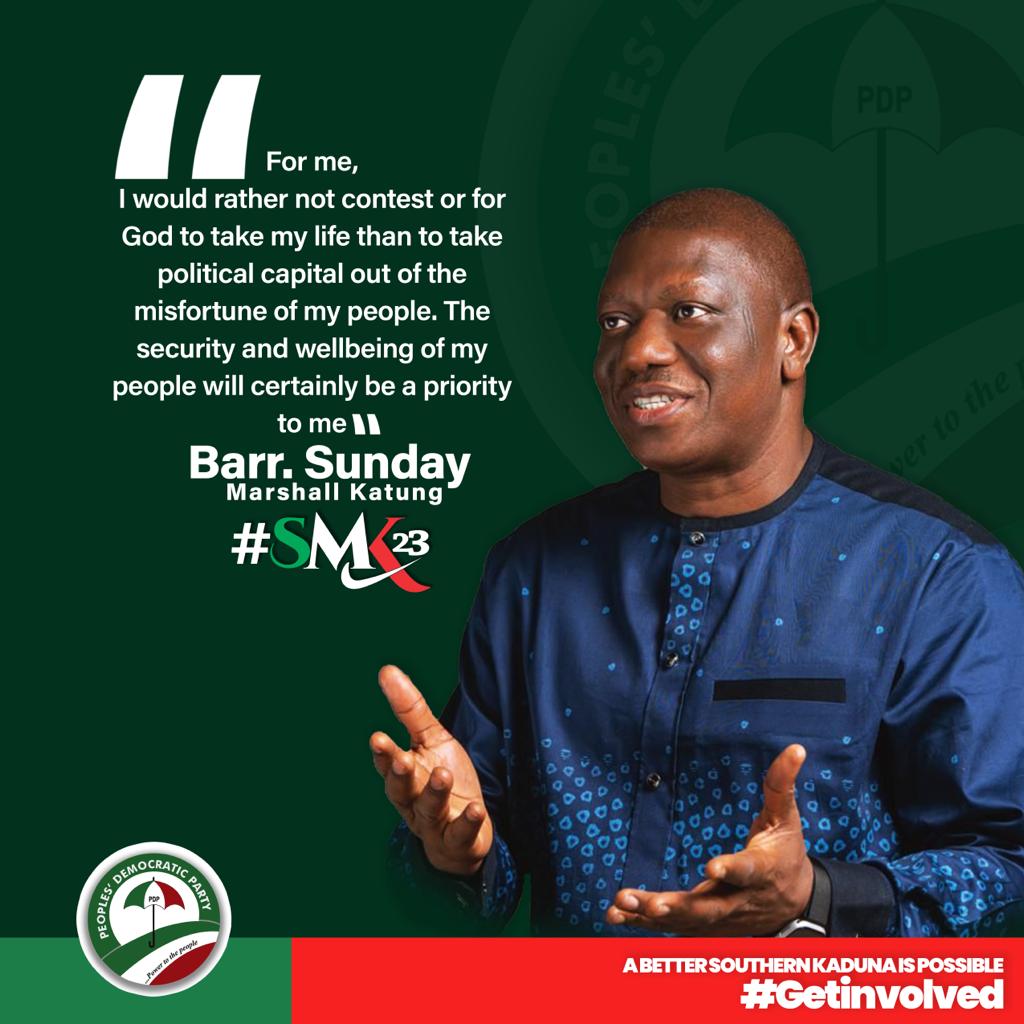
A philanthropist is a person who donates time, money, experience, skills or talent to help create a better world. Some philanthropists are known for giving away substantially to society and the candidate for the Kaduna South Senatorial seat, Honourable Sunday Marshall Katung (SMK) happens to be one. He has regularly donated his time, resources and talent for the benefit of the good people of Kaduna South Senatorial District.

His philanthropic activities span from education, providing succour to the indigent, empowerment and influencing employment opportunities in addition to providing legal services. Specifically, they include:

 a. Eduction and Empowerment:
  1. Setting up an informal scholarship scheme for youth seeking higher education. This scheme has over a hundred (100) beneficiaries across higher institutions in Nigeria in just its first year.
  2. Funding preparatory JAMB and SSCE candidates.
  3. Partnered SMEDAN to conduct skill acquisition training and empowerment schemes for artisans and micro small scale entrepreneurs.
  4. Providing business start up seed capital to over three hundred (300) female entrepreneurs. b. Health:
  5. Outreach programmes that offer free screening, check up, basic surgeries, drugs treatment and therapy
  6. Distribution of mosquito nets for mothers and their children to combat malaria
  7. Outreach has conducted over three thousand (3,000) free surgeries

c. Agriculture:

  1. Distribution of fertilisers by the truck loads
  2. Distribution of improved seedlings

d. Amenities:
As a former member Federal House Representative –
1.He was able to influence the installation and deployment of solar powered street light in Kwoi Town.

  1. moved a motion on the floor of the green chambers for the urgent rehabilitation of the Kwoi -Kurmin Jibrin Road, an important road artery in Southern Kaduna.
  2. Provision of transformers for rural electrification, solar, mechanical and manual (hand) powered boreholes. e. Employment:
  3. Ensured Southern Kaduna youth were not sidelined when the following agencies conduct recruitment:
    i. Federal Fire Service
    ii. Nigeria Immigration Service
    iii. Nigeria Railway Corporation
    iv. National Information Technology Development Agency
    v. Nigerian Postal Service
    vi. National Board for Arabic and Islamic Studies
    vii. DSS
    viii. Animal Research Centre, Vom.
    ix. Etc.
  4. Reinstatement of sons and daughters wrongfully dismissed from employment in the private sector. He also ensured those retired received the gratuities and benefits due to them. f. Humanitarian Commitment:
    Sunday Marshall Katung (SMK) has a special gift of compassion and is always at his best when it comes to touching the lives of the less-privileged. Over the years during his birthday, he always extends his hand of love to those in need as he celebrates with widows and orphanages.

He has also provided succour to victims of ethno-religious crises in Southern Kaduna with provision of meals, medical supplies and education for victims in IDP camps. Also, during the lockdown brought about by the COVID 19 pandemic in 2020, Honourable Sunday Marshall Katung (SMK) donated palliatives to indigent families and those whose means of livelihood were negatively impacted.

In terms of philanthropic activities, Honourable Sunday Marshall Katung stands at the head of this assembly and brought true light to life to the people of Southern Kaduna, thus touching their hearts.
He believes that philanthropic gestures alone cannot solve all societal problems and that only effective and people friendly legislation could. With the right legislation, the right atmosphere that will harness the economic potentials of Southern Kaduna and create employment opportunities can be done.

Let all sons, daughters, residents and lovers of a better Southern Kaduna come together and Get Involved by supporting him to represent Southern Kaduna Senatorial District come 2023.

Thank you.

Nigeria: The Sham 1999 Constitution is The Entry Visa For Fulani – A Non-Indigenous People

By Ndidi Uwechue

09 May 2022

Nigeria is a multi-national country, made up of several Ethnic Nations that could have been countries in their own right if not that Nigeria happened to them. For several years, but most especially now, the Ethnic Nations of the NINAS Alliance Territory (the South and Middle Belt) have been regretting being in this Union, and those who can have joined the mass exodus out of Nigeria, seeking a new home abroad. Now, thanks to the non-violent NINAS Movement, people have become aware that it is the Fulani Caliphate Agenda of conquest and control, that is inflicting miseries, and an existential terror, upon indigenous peoples. 

The Fulani were through trickery, manoeuvred into power by the departing British at Independence in 1960. Since that time, despite their status of being non-indigenous immigrant settlers, the Fulani have had a hostile “born-to-rule” supremacist attitude towards the Owners of the land. Now that indigenous peoples are being slaughtered by armed Fulani and their terrorists for land grab, the question is being asked: The Fulani live among us, but do they have a right to be on our land?

That is a very good question. The answer is that the illegitimate 1999 Constitution is both ENTRY VISA and PERMANENT STAY VISA for the Fulani. Without that 1999 Constitution, a forgery, Fulani would have no legitimate right to enter, or stay in the Middle Belt or South. That Document is a fraud, foisted upon Nigerians. It is the illegitimate powers obtained from that 1999 Constitution that the Fulani use for land grab activities, policies, or (future) plans, for example: 

  1. The quite absurd narrative of “farmer-Fulani herdsman clash” has been completely debunked. It is outright ethnic cleansing (genocide) by armed Fulani for land grab that is going on.
  1. Although it is a deceit to amend a forgery, in the most recent round of “amendments” of the 1999 Constitution, the National Assembly passed provisions for Local Government autonomy. That means LG Areas would be directly controlled by the Fulani-led Central Government, via getting funds, and via a government-controlled INEC controlling elections. 
  1. The National Waterways Bill is a ruse for the Fulani-led government to control the waters and their surrounding banks, including ground waters, in all parts of Nigeria.
  1. RUGA are straight off Fulani colonies, but labelled as cattle colonies. 
  1. Cattle grazing routes. Fulani are new-comers to the NINAS Territory, and it is the British who brought them into the South via Amalgamation (really an Annexation) in 1914. There are no records that indigenous peoples properly agreed to any cattle grazing routes for Fulani. This is just another attempt by the Fulani to lay claim to what is not theirs.
  1. The National Livestock Transformation Plan is a means of imposing Fulani cattle ranches throughout Nigeria, using public money. This is land grabbing.
  1. “Repentant and rehabilitated” terrorists are being REINTEGRATED into communities, and there are reports that they are even placed in the Nigerian Army. Just last week, UN Secretary-General Antonio Guterres (who has Amina Mohammed, a Fulani among his staff), praised Buhari for the ongoing Reintegration of “repentant” terrorists. This is all quite baffling because no UN boss has advised the USA to Reintegrate the foreign terrorists of the 911 terror attacks. Buhari himself has been quoted as saying, “But those with sophisticated weapons, with Ak-47, are from the Sahel area. They are Fulani people from Mauritania, Central Republic Africa…” Thus, Buhari’s Reintegration of terrorists is another form of land grab because Reintegration would mean accepting these Fulani killers into ancestral lands. 

These are just seven examples of how, having gained entry into ancestral lands using a forgery – the 1999 Constitution, Fulani are “ruthlessly” hoping to bring about their Ahmadu Bello’s vision that Nigeria is to be an “estate” of the Fulani.

The illegitimate 1999 Constitution is the ENTRY VISA for Fulani. However, do note that it is indigenous politicians who OPEN THE DOOR for Fulani to enter ancestral lands, by upholding and defending the illegitimate 1999 Constitution. Thus, if indigenous politicians did not collaborate with the Caliphate, Fulani would not be able to enter the ancestral spaces of indigenous peoples. Indigenous politicians are therefore DIRECTLY RESPONSIBLE for the slaughter of their people by armed Fulani, and for the decay and retardation seen throughout their Ethnic Nation, as those are the fruits of the 1999 Constitution. The 1999 Constitution has been Repudiated. Thus, indigenous politicians are soulless traitors of their people by clamouring for, and pushing for Elections 2023 to renew the life of that 1999 Constitution, giving Fulani another four years of illegitimate entry into the ancestral lands of indigenous peoples. 

In conclusion, Fulani are using sorcerer’s tricks and murder to dispossess and grab ancestral lands through ethnic cleansing (genocide), and by policies or laws such as RUGA and Waterways Bill. There is no hope whatsoever for indigenous peoples under such conditions so tens of thousands have fled abroad as migrants, too terrified to return. But the Fulani can be stopped! It is by focusing on indigenous politicians, for they are the ones who hold up the sham 1999 Constitution as a ladder for the Caliphate and their armed Fulani to enter ancestral lands. Therefore, to STOP indigenous politicians means to STOP the Fulani. Indigenous peoples must find a way to stop their politicians from carrying out Elections 2023 which renew the life of the 1999 Constitution, the ENTRY VISA for Fulani. 

Ndidi Uwechue is a British citizen with Igbo heritage from the Lower Niger Bloc. She is a retired Metropolitan (London) Police Officer, she is a signatory to the Constitutional Force Majeure, and she writes from Abuja.

THE AMERICAN VERDICT ON NIGERIA

By Emmanuel Onwubiko 

The latest compilations of human rights abuses in nations around the World as done by the State Department of the United States of America is out and as expected, that of Nigeria is as treacherous and pathetic as it has always been in over a decade. In the case of Nigeria,  it is clear that both the States and the Federal government are simply overwhelmed and are really not doing much to check these tragic human story. 

A review of the Executive summary  shows that there is not really any major milestones in terms of efforts on the part of the current federal government  and the federating units to sufficiently provide effective redress mechanisms to victims of human rights violations. 

The report noted that Nigeria is a federal republic composed of 36 states and the Federal Capital Territory. In 2019 citizens re-elected President Muhammadu Buhari of the All Progressives Congress party to a second four-year term. Most independent observers agreed the election outcome was credible despite logistical challenges, localized violence, and some irregularities.

Significantly, the United States government has nothing good to say regarding the standards of human rights protection expected from the officers and the operatives of the Nigeria Police Force. 

The Americans noted that the Nigeria Police Force, which reports to the Ministry of Police and is overseen by the Police Service Commission, is the primary civilian law enforcement agency and enjoys broad jurisdiction throughout the country. 

The Ministry of Interior also conducts security and law enforcement activities. 

The Department of State Services, which reports to the national security advisor in the Office of the President, is responsible for counterintelligence, internal security, counterterrorism, and surveillance as well as protection of senior government officials. 

The Nigerian Armed Forces, which report to the minister of defense, also share domestic security responsibilities as stipulated in the constitution in the case of insufficient capacity and staffing of domestic law enforcement agencies or as ordered by the president. 

Many states, in response to increased violence, insecurity, and criminality that exceeded the response capacity of government security forces, created local “security” vigilante forces. These local forces reported to the state governor. Civilian authorities did not always maintain effective control over the security services. There were credible reports that members of the security forces committed numerous abuses.

The USA reports that significant human rights abuses included credible reports of: unlawful and arbitrary killings by both government and nonstate actors; forced disappearances by the government, terrorists, and criminal groups; torture and cases of cruel, inhuman, or degrading treatment or punishment by the government and terrorist groups; harsh and life-threatening prison conditions; arbitrary arrest or detention; political prisoners; serious problems with the independence of the judiciary; arbitrary or unlawful interference with privacy; serious abuses in a conflict, including killings, abductions, and torture of civilians; serious restrictions on free expression and media, including violence or threats against journalists and the existence of criminal libel laws. 

Others are the serious restrictions on internet freedom; substantial interference with the freedom of peaceful assembly and freedom of association; serious government corruption; lack of investigation and accountability for gender-based violence, including but not limited to domestic and intimate partner violence, sexual violence, child, early and forced marriage, female genital mutilation/cutting, and other harmful practices; crimes of violence targeting members of national/racial/ethnic minority groups; the existence or use of laws criminalizing consensual same-sex sexual conduct between adults; and the existence of the worst forms of child labor.

The government took steps to investigate, punish, and prosecute alleged abuses by military and police forces, including the now disbanded police Special Anti-Robbery Squad, but impunity for such abuses and corruption remained a problem. These basically are the few areas captured by the Executive summary done by the USA on the situation of human rights.  But the USA left many lacunae in this summary because there were no mention of the weakness of the National Human rights institutions such as the Premier Nigerian Human Rights commission. The National Human Rights commission is so weak that it stands by whilst federal government officials like the minister of Information rides roughshod on the media rights of Nigerians and the minister has so manipulated the National Broadcasting Commission to become a tool for the dictatorial witch hunt of independent broadcasting stations. Lai Mohammed is obviously one amongst the state officials that has done significant damage to human rights promotion and protection. The Ministry of telecommunications and digital economy is another agent of human rights violations through the implementation of some outrageous policies that have resulted in the monitoring of the private communications of Nigerians. The report did not speak about the near moribund status of the Public Complaints Commission which only exists on paper because their impacts are not being felt given that millions of Nigerians with genuine complaints against several public office holders can’t get redress from the Public Complaints Commission which basically exists just to pay salaries to their staff and the board members. 

Nigerians expect that in subsequent human rights reports that the writers endeavour to name and shame Public office holders who are notorious human rights violators. This report is expected to become a springboard for the civil society community to continue to campaign for effective implementation of oversight responsibility by the National Human rights commission, the Public Complaints Commission and the relevant committees of the two chambers of the National Assembly because it is very clear that the security agencies have become enthusiastic human rights violators and these tendencies must be checked and indicted officers penalised in line with the due process of the law. Chapter 4 of the Constitution of the Federal Republic of Nigeria is extensive enough to highlight the key human rights entitlements of the citizens. Reading one of the very recent reports done by the Washington DC based Human Rights Watch, it is clear that the problems are much bigger than what the US state Department captured in their latest human rights report on Nigeria. 

The group in the USA says that attack on human rights is worsening in Nigeria, the Human Rights Watch (HRW), an international non-governmental organisation concerned with human rights matters around the globe, has said.

In its 2022 World Report, which reviews human rights trends and developments in more than 100 countries in the world, the organization said the ban on Twitter in June 2021, was indicative of worsening human rights issues in Nigeria.

President Muhammadu Buhari’s administration had suspended the operations of Twitter in Nigeria after a controversial tweet by him was deleted by the microblogging site.

The government insisted that its action was unconnected to the taking down of Mr Buhari’s tweet but was based on alleged roles of the site in fuelling insecurity, fake news, and separatist activities in the country.

Government’s attempt to rationalise the justification were not accepted, with leading democratic nations like the United States of America, the United Kingdom, and others condemning it as an attack on freedom of expression.

After seven months, the government announced the lifting of the suspension on January 12, after reaching some agreements with Twitter.

But in its 752-page report, the 32nd edition of its World Report, launched on January 13, HRW said the Twitter suspension was a sign of human rights repression in the country.

“The Nigerian government’s ban on Twitter in June, after the social media company deleted a tweet by President Muhammed Buhari for violating its rules, signaled a worsening repression of fundamental rights in the country,” the report read in part.

The report recalled that the ban was widely condemned by citizens who relied on the platform for critical social and political discourse.

Many Nigerians remained active on Twitter using virtual private networks (VPNs) to circumvent the ban even as the Attorney-General of the Federation, Abubakar Malami, threatened to anyone by passing the ban.

In a decision delivered on June 22, the ECOWAS Court in Abuja stopped the government from taking any action against anyone or media houses still using Twitter.

The worst case scenario on human rights in Nigeria is the ease with which citizens are killed by armed non State actors especially armed Fulani terrorists. One instance will suffice as a good example. One hundred and six persons have so far been buried following the attacks on communities in Plateau State, media report say. 

This is according to the Chairman of Kanam Local Government Area of Plateau State Dayabu Garga who gave an update about the renewed violence in some parts of the north-central state.

“I was present on Monday morning where we did mass burial of 106 killed and we are still picking more dead bodies in the farmlands,” he said on Thursday in an interview on Channels Television’s Sunrise Daily.

He also said there are “more than 16 people hospitalised”. Benue State has also killing fields with over 3,000 citizens slaughtered by armed Fulani terrorists in the past 7 years and no single killer is behind bars. 

  • EMMANUEL ONWUBIKO is head of the HUMAN RIGHTS WRITERS ASSOCIATION OF NIGERIA (HURIWA) and can be reached @wwwhuriwanigeria.org. 
Nigeria’s Politicians: When Swearing An Oath Of Office Is A Declaration Of War

By Ndidi Uwechue

8th April 2022

Two very unfortunate things see to it that Nigeria has remained a “criminal enterprise”. Otherwise Aburi and much later PRONACO, had been missed opportunities to have set Nigeria free to become stable, and thus assured of continuing as one unit going into the future. The two unfortunate things that ruin Nigeria’s chances of longevity are #1) The deliberately inflicted ignorance of the population, and #2) The low morality quotient of both the middle class and the elite. 

Exasperating as it may be to observe, the ignorance of the masses is not their fault, and it can be reversed with a change in social and constitutional arrangements. Whereas, it is a choice for the middle class and elite, the creators of society’s values, to be such as they are. 

The situation in Nigeria is that despite the obstacles placed in their way, the non-violent NINAS Movement for Self-Determination has managed to create a growing countrywide consensus against the continued operation of the illegitimate forgery called the 1999 Constitution, the current instrument of governance. The middle class and elite are aware that the 1999 Constitution has been rejected, and even Repudiated, and they know that Nigeria became a Disputed Project from 16th December 2020 when the joint multi-regional NINAS Movement proclaimed a Constitutional Force Majeure with a Notice of constitutional grievances and demand for Transitioning Process for an ORDERLY reconfiguration of the constitutional basis of Nigeria. Lacking the moral make-up to face the FACTS that the 1999 Constitution is a FORGERY, that it is UNJUST and UNDEMOCRATIC to keep on with this fraud, and that a Constitutional Force Majeure has now been thrown into the political and constitutional space, the middle class and elite ignore these, in the (vain) hope that the future will continue to be manipulated to favour their positions in society.

The worst among them are the politicians: both those holding or seeking office, plus members of political parties. For, in Nigeria, all political parties SUBSCRIBE to the illegitimate 1999 Constitution, whether it is an established party, a new party, an anti-corruption party, a youth party, or whatever party. They ALL endorse and champion that fraud and deceit called the 1999 Constitution.

Regarding the issue of serving politicians, they swear an Oath of Office to uphold, defend, and govern by the 1999 Constitution, in so doing they RENEW THE LIFE of the illegitimate 1999 Constitution. Thus, serving politicians of Ethnic Nations ARE RESPONSIBLE for actually bringing the harmful effects of that 1999 Constitution upon their own people. It has now been established by survivors and independent observers that there is an ongoing genocide against indigenous peoples by well-armed Fulani militias for land grab so as to establish a Fulani Caliphate in their hope to bring about Ahmadu Bello’s Declaration of 1960 that Nigeria is to be “an estate” of the Fulani. It is that 1999 Constitution that PREVENTS indigenous peoples from equipping themselves with matching weapons for protection, and to repel any armed invaders. Serving politicians know this, yet they cold-heartedly continue to uphold the 1999 Constitution over their people. This is why, especially in the Middle Belt but spreading southwards, indigenous peoples are being slaughtered on a regular basis by armed Fulani. It is quite scandalous that a false Document enables this slaughter. It must be understood clearly that that Document is both introduced into ancestral lands, and is then also upheld, by serving politicians – against their own people’s welfare, and endangering the lives of their people. When a politician brings death and destruction upon his people by placing upon them (via his Oath of Office) a fraudulent Document that is dishonestly titled the “1999 Constitution” which the people have Repudiated, and which facilitates armed Fulani to slaughter his defenceless people including children, is that not a declaration of war upon his people? It is for the Reader, and for all reasonable people to think this through!

At their high point, believing themselves to be invincible, the Nazis in power and in authority never knew that one day their war (genocide) against unarmed Jews would be stopped, and that they would face NUREMBERG! Serving politicians of the NINAS Territory (South and Middle Belt) should reconsider their treachery against their people, and should stop being an enemy of their people by upholding the death-bringing 1999 Constitution. That 1999 Constitution was not made by “we the people” as it falsely claims and it has been Repudiated. Therefore, serving politicians should do the right thing, and do the right thing the right way. That means, they should not manipulate and push their people to General Elections in 2023 to renew the life of the sham 1999 Constitution yet again. Instead, they should SUSPEND Elections 2023, get political parties to CLOSE SHOP even if temporarily, while they go to Transitional Government where current political office holders would retain their positions, and there would be Self-Determination Regional Referendums where “we the people” decide the future of the Union called Nigeria. 

Ndidi Uwechue is a British citizen with Igbo heritage from the Lower Niger Bloc. She is a retired Metropolitan (London) Police Officer, she is a signatory to the Constitutional Force Majeure, and she writes from Abuja.

Rape Of A Nation And APC/Buhari’s Squandered Messianic Dreams: 2015-2022 Scorecard
           PART I
         THE ECONOMY

             By
      Emmanuel Gandu

ABSTRACT

It is no longer a fallacy that Nigeria is a sinking rudderless ship captained by Muhammadu Buhari with an APC ground, sea, and air crew that have refused to listen to the series of MAYDAY distress calls from helpless Nigerians aboard.
In order to succinctly highlight the stark reality and consequences that have contributed to the deplorable and decaying Nigerian nation, this presentation attempts to be deliberately incisive, measured, and blunt, as it is heavily, and beautifully laced with an array of embroidery of facts, figures, and data.

INTRODUCTION
(a) The man Muhammadu Buhari :
Born in Daura on December 17, 1942 of Fulani descent, Muhammadu Buhari is a retired Nigerian Army General, a former governor, a one time petroleum minister under the Obasanjo military government, a former military Head of State from December 1983 – 1985, and the head of Petroleum Trust Fund under the military government of General Sani Abacha.
In 2015 Buhari at last was for the fourth (4) consecutive time after three (3) unsuccessful consecutive attempts was elected president of Nigeria.
Buhari as a retired military officer, former governor, head of state, was seen to have the capacity to stop corruption, revamp the economy, halt the breakdown of law and order, and other aspects of insurgency. It was not surprising therefore for Nigerians to entrust their destiny to Buhari.
By 2019, Buhari again won re-election with 56% of lawful votes cast for another 4 years as president of Nigeria.
He is happily married (for the second time) to Hajia Aisha Buhari.
He lives a simple austere life characteristic of the typical Fulani.

(b) Buhari’s rising popularity :
So much was going good for Buhari especially starting from his military days as the GOC Jos when he led the Nigerian troops to successfully dislodge the advancing Tchadian soldiers who had encroached into Nigerian territory, even without obtaining clearance from Alhaji Shehu Shagari the then president and commander in chief of the Armed forces.
Also going for him was his fight against corruption, indiscipline, and drug trafficking/abuse. His war against the vices in the Nigerian society otherwise called War Against Indiscipline (WAI) endeared him to both the young and the old, the rich and the poor, and especially the students and labour unions who saw him as a revolutionary leader.
Interestingly, Muhammadu Buhari’s popularity had increasingly and overwhelmingly spread like wild fire not only across the Hausa Fulani northern Nigeria including the Sahel region of West Africa, but also in Southern Nigeria.
This popularity attracted to him complementary and populist names like Maigaskiya (the truthful one), Baba Talakawa, Super Tanker, Mai Ceto (Messiah), Sai Baba, etc. The Buhari brand therefore became a product that was on popular demand.
Little wonder he always had 12 million votes saved in the political bank even before the start of any elections in Nigeria.

(c) The self inflicted eclipse of Buhari :
However, the Muhammadu Buhari that triumphantly rode on the popular mandate of majority of Nigerians to become president in two consecutive terms of 4 years each began to become less and less popular by the day.
Consequently, Nigerians have adduced the following reasons for this failure to Buhari’s door step :
√ Nigeria is flowing with blood and burning by ? fire more than ever before.
√ Fulani heardsmen terrorists kill, rape, burn humans/crops, drive and occupy people’s land un- aprehended.
√ Unending Boko Haram terrorism.
√ Hunger, high cost of living, and hardship in the country never experienced in the history of Nigeria.
√ Banditry, kidnapping, and killings of people in homes, schools, worship centers, farms, and even in military barracks.
√ Relocation of manufacturing companies outside Nigeria.
√ Rising unemployment.
√ Economy in shambles.
√ Increasing agitations for restructuring and secession.
√ Nigerians leaving the country in droves for fear of the unknown.

             THE ECONOMY

The gloomy outlook of the Nigerian dilapidating and jaundiced economy may be the legacy that the All Progressive Party (APC) and Muhammadu Buhari will bequeath to future generations of Nigeria. A legacy of an impoverished, bloody, beger, and inept nation, a divided and polarized citizenry, and a failed state.
These are the facts :
(1) Debts and borrowing :
According to Nigeria’s Debt Management Office (DMO) the nation’s total public debt rose to #38.5 Trillion as at September 2021. This is largely as a result of the government’s penchant for borrowing. This borrowing spree is raising concern among Nigerians on the debt sustainability of the country amidst dwindling revenue to meet the debt obligations to the creditors. This mounting debts will eventually be a cog in the wheel of progress for future Nigerian generations is a frightening concern, and therefore leaves much to be desired.

Regrettably, the Buhari led APC government is alleged to have violated Nigeria’s Fiscal Responsibility Act and the Central Bank of Nigeria (CBN) Act 2007. This is so because Buhari exceeded the fiscal borrowing threshold as stipulated by the Fiscal Act and the CBN Act.
Zainab Ahmed, Minister of Finance Budget and National Planning admitted to this exceeding threshold by Buhari, but defended it on the grounds that COVID 19 was good enough reason to breach the Act.

Meanwhile, Wilson Erumebor, a senior economist at the Nigerian Economic Group, and Vahyala Kwago, a senior Researcher and Policy Analyst at Budgit warned that Nigeria is a case where expenditure keeps rising, revenue not improving as expected, thereby creating a wide fiscal deficit that is majorly financed by borrowing.
Unfortunately, it is a case where government is borrowing more, spending more, and earning less revenue.
This really spells doom for Nigeri’s future.

In order to help Nigeria come out from this fiscal mess, the International Monetary Fund (IMF) offered it’s experienced expert opinion. In its 2020 and 2021 country’s report for Nigeria, the IMF warned that Nigeria’s low GDP compared to high debt profile is highly vulnerable to uncomfortable shocks.

(2) Corruption :
Allegations and counter allegations of corruption cases at the corridors of power churns out figures that lend credence to incontrovertible facts and not mere allegations of corruption.
For instance, the alleged missing #3,143,718,976.47 billion traced to the Ministry of Finance for which the Socioeconomic Rights and Accountability Project (SERAP) is suing Muhammadu Buhari in January 2022 for non – investigation.
This came as a result of the accusations by the Federal Auditor General Office in the 2018 and 2019 audit annual reports that #3.1 billion public funds are missing, missapropriated, or unaccounted for.

According to research by Transparency International, their Corruption Perception Index for 2021 placed Nigeria at 154th position out of 180 countries. This placed Nigeria as the 2nd most corrupt country in West Africa. Nigeria had occupied the 136th position in 2015.

Further more, corruption in government agencies is becoming alarming. For insurance, an audit query mandated the Nigerian Ports Authority (NPA) to refund series of staggering sums of money to the Federal government as products of corruption. These amounts of money include – (a) #40.13 billion, (b) $921.64 million, and (c) £289,931.82 million.

(3) Uncertainty with the 2022 budgetary regime :
Nigeria’s rising debt profile especially debt service to revenue ratio, as well as foreign exchange liquidity constraints portends a gloomy 2022 budgetary regime for the country.
(i) No sooner had Buhari signed the #17.126 Trillion 2022 budget christened ‘Budget of Economic Growth and Sustainability’ than he sent a supplementary budget request to the National Assembly for their consideration.
Contained in this request are :
(a) #2.557 Trillion to fund petroleum payment in 2022.
(b) #25.81 billion for the Power Sector Reform Programme agreement with the World Bank.
(c) #1.42 billion for ministry of Water Resources for 2022.
(d) #3 billion for payment of Local Contractors debts and other liabilities.

(ii) As it stands now, the 2022 budget comes with an already mixed baggage of :
(a) #6.25 Trillion deficit.
(b) # 3.8 Trillion to service debt.
(c) # 5.6 Trillion capital expenditure.
All these wth only a paltry sum of
(d) #3.6 Trillion expected oil revenue.
Unfortunately, however, Nigerians are told that the 2022 budget will be largely financed by new borrowings, privatization proceeds, and loans secured for specific projects.

(iii) Going by a communique released by FAAC on Thursday February 24, 2022, many states of the federation are set to face economic uncertainties and challenges in 2022 as the Federal Accounts Allocation Committee (FAAC) shared the sum of#574,66 billion.
This amount is lower than the #699.82 billion disbursed in December 2021.
As explained further, this fall in FAAC allocation is as a result of Federal government plans to deduct #950 billion for the payment of fuel subsidy from allocations due to states in 2022.

(4) Inflation, poverty, and high cost of living :
The scotch of poverty and hunger ravaging the people, high cost of food, goods and services have all climb up to astronomical proportion beyond the reach of Nigerians. Manufacturing companies have taken a first class flight to other safer countries, unemployment has forced millions of school/University graduates to take to crime.
Regrettably too, the World Bank in its November 2021 figures of statistics shows that the poverty rate stands at 42.8% as Nigeria is witnessing the highest surge ever in food – price inflation in two decades, thereby having a long – run consequences for human capital.

Meanwhile, the Muhammadu Buhari led government is yet to fulfill even one of the ambitious campaign promises made to Nigerians prior to their election in 2015, some of which includes building of one new refinery every year their first four years in government. Others include the eradication of Boko Haram within 3 months of ascending power, eradication of corruption, payment of #5,000.00 to every unemployed adult, employment of 30,000 school leavers every year.

Truth be told, the World Bank in its January/February 2022 edition of ‘Nigeria Development Update’ report said that the Federal government of Nigeria did not take any concerted action towards curbing inflation in 2021 despite an estimated 8 million Nigerians below the poverty line.
According to the Washington based World Bank, Nigeria might have one of the highest inflation rates globally in 2022, with increasing prices diminishing the welfare of Nigerian households.
Further more, Nigeria, according to this world bank report, is also projected to have the seventh (7) highest inflation rate among Sub – Saharan African countries in 2022.

(5) Foreign investment in Nigeria (FDI) :
Foreign Direct Investment in Nigeria is dwindling due to hostile economic policies, insecurity, corruption, unfriendly business climate, and wrong structural policies. Others include fiscal, monetary, and socio economic policies.
No investor will risk his investment in a ‘chaotic’ situation and environment like Nigeria under Buhari’s watch.
According to the National Bureau of Statistics (NBS) Foreign Direct Investment(FDI) into Nigeria slumped to its lowest level in 11 years. Accordingly, FDI dropped to $ 77.97 million in the second quarter (Q2) of 2021 indicating a 49.6% drop.
This downward trend had started in the first quarter (Q1) of 2021 when foreign portfolio investment dropped by 77.4%.
Further more, these findings have been corroborated by both the Organization of Economic Co-operation and Development (OECD), and the United Nations Conference on Trade and Development (UNCTD)
They both agreed that FDI is an integral part of an open and effective international economic system and a major catalyst to a country’s development.
However, Nigeria, according to them has failed to attract FDI’s foreign investment to her local business.

Even the Central Bank of Nigeria in its report of January 2022 disclosed that capital importation into the country fell by 32%.
This, according to the report, was because countries like the UK, USA, South Africa, and others slashed Nigeria’s investments.

(6) Nigeria’s unfriendly business policies – a comparative analysis with Ghana :
It is not a myth that Nigeria is a sinking rudderless ship captained by Muhammadu Buhari with an all APC ground, sea, and air crew that have rejected the series of MAYDAY distress calls from helpless and endangered Nigerians aboard.
In order to succinctly highlight those stark reality and consequences of unfriendly business policies that have contributed to the deplorable decaying Nigerian Nation, a comparative analysis of Nigeria and Ghana will suffice :

(a) Ghana population is estimated at 31 million (United Nations 2021), while Nigeria is projected at 200 million (United Nations 2021).

(b) The fight on corruption and bad leadership in Ghana which was radically introduced by the Revolutionary workaholic fighter pilot president Lt. Jerry Rawlings intermittently 1979, 1981, 1992, and finally ending in 2001 had brought sanity and good governance to that once gold rich Ghana. This progressive trend had been sustained by successive regimes to date, thereby making Ghana the no.1 destination for business, education, and manufacturing amongst others in Africa.

On the contrary, Muhammadu Buhari in his second coming as Nigeria’s leader was popularly elected on the mantra of fighting corruption, insecurity, and revamping the economy.
Sadly enough and unfortunately too, the fight against insecurity is such that the Nigerian military have been so much compromised that they are popularly described as a lame toothless bulldog.

Regrettably too, the fight against corruption by the Buhari government seems to be a fight against only the opposition as indicated by the erstwhile APC National Chairman Adams Oshiomhole’s announcement that any politician who defects to the ruling APC will be given a grand reception, and “his sins will be forgiven.” In this 2 scenarios presented, any investor would rather prefer Ghana to Nigeria.

(c) Nigeria banned/suspended Twitter operation from 5/6/2021 up till 12/1)2022 because Twitter suspended the Twitter account of one Muhammadu Buhari who happens to be the president of Nigeria because he used offensive language that contravened Twitter community standards.
As a consequence of this ban/suspension of Twitter by Nigeria, the country suffered the following losses :
? Nigeria lost $1.549 billion.
? Twitter headquarters is based in Ghana.
? Nigeria have lost out to Ghana on Twitter and software related jobs, tax revenue, allied services patronage, and international image, etc.
? Available facts and data shows that about 40 million Nigerians are on Twitter and hold Twitter accounts.
? It means that the number of Nigerians who use Twitter are more than the total population of Ghana.
? Despite Nigeria’s numerical advantage over Ghana, Twitter refused to leverage on this big business opportunity but went ahead to locate it’s headquarters in Ghana rather than Nigeria.

(d) Job opportunities by International agencies in Ghana and Nigeria :
(I) Volkswagen commissioned its Ghana manufacturing/assembly plant in August 2020.
(II) Toyota company commissioned some of its brand vehicles assembly plant on 29/6/2021 in Ghana.
On the contrary, Nigeria is busy looking for grazing researves and creating grazing routes for cattle, and employing the cattle policy to decimate her 200 million population.

(e) While Ghana is the headquarters for the African Continental Free Trade Area (ACFTA), Nigeria again lost out due to her unfavourable hostile policies despite Nigeria’s huge population that would provide the biggest single market in Africa.

(f) Nigeria is rated as the poverty capital of the World despite being the 7th biggest oil producer in the world.
According to research findings from world reputable organizations including Research Gate (2020); World Poverty Clock (2021); and the SEATTLE based group (2020), more than 50% of Nigeria’s population live in severe poverty.
Interestingly, these research findings are further corroborated by Nigeria’s National Bureau of Statistics (NBS) in its own Nigeria’s Living Standard Survey (NLSS) findings released in 2019. In this their findings, 50% of Nigeria’s population live below the poverty line of #137, 430 ($381.75) per year.
Reasons advanced by these research agencies for the poverty in Nigeria include corruption, unemployment, inequality, illiteracy, inconsistent and unfavorable policies.
On the contrary, Ghana is rated highly with a much better performance because the country has a good level of employment, less corruption, relative equality, high level of literacy, and a conducive climate for ease of doing business – thus attracts foreign investment.

(g) Nigeria banned the use of Cripto currency in February 2021 despite being Africa’s largest Bitcoin market by trading volume.
This financial policy decision made Nigeria to lose capital inflow that would have provided business opportunities and jobs to many of Nigeria’s 200 million population.
Ghana, on the other hand, is opening wide its business doors to a rather free market economy in order to boost capital inflow, generate income, and provide jobs for her 31 million population.

(h) In 2019 Ghana ranked 13 places higher than Nigeria in the World Bank Index for ease of doing business. According to this world bank report, ease of doing business in Ghana increased from 57.0 score in 2016 to 60.0 in 2020, growing at an average annual rate of 1.29%.
Ghana was ranked no. 118 in the world ranking list while Nigeria was at no.131.
This ranking is from 1 – 190, and it starts from the best country as no.1 while the worst country is ranked no. 190. In this findings, New Zealand was ranked no. 1, Singapore no. 2, USA no. 6, UK no. 8, Rwanda no. 38, and Libya no. 186.

(i) Google (HOOGL), Microsoft (MSFT), and Huawei are among international Tech Giants that have expanded their operations in Ghana. This they do by targeting software developers and young creative minds.
Regrettably, Nigeria’s 200 million population is unable to get a bite of this technological bonanza.

(j) Global Peace Index, a reputable world research organization in its 2020 survey report ranked Ghana as the 43rd most peaceful country in the world. Unfortunately, Nigeria was ranked at 147th position.

(k) In 2020 Global Terrorism Index ranked Nigeria as the 3rd most terrorised country in the world. Afghanistan is ranked no.1, Iraq is no. 2, Syria is no. 4, Pakistan no.5, Somalia no.6, DR Congo no.10.
Ghana is reputed to be the most peaceful country in Africa.

Watch out for 🙁 Part II Security) next.

                   Peace ?
                 17/3/2022
Is Dave Umahi Entitled To Due Process?

By Emmanuel Onwubiko


Democracy is indeed beautiful.  Beautiful is edifying because everyone has a say but the right thing is always done. 
But Constitutional democracy is even more beautiful given the fundamentals that make it work in such a vibrant fashion that Justice, fairness and equity are not only done but seen to have been done.
Additionally, the constitution of Nigeria which makes us a Constitutional democracy spell out in lucid format how and what each tiers of government should do as its very essence.
Beginning from section 4, 5 and 6 the Nigerian Constitution clearly tells us the mandates of each of the three arms of government viz the legislature, the executive and the judiciary. 
The Judiciary is clothed with the judicial powers of the federation in section 6 thus:”  The judicial powers of the Federation shall be vested in the courts to which this section relates, being courts established for the Federation. 
(2)     The judicial powers of a State shall be vested in the courts to which this section relates, being courts established, subject as provided by this Constitution, for a State. 
(3)     The courts to which this section relates, established by this Constitution for the Federation and for the States, specified in subsection (5) (a) to (1) of this section, shall be the only superior courts of record in Nigeria; and save as otherwise prescribed by the National Assembly or by the House of Assembly of a State, each court shall have all the powers of a superior court of record. 
(4)     Nothing in the foregoing provisions of this section shall be construed as precluding:- 
(a)      the National Assembly or any House of Assembly from establishing courts, other than those to which this section relates, with subordinate jurisdiction to that of a High Court; 
(b)     the National Assembly or any House of Assembly, which does not require it, from abolishing any court which it has power to establish or which it has brought into being.
(5)     This section relates to:- 
(a)      the Supreme Court of Nigeria; 
(b)     the Court of Appeal; 
(c)      the Federal High Court; 
(d)     the High Court of the Federal Capital Territory, Abuja; 
(e)     a High Court of a State
(f)      the Sharia Court of Appeal of the Federal Capital Territory, Abuja;
(g)      a Sharia Court of Appeal of a State; 
(h)     the Customary Court of Appeal of the Federal Capital Territory, Abuja; 
(i)      a Customary Court of Appeal of a State;
(j)      such other courts as may be authorised by law to exercise jurisdiction on matters with respect to which the National Assembly may make laws; and 
(k)     such other court as may be authorised by law to exercise jurisdiction at first instance or on appeal on matters with respect to which a House of Assembly may make laws.
(6)     The judicial powers vested in accordance with the foregoing provisions of this section – 
(a)      shall extend, notwithstanding anything to the contrary in this constitution, to all inherent powers and sanctions of a court of law
(b)     shall extend, to all matters between persons, or between government or authority and to any persons in Nigeria, and to all actions and proceedings relating thereto, for the determination of any question as to the civil rights and obligations of that person; 
(c)      shall not except as otherwise provided by this Constitution, extend to any issue or question as to whether any act of omission by any authority or person or as to whether any law or any judicial decision is in conformity with the Fundamental
Objectives and Directive Principles of State Policy set out in Chapter II of this Constitution; 
(d)     shall not, as from the date when this section comes into force, extend to any action or proceedings relating to any existing law made on or after 15th January, 1966 for determining any issue or question as to the competence of any authority or person to make any such law”.
 
The functionality and smooth workings of the nation’s judiciary are also systematically organized so every citizen of Nigeria could enjoy the full benefits of the due process of the law including the vital element which is the right of appeal in the way that if a citizens feels aggrieved about the decision of each of the member of the collective court System, such a citizen is constitutionally protected to exhaust what is termed legally as the right of appeal through the court of appeal up until the supreme court of Nigeria.
We are actually discussing the matter involving the governor of Ebonyi State Mr. Dave Umahi who together with his deputy and about 16 members of the Ebonyi State legislature are contesting a judgment of the Federal High Court, Abuja division which sacked them from their political positions for cross carpeting from the Peoples Democratic Party to the All Progressives Congress. What the governor has set out to do is to test the viability of the constitutional concept of due process.
We then asked, what Is Due Process in which case an expert Michael Boyle says: Due process is a requirement that legal matters be resolved according to established rules and principles, and that individuals be treated fairly. Due process applies to both civil and criminal matters.
In countries with developed legal systems, individuals expect that the rights enshrined in their constitutions will be applied to them fairly. This expectation of due process outlines the relationship individuals expect to have with their local, state, and federal governments—specifically, that the rights of the individual will not be violated.
KEY TAKEAWAYS of the concept of due process: Due process requires that legal matters be resolved according to established rules and principles and that individuals be treated fairly.
The origin of due process is often attributed to the Magna Carta, a 13th-century document that outlined the relationship between the English monarchy, the Church, and feudal barons.
In the U.S. due process is outlined in both the Fifth and Fourteenth Amendments.
The Sixth Amendment adds due process protections to criminal defendants.
One example of due process is the use of eminent domain.
Understanding Due Process
The origin of due process is often traced back to the Magna Carta, a 13th-century document that outlined the relationship between the English monarchy, the Church, and feudal barons. The document referred to as a charter (carta means charter in medieval Latin), sought to address many economic and political grievances that barons had with the monarchy.
 
In one of its clauses, the king promised: “No free man shall be seized or imprisoned, or stripped of his rights or possessions, or outlawed or exiled, or deprived of his standing in any other way, nor will we proceed with force against him, or send others to do so, except by the lawful judgment of his equals or by the law of the land.”1
The king was thus prevented from arbitrarily changing or ignoring laws, with the Magna Carta establishing the rule of law that the monarchy must follow.
 
Due process continued to be a part of British law for centuries after the signing of the Magna Carta, but the relationship between parliament and the courts limited its application in practice. The courts did not have the power of judicial review, which would have allowed them to determine whether government actions violated the rule of law, and thus could not always enforce due process. Judges could not be as assertive in defending due process in the face of parliamentary action, with the opposite holding true in the United States.
Types of Due Process according to the expert and he reminds us that in the United States, due process is outlined in both the Fifth and 14th amendments to the Constitution. Each amendment contains a due process clause, which prohibits the government from taking any action that would deprive a person of “life, liberty, or property without due process of law.” The due process clause provides several types of protection.2
Procedural Due Process according to him Procedural due process requires that when the federal government acts in a way that denies a citizen of a life, liberty, or property interest, the person must be given notice, the opportunity to be heard, and a decision by a neutral decision-maker.2
 
What is Substantive Due Process?  Substantive due process is a principle allowing courts to protect certain fundamental rights from government interference, even if procedural protections are present or the rights are not specifically mentioned elsewhere in the U.S. Constitution. Courts have taken an assertive approach to upholding due process, which has resulted in the executive and legislative branches of government adjusting how laws and statutes are written. Laws that are explicitly written not to violate due process are those that are least likely to be struck down by the courts.
 Due process in the U.S. also protects individuals from vaguely written laws and incorporates the Bill of Rights. (https://www.judiciary.uk/)
Now let’s read a little literature review of the concept of the right to appeal then we situate it within the context of the constitutionally protected right of governor Dave Umahi to exhaust his RIGHT OF APPEAL. 
The experts say that the most obvious way in which individual judges are accountable is through the right of the party to the proceedings to appeal any judicial decision, in some cases through several higher courts. In this way the losing party is able to have the decision reviewed by another independent judge or judges. The court determining an appeal will correct errors by the trial judge and the right of appeal ensures that, as far as possible, courts arrive at correct decisions. The decisions of appellate courts are fully reasoned, widely available and they do not always pull their punches.
Only a small number of the millions of cases commenced each year are subject to a successful appeal. For example, 1,553,983 civil (non-family) cases started in 2011, whilst just 1,269 appeals were filed in the Court of Appeal Civil Division in the same period. It is vital the right exists as it ensures that if a judge does make an error of law or fact the means exist to correct it. In this sense the right of appeal as a form of explanatory accountability has two distinct (but overlapping) functions, one private and one public. These were first noted by the Roman legal scholar Justinian.
The private function is to provide accountability to the individual litigants. The public function is that enabling errors to be corrected maintains and enhances the confidence of citizens in the justice system. Another aspect of the public function is that the appeal court can provide guidance for future cases and thus facilitate certainty. In these ways the right of appeal furthers the rule of law.
Examples of the many contexts in which there may be a right of appeal are:
•       In criminal cases there may be an appeal against conviction or sentence by the defendant, and a reference to the Court of Appeal by the Attorney General against a sentence that is considered to be unduly lenient in more serious cases.
•       In family cases, an appeal against a judge’s decision to place a child in care, to grant custody of a child to one parent rather than the other, or to determine how the matrimonial assets should be divided on divorce;
•       In civil cases the examples include; appeals against a judge’s determination of a contractual dispute (for example between consumer and supplier, builder and house-owner, or two businesses), a boundary dispute between neighbours, or a claim for compensation for personal injuries sustained in an accident or because of negligence by a doctor;
•       Against decisions of judges ruling on challenges by citizens to the decisions of public authorities; for examples challenges to decisions of NHS Trusts as to the availability of medicines, and decisions of planning authorities granting or refusing permission to build or extend houses, roads or motorways;
•       Procedural decisions made by judges in all parts of the justice system, such as whether to allow or disallow certain evidence to be put before the court, whether or not to require disclosure of certain evidence, or whether or not to grant an adjournment are also subject to appeal.
In 2012 just 62 individuals had their sentence increased after having their cases referred to the Court of Appeal by the Attorney General as ‘unduly lenient’ – a small fraction of the 138,808 cases dealt with by the Crown Court that year. There is also a proportionately small number of appeals against conviction or sentences. It is important to remember that these references and appeals represent only a small minority of those cases which are decided in the course of a year, and that they are not representative of the vast majority of appeals by those who have been convicted of a criminal offence where the sentencing decision of the court is upheld. This is despite the very strong criticism which is levelled at judges on the grounds that sentences are insufficiently severe.
It is tempting to try to analyse the performance of individual judges by looking at the number of appeals against them and then drawing the conclusion that those judges who are often successfully appealed are in some way less than competent. Such a conclusion cannot properly be drawn. The number of successful appeals against an individual judge’s decisions is not necessarily indicative of competence. Figures on successful appeals against a judge’s decisions can only begin to have relevance if they are set against the total number of decisions made by the judge in question, and those where there has been no appeal, or an appeal has been rejected. It should also be borne in mind that some judges have caseloads involving more complex and serious cases, so they might be more likely to feature in appeal cases. In any event, there are many cases where the Court of Appeal will overturn decisions without implying any criticism of the original judge, for example, where the lower court was required to follow an earlier decision of the Court of Appeal which is subsequently found to be incorrect.(         ).
This right of appeal is what governor of Ebonyi State, David Umahi, and his deputy, Dr. Eric Igwe, have approached the Abuja Division of the Court of Appeal to set aside the judgement that sacked them from their respective offices over defection from the Peoples Democratic Party, PDP, to the ruling All Progressives Congress, APC.
This came as the Nigerian Bar Association, NBA, yesterday lashed out at the governor over his outburst against the judge that gave the judgment, Justice Inyang Ekwo, describing it as “executive rascality.”
It would be recalled that Umahi had, in the aftermath of the judgement on Tuesday, accused the judge of doing a “hatchet job” in his ruling.
This is even as Ebonyi State government, yesterday, described the verdict against the governor and his deputy as an attempt to heat up the polity in the state.
Governor Umahi and his deputy, through their team of lawyers, led by a Senior Advocate of Nigeria, SAN, Chukwuma Ume, in their eight grounds of appeal, maintained that Justice Inyang Ekwo of the Federal High Court in Abuja, erred in law in his judgement and caused a grave miscarriage of justice against them.
They argued that the trial court, in ordering them to vacate their offices, based on the suit, marked FHC/ABJ/CS/920/2021, attempted to overrule a subsisting decision of the Supreme Court in AG Federation v. Atiku Abubakar & 3 ORS (2007) LCN/3799 (SC).
They contended that the apex court had in its decision, held that no constitutional provision prohibited a sitting president or vice president, and invariably, governor or deputy governor, from defecting to another political party.
They maintained that the trial high court judge erred, when he held thus: “I have not seen any authority which propounds that where a governor or deputy governor defects his political party on which platform he was elected into office, he cannot be sued by that political party to reclaim its mandate… Section 308 of the 1999 Constitution did not envisage such a situation.”
They argued that the trial court ought to have dismissed the case of Peoples Democratic Party, PDP, in view of the clear provision of Section 308 of the 1999 Constitution (as amended).
“The provisions of Section 308 are specific, notwithstanding anything to the contrary in this constitution, but subject to subsection (2) of this section, no civil or criminal proceedings shall be instituted or continued against 3rd and 4th Appellants during their mandate in office as Governor and Deputy Governor respectively.
“There is no provision of the 1999 Constitution (as amended) that provides for the removal of 3rd and 4th appellants as sitting governor and deputy governor respectively of Ebonyi State for reason of defection.”
NBA slams Umahi, describes response to court order as executive rascality
Reacting to the governor’s outburst against the trial judge, yesterday, the Nigerian Bar Association, NBA, called on him to immediately render an apology for his attack on Justice Inyang Ekwo, describing the outburst as executive rascality.
NBA President, Mr. Olumide Akpata, while reacting in a statement, said: “The NBA has noted with utter dismay, the unfortunate and totally unacceptable reaction of Dave Umahi to the judgement of the Federal High Court, Abuja, delivered on March 8, 2022, by Justice Inyang Ekwo, which, inter-alia, ordered him and Mr. Eric Igwe to vacate the offices of governor and deputy governor, respectively, of Ebonyi State on grounds of their defection from Peoples Democratic Party, PDP, to the All Progressives Congress, APC.
The statement read: “Following the judgment, Umahi, in the course of a press conference —video evidence of which is currently making the rounds on both new and mainstream media — threw caution to the wind and deployed very uncomplimentary adjectives and intemperate language in characterising both the judgement and Justice Ekwo, including but not limited to describing the judgment as ‘jungle justice’ and His Lordship as ‘a hatchet man.’
“As if these were not enough, Umahi accused the court of ‘murdering justice’ and also arrogated to himself the judicial powers and magisterial authority to declare the judgement of a court of competent jurisdiction as null and void, while unashamedly declaring his intention to disregard the judgement in favour of another.
“To put it plainly, this is impunity of the highest order and executive rascality taken too far.  While the NBA has absolutely no interest in the outcome of the case in question and will continue to stay away from partisan politics, it is inconceivable that this association that is charged with upholding the rule of law and defending the judiciary would sit idly by in the face of this unprovoked and totally unwarranted attack on the judiciary.
‘’It is for this reason that we condemn without equivocation, Umahi’s unfortunate diatribe which, if it had emanated from an average litigant, would still have been regarded as shocking but coming from one who occupies the exalted office of a state governor, is nothing short of a national embarrassment.
“In light of the foregoing, the NBA, hereby, demands an immediate apology from Umahi and a retraction of the comments he made against the person and Judgment of Justice Ekwo of the Federal High Court.
“It is also our demand that this apology and retraction be given as much media coverage as the press conference where the unfortunate comments were made.”
SANs divided over Umahi’s sack by high court
Meanwhile, some Senior Advocates of Nigeria, SANs, remained divided, yesterday, over the sacking of the governor and his deputy by the court.
While some of them hailed the decision of Justice Inyang Ekwo, others maintained that the high court lacked the powers to order the governor and his deputy to vacate their respective offices.
In his reaction, Olisa Agbakoba, SAN, said:  “Based on the Supreme Court decision in Amaechi vs Celestine Omehia and PDP, the candidate who wins political office holds the office in trust for the party.
“The party is the only legally permissible entity under the constitution and the Electoral Act, who canvasses for votes. As a result, the political office to which a candidate runs, say for president or Senate etc, is to the benefit of the party exclusively.”
Prof. Epiphany Azinge, SAN, in his reaction, said: “There are many dimensions to the issue. First is, can an action be brought against a sitting governor regardless of the provision of Section 308 of the Constitution on immunity?
“The court answered in the affirmative and I respectfully agree. Second is, whether earlier decisions of the Supreme Court on the subject of defections as it affected the legislature can by parity of reasoning be stretched to the executive?
“Again, the court answered in the affirmative. I am not sufficiently persuaded. First is that the constitution is silent in that regard. But can the judiciary not engage in judicial lawmaking to fill the gap when there is obvious lacunae?
Adding his voice to the debate, Dayo Akinlaja, SAN, said: “The reality on ground is that the court that gave this judgment is a court of first instance.
“There is as such a window of opportunity for an aggrieved party to appeal against the judgement. Having regards to the all important nature of the matter, it is certain that there will be an appeal.
“My own attitude is that the Court of Appeal should be allowed to decide the matter in a way and manner considered proper by that appellate court.”
While disagreeing with the judgement, Jubrin Okutepa, SAN, said: “This judgment, on the superficial level, seems very attractive and well intentioned to instill political sanity in our otherwise reckless political terrains.
“But beyond this and also scoring political debates, is there jurisdiction in the Federal High Court to make the orders it made, in the light of, and upon a dispassionate construction and interpretation of Nigerian Constitution 1999 (as amended)? I do not think so.”
“There is no power and jurisdiction in the Federal High Court to determine and declare that by constitutional misconduct of defecting to another political party other that the party upon which the governor and the deputy governor were elected, their seats had become vacant and to order the conduct of election to their offices.”
Similarly, Chief Mike Ozekhome, SAN, said: “I am of the firm belief that the judgement, shredded of all legal and factual details, cannot stand the acid test of constitutionalism, nor pass the furnace of appellate courts scrutiny. This is because the tenure of office of a governor and his deputy are constitutional matters.
“Perhaps, the jurist’s learned attention was not drawn to appellate decisions on this type of matter, which under the doctrine of stare decisis and judicial precedent, he ought to have followed meticulously.
“I humbly submit that a governor already sworn in cannot be removed by the Federal High Court through an originating summons. It will surely be set aside on appeal. Mark my words.”
A universal fact which is not I contention is the constitutionally protected right of appeal of the Ebobyi state governor and his deputy.  
 
*EMMANUEL ONWUBIKO is head of the HUMAN RIGHTS WRITERS ASSOCIATION OF NIGERIA (HURIWA) and was federal commissioner of the NATIONAL HUMAN RIGHTS COMMISSION OF NIGERIA.
 

Muhammad Nami’s FIRS: A New Era Of Tax Efficiency

By Queen Onwughalu

The innovations and reforms undertaken at Federal Inland Revenue Service (FIRS) by the new tax master, Muhammad Nami, call for a closer look. Since the discovery of oil in Nigeria in 1956, the nation has continued to rely more and more on oil revenue as its economic mainstay. Until recently, when oil prices in the international market fell into a glut, internally generated revenue (IGR) has not been given the attention that it deserves as the major augmenter to the nation’s revenue base. The need for alternative revenue sources has been a growing concern over the years, leading to the much talked about diversification of the economy. Taxation as one of these measures is primarily to assist the nation’s economy and like in other countries, imposed to generate revenue for the government to meet its capital and recurrent expenditure.

With the dwindling oil revenue, internally generated revenue has become a great concern and successive governments in Nigeria have made conscious efforts to reposition the Federal Inland Revenue Service (FIRS). Thus in December 2019, President Muhammadu Buhari replaced Babatunde Fowler with Muhammad M. Nami as chairman of Federal Inland Revenue Service (FIRS). Mr. Muhammad M. Nami, is a well-trained Tax, Accounting and Management Professional with highly rated qualifications and professional practice spanning many professional bodies. Nami has almost three decades of practical working experience in Auditing, Tax Management and Advisory and Management Services to clients in Banking, Manufacturing Services, Public Sector and Non-Profit organizations.

There is therefore no doubt that his appointment as chairman of the Federal Inland Revenue Service (FIRS) is one round peg in a round hole. And he has been on top of the daunting challenges of the sector. Nami understands clearly that revenue collection in Nigeria faces some formidable problems, which include the high tax rates and complex filing procedures, multiple taxation and lack of proper enlightenment, lack of statistical data, poor tax administration, and inability to prioritize tax effort, multiplicity of taxes and increase in underground economy.

Taxation is a main source of revenue to governments across the world; thus tax becomes a burden that every citizen must bear to support the government just as the government has some functions to perform for the well-being of those it governs. Tax is therefore a compulsory contribution from a citizen to the government to defray the expenses incurred in the common interest of all, without reference to special benefit conferred. Though it is anticipated that tax being a contribution to settle the cost incurred by the government, the state uses the revenue collected from the taxes to provide good and social services such as hospital, school, public utility service and so on, which benefit all the people. This is a basic social contract, which the state must fulfill to continue to justify its demand for tax compliance from citizens.

Despite its necessity, Nigerians generally do not pay tax, making its collection as revenue generation an uphill task. Nami and team have been improving the prospects of rax collection and administration. FIRS under him have improved so much on Tax compliance strategy meant to elicit voluntary tax compliance.

The FIRS under Nami has demonstrated good intention and has secured the understanding of Nigerians that tax is inevitable and an indication of being a good citizen. Companies, small, medium and big, have been made to keep proper and complete records of their business transactions to make way for proper evaluation and for the FIRS to be objective in their assessment to avoid taking excess tax from the taxpayer.

FIRS under Nami is particularly dealing with Corruption risk-mitigating issues to ensure efficient service delivery by putting in place and enforcing Code of Conduct for staff, Internal Control that have shown zero tolerance for corruption and having in place sanctions and incentives, whistleblowing and its protection as well as regulation against corrupt practices.

Nami as a new broom that sweeps clean was tested and confirmed within his first year in office, in 2020, when the Coronavirus pandemic struck. Economies across the world were battered and most countries suffered fiscal shocks. Revenue authorities could not shore up enough funds to meet the needs of the government to execute their mandates. Despite the fiscal chaos, the FIRS under Nami was able to meet 98% of the national tax target for that year. It collected total tax revenue of over N4.952 trillion, a little short of the target of N5.07 trillion the federal government had set for it. This near 100 per cent feat was prodigious. It was coming in the same year the pandemic had shrunk business activities round the world, provoked lockdowns and frustrated commerce. FIRS under Nami had to grant tax exemptions to small companies to cushion the effects of the pandemic. In the same year too, the Service under Nami achieved 109 per cent of its non-oil tax collection target. In the first quarter of 2020 alone, stamp duty earnings jumped to over N66 billion from the N18 billion recorded the previous year.

Nami’s achievements as the helmsman of FIRS are legion but two or three of such outstanding achievements deserve some special mention. Apart from building institutional frameworks to collaborate better with stakeholders and make FIRS a customer-friendly institution and data-driven, Nami has deployed the revolutionary TaxPro Max: FIRS’ homegrown digital platform for tax administration, which allows taxpayers to register, file returns and pay their taxes easily from any location.

FIRS under Nami has also set up the Tax Incentive Management Department to monitor and take charge of the tax affairs of enterprises enjoying tax exemptions and holidays and ensuring they do not take undue advantage of their status as a cover to earn taxable income and refuse to pay taxes on such income. Nami also set up the Intelligence, Strategic Data Mining and Analysis Department of the FIRS. This department mines data and analyses it to make sense of what is happening across the country and the world for more efficient tax administration. The Service has deployed a digital service interface, the Digital Economic Compliance (DEC) Tool, to facilitate the implementation. The implementation of the DEC Tools also assists the Service in determining entities that fall within the SEP threshold and relevant turnover generated from Nigeria was revolutionary in itself.

Reward for good work, they say, is more work. Nami’s giant strides as a tax master have been recognized globally. On Friday, November 12, 2021, there was a buzz among tax aficionados because Muhammad Nami, the Federal Inland Revenue Service (FIRS) boss had been elected President of the Commonwealth Association of Tax Administrators (CATA). He is the first Nigerian in the history of CATA to occupy that position. CATA is an association constituted at the meeting of the Commonwealth Finance Ministers in Barbados in 1977 to promote the improvement of tax administration within the Commonwealth with particular interest in developing countries. In 1978, 26 countries, including Nigeria formed CATA and the membership has grown to 47 today.

When Nami assumed office, four items were top on his agenda for the Commonwealth Association of Tax Administrators: improve the capacity of members to meet up with the dynamics of today especially in technological advancements; promote the Multilateral Commonwealth income Tax Relief for all member countries; promote the Bilateral Avoidance of Double Taxation Treaty among member countries; and forge strategic partnerships with developmental and multilateral institutions, for support in capacity building for CATA members.

Nami is aware that the emerging fourth disruption in the world economy is the ICT revolution, which has engendered digitization and digitization. Nami understands this and has completely transformed and repositioned FIRS to lead the nation into it. Other components of the nation’s economy need to emulate the revolution, which has taken place in the Federal Inland Revenue Service.

Nami has not hidden his goal of making the FIRS a 100 per cent automation tax administration institution. Apart from shoring up revenue, full automation of all its tax administration processes will block revenue leakages thereby revolutionizing revenue generation in Nigeria. Nami has also called for the cooperation of Nigerians to achieve this and see tax evasion as a crime and economic sabotage.

Nami’s landmark achievements did not come to those who know him and his background as a surprise. As a man tailor-made for the job, he is an expert in rendering advisory support services to investors in respect of new businesses, trading, service, manufacturing and other sectors of the economy. The Bayero University and Ahmadu Bello University product, Mr. Muhammad Nami is also a Fellow of the Chartered Institute of Taxation of Nigeria (CITN), the Chartered Institute of Forensic and Investigation Professionals of Nigeria, the Institute of Debt Recovery Practitioners of Nigeria and an Associate Member of the Nigerian Institute of Management (Chartered) and the Association of National Accountants of Nigeria (ANAN).

He began his career with PKF Professional Services in 1993 and rose to the position of a Senior Consultant in charge of Tax management and Advisory services. He was also the Managing Consultant of Manam Professional Services (Chartered Tax Practices and Advisers) based in Kaduna, Abuja and Minna from October, 2018 to December, 2019 when he was appointed as FIRS boss. Mr. Nami also served on many companies’ Board and Statutory Board Audit Committees. He was appointed as a member, Presidential Committee on Audit of Recovered Stolen Assets in November, 2017 by President Muhammadu Buhari. In addition, Mr. Nami is also the Chairman, Joint Tax Board (JTB) and Chairman of African Tax Administrators Forum (ATAF). These added feathers confer on him the enviable responsibility of contributing to the economic growth and development of Africa’s largest country, Nigeria.

Also he created Emerging and Special Tax Department to cover areas such as emerging tax matter like crypto currency, e-commerce , Social media platform like Twitter, Instagram, face book that do not usually have presence
2) He created Special Crimes Department which came into being this year with the mandate to prosecute tax criminals or reduce to the barest minimum tax crimes in the country with powers of Nigeria Police Force and other law Enforcement Agencies . The staff have been designated as Special
Purpose Tax Officers with powers to detain and prosecute etc

Nigerians have to reciprocate the great job being done by Nami and FIRS by committing to meeting tax obligations while the government should be more serious in the discharge of its responsibilities to the governed in fulfillment of the said social contract. Tax evasion and corruption must be seen as social and economic cankerworms by the citizens. Public offices and good things of life must be shut to tax evaders and corrupt citizens. Good taxpayers and honest citizens must be adequately rewarded through good governance and constant improvements in the standard of living of citizens.

ONWUGHALU QUEEN IFUNANYA IS A STAFF OF HUMAN RIGHTS WRITERS ASSOCIATION OF NIGERIA (HURIWA).