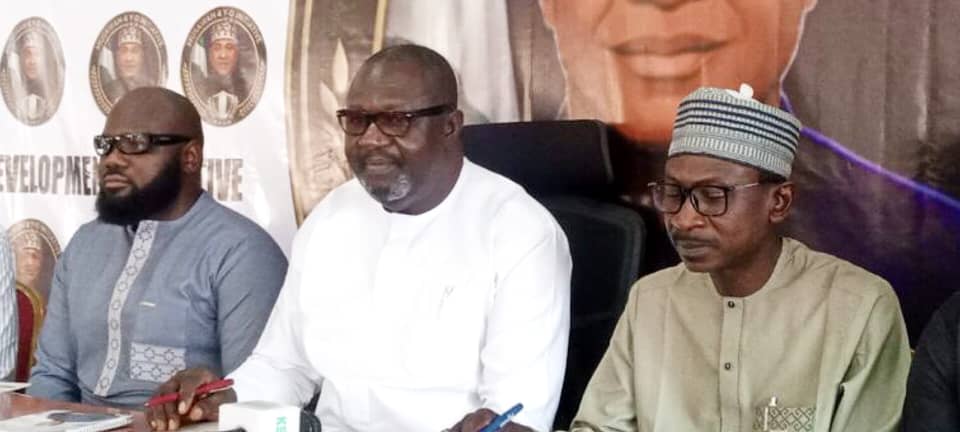
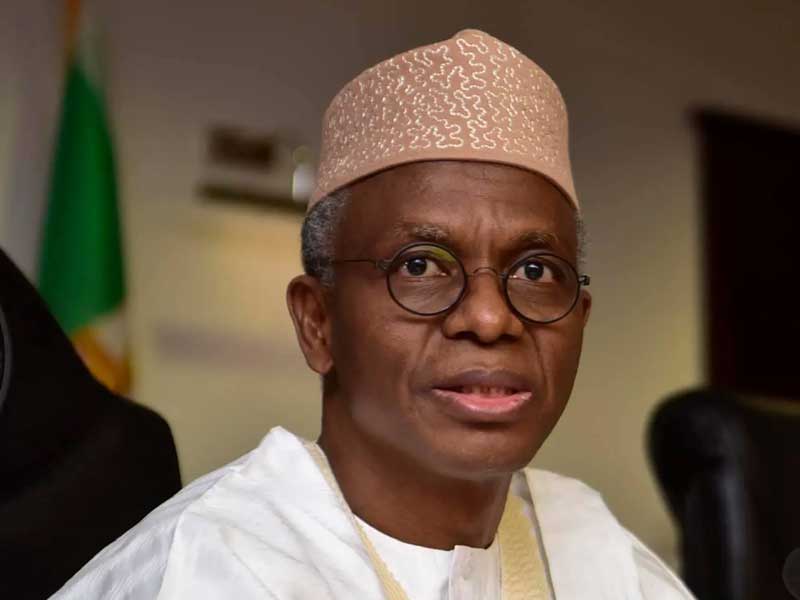
Power Shift at the Grassroots: MUSAWAH Ignites Kaduna with Massive 23 LGA Inauguration

A new wave of grassroots mobilization is sweeping through Kaduna State as the Musawah for Youth and Development Initiative unleashes one of its biggest structural expansions yet, inaugurating 23 Local Government Area (LGA) structures in a single, decisive move.

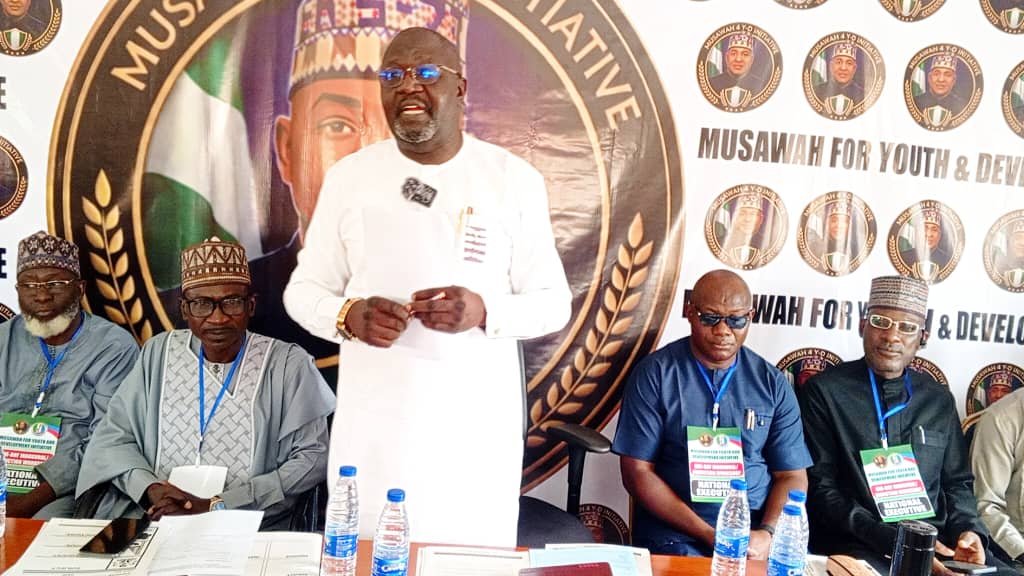
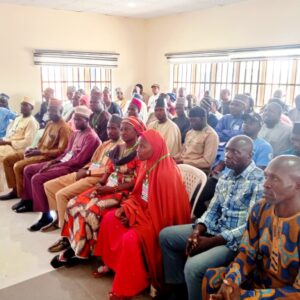
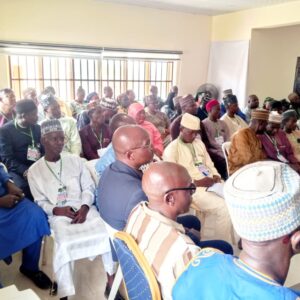
The landmark event, held on March 24, 2026, at the Musawah Head Office in Kaduna, was more than a ceremony, it was a clear signal of rising political consciousness, youth engagement, and coordinated grassroots action.

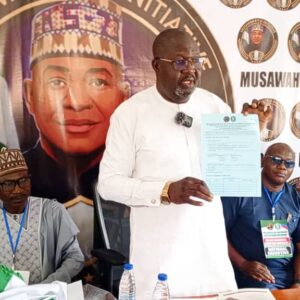
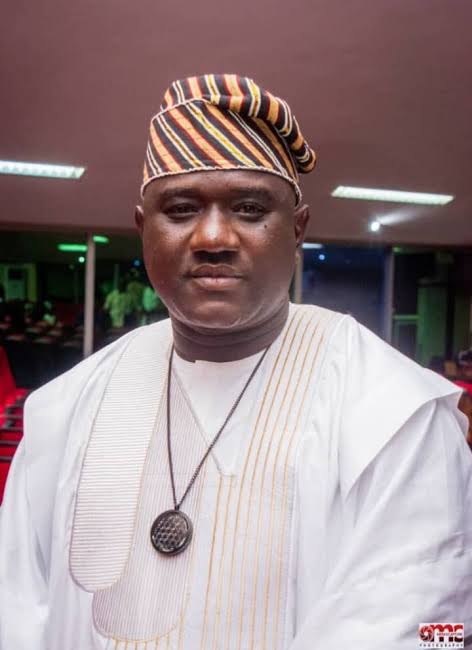
At the center of it all was the National Coordinator, Polycarp D. Gankon, whose message set the tone for what many described as a turning point for the initiative.

“This is not just an inauguration, this is a movement taking shape,” he declared, as newly appointed leaders responded with visible enthusiasm and commitment.

Built on the leadership ideals of Christopher Gwabin Musa, the initiative continues to push a bold agenda rooted in inclusive governance, youth empowerment, and development-focused politics — a message that is rapidly gaining traction across communities.

The scale of the expansion is significant. A total of 92 officials have been deployed across the 23 LGAs, covering key roles such as coordinators, secretaries, women mobilisers, and youth mobilisers. But that is only the beginning.

In what appears to be a strategic masterstroke, Musawah is now moving even deeper, rolling out ward-level structures that will see nine additional officials appointed in every ward — a move set to dramatically widen its grassroots reach and operational strength.

The initiative also used the moment to reaffirm its strong backing for Bola Ahmed Tinubu and Uba Sani, positioning itself within a broader alignment focused on stability, security, and national development.

With chants of “Home for All – Gidan Kowa” echoing through the venue, the message was unmistakable: Musawah is not just organizing, it is mobilizing.

As the dust settles on this high-impact inauguration, one thing is clear — the Musawah Initiative is building more than structures; it is building a movement, one community at a time.

Australian Mining Executive Referred to Australian Federal Police as Kaduna Communities Allege Bribery and Corruption


By Biliyaminu Suraj

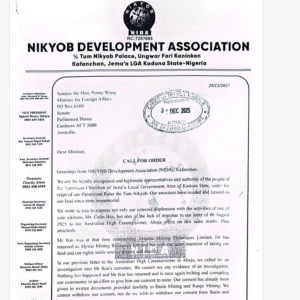
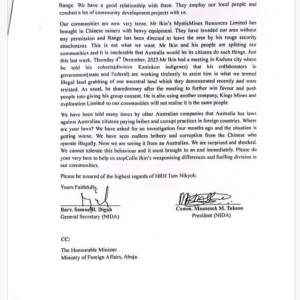
Fresh allegations of coercion, political interference and foreign bribery have emerged around one of Nigeria’s most promising lithium deposits, after community leaders in Kaduna State referred an Australian mining executive to the Australian Federal Police  for investigation.

The case centres on Colin Ikin, an Australian national linked to a cluster of companies — Atlantic Mining Techniques, Mystic Mining and Kings Mines — that have been attempting to secure community consent to operate on tenements discovered and developed by UK-registered Jupiter Lithium Ltd in the Kaninkon Chiefdom of Jema’a Local Government Area.

Community leaders say Mr Ikin and his associates sought to pressure them into granting access to the mine-ready project, despite Jupiter Lithium’s long-standing presence and development work in the area.

Community alleges high-level assurances

According to letters sent to Nigerian and Australian authorities and reviewed by this newspaper, representatives of the so-called “Atlantic group” met the Paramount Ruler in December 2025. The delegation, introduced through a village chief, allegedly told the ruler that they had the backing of  high level Nigerian government officials that Jupiter’s titles would be revoked or “cut into pieces” to allow new entrants – an assertion that, if verified, would raise serious concerns about political interference in the allocation of mining rights in a sector the government has repeatedly described as central to Nigeria’s economic future.

Community leaders say they rejected the overtures, citing Jupiter Lithium’s seven-year record of community development, local employment and a formal Community Development Agreement (CDA). “We refused to give consent to any of Mr Ikin’s companies,” the community wrote in one of several letters to the minister and the DG-NMCO.

A controversial figure resurfaces in Nigeria

Mr Ikin is a familiar figure in Australian mining circles. As head of the former ASX-listed Preston Resources, he presided over the Bulong laterite nickel project near Kalgoorlie — one of Western Australia’s most notorious mining failures. The project collapsed with estimated debts of about A$600 million and accumulated losses of roughly A$750 million.

Nigerian media have previously reported concerns about his activities in other African countries. Individuals familiar with the matter say Mr Ikin is employed by businessman Gilbert Chagoury, and that the companies involved in the Kaduna push are administered by associates linked to the Chagoury network.

Escalation to the Australian government

After receiving no response to multiple letters sent to Nigeria’s Minister of Solid Minerals and the DG-NMCO, the Kaninkon community escalated the matter to the Australian High Commission in Abuja, alleging that Mr Ikin’s conduct amounted to foreign bribery and corruption under Australian law.

When their first two letters went unanswered, the community wrote directly to Australia’s Minister for Foreign Affairs. In January 2026, the Australian High Commissioner advised that allegations involving an Australian citizen should be referred to the Australian Federal Police, which has jurisdiction to investigate foreign bribery and grand corruption offences involving Australian nationals. The community subsequently submitted a formal referral to the AFP’s Taskforce Solaris in Canberra.

The AFP does not comment on ongoing assessments, but any inquiry would likely examine the alleged political assurances Mr Ikin is said to have cited, as well as the corporate structures behind Atlantic Mining Techniques and related entities.

A test for Nigeria’s mining reforms

The dispute comes at a sensitive moment for Nigeria’s mining sector, which the Tinubu administration has positioned as a cornerstone of its economic diversification agenda. Investors say the allegations highlight persistent weaknesses in licensing transparency, political interference and institutional oversight.

Jupiter Lithium Ltd, which has had several of its mining lease titles revoked, has been unable to commence mining on its remaining tenements despite completing exploration and development work. The company said the credibility of Nigeria’s mining reforms depends on adherence to due process. “Transparency and the rule of law must prevail,” a representative said.

For the Kaninkon community, the stakes are immediate. “We have worked with Jupiter for seven years,” a community leader said. “We cannot allow people to come with political backing to take what is ours.”

Whether the Australian Federal Police opens a full investigation may determine how far the allegations reverberate — in Abuja, in Canberra, and across a global critical minerals market increasingly shaped by governance risks.


China’s Increasing Control of Africa’s Mineral Resources


By Biliyaminu Suraj

biliyasuraj247@yahoo.com

Nigeria’s Minister for Mines prides himself on his recent re-election as Chairman of the newly formed Africa Minerals Strategy Group, established by African Ministers of Minerals and Mining to foster cooperation among African nations in the development of critical minerals. Minister Alake is a former journalist and close friend of President Tinubu. During Tinubu’s two terms as Governor of Lagos State it was Alake who managed Tinubu’s media as the Governor’s Commissioner for Information and Strategy.

It is this African Minerals Strategy Group that is leading the push for the introduction of the Madini Protocol, a blockchain platform which will be the Trojan Horse for Chinese control of the African minerals sector.

Since becoming Minister for Sold Minerals Development Alake’s primary focus has been on securing large-scale investments and fostering partnerships for local mineral processing. This has led to the development of several lithium processing plants in Nigeria, primarily backed by Chinese investment. Major Chinese companies such as Canmax Technology, Jiuling Lithium, Avatar New Energy, and Asba have announced investment in lithium processing facilities in Nigeria.

Since late 2025, Canmax has aggressively secured lithium ore to feed its expanding processing faciliies. Canmax Technologies is primarily owned and controlled by its founder and chairman, Mr Pei Zhenhua, alongside his wife, Rong Jianfen. Alake claims Canmax is investing US$200M to develop lithium mining operations in Nigeria, in line with Chinese aggressive moves to control African mineral resources and infrastructure such as ports and railways necessary to exploit the mineral reserves.

Chinese megafirm CATL announced plans to increase its stake in Canmax’s lithium subsidiaries. CATL holds approximately 40 percent of the global EV battery market and almost 70 percent of the NCM (Nickel-Cobalt-Manganese) battery market in China. China as a whole processes approximately 65 percent to 80 percent of the world’s lithium. As the dominant player in China, CATL effectively directs a majority of the lithium hydroxide refined within the country toward its own Gigafactories.

Minister Alake has become a frequent and strong advocate for China’s involvement in Nigeria’s minerals and infrastructure development which has been a hallmark of his many trips to China.

As Chairman of the Africa Minerals Strategy Group, Minister Alake has introduced the Madini Protocol, a Chinese backed blockchain-based platform for trading and digital financing. This hi-tech system is not only designed for tracking minerals from extraction to market but also tracking every person involved in the supply chain including local villagers who may be employed at the mine. The system converts unmined mineral reserves into tradable digital tokens.

In other central Asian countries China state-controlled tech companies are rolling out platforms that turn natural resources including water into digital tokens tradable on blockchain-based platforms and for digital financing. The Chinese companies rolling out deals with governments say there is no limit to what they can tokenize and make tradable on their platforms.

The Madini Protocol, made possible through a collaboration between David Chen (Founder of BLCP Capital, now Chairman of GTIF) and Chris Wong (CEO of LifeSite). LifeSite Inc., is fronted as the technology company behind the TokenX platform and the Madini Protocol. The background of Wong’s co-founders in this hi-tech digital software is interesting. Crystal Lee, a co-founder of LifeSite, was Miss California 2013 and runner-up in the Miss America 2014 pageant. YoonJin Chang, also a co-founder of LifeSite was a former Miss Korea runner-up in 2010.

Wong’s long term business associate is David Chen who founded and led Deloitte’s Chinese Services Group in Mexico. Chen’s experience is primarily with food, health, entertainment and real estate industries before moving into global esports and entertainment through FaZe Clan which achieved a valuation of $725 million via a special purpose acquisition company (SPAC) merger in 2022 only to plunge to a 2026 estimate of $13 million.

Wong and Chen’s Madini Protocol is touted as a vehicle allowing African nations to raise capital via the Africa Mineral Token (AMT). In fact, it is a route for China to capture control of Africa’s mineral resources initially targeting Lithium and Gold. It is promoted by Minister Alake as a means of financing through the digital tokenisation to provide a way for Chinese funding for projects via smart contracts on the blockchain.

The Africa Minerals Strategy Group led by Minister Alake is China’s Trojan Horse to capture control of Africa’s mineral resources through mining infrastructure investment using the Madini Protocol to fund Chinese built and operated ore processing plants. All the while Nigerian officials turn a blind eye to the Chinese sourcing of lithium ore for their Nigerian processing plants from illegal miners, paying protection money to heavily armed militants, bandits and ISIS connected groups controlling increasingly larger areas of Nigeria’s North and Central regions. The extreme insecurity of these areas is a perfect cover for Chinese companies illegally mining who pay terrorists protection money rather than state royalties.

In the Year of the Horse Mines Ministers across Africa, like the people of ancient Troy, may welcome the gift brought to their gates by Minister Alake and his Chinese backed partners only to find it is a Trojan Horse which, once inside the gates, is uncontrollable.


WIKIPEDIA: JUKUN WAPAN LANGUAGE TO GET ITS OWN EDITION 

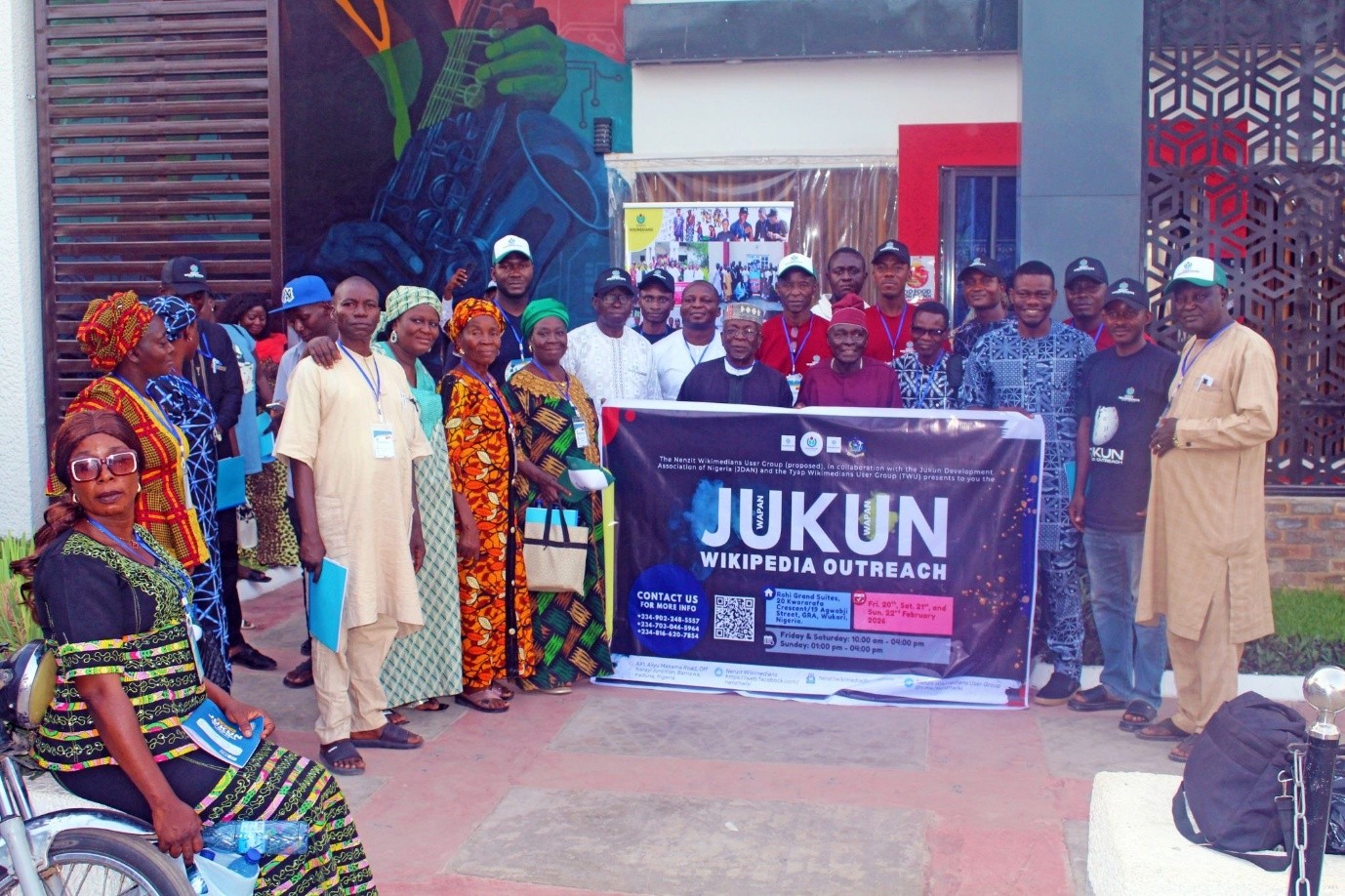
Not less than 50 Jukun Wapan speakers gathered on Friday, 20th February 2026, as the news of the Nenzit Wikimedians team coming to help start the Jukun Wapan Wikipedia was heard, to participate in the Jukun Wikipedia Outreach. The Wikimedia team, consisting of members of the Tyap Wikimedians User Group from Tyap-speaking background (Kambai Akau and Kuyet Friday Musa) and Jju-speaking background (Joshua Jacob Nzamah and Abukam Peter Adamu) on arrival, headed to see the Aku Uka of Wukari in his palace, to brief him of the reason for their visitation. The Aku Uka was very delighted and gave the team his blessings. The Wikimedia team was accompanied to the Aku Uka’s palace by members of the Jukun Wapan bible translation team, led by the coordinator, a retired clergyman and village head of Byepyi, Atando James Kinda Agbu, and another member of the team, Amos Jonathan Ajotsatutu, who made sure that the Wikimedia team was well taken care of. After the visit to the Aku Uka, the team headed back to meet the venue at Rohi Grand Suites, 20 Kwararafa Crescent/19 Agwabji Street, GRA, Wukari, where they began the first of the three-day session with the aspiring editors.
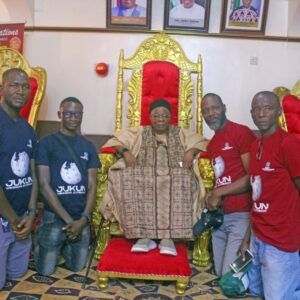
Image: L-R: Friday Kuyet Musa, Kambai Akau, Aku Uka of Wukari (Dr. Ishaku Adda Ali, Matakitswen I), Joshua Jacob Nzamah, and Abukam Peter Adamu. (File:Nenzit Wikimedians and the Aku Uka, Matakhitswen 02.jpg. (2026, March 17). Wikimedia Commons.

The Jukun Wapan language, one of the about 17 Jukunoid languages in existence today, will be the first of them to have a Wikipedia edition in Taraba State, and maybe one of the few languages in the Middle Belt after the Tyap, Igala, Nupe, Jju, and Karekare Wikipedia editions. There are currently language editions like Bole, Berom, and Hyam Wikipedia editions being developed in the Wikimedia Incubator, and Jukun Wapan just got added to the list.

In 2022, the Tyap language, spoken in Southern Kaduna and Plateau States became the very first language in the Middle Belt to get its own Wikipedia. The Tyap Wikimedians User Group became an approved affiliate of Wikimedia Foundation Inc. (WMF), later in the same year, and the Tyap Wikimedians Organisation registered with the CAC in January 2023. Kambai Akau (Levi Kambai Timothy) leads the activities of the group and is supported by Kuyet Friday Musa and other community volunteer staff. Nenzit Wikimedians is a tag for all editors of Central Nigerian (Nenzit or Platoid) languages, consisting of the likes of Tyap, Jju, Berom, Hyam, Jukun, Tarok, Tsuvadi, and many more belonging to the Plateau, Kainji, and Jukunoid subbranches.

The Nigerian Middle Belt boasts of over 200 languages, but most of them are underdeveloped and endangered. The bigger languages spoken in Nigeria, namely: Hausa, Igbo, and Yoruba, including English and Nigerian Pidgin languages, are dominant. These languages tend to have more attention from the Nigerian government at the expense of the minoritized languages. Through the support from the WMF, the Nenzit Wikimedians hope to change that narrative, and document, preserve, and promote the wealth of the cultures of the Middle Belt for posterity’s sake and to instill the needed confidence for the natives of these languages to continue speaking their languages and developing their identity, especially the youths.
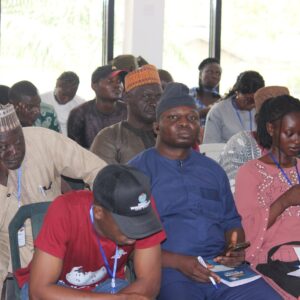
Image: Participants on the second day of events (File:Attendees during the Jukun Wikipedia Outreach 02.jpg. (2026, March 17). Wikimedia Commons. 

The Jukun Wikipedia Outreach was a success. It lasted from Friday, 20th to Sunday, 22nd February, 2026, with Kambai taking most of the workshop sessions, supported by Kuyet and Joshua. Prior to the program’s kick-off, many participants followed the guidelines on the Event:Jukun Wikipedia Outreach page on Meta-Wiki to create their user accounts. In the program, they learned about the Wikimedia sister projects and were shown how to navigate and create their first articles and edit them in the Wikimedia Incubator, where new Wikimedia language editions are developed before being launched publicly. At the end of the event, not less than 140 articles were created by the participants, among which was one of the sons of Dr. Shekarau Angyu Masa-Ibi (Kuvyon II), the previous Aku Uka of Wukari, Prince Ajifada Shekarau, who was an event co-organizer alongside Amos Jonathan Ajotsatutu, Peter Agan, and Sike-Uwbu Daude Gbana. Many writers and scholars of Jukun Wapan extraction were present, and books written in Jukun Wapan were donated to the Nenzit Wikimedians, and others were purchased. The Nenzit Wikimedians were fed with huge wraps of pounded and fish from the Benue River, experiencing the Jukun hospitality at its utmost!
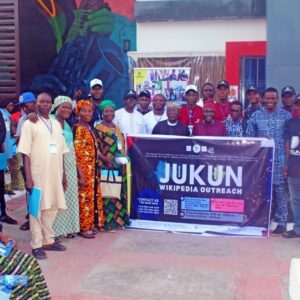
Day 3’s group picture (File:A group photograph on the Day 3 of the Jukun Wikipedia Outreach 2026.jpg. (2026, March 17). Wikimedia Commons.

The top editors in the outreach program were gifted with souvenirs on the last day of the event, with Joseph Atebo N. Afyenakun, Yavini Ladi, and Jibo Paul Aten-wunu topping the first three highest editor ranks. Others were also encouraged to keep editing even after the event, to enable the project to move out of the Wikimedia Incubator within the next couple of months.

The Nenzit Wikimedia team travelled all the way from Kaduna and Zonkwa to attend the program in Wukari, and had to cross the Benue River at Ibi, where the a bridge is yet to be constructed, for the sake of bringing more underrepresented languages in the Middle Belt into lamplight because they take it s a responsibility which they owe the next generations unborn, for the preservation of the identity of the peoples of the region through online open source documentation on Wikimedia sister projects like Wikipedia, Wikidata, and Wikimedia Commons.

The group seeks the partnership of non-governmental organizations working along the same terrain to boost synergy and increase the momentum needed to preserve and enhance the linguistic identity of the underrepresented in the Middle Belt.


Agatu Chairman Commends Peaceful Protest, Moves to Establish Military Base as Displaced Residents Demand End to Killings

The Chairman of Agatu Local Government Area in Benue State, Hon. Melvin Ejeh, has commended the peaceful protest staged by displaced residents of Agatu communities who are demanding an end to persistent attacks and the safe return to their ancestral homes.

Hundreds of internally displaced persons and youths from Agatu took to the streets on March 13 and March 14, 2026, blocking sections of the Oweto–Otukpo highway near the Oweto Bridge in a dramatic demonstration against the continued killings in their communities.

The protesters, many of whom have lived in makeshift shelters for years after fleeing repeated attacks, carried placards with inscriptions such as “Stop Agatu Killings Now,” “Save Agatu Land,” and “Let Us Return to Our Farms.” They accused armed Fulani militants of driving them from their ancestral villages and demanded urgent intervention from both the federal and state governments.

Their key demands included:

· Immediate deployment of adequate security forces to Agatu communities
· The safe return of displaced farmers to their ancestral lands
· The dismantling of armed groups operating in the forests and rural settlements
· Government protection for farming activities ahead of the planting season

Agatu, a predominantly agrarian area in Benue State, has endured years of violent attacks linked to the broader Fulani militant attacks in Nigeria’s Middle Belt. The crisis has resulted in the destruction of villages, displacement of thousands and significant loss of lives over the past decade.

Reacting to the protest, Ejeh said he understood the frustrations of the displaced residents and acknowledged their right to demonstrate peacefully.

“I want to say that I understand why the protesters embarked on this peaceful action, and I wish to state that they have every right to protest and demand the opportunity to return to their ancestral lands,” he said while speaking to our correspondent.

The council chairman also revealed that concrete security measures were already underway to stabilize the area and restore confidence among displaced residents.

“As we speak, I have made available all the necessary arrangements to bring in a military base in Agatu and closer to the areas of conflict,” he said.

According to him, the proposed security deployment would not be symbolic but operationally robust.

“This military unit would be equipped with the latest kinetic and modern weapons. They will be armed with armoured vehicles, tanks and drones. Furthermore, they will not remain on the highways but will be embedded with the villagers in the affected communities.”

Ejeh added that the military would work closely with local security structures.

“The troops will operate in conjunction with local vigilante groups in Agatu to ensure that every community is adequately protected.”

He emphasized that the people of Agatu have endured too much violence and instability.

“We have had enough of bloodshed, killings and death in Agatu land,” he said.

Ejeh further disclosed that he had already consulted with key authorities regarding the plan.

“I have discussed with the state governor and the military officers in charge of Operation Whirl Stroke, and they have agreed with my plans to strengthen security in the area.”

Observers note that the chairman’s response reflects growing pressure on authorities to address the humanitarian and security crisis facing displaced communities across parts of Benue State.

In recent months, Ejeh has also taken a firm stance on the presence of armed pastoral groups in the area. Community leaders say he previously issued directives instructing Fulani herders operating illegally within Agatu territory to vacate the land in order to prevent further clashes and protect farming communities.

While the security situation remains fragile, many residents view the chairman’s proactive engagement with both the military and state authorities as a step toward restoring stability.

For displaced families who have spent years away from their homes, the hope is that the current momentum driven by both community advocacy and government response may finally pave the way for their safe return to the lands they have long called home.

MUSAWAH FOR YOUTH AND DEVELOPMENT INITIATIVE IN RESPONSE TO THE MISGUIDED UTTERANCES OF OMOYELE SOWORE AND ONE ABDUL DAN BATURE ON THE MINISTER OF DEFENCE GEN CHRISTOPHER MUSA


TEXT OF A PRESS CONFERENCE BY THE MUSAWAH FOR YOUTH AND DEVELOPMENT INITIATIVE IN RESPONSE TO THE MISGUIDED UTTERANCES OF OMOYELE SOWORE AND ONE ABDUL DAN BATURE ON THE MINISTER OF DEFENCE GEN CHRISTOPHER MUSA HELD AT THE MUSAWAH HEAD OFFICE, KADUNA ON THURSDAY 12TH MARCH, 2026.

Gentlemen of the Press:

Our attention has been drawn to a recent public statement and social media videos in which Mr. Omoyele Sowore and a so-called group Arewa Youths, led by one Abdul Dan Bature, launched attacks against the Honourable Minister of Defence, General Christopher Musa.

In the circulated remarks, Dan Bature called for the removal of the Honourable Minister from office over rising insecurity while Mr. Sowore publicly mocked the Minister’s proposal to strengthen Nigeria’s border security, ridiculing the suggestion that Nigeria should reinforce its borders to reduce insecurity.

These statements have generated significant online debate. However, they have also contributed to misinformation and unnecessary politicisation of a very serious national issue.

 The Distinguished Service Record of General Christopher Musa

General Christopher Musa is not a social media personality. He is a career military officer who has devoted decades of his life to the Defence of Nigeria.

Throughout his professional career in the Armed Forces, he has served in numerous operational and strategic positions and has played key roles in the fight against insurgency, terrorism, and banditry across different regions of the country.

Like many security leaders around the world, he also communicates publicly to explain national security challenges and reassure citizens. Responsible communication with the public should never be mischaracterised as “content creation.”

Questions That Must Be Asked 

While criticism is part of democracy, Nigerians are also entitled to ask important questions about those who make sweeping attacks against national security leadership.

At a time when Nigerian soldiers are risking their lives daily in the fight against terrorism and banditry, why would public commentators choose to ridicule national security discussions instead of supporting efforts to strengthen them?

It is unfortunate that Sowore has refused to be serious in his life, always behaving like a street charlatan who does not understand governance yet he wants to be president of over 250 million Nigerians. His choice of words against the minister of Defence shows how disrespectful, irresponsible, parochial and rude he can be, little wonder he can’t ever achieve his leadership aim. 

Or is there something Sowore is benefitting when serious national security discussions are reduced to political theatre designed primarily for social media attention?

For Dan Bature, the so-called Arewa Youth leader, we advise that you should join others to support the minister in his quest to restore peace across communities in Nigeria instead of joining forces against him. The north is facing multiple security challenges and the minister is doing his best to stem the tide. He does not need distraction now from road side gossips. For President Bola Tinubu to have appoint Gen. Christopher Musa Minister of Defence after he served as Chief of Defence staff means he trust his capacity and ability to deliver.

A Call for Responsible National Dialogue

Nigeria’s security challenges are too serious to be trivialised through sensational commentary or politically motivated attacks.

Constructive criticism is welcome in a democracy. However, such criticism must be responsible, informed, and directed toward strengthening national institutions rather than undermining public confidence in them.


We therefore call on all public commentators, activists, and political actors to approach discussions on national security with the seriousness and patriotism the subject demands.


Nigeria’s security must remain a shared national responsibility.


Thank you and may God bless the federal republic of Nigeria.


Signed,


Amb. Dr. Polycarp Gankon

National Coordinator

Musawah For Youth & Development Initiative

Court of Appeal Reserves Judgment on Elrufai’s Order That Scrapped Friday Work and School Days in Kaduna


By Steven Kefas

A significant legal battle over the constitutional validity of a controversial executive order that effectively eliminated Fridays as a working and school day in Kaduna State moved a step closer to resolution on Wednesday, as the Court of Appeal, Kaduna Division, reserved judgment in the matter of Gloria Mabeiam Ballason v. Governor of Kaduna State and 3 Others, Appeal No: CA/K/104/2023.

The three-man panel, comprising Hon. Justice Onyekachi Aja Otisi, Hon. Justice Abimbola Osarugue Obaseki-Adejumo, and Hon. Justice Sybil Onyeji Nwaka-Gbagi, heard arguments from both sides on 11 March, 2026, before reserving the appeal for judgment.

The case centres on an executive order issued by former Kaduna State Governor, Mallam Nasir Ahmad Elrufai, which took effect on 1 December, 2021, reducing the official working and schooling week from five days to four. Under the order, Fridays ceased to be working days for civil servants and school days for pupils across the state. Remarkably, despite El-Rufai’s departure from office, the policy has remained in force to this day, making it over four years since Kaduna residents lost the Friday workday.

Gloria Mabeiam Ballason, a prominent human rights lawyer and the appellant in this matter, argues that the executive order is unconstitutional and has caused measurable harm to workforce productivity, school children’s education, and her own professional legal work. Appearing in person to argue her case, Ballason adopted her filed briefs and urged the appellate court to allow the appeal and set aside the ruling of the lower court, which had previously ruled against her position.

Appearing for the 1st, 2nd, and 3rd Respondents was Dr. J.A. Kanyip, the Attorney General of Kaduna State, who was accompanied by a legal team including A.A. Aku Esq., S.M. Gamaliel Esq., M.P. Danjuma Esq., and Koni Tauna Esq. The respondents similarly adopted their briefs and urged the court to uphold the lower court’s ruling and dismiss the appeal.

Notably absent was any representation for the Minister of Interior, named as the 4th Respondent in the suit, despite evidence presented to the court confirming that the Minister’s office had been properly served with hearing notices. The court took note of this absence.

Background to the Matter

When Elrufai announced the four-day work week in late 2021, it was one of several sweeping administrative decisions that defined his controversial second term as governor. The order applied to civil servants and public schools across Kaduna State, with Fridays effectively becoming a non-working day. Proponents of the policy argued it could reduce overhead costs for the state government and offer workers an extended rest period. Critics, however, raised immediate alarm about the impact on service delivery, the disruption to children’s schooling calendars, and whether a sitting governor possessed the executive authority to unilaterally restructure the working week without legislative backing.

Ballason’s case strikes at exactly that question of constitutional authority. Her suit contends that an executive order of this scope, one altering the fundamental structure of public employment and public education, exceeds the powers of a state governor acting alone, and that the policy as implemented violates applicable constitutional provisions.

What makes the case particularly striking is its longevity. Elrufai left office in May 2023, and yet his successor’s administration has allowed the four-day order to stand, meaning the policy has now outlasted the man who created it. Workers, schoolchildren, and professionals across Kaduna State continue to operate under an arrangement that was never subjected to legislative debate or public consultation.

With judgment now reserved, the Court of Appeal’s decision will carry far-reaching implications, not only for Kaduna State, but potentially setting a precedent on the limits of gubernatorial executive power across Nigeria’s northern states.

Middle Belt Times will report the judgment as soon as it is delivered.

Soldiers Not Protecting Middle Belters But Protecting Cows

By Mike Odeh James

A recent Punch report celebrated Nigerian soldiers for foiling a cattle-rustling attempt in Agatu Local Government Area of Benue State, complete with photographs of arrested men proudly displayed like trophies. The comments section was having none of it.

“This is the only thing the Nigerian Army knows how to do — guide Fulani terrorists to kill Benue citizens, then arrest innocent Benue youths and parade them as cattle rustlers to justify the killings,” one reader wrote.

That is not an exaggeration. That is a pattern.

The men arrested are not criminals by disposition — they are indigenes of a land soaked in the blood of their own people; survivors of years of Fulani terrorist massacres who have buried neighbours, fled burning homesteads, and watched their farmlands annexed by armed herders. The military knows this. It does not care.

These same soldiers — fully aware that Benue State has a legally operational anti-open grazing law — have deliberately looked the other way as Fulani herders brazenly violate that law, driving cattle across cultivated farmlands, destroying harvests and livelihoods, without a single arrest, a single query, or a single apology.

The selectivity is not incompetence. It is policy.

In Amadu, Taraba, soldiers ignored repeated community distress calls about Fulani attacks — then swooped in to arrest local men the moment Fulani complainants pointed fingers. In Abaji Kpav, troops deployed ostensibly against militants instead turned their boots on the very villagers they were sent to protect, beating elders and humiliating residents.

The Nigerian Army owes the Middle Belt an explanation. Who exactly are these soldiers serving — the Nigerian constitution, or the herdsmen’s cattle?