Appraising Buhari’s War on Terror
Comrade Emmanuel Onwubiko

By

Emmanuel Onwubiko

Last week, the Reverend gentleman who is the Special Adviser on Media and publicity to President Muhammadu Buhari in the person of the erstwhile Managing Director of the Daily Sun newspaper Mr. Femi Adesina told his audience that within days the administration would showcase a documentary on the milestones madecin two years of the second and final constitutionally permitted term of the President. 

Most Nigerians battling with how to overcome the economic challenges foisted on them essentially by the consequences of the Covid-19 PANDEMIC did not actually take him serious. Moreso, the Spokesman of the President is a man who has consistently defended the policies of the administration some of which have adverse economic consequences on the living conditions of millions of Nigerians. However, the documentary has actually been shown. But this is not the theme of this write up which essentially represents the official position of the non governmental body that I have led since the last fourteen years known as HUMAN RIGHTS WRITERS ASSOCIATION OF NIGERIA (HURIWA). This reflection of my group is on the positive trends made by the federal government in the area of arms procurement process that began when LIEUTENANT GENERAL TUKUR YUSUF BURATAI headed the Nigerian Army for nearly 6 years since 2015 up ubtil he voluntarily retured from active soldiering work and was tapped for another international assignment for Nigeria as the Country’s Ambassador to Benin Republic.  During his years in service as Head of the Army General Buratai established a system of transparency and accountability in all aspects and in the area of procurement of weapons,  he made the process so open and subject to public scrutiny in such a way that the media captured moments when those weapons were procured, delivered and deployed. In one of those public occasions, General Buratai said the equipment has aided military operations against bandits and Boko Haram/ISWAP terrorists in the North East.

The media reported then that the Nigerian Army had inducted eight units of locally made combat vehicles Mine–Resistant, Ambush–Protected (MRAP), also called `EZUGWU’’ into Operations Lafiya Dole and Sahel Sanity.

The then Chief of Army Staff, Tukur Buratai, who made this known at the inauguration of the vehicles in Kaduna, said the equipment has aided military operations against bandits and Boko Haram/ISWAP terrorists in the North East.

The News Agency of Nigeria (NAN) reports that the vehicles, which are designed specifically to withstand improvised explosive device attacks and ambushes, were manufactured by the Command Engineering Depot, Kaduna.

General Buratai, who was represented by the Commandant Nigerian Defence Academy (NDA), Jamil Sarham, also inaugurated the Smart Factory also called Additive Manufacturing Technology, Vehicles Assembly shop and Officers/Soldiers accommodation at Command Engineering Depot (CED).

“The vehicles have significantly improved our capability to defeat our common adversary, Boko Haram and the Islamic State of West Africa Province,’’ he said.

The army chief said that the induction of the vehicles was a “clear testament to the unprecedented commitment of the Nigerian Army to building industrial capacity of the CED to undertake in-depth Research, Development and Innovation (RDI).’’

“Today, one of the greatest challenges facing the Armed Forces of Nigeria (AFN) and other security agencies is an outright reliance on importation of defence logistics from allies.

“Accordingly, President Muhammadu Buhari posits that Nigeria’s dependence on other countries for critical military equipment is unacceptable, the country must evolve (a) viable mechanism for near self-sufficiency in military equipment and logistics production,’’ he said.

General Buratai said that the president’s charge, therefore, made the Nigeria Army to initiate collaboration among CED, Defence Industries Corporation of Nigeria and Buffalo Engineering Technical Services Ltd., to produce the local MRAPs.

He said that additional defence logistic requirements produced through the collaboration include “Light Armoured Tactical Vehicle, Special Patrol Vehicle, Mobile Field Bakery and Mobile Borehole Drilling Machine among others.’’

“Succinctly, these platforms are aiding the Nigerian Army to perform its constitutional roles across all spectra of warfare such as the ongoing counter insurgency operations in the North East and other operations.’’

Earlier, the Commander, Engineering Depot, Sunday Araoye, said the induction of the vehicles was a clear manifestation of the Nigerian Army’s commitment to enhancing the industrial base in the country.

Araoye said that the uncommon approach was adopted in fabricating the hardware for the armed forces and other security agencies in the country.

The then Chief of Army Staff, Lt.-Gen. Tukur Buratai, had also in Kachia, Kaduna State, inspected and inducted new set of artillery guns and equipment to be deployed for operations in the North East.

General Buratai also inaugurated the new Headquarters complex for the Nigerian Army School of Artillery, NASA, as well as  inspected several ongoing projects in the school and the barracks’ community.

The News Agency of Nigeria reported that the Federal Government, through the Ministry of Defence, procured the brand new artillery guns and equipment.

The guns are field artillery pieces and some of the equipment are vehicle ultra-light carriage for artillery and self propelled light gun series whose identity and specification would not be published for security reasons.

 Speaking to journalists after the commissioning ceremony, then spokesman of the Nigerian Army, Brig- Gen. Sagir Musa said the COAS was in the NASA to inspect and test fire the guns, in line with his vision of ensuring a conducive working environment for officers and men of the Nigerian Army.

“It was in this vein the COAS commissioned the ultra-modern NASA Headquarters here in Kachia today which you just witnessed.

“Given the quality of work done, that singular act is commendable and will help in enhancing the productivity of officers and soldiers of the Nigerian Army School of Artillery”.

“The new artillery guns inspected by the COAS will be inducted into the Northeast Theater of Operation Lafiya Dole in the North East”, Brigadier General Musa said. 

Therefore, Appraising the progress so far recorded in the war on terror, especially with the purchase and delivery of the first batch of the Tucano Jets, the foremost pro-democracy and leading civil rights advocacy group; Human Rights Writers Association of Nigeria (HURIWA) has commended the level of commitment of the current administration of His Excellency, President Muhammadu Buhari in the war against terror through his efforts in arms procurement since its inception in 2015.

A statement endorsed by the National Coordinator; Comrade Emmanuel Onwubiko quoted HURIWA as saying that there were hitherto a number of significant difficulties for the Nigerian military in what was termed the “Long War on Boko Haram;” ranging from weapon system acquisitions and personnel drawdowns, Nigeria’s denied access to sophisticated weapons in the past and the past administration’s mismanaging and embezzling of funds meant for weapons procurement.

However, at the inception of the President Muhammadu Buhari administration, one thing was clear to all, here was a soldier’s soldier coming to tackle a most difficult and daunting task of winning the war against terrorism.

Before the Buhari administration came into the office, the previous administration for the most part of its six years of existence had battled, albeit unsuccessfully the Boko Haram terror group,  adjudged as one of the deadliest, if not the deadliest in the world. Such was the enormity of this task.

Although the reins of governance fell into Buhari’s way through his victory at the 2015 elections, the task of fighting terror was given to one of Nigeria’s most loyal military officers in the person of  General Tukur Yusuf Buratai by his appointment as the Chief of Army Staff in 2015 and by extension the man upon whom the biggest responsibility yet, in recent times fell upon not only to win a most unconventional warfare against terror, but to organize a largely disillusioned, ill-equipped, low in morale army, that had so suffered on many fronts, in organization, motivation and infrastructure, more than in the fronts fighting terror”, HURIWA informed.

Highlighting the efforts the current administration has made in arms procurement right from the past Chief of Army Staff; Lieutenant General Tukur Yusuf Buratai (rtd.) and his counterparts held sway, HURIWA recalled that on December 14, 2017, Nigerian governors had approved the release of $1bn from the country’s excess oil account to the federal government to buy arms for the effective execution of the Boko Haram war.

The approval, which reportedly reduced the $2.3bn Excess Crude Account by half, HURIWA noted that development had generated heated debate with some analysts saying the money would be stolen just as the rights group stated that though some governors from the South rejected the approval, the Edo State Governor, Godwin Obaseki, briefed the press on the decision after the meeting of the National Economic Council (NEC), during when he assured that the money would cover the whole array of needs which included purchase of equipment, training for military personnel and logistics.

Subsequently, in April 2018, in a letter to the National Assembly, Buhari disclosed that the sum of $496m was withdrawn from the Excess Crude Account for the purchase of military aircraft. However, the money was paid to the United States for the 12 Super Tucano aircraft nation’s fight against terrorism.

On July 22nd, 2021, The Nigeria Airforce (NAF) announced it had received the first batch of six A-29 Super Tucano aircraft from the United States since its purchase in 2018, with the last batch due to arrive before the end of the year. This was disclosed in a statement by the Director of Public Relations and Information for NAF Headquarters; Edward Gabkwet in Abuja.

The aircraft represented a historic level of partnership achieved between the US and the Nigerian military. This is because, beyond the new hardware on the runway, this programme has brought the two nations’ militaries closer in formal training, professional development, air base construction, logistics planning, and negotiations. We are pleased with this partnership approach to end violent extremism and ensure a more stable, prosperous country for all Nigerians,” HURIWA added.

Also HURIWA informed that beyond the Tucano Jets, various procurements had been made for the purchase of critical equipment for the army, navy and air force, in support of the war on terror contrary to allegations.

Quoting the senior special assistant to President Muhammadu Buhari on media and publicity; Garba Shehu, HURIWA revealed thus: “Various other military procurements for critical equipment have been made. These are for the Nigerian Army and the Nigerian Navy, amounting to $380.5m. These procurements include money for the purchase of Navy Lynx helicopters.

The total amount spent is $876.8m. The equipment paid for has due dates of delivery of between six months to two years. Balance of the money that is unspent as at March this year is $123.1m”, HURIWA quoted Garba Shehu to have said.

Furthermore, rejecting the integration policy of the government which favours terrorists, the rights group emphasized on the need for the administration to widen the scope of the war on terror by bringing terrorists to justice adding that the policy is serving as potential recruitment grounds for terrorists since terrorists who are released mostly return to their bad ways because its ideological and the process of deradicalisation is not adequately implemented in Nigeria due to lack of expertise within Nigeria for such.

Although, for a successful counter-terrorism campaign, scholars and conflict practitioners emphasize a combination of military and non-military strategies. While a military strategy is useful to weaken the military capacity of terrorists, non-military strategies including negotiations, deradicalization, disarmament, rehabilitation, reintegration, and other soft measures are advanced to tackle the underlying problems fuelling terrorism to achieve a long-term peaceful outcome.

While within the non-military approach, deradicalization program is very significant, especially in combating religion- or ideology-motivated terrorism, given that the strategy not only aims to deconstruct extremist ideologies but also facilitates the rehabilitation and reintegration of ex-combatants and victims of violent extremism, the design and implementation of the deradicalization program of the Nigerian government towards countering Boko Haram have structural weaknesses that has further contributed to the problem of violent extremism, the rights group explained.

HURIWA therefore craved that the process of bringing suspected terrorists to justice could be fast-tracked, explaining that the criminal jurisdiction of a court is activated through a formal charge before a court of competent jurisdiction. “So, without a formal charge filed against a suspect, the machinery of justice via the judiciary has not been set in motion”.

However, HURIWA pointed out that it is important that security agencies conclude investigations before the prosecution of persons or organisations indicted, adding that those could be handled with every sense of urgency. “This cannot be done by mere lip service but by concentrated positive efforts, which is presently lacking since the Terrorism Act seems to be in abeyance and relegated to the background with the reintegration policy of the government being proposed for arrested suspected terrorists.

If the suspected terrorists are granted amnesty, it definitely would be applicable to their sponsors too. So, we are invariably back to square one, where the will to enforce existing law is lacking,” HURIWA reasoned.

Noting that terrorism is a global challenge, HURIWA warned that except suspects are prosecuted and punished for crimes against humanity with concerted global collaborations, sponsorship for terrorism would continue to evolve.

Hence, HURIWA concluded by condemning the general state of insecurity, occasioned by payment of ransom to terrorists when they abduct citizens. “What can we call our present situation where bandits kidnap people and are paid ransom by the government? Is that not a form of sponsorship for terrorism?” HURIWA asked. We urge that the wealth of experiences of past Service Chiefs including the strategic thinking of Generals such as Buratai should be tapped so the current Army Chief of Staff Lieutenant General Yahaya Faruk who has started well can be able to finish the war on terror in no time. 

*EMMANUEL ONWUBIKO is the Head of HUMAN RIGHTS WRITERS ASSOCIATION OF NIGERIA (HURIWA) and blogs @www.thenigerianinsidernews.com, www.huriwanigeria.com. 

Networks Shutdown: A Mere Charade, Terrorists Still Attack and Kill at Will
Steven Kefas

By Steven Kefas

Reactions have continued to trail the decision of the Nigerian government to shutdown telecommunications network in states affected by terrorism in the North-West region of the country. States such as Katsina, Zamfara, Sokoto, Kaduna and even neighboring Niger in the North Central have had telecommunications network shutdown in several local government areas.

The Nigerian Communication Commission (NCC), the agency saddled with the responsibility of overseeing and managing all communication architectures in the country ordered the shutdown of telecommunication networks in early September 2021 citing the war against terrorists elements in the region as yardstick.

In Katsina state, the President’s home state for example, at least 13 local government areas believed to be under the control of terrorists had telecommunications network shutdown since early September. This came after initial denial from the NCC that such was going to happen.

Neighboring Zamfara state also shutdown telecommunications network in the entire state for several weeks while Sokoto state did the same for 14 local government areas.

Niger state and also Kaduna state implemented network shutdown in parts as telecommunications networks in several local government areas were also shut down all in the guise of fighting terrorists.

While the states and federal government wants Nigerians to believe that the network shutdown is actually achieving the desired results, the realities on ground prove otherwise as the terrorists have not relented in their nefarious activities since the shutdown.

Even though the shutdown may have achieved some results in terms of diminishing the terrorists’ capacity to operate, the demerits outweigh the merits as over 300 people have been killed across the five troubled states of Katsina, Sokoto, Zamfara, Kaduna and Niger since the shutdown was implemented in September. A figure many like myself believe to be too high considering the fact that a much publicised military operation is ongoing in the region.

Abductions have also continued unabated as the terrorists have devised means of communication such as using satellite phones to bypass the effects of the shutdown or using network architectures in Niger Republic to carry out their operations.

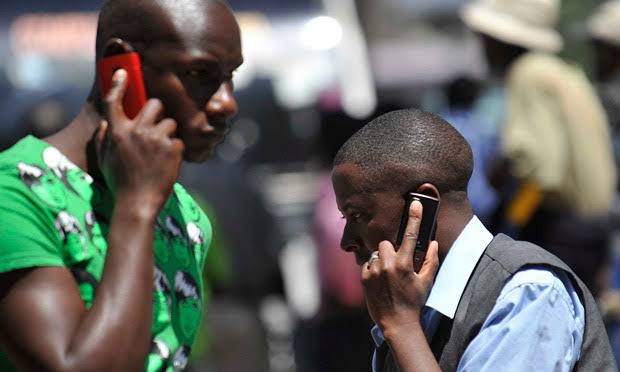
In an interview with dailytrust, a popular Nigerian based newspaper, terrorists commander, Shehu Rekeb boasted that the shutdown of telecommunication networks in the area does not stop them from operating as they now use thuraya satellite phones which do not require the conventional GSM network to function. Rekeb also said that certain GSM networks still operate in some parts of the states where the shutdowns were in effect.

“There are places you can make calls if you have Glo aand Airtel lines,” he told the Daily Trust September 13. This further raises questions on the sincerity of the telecommunications network shutdowns in the area.

A resident of Zamfara who relocated to Kaduna in late September told me under the condition that his identity must be anonymous that some areas still have globacom and Airtel networks making it possible for the terrorists to still communicate and launch attacks on communities. His testimony further confirms the claim of Shehu Rekeb.

Aside from the huge negative impacts the network shutdown is having on citizens who rely on networks to carry out their daily legitimate productive activities, the shutdown has also failed to improve the security of the citizens of the region as the terrorists still carry out deadly attacks on communities almost on a daily basis. This week alone over 30 people have been killed in separate attacks in Zamfara and Katsina communities despite the ongoing military operations and network shutdown. On 26 of September, 38 people were killed by terrorists in Madamai and Abun communities in Mallagum district of Kaura local government area of Kaduna state. In the same week another 60 were killed in Sokoto and Niger communities in separate attacks.

Even the military fighting the terrorists in the North West are not exempted from the negative impacts of the network shutdown. On 11th of September 12 military personnel paid the supreme price when terrorists took advantage of the shutdown and launched a deadly attack on a forward military operation base in Mutumji, Zamfara state. Reacting to the attack, a too military source told dailytrust that the shutdown made it impossible for the troops to communicate amongst themselves when the terrorists attacked.

“While the jamming of GSM in Zamfara has gone a long way in taming the bandits, it also has a negative effect on troops because communication among them was also extremely restricted,” the source said.

“Most of the foot soldiers relied on normal phone networks instead of any of the specialised communication gadgets that should be deployed during operations such as the one going on in the North West.

“Only the top commanders have military radio or walkie-talkie, meaning those in the frontlines would only use their personal mobile phones which are no longer accessible.

“The bandits took advantage of this and attacked them at their forward operation base. As you can see, the attack was launched on Saturday but it only came to the fore days after,” he said. Another source said there was the need to deploy specialised communication gadgets for the troops.

“The ban on communication in Zamfara and parts of Katsina is not bad in its entirety but the military high command should have taken note of the adverse effect on troops.” The military source said.

In the same vein, another security source told Dailytrust in September that the telecommunications network shutdown was not ‘well-thought-out and bypassed the due process of getting clearance from the National Security Adviser (NSA), Babagana Monguno, who oversees cyber security’.

In as much as some sessions of the Nigerian media would want to paint a scenario that the network shutdown and ongoing military operations in the North-West have achieved the desired results, citizens in the areas are daily counting their losses in the forms of burying their loved ones and inability to even send SOS calls when under terrorists attacks due to absence of telecommunication networks in the area.

Socioeconomic activities that rely solely on telecommunication network facilities to function have also been crippled in the region forcing many to be out of jobs in an economy where inflation is currently on an all time high.

The Federal government must as smarter of urgency and national importance review the ongoing suspension of telecommunication networks in the North-West region to ensure necessary measures are out in place to achieve maximum results.

Dealers of the so-called thuraya satellite phones in the country must be investigated and possibly prosecuted for aiding and abetting terrorists activities in the country.

Award-winning TV Reporter Lauds Citizen Journalists of Plateau State

Faults Barak Obama for Subverting War on Terror in Nigeria

Self-taught journalists in the Jos metropolitan area are the featured truth tellers of a ground-breaking documentary on the Nigerian conflict produced by Fox Nation reporter Lara Logan. Lawrence Zongo and Masara Kim, Plateau State natives, collaborated for months with war correspondent Logan to make the 38-minute film, which is the Fox News corporation’s first in-depth examination of the tragic loss of life some call Nigeria’s “Silent Slaughter.”

It will be reported at an invitation-only Press Conference in Miango on October 15 where elected lawmakers and community leaders will acknowledge the Rural Watch achievement.

The film has been excerpted in segments on the YouTube channel of ICON PSJ media: https://youtu.be/94bVIPo5yPI

Logan, known in the United States as an award-winning war correspondent, delves deeply into the views and motivation of five reporters associated with a group Zongo created called “Rural Watch.” The mentor of the group is Washington-based editor Douglas Burton, who enables the Rural Watch writers to get published in The Epoch Times. Lawrence Zongo, a high-school history teacher and human rights activist, teamed with Masara Kim, a respected conflict reporter in Jos, Luka Binniyat in Kaduna, and Tom Garba in Adamawa as well as many others.

The film credits the Nigerian reporters for making the dangerous and painstaking trips into rural villages in the Middle Belt to get testimonies of the victims and their families. Logan takes pains to stir the conscience of the West, long accused of being a “conspiracy of silence.” “Masara Kim,” she says in her narration, is the “eyes and ears of a world that doesn’t care.” After months of interviews with the conflict reporters and Nigeria asylum seekers in the West, Logan cuts through the fog of war to show who in Nigeria is killing who and why.
Dr. Sulieman Yahaya Kwande, a former Representative of Bassa/ Jos North from the ruling party of All Progressive Congress (APC), has said that “Killings of any religion or tribe is an evil act and against the will of God. Nigeria authority should take quick action and stop such killings, I appreciate Lara Logan and the team of Rural Watch News for the timely report.”

“This documentary has been produced to open the heart, eyes and conscience of an otherwise unperturbed world to the wanton cruelty of bands of murderous Jihadists. I strongly commend this great effort,” according to Dr. Pogu Bitrus, National President of the Middle Belt Forum.

A respected scholar in Washington D.C. has said the film exceeded her expectations. “Even for those of us informed about the Fulani and Boko Haram atrocities — this film is an eye opener,” wrote Nina Shea, director of the Center for Religious Freedom at the Hudson Institute.

Among several revelations in the film, Logan documents how Barak Obama rebuffed President Goodluck Jonathan when he needed arms to fight Boko Haram and put its weight behind the election of Muhammadu Buhari.

The press event coincides with the grim anniversary of a massacre of 29 Christian villagers in a classroom of LEA Primary School Nkiendoro, for which no one has been held accountable.
“They were looking for refuge at a military base to hide from their attackers, yet they were locked in the classroom and killed by Muslim Fulani terrorists as a result of the negligence of the Military,” according to Zongo.

At least 20 Killed, 90 Wounded As Bomb Rocks Shiite Mosque In Afghanistan During Prayers

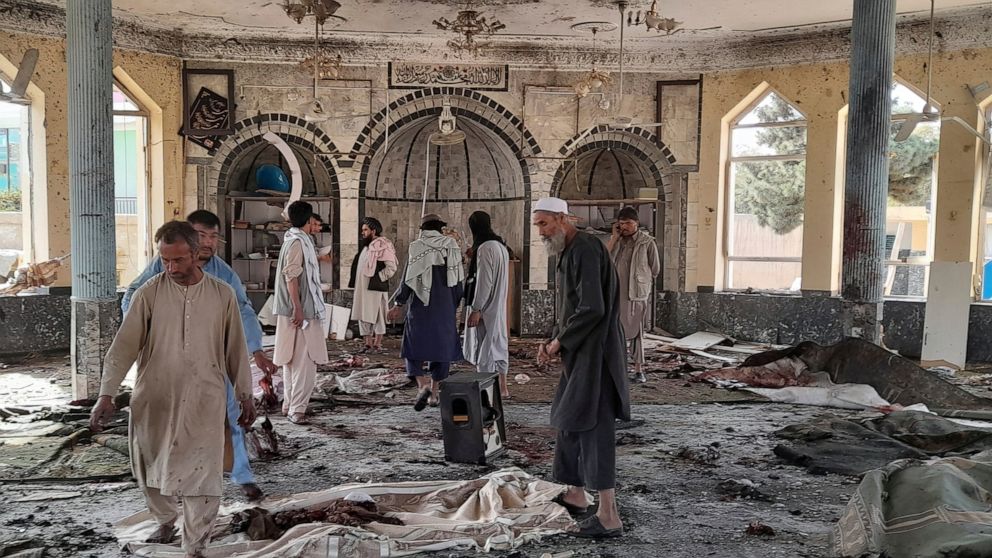
No fewer than 20 people were reportedly killed and 90 others injured in a mosque explosion during Friday prayers in Kunduz city, capital of Afghanistan’s northern Kunduz province.

Asuicide bomber was said to be responsible for the blast, CNN reports. 

An official with Doctors Without Borders (MSF), Sara Chare noted that some of those killed and wounded were brought to the NGO’s facility in the city of Kunduz, and that the number of dead could be higher.

A Taliban spokesman, Zabihullah Mujahid on his Twitter handle said “security forces are at the scene, and investigation is underway,” noting that no group has yet claimed responsibility for the attack.

Mujahid also said “a number of our compatriots were martyred and injured.”

The explosion took place around 1pm at the Sayedabad Street.

The bombing attack on the Shiite mosque inflicted serious injuries on many people.

A Kunduz resident named Hafizullah who lives near the mosque described the incident as a total disaster stating that, “All the windows of houses close to the mosque have been shattered and I see pieces of flesh on the street.”

Wall Street Journal reports that while there was no immediate claim of responsibility, Islamic State’s regional affiliate has carried out a series of attacks targeting the country’s Shiite community in recent years. 

The group, Islamic State-Khorasan Province, or ISKP has organised a series of attacks since the US withdrawal in August, targeting Taliban officials at a mosque in Kabul last Sunday.

The Taliban and ISKP both seek to implement strict Islamic rules in Afghanistan; the two groups have profound religious and political differences. 

Though the Taliban had previously persecuted Shiites when they ruled the country in the 1990s, their current government includes a member of the Hazara Shiite community as a deputy minister.

Islamic State, by contrast, views all Shiite Muslims as heretics who should be exterminated.

[Saharareporters]

Bandits Kill Eleven in Latest Katsina Attack
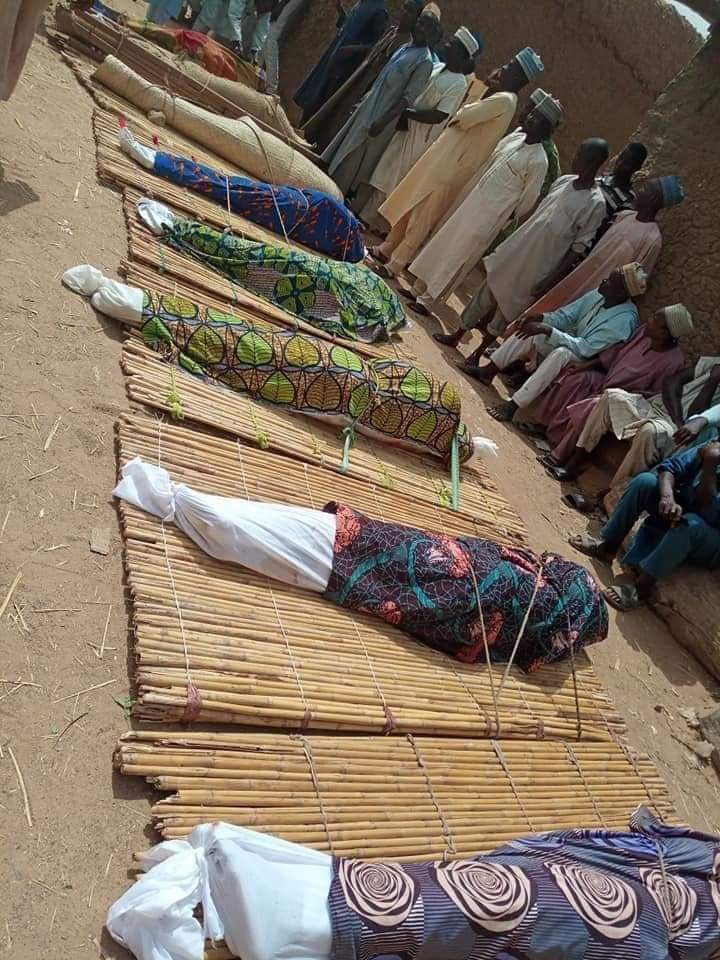
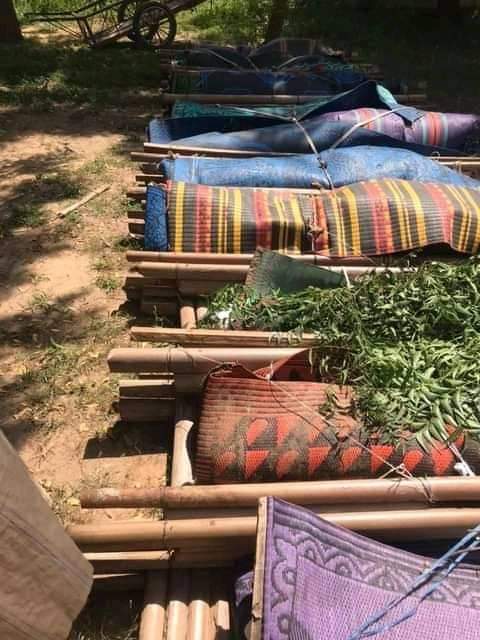
Dead bodies awaiting burial after the attack

At least eleven persons have been reported killed after deadly armed bandits launched an attack on Yasore community in Batsari local government area of Katsina state, North West Nigeria.

The attack was made known by Activist Yusuf Anka who has been consistently reporting the activities of bandits in the North-West region of Nigeria.

According to a tweet put forward on his twitter handle, Anka reported that the bandits also injured ten villagers during the deadly attack. He further said that houses were destroyed by the bandits.

This attack is coming barely 24 hours after bandits killed 18 people in Kuryan Madaro communit in Kaura local government area of neighboring Zamfara state.

Katsina the home state of President Muhammadu Buhari has been under repeated armed bandits attack with almost a dozen local government area alleged to be under the control of the bandits despite ongoing military operations in the region.

JUST IN: Bandit Who Indicted El-rufai Makes U-turn, Says “That was not what I meant” During fresh Interrogation
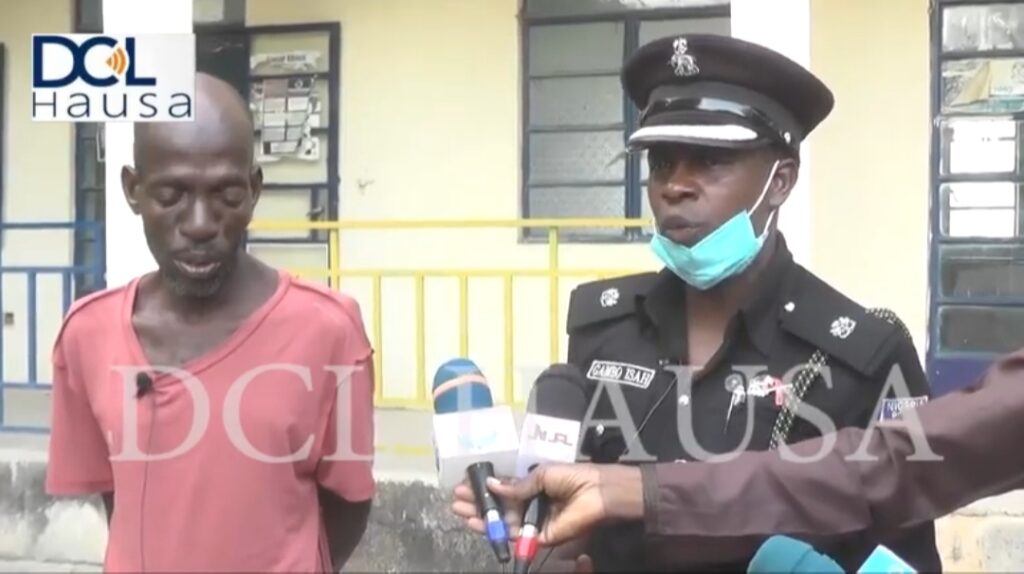
Ado Namarai and the Katsina state police PRO, Gambo Isah during the the fresh Interrogation in Katsina

A new twist has emerged in the interrogation of Ado Namarai, an arrested bandit from Katsina state who was part of a deadly bandits gang operating in Kaduna state, North-West Nigeria.

Middle Belt Times on Saturday exclusively reported that the bandit during interrogation indicted the Kaduna state Governor for “knowing about the place” where the bandits operate in a village called Sabon Filli in Giwa local government area of Kaduna state.

In a new video obtained by MBT, the bandit was seen speaking during a fresh Interrogation organized by the Katsina state police command where he was asked to clarify on his comment indicting El-rufai during his previous interrogation. The bandit speaking in Hausa language then said he didn’t mean that the governor was supporting the bandits activities.

The reason why I said El-rufai knows about the place is because last year, over a year and some months ago, I did 28 of the Ramadan fasting there in Sabon Filli before I came back here to Katsina and did the 29th and since then God hasn’t given me the grace to return there.

Certainly the reason why I said El-rufai knows where the bandits are is because, if El-rufai wants to work sincerely because of God like the Katsina state Governor is doing, he would have done so.

An airplane came to Sabon Filli and was releasing bombs, there were 4 Hilux vehicles on the ground, I was in my farm working that day. The aeroplane was shot and it managed to return back to the airport.

I hid in my farm and saw when one of the Hilux driver was shot, the others turned and left. This battle went on from 8am to 4pm. After the battle, the Hilux was burnt by the bandits. If you go there now you will see the burnt Hilux.

That is just what I meant by saying El-rufai knows about the place where the bandits are, because in his position as governor, he has the capacity to send in security to clear the place.

Am sure where he is seated now, in my own thinking, he is aware and sees everything that is happening

It would be recalled that Middle Belt Times on Saturday placed a call to the Katsina state police PRO, Gambo Isah to comment on the bandit’s indictment of El-rufai but he refused saying;

I cannot comment on the matter

As at the time of filing this report, MBT could not ascertain why a fresh interrogation was organized for the arrested bandit and under which circumstances he was brought to talk to the press.

Kaduna state has been ravaged by insecurity in the last decade with the situation becoming worse since the coming of the current APC administration in 2015. Several communities have been sacked by rampaging Fulani herdsmen and bandits while thousands have been killed along the line.

It would also be recalled that in 2016 the Kaduna state Governor during an interview session on Channels TV, confessed to offering the herdsmen carrying out killings of genocidal proportion in Southern Kaduna monetary compensation to stop the killings in the region, an action that further intensified the killings in the area.

Last Thursday, 38 victims of Fulani terrorists attack in Madamai and Abun communities were laid to rest during a mass burial covered by MBT.

Bandits Kill 18 in Fresh Zamfara Attack
Bodies of the victims prepared for burial according to Islamic rites

No fewer than 18 people have been killed by daredevil armed bandits during a Tuesday night attack in Kuryan Masari community in Kaura local government of Zamfara state, North West Nigeria.

The bandits invaded the community in their usual manner and began shooting sporadically. 18 vehicles including a police patrol vehicle were also destroyed during the attack.

The attack was revealed by Zamfara Activist, Yusuf Anka who tweeted about the ugly incident on his twitter handle, @ankabiy.

18 people have been killed last night in Kuryan Madaro of Zamfara by armed bandits burning down homes, businesses and 18 Vehicles including a police patrol vehicle.
The deaths and destructions are too many for the people.?

Yesterday’s attack is one of many attacks carried out by bandits in Zamfara since the Nigerian government announced the shutdown of telecommunication networks in the state, a decision many Nigerians including Anka have continued to question it’s sincerity of purpose in the ongoing military operations in the state.

How Terrorists Who Declared Ceasefire On Abductions Gunned Down ’30 Bandits’ In Kaduna

A clash between terrorists belonging to the Ansaru group and bandits has reportedly claimed the lives of at least 30 bandits around the Damari axis of Birnin Gwari Local Government Area of Kaduna State.

Multiple sources confirmed to Daily Trust that the two criminal groups started a battle for supremacy last week.

The report came three weeks after terrorists fleeing military onslaught in Zamfara State took refuge in Saulawa and Damari villages of Birnin Gwari LGA, where they hoisted their flag.

Following telecommunication shutdown in some LGAs of Kaduna, including Birnin Gwari, a resident, Samaila Yakubu, who spoke with Daily Trust from Zaria, said the crisis between the two criminal groups followed an order by the terrorists.

He said the terrorists had restricted bandits from abduction and invasion of communities.

Yakubu said the bandits had resisted the law, which led to a wrangle that claimed the lives of four bandits and one member of Ansaru group last Tuesday.

He said a tit-for-tat attack had ensued between the two groups which climaxed with the killing of about 30 bandits last week.

Also corroborating the incident, Hassan Ibrahim from Giwa LGA, said the terrorists had warned bandits to desist from rampant abductions, adding that the warning had not been heeded by the bandits which led to the clash.

Ibrahim said, “The killings between the two groups are ongoing but abductions are on a decline. The focus of the terrorists is now on how to get fuel and money from travellers.

“Two days ago, they ambushed my nephew along the Birnin Gwari- Zaria road on a motorcycle and they emptied his fuel tank.

“They then collected his phone and money he had on him and set him free. I believe the new security measures are working,” he said.

When contacted, Kaduna State Police Public Relations Officer, ASP Mohammed Jalige, asked for time to clarify the situation from the DPO in charge of the area but hours later, he did not respond to calls to his phone.

(Dailytrust)

Panic As Bandits ‘Set Up Camps’ In FCT

There is panic in some rural communities of the Federal Capital Territory (FCT) following reports that fleeing bandits from the North are setting up camps in forests of the territory.

Daily Trust gathered from some locals that the bandits have set up camps around Zukpatu, Gadoro, Achimbi, Pesu, Duda, Pani, Gaube and New Gwombe communities in Kuje Area Area Council.

Most of the communities share boundaries with Nasarawa State.

Daily Trust reports that Kuje has over 400 communities not connected with any road network.

It was further gathered that the bandits are taking advantage of the rocky hinterlands to establish their bases.

According to some villagers, who spoke with our reporter, although the bandits have not started attacking them, they have been warning them against exposing their hideouts to security agents.

A resident of Gaube, who simply identified himself as Ibrahim, said the setting up of the camps by the bandits had caused panic, adding that residents, especially, farmers, now went to their farms in fear.

Ibrahim said, “Whenever the bandits come across locals in the farms or streams, they only caution us not to report to security agents their locations.”

He further said the bandits sometimes gave money to residents to buy them foodstuff and other items.

A rescued kidnap victim in Pegi axis of Kuje, who preferred anonymity, while lamenting his experience in the hands of the bandits, said they had set up camps at the bases of rocky hills.

He said, “Government needs to do something quickly before the situation gets out of hand because of what I saw. I wonder how these criminals were able to get to such places with arms.”

A resident of Gwombe who gave his name simply as Alhassan said bandits had taken over the forest around the community.

Alhassan said, “I think since they attacked and kidnapped some people in our village early this year, they don’t attack our people again, except that they send our people they come across on errands and warn them against telling security agents of their hideout.”

A traditional ruler in the FCT, who preferred anonymity, said the setting up of camps by bandits in some forests in rural communities posed serious threat to lives and property.

He recalled how bandits attacked commuters and villagers on the Gaube-Kuje road last year, which informed the setting up of a joint task force around the community.

He said, “But today, the task force has left the area and the kidnappers have returned, picking people around Gaube axis.”

The chief further said hunters and farmers usually came across the bandits but they were afraid of exposing them.

He, therefore, appealed to the federal government to take immediate action, while collaborating with traditional rulers in order to tackle insecurity in the territory.

The spokesperson of the FCT Police Command, DSP Adeh Josephine, asked our reporter to give her time to make enquiry about the development.

(DAILYTRUST)

JUST IN: UAE Convicts Six Nigerians For Funding Terrorism
Terrorist with weapon. Stop terrorism. Terrorism concept. Vector graphics to design.

The United Arab Emirates has convicted six Nigerians over alleged funding of Boko Haram.

The convicted persons are;

  1. Surajo Abubakar Muhammad – Life
  2. Saleh Yusuf Adamu – Life
  3. Ibrahim Ali Alhassan – 10 years
  4. AbdurRahman Ado Musa – 10 years
  5. 5. Bashir Ali Yusuf – 10 years
  6. Muhammad Ibrahim Isa – 10 years

It would be recalled that the Nigerian government has repeatedly said she is not going to reveal the identities of alleged sponsors in the country.